The Two Exceptions to the Texas Road Ban
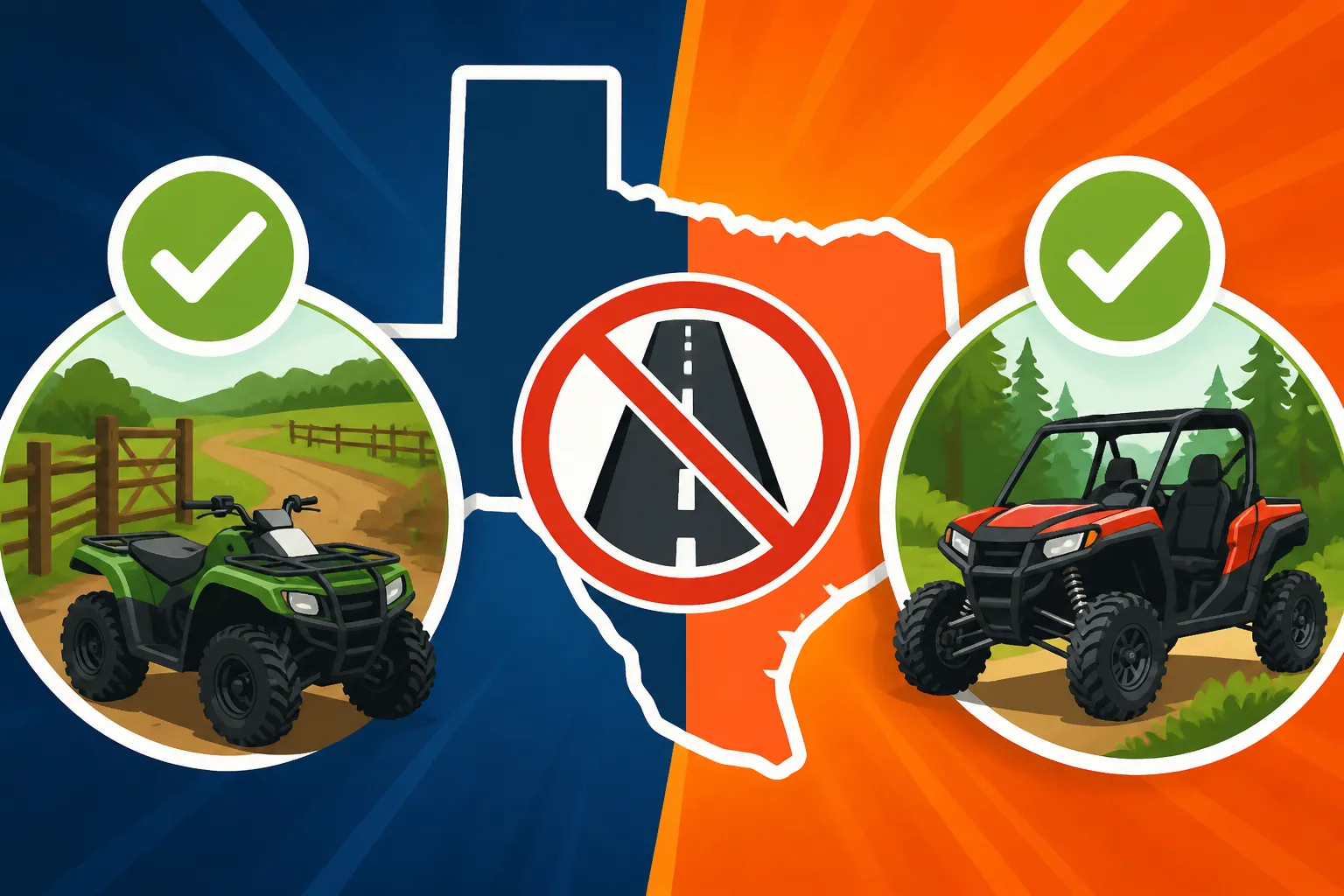
It's incredibly frustrating when you invest in a powerful ATV or UTV, only to find out you can't just hop on it and cruise down your neighborhood street or even cross a highway without risking a ticket. Texas law generally keeps off-highway vehicles (OHVs) strictly off public roads, leaving many riders feeling restricted. This guide is here to unravel the complexities, diving deep into the two specific exceptions that do allow limited road use for your ATV or UTV in the Lone Star State, helping you understand when, where, and how you might legally operate your machine on pavement.
The Frustration of Texas's General Road Ban on OHVs
Let's just get this out of the way: for the most part, you can't ride your ATV or UTV on Texas public roads. It's a common point of confusion and a source of real annoyance for folks who own these machines. You see side-by-sides everywhere these days, capable of incredible speeds, and you might think, "Well, if it has headlights and seatbelts, why can't I just take it to the corner store?" Unfortunately, Texas law has a very clear distinction, and OHVs generally fall outside the definition of a "motor vehicle" that can be registered and licensed for street use.
Why the Default is "No Street Legal ATVs"
The core of the issue lies in how Texas defines and classifies vehicles. An ATV or UTV, by its very design and statutory definition, is intended for off-road use. It doesn't meet the safety and equipment standards required for traditional on-road vehicles like cars and trucks. Things like proper turn signals, specific headlight and taillight configurations, safety glass, and even federal crash standards are simply not built into the design of most off-highway vehicles. Because of this fundamental difference, the Texas Department of Motor Vehicles simply will not issue a standard license plate and registration for an ATV or UTV that would permit it on regular streets. This is why you often hear the firm answer: [Street Legal ATVs in Texas: The Short Answer] is "no."
This isn't a unique Texas thing, either; many states have similar restrictions. The state's primary concern is public safety. Mixing fast, exposed, and often less stable off-road machines with cars and trucks operating at higher speeds and within different traffic rules creates a hazardous environment. Imagine trying to stop a fully loaded side-by-side with knobby tires quickly on wet asphalt alongside a semi-truck – it's just not designed for that. The legal framework reflects an intent to protect both OHV riders and other motorists.
The Practical Impact on Riders and Ranchers
This blanket ban creates significant practical headaches. For recreational riders, it means you can't simply ride from your house to a nearby trail system. You're almost always going to need a truck and trailer to transport your machine to an approved riding area, like Barnwell Mountain Recreation Area or Hidden Falls Adventure Park. This adds time, expense, and planning to what you might hope would be a spontaneous outing. It limits where you can ride and how often, pushing recreational use squarely onto private land or designated off-road parks.
Ranchers, farmers, and others using OHVs for work face a different, but equally challenging, set of circumstances. Picture a vast ranch where tasks often require moving from one pasture to another, crossing county roads in the process. Or a utility worker needing to access power lines by traversing a short section of paved road. Hauling a UTV onto a trailer for every single road crossing is wildly inefficient and impractical. This is where the specific exceptions come into play, born out of a recognition that certain uses are essential and can be managed safely under strict conditions.
Dispelling Myths About Making an OHV "Street Legal"
Before we get to the exceptions, let's clear up a common misconception: you cannot "make" your ATV or UTV street legal in Texas by simply adding accessories. This is perhaps the biggest source of confusion and disappointment for many owners. I've seen folks spend a small fortune on aftermarket kits – turn signals, mirrors, horn, DOT-approved tires, windshields, the works – thinking this will solve the problem. While these additions are great for safety and functionality off-road, they don't change the fundamental classification of your vehicle in the eyes of Texas law.
The problem isn't just about equipment; it's about the vehicle's original manufacturer's certificate of origin (MCO) and how the state registers it. If it's titled as an "Off-Highway Vehicle" (OHV), it's not a "motor vehicle" for general road registration purposes. You can pour money into lights and blinkers from, say, SuperATV's extensive catalog, but the state will still look at your MCO and say, "Nope, that's an OHV." This is why [Why Texas Will Not Register an OHV for the Road] is such a critical concept to grasp – it's not about what you add, but what the vehicle is in the legal sense. Don't fall into the trap of thinking a few hundred dollars in accessories will open up all Texas roads to your machine.
Exception One: The Golf Cart Rule (and Its UTV Kin)
The first significant exception centers around golf carts, but it has important implications for UTVs that often get used in similar, low-speed scenarios. Texas law allows for the limited operation of certain low-speed vehicles, including golf carts, on public roads under very specific conditions. These rules are designed for short, localized trips, not for general transportation.
Driving to the Course and Back: The Specifics
The primary scenario for this exception is, unsurprisingly, getting to and from a golf course. Texas Transportation Code Chapter 551 allows a person to operate a golf cart on a public highway that has a posted speed limit of 35 miles per hour or less. However, this isn't a free pass to drive anywhere under 35 mph. The operation must be within a maximum of two miles from the point where the golf cart is usually parked to access a golf course. So, if your UTV is parked at your home, and your golf course is a mile away, you might be in the clear. But if it’s three miles away, you're out of luck. This "two-mile" rule is strictly enforced and is there to ensure the operation is genuinely short-distance and ancillary to the golf activity.
Furthermore, the operation is limited to daylight hours. You can't be puttering along after sunset, even if your UTV has powerful headlights. The intent is clear: minimize risk by limiting these vehicles to times of good visibility and short, specific routes. This exception is codified in [Texas's Golf Course Exception] and is crucial for many communities built around golf courses, especially those that rely on golf carts (and UTVs mimicking them) for local travel.
Conditions for Using This Exception (Daylight, Proximity)
To be clear, this isn't just a suggestion; these are mandatory conditions. If you're operating your UTV under the golf cart exception, you must adhere to:
- Road Speed Limit: The public road must have a posted speed limit of 35 miles per hour or less.
- Distance: You cannot operate the vehicle more than two miles from the location where it is normally parked to access the golf course. This means you can't just drive two miles in any direction from your house if there's no golf course access involved. The intent of the travel must be related to accessing the golf course.
- Daylight Hours: Operation is strictly limited to between sunrise and sunset. No evening or night cruises.
- Equipment: While not explicitly detailed in the law as an "OHV requirement" for this specific exemption, it's always wise to ensure your UTV has basic safety equipment like working headlights, taillights, and brakes. Although it's not a full street-legal conversion, visibility is key.
Ignoring any of these conditions can quickly turn a legal trip into a Class C misdemeanor, which can carry fines. It's about being responsible and understanding the narrow scope of the privilege.
How UTVs Often Fit This Category
Here's where it gets interesting for UTV owners. While the law specifically mentions "golf carts," many UTVs, particularly those designed for utility or recreational use in calmer settings, can functionally operate within these rules. They are often low-speed, especially when not pushed, and fit the general profile of a "golf cart" for short trips. If your UTV is primarily used for tasks around a property that abuts a golf course, or if you regularly transport your golf clubs in it, you might find yourself falling under this exception.
However, it's not a license to say "my UTV is a golf cart." You'd need to demonstrate that your use aligns with the specific intent of the law – that you are indeed using it for golf course access. For many UTVs, especially those beefed up with lifts and large tires, they might not outwardly resemble a golf cart, but their low-speed capability and use pattern can still qualify. Just remember, it's about the use case and adherence to the strict conditions, not necessarily the vehicle's appearance. Local law enforcement has the final say in interpretation on the spot, so always err on the side of caution.
Exception Two: The Agricultural/Utility Exemption
This is arguably the most common and vital exception for many Texans, especially those living in rural areas or involved in farming, ranching, or specific utility work. Texas recognizes that these vehicles are indispensable tools for certain industries and tasks, and requiring them to be trailered for every road crossing or short commute on public land would create an unbearable burden.
When "Work" Trumps the Ban: Farm, Ranch, and Utility Use
The law allows ATVs and UTVs to be operated on public roads when used for an "agricultural purpose" or by a public utility. This is a big deal for thousands of Texans. Think about a rancher checking fences, moving livestock, or hauling feed from one section of a large property to another, which might involve crossing a county road. Or a farmer needing to inspect irrigation lines that run along a road right-of-way. These are not recreational activities; they are essential work. The emphasis here is on the purpose of the operation – it must be directly related to the agricultural or utility work at hand.
The law does not define "agricultural purpose" exhaustively, but common interpretations include farming, ranching, timber operations, and similar activities. [Riding an ATV for a Texas Agricultural Operation] is usually the clearest path to using this exemption. If you're using your UTV to check on a herd of cattle, for example, and need to cross a public road to get to the next pasture, this exception is designed for you. This distinction between work and play is fundamental to understanding the breadth (and limits) of this rule.
Crossing Roads and Short Distances for Agricultural Purposes
While the "work" aspect is key, there are also limitations on how and where you can operate. Generally, the operation should be for short distances and for the purpose of moving from one field, parcel, or work site to another. It's not an excuse to take a leisurely drive down the highway for miles. You might be able to use your UTV to go down a short section of a county road to reach your neighbor's property to borrow a tool for the ranch, but you can't drive it into town to pick up groceries.
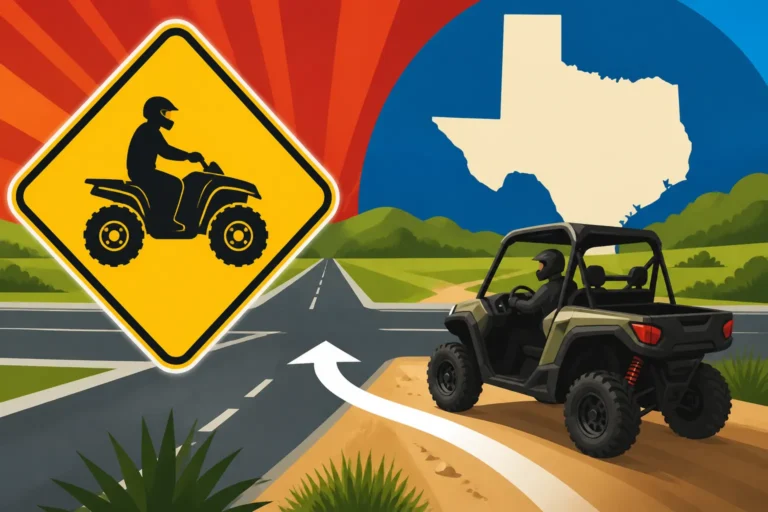
For agricultural operations, the law permits travel on public roads with a speed limit of 35 miles per hour or less. This mirrors some of the golf cart rules but broadens the scope of who can use it. You can cross highways, but usually only at an intersection and after coming to a complete stop, ensuring it's safe. It's about minimizing the time spent on the road and prioritizing safety during those essential transitions. Remember, the intent is functional, not recreational.
Specific Rules for Equipment, Flags, and Lighting
Even when operating under the agricultural/utility exemption, there are specific equipment requirements designed to enhance safety and visibility. These are crucial and often overlooked.
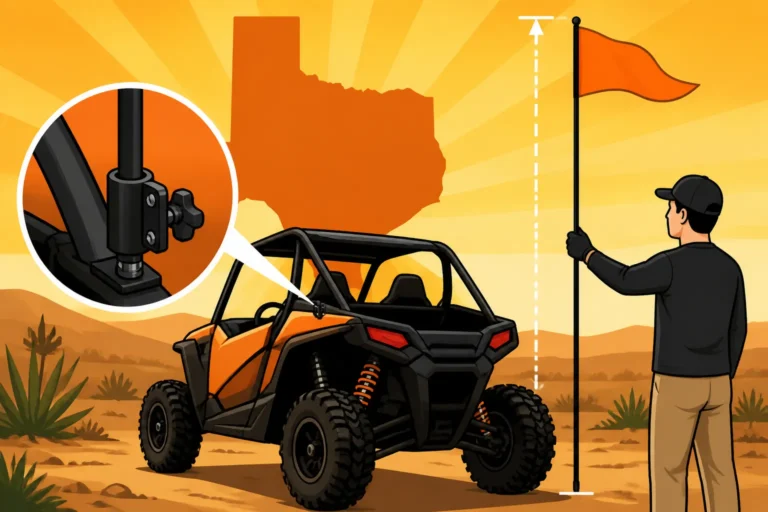
- Orange Warning Flag: Your OHV must be equipped with a visible orange flag. This flag needs to be at least 6 feet above the ground when measured from the ground to the top of the flag. This ensures maximum visibility for other motorists, especially on uneven terrain or when cresting hills. [The 6-Foot Orange Flag Texas Requires] isn't just a suggestion; it's a legal requirement designed to make your slow-moving vehicle more noticeable.
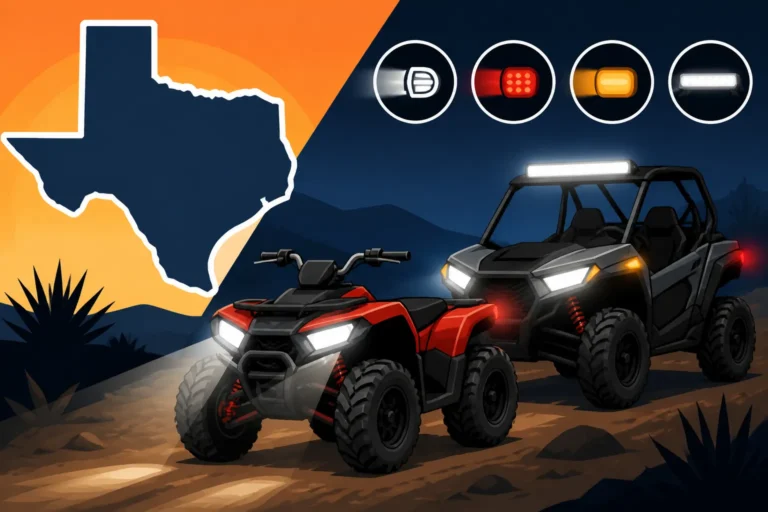
- Headlights and Taillights: If you're operating during daylight hours, your OHV must be equipped with working headlights and taillights. And here's the kicker: even if it's broad daylight, you're required to use them. This dramatically increases your visibility to oncoming and following traffic. [Headlights and Taillights in Daylight] are not just for night; they're a daytime safety mandate for agricultural road use.
- Speed Limit: As mentioned, the operation is generally limited to roads with a posted speed limit of 35 miles per hour or less.
- No License Plate Needed: A significant relief for ranchers is that [Why Agricultural Use Needs No Plate] means you don't need a specific OHV license plate for these operations. Your OHV title is sufficient to prove ownership, but you won't be expected to have a registration tag for road use.
This exception is invaluable for rural Texans, but it demands strict adherence to the safety protocols. Law enforcement officers are well aware of these rules and will ticket those who misuse the exemption or fail to meet the equipment standards.
Other Limited Local Road Access Scenarios
Beyond the two primary exceptions, there are a few other nuanced situations where an ATV or UTV might find itself legally, albeit briefly, on public roads. These are often highly localized or tied to very specific types of communities.
Master Planned Communities and Their Unique Rules
Some master planned communities in Texas have special provisions for golf carts and, by extension, sometimes UTVs, to operate on their internal roads. These are typically private roads or roads within a specific development that are explicitly designed and designated for such use. The key here is "master planned community" and the existence of "uniform covenants" that allow for it. The rules are set by the community's homeowners association (HOA) or developer and usually require strict adherence to speed limits, safety equipment, and sometimes even specific hours of operation.
It's vital to understand that this permission is almost always restricted to the internal roads within that specific community. You cannot drive your UTV out of the community and onto a state highway or general county road, even if it has a 35 mph speed limit, unless one of the other exceptions applies. [Master Planned Communities and Uniform Covenants] are the legal basis for these localized rules. If you live in such a community, always check your HOA's specific bylaws and any local ordinances that might apply. Don't assume anything; get it in writing or refer to official community guidelines.
Small Counties and Specific Municipal Ordinances
While Texas law provides a general framework, there's a degree of local control that can sometimes create additional, very specific allowances. Counties with a population of 37,000 or less, or those bordering the Red River, have had the option to enact ordinances allowing OHVs on their public roads with a speed limit of 35 mph or less. However, this is not a widespread phenomenon. Many counties, even if they qualify, choose not to exercise this option due to safety concerns or the administrative burden.
Similarly, some cities might have very specific, highly localized ordinances allowing OHV use on certain low-speed streets, typically for very short distances or within defined areas like parks or waterfronts. These are exceedingly rare for ATVs and UTVs and are more commonly seen for golf carts. The critical takeaway is that these are exceptions to an exception, and you absolutely cannot assume such an ordinance exists. Always check with the specific county or city's administrative offices and law enforcement to confirm. Relying on hearsay or what a friend "heard" could lead to a hefty fine. [Which Texas Counties May Open Roads] outlines the general possibilities, but actual implementation is scarce.
Understanding the "35 MPH or Less" Road Designation
You'll notice that many of these exceptions hinge on the road having a posted speed limit of 35 miles per hour or less. This isn't an arbitrary number; it's a critical safety threshold. Roads with lower speed limits are generally considered safer for shared use with slower-moving vehicles like OHVs and golf carts. They often have less traffic volume, shorter sightlines, or are in areas where drivers are expected to be more cautious.
However, the "35 MPH or Less" rule is often misinterpreted. It means the posted speed limit must be 35 mph or less, not just that you drive your OHV at or below 35 mph. You can't take your UTV on a 45 mph road just because you promise to drive slowly. The legal limit of the road itself is the determining factor. This limitation reinforces the idea that these vehicles are not meant for mainstream road travel, but only for highly restricted, low-speed environments where the risk to other motorists is minimized. Always check the posted speed limit signs, and if there are none, assume the default speed limit for that type of road and err on the side of caution – better safe than sorry, and certainly better than a ticket. This is directly relevant to [Texas Rules for Riding on a 35 mph Road].
Here's a quick summary table of the main exceptions:
| Feature | Golf Cart Rule (and UTVs) | Agricultural/Utility Exemption |
|---|---|---|
| Purpose | Accessing golf course | Agricultural work, utility service |
| Road Speed Limit | 35 MPH or less | 35 MPH or less (for direct crossing, may be higher speed limit) |
| Distance | Max 2 miles from parking spot to golf course | Short distances between work sites/crossing roads |
| Time of Day | Daylight hours only | Any time, but lights required |
| Required Gear | Basic safety equipment (head/taillights, brakes recommended) | 6-foot orange flag, headlights, taillights (on at all times) |
| License Plate | Not required | Not required |
| Primary Law | Transportation Code Chapter 551 | Transportation Code Section 551.002 |
What These Exceptions Don't Mean
It's critical to understand that while these exceptions offer some flexibility, they are not a loophole to make your ATV or UTV a regular street-legal vehicle. Misinterpreting these rules can lead to significant legal trouble, fines, and potentially dangerous situations.
No General Public Road Use for Recreation
The biggest misconception is that these exceptions open the door for recreational street riding. They absolutely do not. The intent behind both the golf cart/UTV rule and the agricultural/utility exemption is very specific: functional use for a defined purpose, not joyriding or commuting for leisure. Taking your UTV to the local ice cream shop, even if it's within two miles and on a 35 mph road, likely doesn't fall under "accessing a golf course." Similarly, driving your quad to a friend's house just to hang out isn't an "agricultural purpose."
If your primary goal is to use your OHV for fun on public roads, these exceptions won't save you. Texas law is quite clear: if it's not explicitly covered by one of these narrow exemptions, your ATV or UTV belongs off-road. Trying to stretch the definition of "agricultural purpose" for a casual ride is a quick way to get [Texas Fines for Illegal ATV Road Use].
The Difference Between Permitted Use and "Street Legal" Status
This is a subtle but crucial distinction. "Street legal" implies full compliance with all motor vehicle laws, including registration, licensing, and equipment standards that would allow unrestricted (within traffic laws) operation on any public road. An OHV operating under one of these exceptions is not street legal. Instead, it has a permitted use for a very specific, limited purpose under specific conditions.
Think of it like this: a tractor is permitted on a highway for certain agricultural operations, but it's not a "street legal" car. It has a specific function and is allowed under specific circumstances. The same applies to your ATV or UTV. You're not making it into a car; you're temporarily and narrowly exercising a privilege granted by law for essential tasks or specific community access. Many aftermarket parts, even from reputable brands like SuperATV, are designed to enhance off-road performance and safety, but they do not magically transform an OHV into a street-legal vehicle in Texas.
Consequences of Violating the Road Rules
Operating your ATV or UTV on a public road outside of these narrow exceptions can lead to a Class C misdemeanor. While this is the lowest class of misdemeanor, it still carries a fine. But beyond the ticket, there are other, potentially more severe consequences:
- Vehicle Impoundment: Law enforcement can impound your vehicle, adding significant towing and storage fees to your woes.
- Accidents and Liability: If you're involved in an accident while illegally operating your OHV on a public road, your insurance policy might not cover damages, leaving you personally liable for extensive medical bills and property damage. Most ATV/UTV insurance is designed for off-road use, not illegal street use.
- Personal Injury: The inherent design of OHVs makes them less safe in collisions with traditional vehicles. Operating them illegally on roads significantly increases your risk of serious injury or fatality.
- Increased Scrutiny: Repeated violations or high-profile incidents can lead to stricter enforcement or even calls for changes in the law, potentially making it harder for legitimate users to exercise these exceptions in the future.
The bottom line is to be diligent and informed. If you're unsure whether your intended use falls within one of these exceptions, consult with local law enforcement or an attorney who specializes in Texas vehicle laws. It's always better to ask questions and be certain than to assume and face the consequences.
Disclaimer
This article is for general informational purposes only and does not constitute professional advice. Laws, prices and regulations vary by location and change over time. Consult a qualified professional for guidance on your specific situation.