Land That Took a Grant and Now Needs a Decal
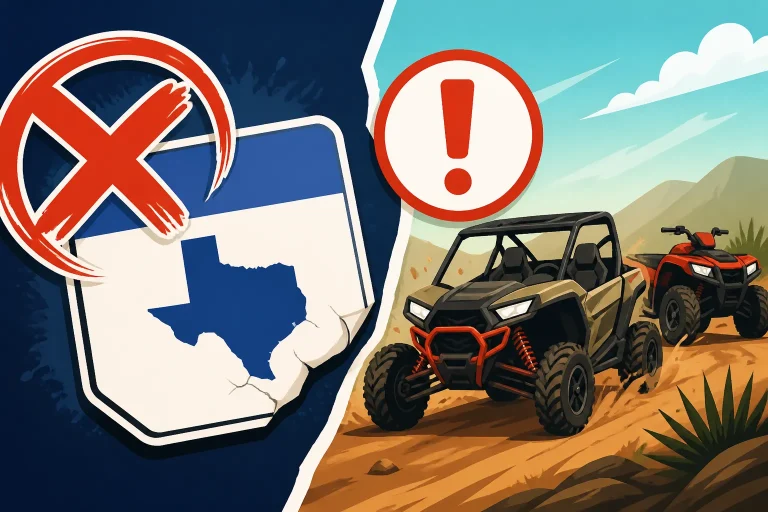
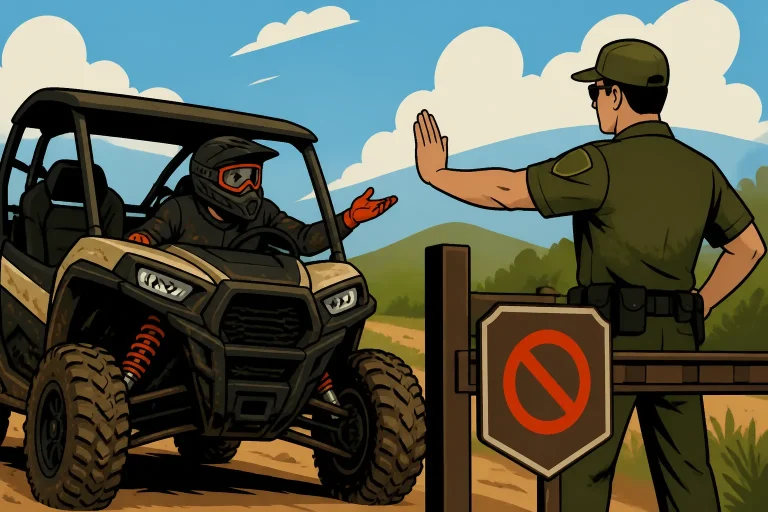
A riding area can be privately operated and still require a Texas OHV decal if it received public OHV grant funding. That can be confusing when you expect decals to apply only on state land. The key is where you ride, not just who owns the property: check whether the venue is grant-funded, then bring the required decal or proof of purchase.
Why a grant-funded venue can require a Texas OHV decal
The Texas Parks and Wildlife Department administers the state’s Off-Highway Vehicle decal program. According to the department, riders must display a valid Texas OHV decal when operating an OHV at a grant-funded venue or on public land. The requirement applies even if the venue is not a state park.
That does not mean every privately owned riding area automatically requires a decal. Texas Parks and Wildlife Department says an OHV decal is not required when an ATV or UTV is operated exclusively on private property. The practical distinction is whether you are riding only on private property or at a venue that falls under the public-land or grant-funded riding requirements.
A grant-funded venue may be run by a private organization, a local group, or another land manager. The property’s ownership and the rules for riding there are separate questions. If the venue received OHV grant funding, its decal requirement can apply even though the gate, trails, or facilities are not operated by Texas Parks and Wildlife.
Before making a trip, ask the site manager whether the riding area is covered by the Texas OHV decal requirement. Confirm whether the rule applies to every riding machine, what proof the venue accepts, and whether it has other entry or use requirements. A venue’s own website or staff can clarify its rules, but the statewide decal program is administered by Texas Parks and Wildlife.
| Where the OHV is operated | Texas OHV decal takeaway |
|---|---|
| Exclusively on private property | The Texas Parks and Wildlife Department says a decal is not required. |
| On public land in Texas | A valid Texas OHV decal is required, according to the Texas Parks and Wildlife Department. |
| At a grant-funded OHV venue | The Texas Parks and Wildlife Department requires a valid Texas OHV decal for operation there. |
| At a site with unclear status | Ask the land manager whether the riding area is grant-funded or treated as public riding land before unloading. |
For a broader explanation of how the sticker requirement works, see The Texas OHV Decal Requirement Explained. If you are comparing a private ranch ride with an organized riding area, Why Private Land Needs No Texas Decal explains the private-property exception.
How to check the venue rule and get ready to ride
A quick check before you leave can prevent a wasted drive or a problem at the entrance. Do not rely only on the venue’s ownership, its name, or the fact that it is not a state park. Ask about the riding area’s status and the decal requirement specifically.
- Contact the venue. Ask whether the area is a Texas OHV grant-funded venue or public riding land, and whether each machine needs a Texas OHV decal.
- Ask what proof is accepted. Texas Parks and Wildlife Department says that while riding public land, a valid decal must be displayed on the vehicle. If the decal has not arrived, proof of purchase or a receipt must be readily available.
- Check whether the decal is already on the machine. A decal from another state does not replace the Texas requirement. Texas Parks and Wildlife Department says Texas has no reciprocity agreement for out-of-state OHV decals or registrations.
- Confirm the venue’s other rules. A decal is not a substitute for any separate park entry requirement, trail permit, or venue-specific rule. Ask the operator what else applies.
- Bring the rider’s safety certificate. Texas Parks and Wildlife Department says riders on public land must carry a valid safety certification and show it upon request.
- Check the machine before loading. Review the vehicle’s lights, exhaust system, spark arrester, and required safety equipment against the rules for the land where you plan to ride.
The Texas OHV decal fee is $16 per fiscal year, according to the Texas Parks and Wildlife Department. The department administers the program, but a venue may have separate charges or conditions, so confirm those directly with the operator. For details about how the decal cost works, see Texas OHV Decal Cost.
If you are visiting from outside Texas, do not assume that your home state’s sticker will be accepted. According to the Texas Parks and Wildlife Department, Texas does not offer reciprocity for out-of-state OHV decals or registrations, and nonresidents must buy a Texas decal to ride on public lands or grant-funded venues. Does a Nonresident Need a Texas OHV Decal? covers that issue in more detail.
Decal, certificate, and machine checks are separate
The decal is only one part of preparing for a public-land or grant-funded ride. It does not certify a rider’s training, make an ATV road-legal, or replace the venue’s operating rules. Treat the decal, safety certificate, and equipment checks as separate items.
Carry proof of the decal and safety training
Texas Parks and Wildlife Department says the valid Texas OHV decal must be displayed on the vehicle. If the physical decal has not arrived, keep proof of purchase readily available. Do not assume that a receipt for a different machine, an expired decal, or an out-of-state sticker will satisfy the Texas requirement.
A safety certificate is a separate requirement. Texas Parks and Wildlife Department recognizes certificates showing successful completion of the ATV Safety Institute’s ATV RiderCourse, including hands-on training, or equivalent safety training issued under the authority of Texas or another state. Riders must carry their valid certification on public land and show it if asked.
Age and supervision rules also apply. According to the Texas Legislature, anyone younger than 14 operating an ATV on public land must be accompanied by and under the direct supervision of a parent, guardian, or authorized adult. A rider aged 14 or older may ride without adult supervision if they hold a safety certificate or are under the direct supervision of a certificate holder. For more on training and proof, see Texas OHV Safety Certificate Requirements.
Inspect safety equipment before the trip
Different rules may apply to ATVs and UTVs, so check the machine and its occupants rather than assuming one checklist covers both.
The Texas Parks and Wildlife Department requires ATV operators and passengers on public lands to wear helmets that meet United States Department of Transportation standards. The department also says seat belts must be worn in UTVs operating on public lands when the vehicle is equipped with them.
Texas Parks and Wildlife Department requires an ATV or UTV on public property to display a lighted headlight and taillight from one-half hour after sunset until one-half hour before sunrise, and whenever visibility is reduced. The Texas Legislature also requires OHVs on public property to have a United States Forest Service-qualified spark arrester that has not been removed or modified.
The Texas Legislature prohibits muffler cutouts, bypasses, or similar devices on motor vehicles, including OHVs on public property. Texas Parks and Wildlife Department further requires an adequate muffler system in good working condition on ATVs and UTVs operated on public OHV land. If a ride is at a Texas state park trail system, the department sets a maximum exhaust sound volume of 96 decibels.
Passenger rules matter too. According to the Texas Legislature, a person operating an ATV on public property may not carry a passenger unless the manufacturer designed the vehicle to transport one. Children also have age and vehicle engine-size restrictions on public land and in state parks. Check the applicable requirements before bringing a young rider or passenger.
These equipment and rider rules are not replaced by buying the decal. For a wider overview of riding conditions on public land, see Texas Rules for Riding Public Land.
Common mistakes to avoid before arriving
The most frequent misunderstanding is treating the decal requirement as an ownership rule: “It is not a state park, so I do not need a sticker.” That conclusion can be wrong at a grant-funded venue. Ask about the venue’s status rather than using its ownership or branding as a shortcut.
Another mistake is confusing the Texas OHV decal with a title or ordinary vehicle registration. Texas residents are required to title off-highway vehicles such as ATVs and UTVs through the Texas Department of Motor Vehicles, but those machines are not eligible for standard motor vehicle registration. The title and the OHV decal serve different purposes. The department’s standard OHV title application fee is $28 or $33, depending on the county of residence. For that process, see Titling an ATV in Texas.
It is also easy to assume that a Texas title, a safety certificate, or a receipt from another state covers the decal requirement. They do not. The decal is a Texas OHV program requirement for riding on public land and grant-funded venues; the title identifies ownership, and the safety certificate shows training. Texas Parks and Wildlife Department says there is no reciprocity for out-of-state OHV decals or registrations.
Finally, do not wait until you reach the trail entrance to figure out whether the decal is attached or whether your purchase receipt is accessible. Confirm the rule with the venue, keep the decal visible on the machine, and carry proof of purchase if the decal has not arrived. Carry the rider’s certificate as well. Those simple checks help avoid a last-minute turnback and keep the paperwork distinct from the venue’s other rules.
Sources
- Texas Legislature — Transportation Code Title 7, Chapter 663. Certain Off-Highway Vehicles (checked November 2, 2026)
- Texas Parks & Wildlife Department — OHV FAQ — Texas Parks & Wildlife Department (checked November 2, 2026)
- Texas Parks and Wildlife Department — Eisenhower State Park OHV Rules and Regulations (checked November 2, 2026)
- Texas Department of Motor Vehicles — Out of State and Imported Vehicles (checked November 2, 2026)
Disclaimer
This article is for general informational purposes only and does not constitute professional advice. Laws, prices and regulations vary by location and change over time. Consult a qualified professional for guidance on your specific situation.