Texas Rules for Riding a National Forest Trail
Texas National Forest trails can look like public roads on a map, but riding rules are narrower: only designated routes may be open to OHVs, and access can change with weather or maintenance. This article explains what to check before riding, how the Texas OHV decal differs from a Forest Service fee, and what out-of-state visitors should bring.
Know which trail you are riding
The Sam Houston National Forest OHV trail system is a common destination for riders in Texas. It is a designated trail system, not permission to ride anywhere in the forest. Use only routes officially open to your type of machine, and stay on the marked trail. Riding off-route can damage the land and may violate trail rules even when the surrounding area looks passable.
Trail maps, gates, signs and current closure notices all matter. A route shown on an older map may be closed, rerouted or temporarily unavailable. Weather can also change conditions quickly: wet soil is vulnerable to deep ruts, and a trail may close after rain or for other safety and maintenance reasons. Check the current Sam Houston National Forest OHV status before you set out, then follow signs at the trailhead if they differ from a map or an older online listing. For broader public-land basics, see Texas Rules for Riding Public Land.
The forest trail system has a 50-inch width limit for vehicles on its designated OHV routes. That limit can exclude many side-by-sides, so do not assume a UTV fits just because it is an off-highway vehicle. Measure the machine at its widest point, including accessories that affect its width, and confirm the trail’s current rule before hauling it there. A machine that is too wide may need a different riding area; see Texas Rules for a Machine Over 50 Inches.
| Before you ride | What to check | Why it matters |
|---|---|---|
| Route access | Current Forest Service map, closures and trailhead signs | A trail may be closed or restricted even if it appears on an older map |
| Machine width | The limit for the specific trail system | The Sam Houston OHV trails have a 50-inch maximum for vehicles on designated routes |
| Texas OHV decal | Whether your machine needs a current Texas decal | Public-land riding requirements are separate from a forest day-use fee |
| Forest fee | Whether the trailhead requires a day-use payment or accepts a pass | The Texas decal does not pay a separate Forest Service fee |
| Rider requirements | Age, supervision, safety certificate and protective gear | Public-land rules can apply in addition to the land manager’s own conditions |
| Weather | Recent rain and current trail status | Wet or damaged trails may close to protect the route and riders |
A forest road is not automatically an OHV trail. Some roads may allow motor vehicles under rules that differ from the OHV trail system; others may be closed to public motorized use. Do not use a road as a way to bypass a trail restriction. Confirm that both the route and your vehicle are permitted there.
Similarly, having a title, plate or street-legal equipment does not make every forest road or trail open to your machine. Titles and plates serve different purposes from trail access. Texas’s off-highway title and plate rules do not replace land-manager restrictions; The Texas OHV Decal Explained covers the state decal that applies to many public-land rides.
Sort out the Texas decal and Forest Service fee
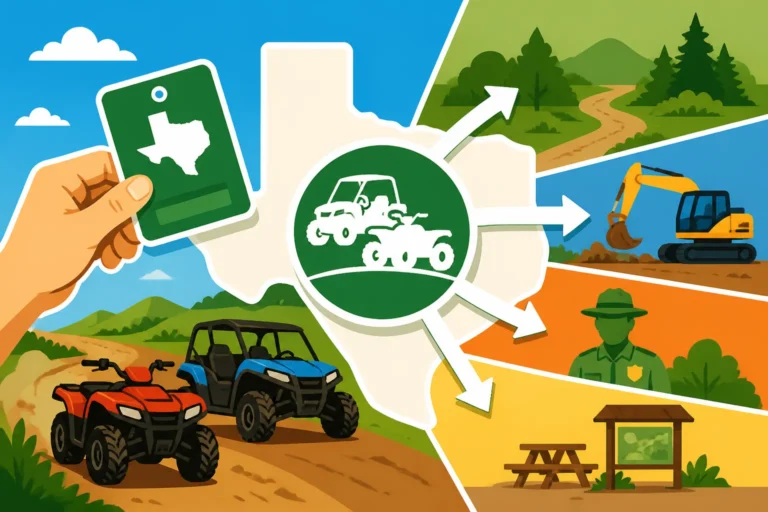
Two separate costs or permissions can apply at a national forest trailhead: the Texas OHV decal requirement and a Forest Service day-use fee. One does not automatically replace the other.
Texas generally requires an OHV decal for operating a covered machine on public land. The requirement is not limited to Texas residents. A rider visiting from another state should not assume that a home-state sticker, registration or safety card substitutes for the Texas decal. Check the current rules for your machine and riding location through the official Texas OHV decal information before travelling. More detail on where the decal applies is available in Where a Texas OHV Decal Is Required.
A Forest Service day-use payment, when required at a particular trailhead, is a separate charge for using that site or facility. Paying it does not satisfy the Texas decal requirement. Likewise, buying a Texas decal does not cover a separate Forest Service fee. The fee method and accepted passes can vary by site, so check the trailhead’s current instructions. If a self-service payment station is used, keep the receipt or other proof with you as directed.
This distinction is easy to miss because both requirements may involve a payment before riding. Think of them as two different checks: the state decal is tied to Texas OHV rules, while a forest fee or pass is tied to access at a particular Forest Service site. The relationship between the two is explained in Does an OHV Decal Cover the Forest Day-Use Fee? and Texas National Forest Permits.
A practical preparation sequence is:
- Confirm the trail is open and that your machine fits its width and vehicle-type limits.
- Check whether your machine needs a Texas OHV decal, and obtain one through an approved channel before the ride.
- Check the trailhead’s Forest Service fee or pass requirements. Do not count the state decal as payment.
- Bring any required proof of payment and the rider documents that apply to your group.
- Recheck closures and conditions before leaving home and when you reach the trailhead.
Some visitors arrive with a street-legal vehicle and wonder whether its registration changes the decal requirement. That depends on the machine’s legal status and the applicable exception; a road plate alone is not a general substitute for checking the OHV rules. Review Texas OHV Decal for a Street-Legal Machine if the vehicle is registered for highway use.
Check age, supervision and safety requirements
Texas public-land OHV rules can apply to riders as well as machines. In particular, riders under 14 need to pay close attention to the state’s safety-certificate and supervision requirements. Confirm the current rule for the rider’s age, make sure any required adult supervision is arranged, and carry the required certificate or proof. The details are covered in Texas OHV Safety Certificate Requirements.
A certificate from another state may be accepted under Texas reciprocity rules, but do not assume every card or course automatically qualifies. Check that the credential meets the Texas requirement and bring proof that can be shown if asked. Visitors can review Does Texas Accept an Out-of-State Safety Certificate? before setting out. A family riding with children should also verify the land manager’s own requirements, since a trailhead may have conditions in addition to state rules.
Protective equipment matters even when the ride is short or the trail feels easy. Check the current Texas requirements for helmets and eye protection, and follow any stricter park or Forest Service conditions. Bring well-fitting equipment for every rider, not just the operator. A trail can include dust, branches, uneven ground and other hazards that are difficult to judge from the parking area.
Do not treat a child’s ability to operate a machine as proof that the child meets the legal requirements to ride it on public land. Check age-specific rules, the machine’s size and intended rider, and any supervision requirement together. If a rider needs an adult nearby, make sure the adult is actually able to supervise rather than simply riding elsewhere in the group.
Before unloading, also confirm that the machine is in suitable condition for the route. Check tires, brakes, throttle, controls and any required safety equipment. Secure loose gear, carry water, and plan for the possibility of changing weather or a longer return than expected. Forest riding can take place away from convenient services, so a basic repair kit and a charged phone are sensible even when neither is a substitute for following trail rules.
Plan for closures, fees and a smooth trailhead check-in
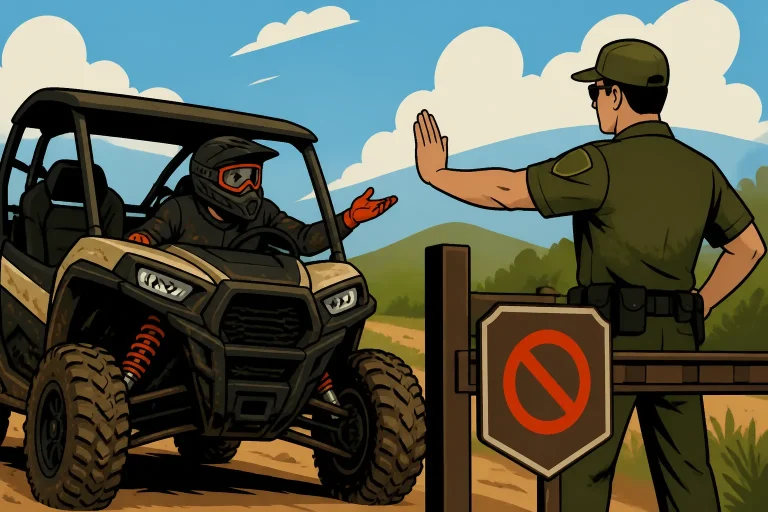
Conditions and access can change, so a plan made weeks ahead should not be treated as confirmation that the trail is open on ride day. Check the official Forest Service information shortly before departure, especially after heavy rain or during a period when closures are possible. If the route is closed, do not ride around a gate or use an unmarked bypass. Find another legal place to ride instead. Texas Trails After Heavy Rain explains why wet conditions can affect access.
Build time into the trip for the trailhead payment process and a final check of posted notices. If payment is collected at a self-service station, follow its instructions carefully and keep the proof it issues. If you have a pass, confirm it applies to that location and bring it in the form required. Do not rely on a photo of a pass or an old receipt unless the site expressly accepts it.
A compact checklist helps avoid the most common problems:
- Current trail map or route information
- Confirmation that the trail is open
- Machine measured against the width limit
- Required Texas OHV decal
- Forest Service fee payment or an accepted pass, if required
- Safety certificate and supervision arrangements where applicable
- Helmets, eye protection and other required equipment
- Proof of payment and relevant documents kept accessible
For riders coming from outside Texas, there are two questions to settle separately: whether the machine meets Texas public-land decal rules and whether the trailhead requires its own fee or pass. A home-state decal should not be treated as automatic permission to ride in Texas. The same caution applies to safety credentials: confirm acceptance rather than relying on a verbal assurance or a card that may not meet the Texas standard.
If you reach the trailhead and discover a width mismatch, closure or missing requirement, the safe choice is to stop and resolve it before unloading or entering the trail. Do not assume that a short stretch, an empty trail or a machine that is nearly within the limit makes an exception. A little checking beforehand is usually easier than finding out at the gate that the group cannot ride.
Disclaimer
This article is for general informational purposes only and does not constitute professional advice. Laws, prices and regulations vary by location and change over time. Consult a qualified professional for guidance on your specific situation.