Why Agricultural Use Needs No Plate
It's incredibly frustrating when you're just trying to get a job done on the farm or ranch, moving equipment or checking fences, and the rules around ATVs and UTVs on public roads feel like a tangled mess. You see some folks with special plates, others without, and you're left wondering what applies to your hard-working off-highway vehicle (OHV) when it needs to touch pavement. This guide is here to untangle that confusion, specifically focusing on why ATVs and UTVs used for legitimate agricultural purposes in Texas are often exempt from needing a traditional off-highway vehicle plate when crossing or using certain public roads.
The Foundation of the Exemption: Texas Law and Agricultural Use
Texas, being a vast agricultural state, has long recognized the critical role that ATVs and UTVs play in farming and ranching operations. The state legislature understands that these machines are essential tools, not just recreational toys, for countless Texans who rely on the land for their livelihood. Because of this, a specific framework exists to allow these agricultural vehicles to operate on public roads under certain conditions without the need for the off-highway vehicle license plate that other OHVs might acquire for limited road access.
The Legislative Intent Behind the Exemption
The intent behind these exemptions is purely practical. Imagine a rancher needing to move a side-by-side from one pasture to another, separated by a county road, or a farmer needing to quickly transport tools from the barn to a distant field across a state highway. Requiring these folks to load their OHV onto a trailer every single time would be incredibly inefficient, costly, and frankly, a huge burden on operations that are often time-sensitive. Texas law acknowledges that these movements are an integral part of agricultural work, not joyrides. The exemption aims to facilitate essential farm and ranch activities while still maintaining public safety on shared roadways. It's a pragmatic approach to rural life, acknowledging the reality of how land is worked and managed across the state.
This legislative understanding helps keep the wheels of agriculture turning smoothly, ensuring that those who feed our state can do so without unnecessary red tape for their essential equipment. It’s about recognizing the utility of these machines in a working context, distinct from their recreational counterparts, and providing a sensible pathway for their use on limited public stretches.
Differentiating Between OHV Plates and Agricultural Exemptions
It's really important to draw a clear line here, because this is where a lot of the confusion often crops up. Texas does offer a specific off-highway vehicle (OHV) license plate for ATVs, UTVs, and other qualified machines. This plate allows limited access to certain public roads, typically those explicitly opened by a county or municipality, or in specific cases like golf cart communities. However, the purpose of this plate is generally for recreational riders or those using their OHV for non-agricultural work that requires road access. For example, if you live in a master-planned community that allows OHVs on its streets, you might opt for this plate. You can read more about [The Texas Off-Highway Vehicle License Plate] in another post.
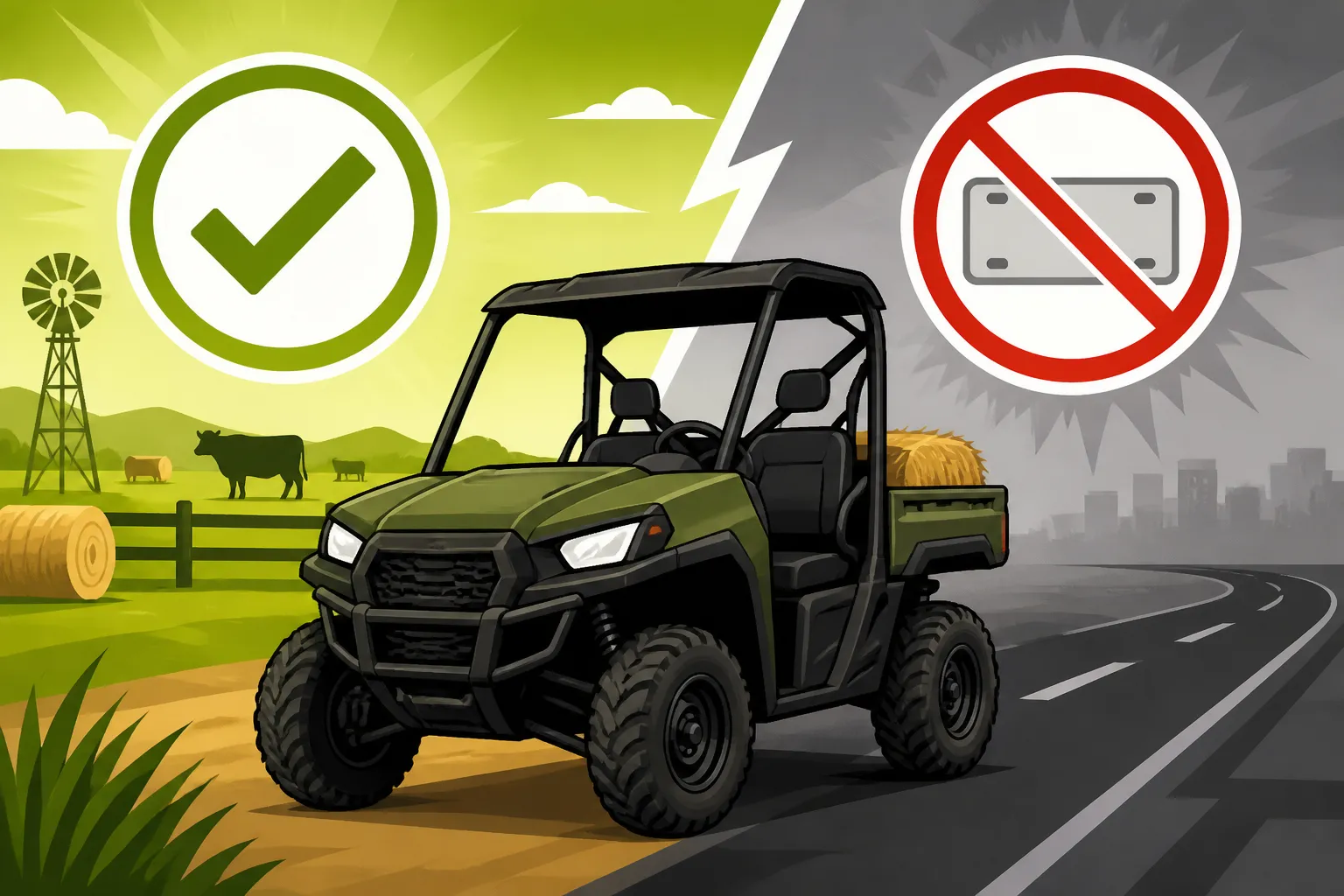
The agricultural exemption is fundamentally different. When an ATV or UTV is used exclusively for an agricultural operation as defined by Texas law, it often doesn't need any plate to use certain public roads under very specific circumstances. This isn't about opening up roads for general OHV use; it's about making an exception for the vital work of farming and ranching. The machine isn't being "registered" for road use in the traditional sense, nor is it subject to the same road-going requirements as a standard street-legal vehicle. This distinction is key: the agricultural exemption is about the purpose of the vehicle's use at that specific moment, not a general allowance for all OHVs to roam public roads. Frankly, [Why Texas Will Not Register an ATV for the Road] is a deep topic, and the agricultural exemption is one of the few narrow windows where an OHV can touch pavement.
What Exactly Counts as "Agricultural Use" in Texas?
Understanding what truly constitutes "agricultural use" is paramount because the exemption hinges entirely on this definition. It's not enough to simply own a piece of rural land; the activity itself must be directly related to an agricultural operation. This specific interpretation helps prevent misuse of the exemption and ensures that only legitimate farm and ranch activities benefit from the relaxed plating requirements.
Defining "Agricultural Operation" for OHV Purposes
In Texas, an "agricultural operation" for the purpose of OHV road use is quite specific. It broadly refers to the cultivation of plants and animals for food, fiber, or other agricultural products, as well as their related management and maintenance activities. This can include a wide array of tasks that are common on farms, ranches, and even timber operations. For instance, hauling feed or water to livestock, transporting tools or fence repair materials between pastures, inspecting crops or irrigation systems, moving implements from one field to another, or even guiding cattle or sheep are all activities that typically fall under this umbrella. If you're using your ATV or UTV to spray weeds, check on newborn calves, or deliver supplies to a remote deer stand on your working ranch, that's generally considered agricultural use.
It's the actual work being performed that matters. Simply riding your side-by-side around your 50-acre property for fun, even if you technically have cows somewhere on the land, doesn't qualify as agricultural use for the road exemption. The machine must be an integral part of the productive activity of farming, ranching, or timber production at the time of its road use. Think of it as a rolling tool for your livelihood, not just a way to enjoy the scenery.
Proof and Documentation for the Exemption
Unlike a traditional vehicle registration or an OHV plate that provides clear documentation of road legality, the agricultural exemption doesn't come with a specific "sticker" or paper to display on your machine. This can sometimes create an uncomfortable situation if you're stopped by law enforcement. While you don't need a specific road-use permit, it's prudent to be able to articulate and, if necessary, demonstrate that your use of the OHV on the public road is for a legitimate agricultural operation.
This might mean being prepared to explain your destination and purpose, especially if you're traveling a longer distance on a public road. Some ranchers carry a copy of their agricultural sales tax exemption certificate, which, while not directly related to road use, helps establish their status as an agricultural producer. In Texas, there are clear guidelines for [Texas Ag Exemption on an ATV Purchase], which outlines how farmers and ranchers can avoid paying sales tax on equipment used exclusively for agriculture. This same spirit of agricultural operation underpins the road-use exemption. Similarly, when you fill out forms like [Ag and Timber Exemptions on Form 130-U] for titling, you're already declaring your machine's intended agricultural purpose. While not a direct "road permit," these documents collectively paint a picture of legitimate agricultural activity should you ever need to justify your plate-less road travel. Being able to clearly and calmly explain your work and why your ATV or UTV is on the road for that specific task is your best defense.
Navigating Public Roads for Farm and Ranch Work
Even with an agricultural exemption, you can't just take your ATV or UTV wherever you please on public roads. Texas law places specific limitations on where and how these machines can be operated, focusing on minimizing risks and ensuring they are used only when necessary for agricultural tasks. These rules are designed to balance the needs of farmers and ranchers with the safety of the general public.
Permitted Roadways and Distance Limitations
When using your ATV or UTV for agricultural purposes without a plate, you're generally restricted to certain types of public roads. Primarily, this means county roads and secondary roads that are integral to your farm or ranch operations. The law recognizes the need to connect pastures, fields, or barns that might be divided by these routes. A common stipulation often associated with these types of movements, even for agricultural exemptions, is a distance limit – for example, typically not exceeding 25 miles from the origin point to the destination. This helps ensure that the use is localized and directly tied to the operation, not for long-distance travel. If you're thinking about [Texas Rules for Riding a Farm Road], remember that these rules are tailored for the practical movement of equipment, not for extended excursions.
For instance, if your ranch spans both sides of a county road, you can definitely take your side-by-side directly across or along that road to get from one section to the other. However, you couldn't, say, drive your utility vehicle 50 miles down a state highway to pick up parts in the nearest town, even if those parts were for your agricultural equipment. That would require trailering. The key is that the road use must be reasonably necessary for the agricultural operation and within the specified distance limits. This 25-mile rule, often tied to "origin to destination" for agricultural vehicles, is a crucial detail to remember. [25 Miles Origin to Destination] directly applies to this.
Crossing Highways and Divided Roads
One of the most concerning scenarios for ranchers and farmers is needing to cross a busier state highway or even a divided road as part of their daily work. Texas law does provide a pathway for this, but it comes with very strict safety requirements. You cannot simply merge onto a highway and drive down it. The rule is generally limited to crossing at a 90-degree angle to the flow of traffic, ensuring the shortest possible time in the traffic lanes.
Before attempting such a crossing, you must come to a complete stop, yield to all approaching traffic, and ensure that your sight lines are clear in both directions. It’s imperative to choose a crossing point where you have maximum visibility and where other drivers can clearly see you. This isn't a casual maneuver; it demands extreme caution. If you're on a divided highway, you generally must cross each section separately, stopping in the median (if safe and permissible) before crossing the second set of lanes. Understanding [Crossing a Highway on an ATV in Texas] is vital for your safety and to remain compliant with the law. There's a big difference between [Crossing a Texas Road at an Intersection] where there might be traffic controls, and [Crossing a Texas Road Away From an Intersection], where you're solely responsible for finding a safe window. Always prioritize safety over speed when performing these necessary crossings.
Beyond the Plate: Other Rules for Ag-Use OHVs on Roads
Even though your agricultural ATV or UTV might be exempt from needing an OHV license plate, that doesn't mean it's exempt from all rules when operating on public roads. Texas law still mandates certain safety equipment and operational guidelines to ensure the safety of both the OHV operator and other motorists. These requirements are often straightforward but are absolutely critical to comply with.
Essential Equipment for Road Use
When your ATV or UTV is operating on a public road for agricultural purposes, it still needs to be visible and safe. One of the most common and easily identifiable requirements is the display of a prominent orange safety flag. This flag, sometimes referred to as a "whip flag," needs to be mounted at least six feet above the ground, making your machine much more noticeable to other drivers, especially over hills or around bends. Think of it as an extra layer of visibility for a vehicle that's lower to the ground than a truck. [The 6-Foot Orange Flag Texas Requires] isn't just a suggestion; it's a legal requirement for these road-bound agricultural machines.
Additionally, even if you're only riding in daylight, your ATV or UTV generally needs to have functioning headlights and taillights. While you might not always be using them during the day, they are essential for operating in low-light conditions or even just for improved visibility to oncoming traffic. It’s also important that your machine is equipped with a properly functioning exhaust system, including a spark arrester. This isn't just for noise reduction; it's a critical safety feature to prevent wildfires, especially when operating in dry fields or brush. [Spark Arresters Qualified by the Forest Service] are what you need to look for. If you're upgrading your utility machine, companies like SuperATV offer a range of accessories from lighting kits to flag mounts that can help you meet these safety standards.
Helmet and Passenger Rules for Agricultural Operation
The rules around helmets and passengers for agricultural OHVs on public roads can be a bit nuanced, so it's important to pay close attention. For the operator of an ATV or UTV being used for an agricultural operation, Texas law often provides an exemption from the helmet requirement, if the machine is equipped with a roll bar or roll cage and the operator is wearing a seatbelt. This acknowledges the utility nature of the vehicle and the practicalities of farm work. [When Farm Work Waives the Texas Helmet Rule] is a specific allowance for these working machines. However, if your machine doesn't have a roll cage, or if you're not wearing a seatbelt, the helmet requirement typically still applies.
When it comes to passengers, the rules tend to be stricter. Generally, any passenger on an ATV or UTV used on a public road, even for agricultural purposes, should be seated in a manufacturer-designed and designated seating area. This means no riding on the fenders, standing in the bed of a UTV, or carrying extra people beyond the machine's intended capacity. If a passenger is under a certain age, they may also be subject to helmet requirements, regardless of the agricultural exemption for the operator. [Why Passengers Need Manufacturer-Designed Seating] is about safety first, ensuring anyone riding is secure and protected. Always err on the side of caution when carrying passengers, especially minors, and make sure they are properly secured and, if necessary, wearing a helmet.
Common Misconceptions and Avoiding Penalties
Despite the clear legal framework, there are still many misconceptions surrounding the agricultural exemption for ATVs and UTVs on Texas roads. These misunderstandings can inadvertently lead to costly penalties or, more importantly, unsafe situations. It's crucial for every farm and ranch operator to truly grasp the spirit and letter of these laws to avoid issues.
The Difference Between Ag-Exempt and Recreational Riding
Here's one of the biggest pitfalls: simply owning a ranch or farmland does not automatically make every ride on your ATV or UTV an "agricultural use." This is where many people get into trouble. The exemption is tied directly to the purpose of the ride, not just the location or the owner's profession. If you're taking your kids for a joyride around the property, that's recreational. If you're going to your deer blind purely for hunting, that's recreational. If you're using your UTV to haul firewood for your personal home, that's generally not considered an agricultural operation under the law.
The vehicle must be actively engaged in or directly supporting the production of crops, livestock, or timber. For example, moving a deer feeder during the off-season for maintenance might count as agricultural support, but using the ATV to get to a hunting spot during hunting season likely would not. It's about distinguishing between a tool for earning a living from the land and a vehicle for leisure or personal convenience. If your primary purpose isn't directly related to agricultural production, you should assume the agricultural road-use exemption does not apply. This nuance is critical for staying on the right side of the law and truly understanding "Why Agricultural Use Needs No Plate."
What Happens If You Misuse the Exemption
Misusing the agricultural exemption, whether intentionally or out of ignorance, can lead to real consequences. Operating an OHV on a public road outside the scope of agricultural use and without a proper OHV plate can result in a citation. These infractions are typically considered Class C misdemeanors under Texas law. While they might not seem as severe as higher-level offenses, Class C misdemeanors still carry fines and can be a significant hassle. [Class C Misdemeanors Under Texas OHV Law] usually involve monetary penalties, which can quickly add up if you're cited multiple times.
Beyond the legal penalties, there's the very real risk of accidents. Public roads are designed for vehicles that are built and regulated for higher speeds and traffic volumes. An OHV, even a rugged SuperATV side-by-side, might not have the same visibility, braking capability, or stability on pavement as a passenger car or truck. If you're involved in an accident while improperly operating your OHV on a public road, you could face severe liability issues, not to mention the potential for serious injury to yourself or others. Always educate yourself on the specific rules of the road for OHVs in Texas, and if in doubt, choose to trailer your machine rather than risk a citation or an accident.
Comparing Agricultural Exemption to Other Road Rules
Texas has several distinct categories and exceptions for vehicles on public roads, and it's easy for the lines to blur when you're talking about anything other than a standard passenger car. Understanding how the agricultural exemption fits into this broader landscape, and how it differs from other allowances, is crucial for comprehensive knowledge. It helps to clarify why certain machines have specific plates while others, like ag-use OHVs, do not.
How Ag Exemption Differs from City/County Road Openings
This is a really important distinction! While the agricultural exemption allows plate-less OHVs on specific roads for farm/ranch work, some Texas counties and municipalities have gone through a process to open certain public roads to general OHV use. However, these "open road" allowances come with their own set of rules, which are often much stricter than the ag exemption. For these opened roads, you typically will need to have a Texas Off-Highway Vehicle license plate on your machine. You'll also likely be required to carry liability insurance, wear a helmet (regardless of a roll cage), and ensure your OHV has proper lighting, mirrors, and sometimes even turn signals.
The purpose of these opened roads is usually to provide recreational access or allow residents in certain communities to use their OHVs for local errands. It's not tied to agricultural production. For instance, if a county passed an ordinance to open all county roads to OHVs, you'd generally need that specific OHV plate to ride your recreational quad on those roads. This is a very different scenario from moving your UTV across a county road to check on a pasture fence under the agricultural exemption. [Which Texas Counties May Open Roads] outlines the general process for this. Always check local ordinances, as they can vary greatly, and never assume an "open road" rule for recreational use applies to your agricultural machine without a plate.
Low-Speed Vehicles and Golf Carts
Another area of common confusion arises with low-speed vehicles (LSVs) and golf carts, which sometimes bear a superficial resemblance to ATVs or UTVs, especially side-by-sides. However, these categories have entirely separate classifications, plates, and road rules in Texas. Low-Speed Vehicles are actual street-legal vehicles that must meet federal safety standards, including headlights, taillights, turn signals, seatbelts, and a windshield. They are issued a standard Texas license plate and can be driven on roads with a speed limit of 35 mph or less. They are registered and titled much like a car.
Golf carts, on the other hand, have very specific and limited road access. They are generally restricted to golf courses, master-planned communities, or roads with a speed limit of 35 mph or less, and often only during daylight hours. While some golf carts can get a special plate for road use in certain areas, their rules are distinct from OHVs. [Texas Golf Cart Plate Rules] clearly lay out these specific requirements, which are very different from the agricultural OHV exemption. Similarly, [Texas Low-Speed Vehicle Rules] address a class of vehicle that is intended for street use, unlike a typical ATV or UTV. Trying to apply golf cart or LSV rules to your ATV or UTV for agricultural use would be incorrect and could lead to fines or safety issues. Each vehicle type has its own defined place within Texas traffic law.
Disclaimer
This article is for general informational purposes only and does not constitute professional advice. Laws, prices and regulations vary by location and change over time. Consult a qualified professional for guidance on your specific situation.