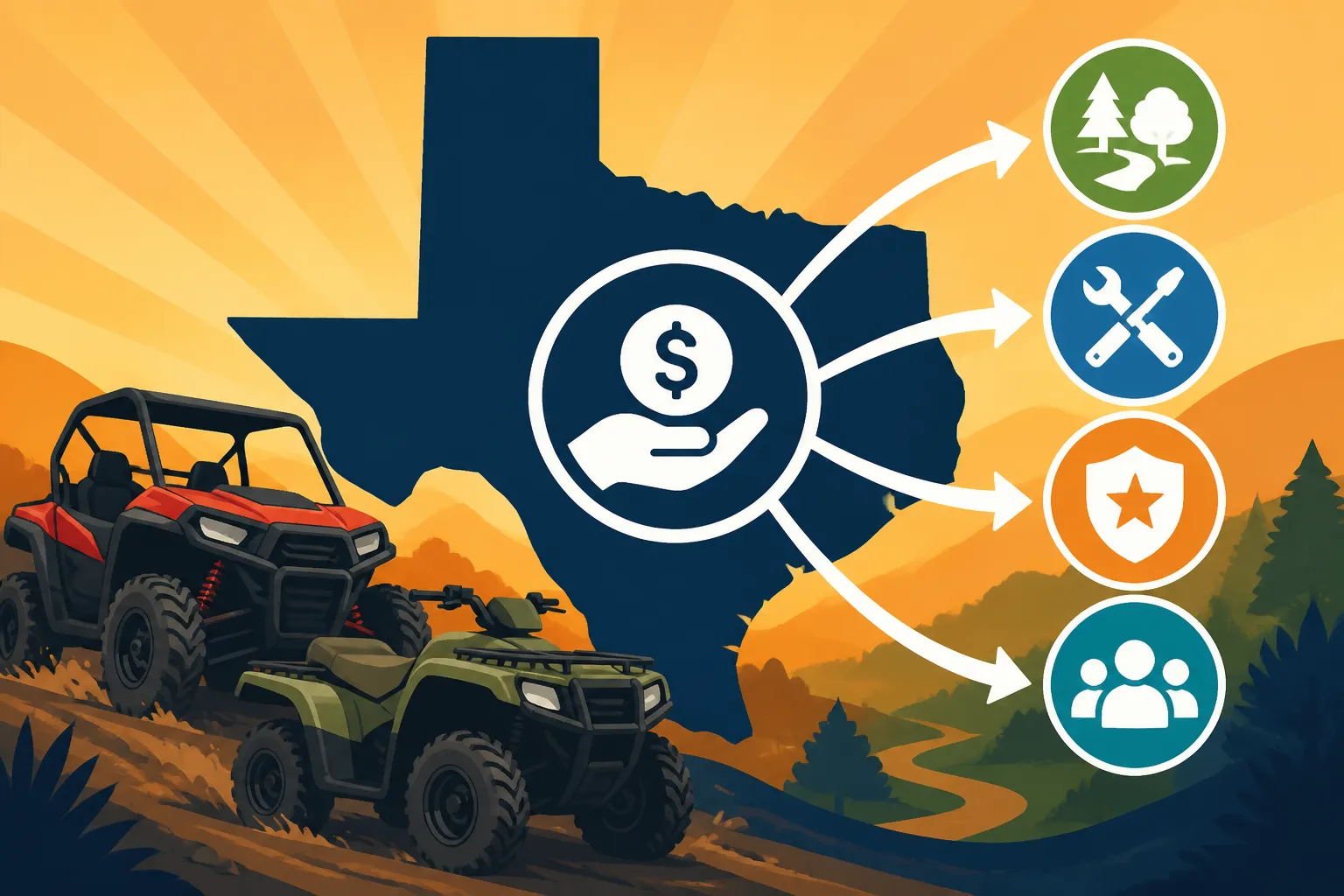
Where Texas OHV Title Money Goes
It's incredibly common to walk out of your local county tax assessor-collector's office in Texas with a shiny new title for your ATV or UTV and a receipt that looks like a jumble of numbers. Many folks see that final total and instinctively wonder: exactly where does all that money go? It's not just one big "title fee" – there are several distinct charges involved, each funneling into different state and local coffers. This guide is going to meticulously unravel those costs, showing you precisely where your hard-earned dollars go when you title an off-highway vehicle in the Lone Star State.
Breaking Down the Costs You See at the Counter
When you head to your county tax office to title your new-to-you or brand-new off-highway vehicle (OHV), it can feel like you're just paying one lump sum. But take a closer look at that receipt, and you'll often see several line items. Each one serves a different purpose, and understanding this breakdown is the first step to knowing where your money ultimately ends up. It’s easy to feel a bit lost in the paperwork, especially if you’ve never titled an OHV before, but let's demystify it.
More Than Just a "Title Fee" – The Itemized Charges
The phrase "title fee" is often used broadly, but it specifically refers to the charge for the processing and issuance of the official certificate of title. This is a relatively small portion of what you'll typically pay when you first title a machine. You'll likely encounter other significant costs that are collected at the same time, but they aren't part of that core title fee. Think of it like buying a new appliance: there's the price of the appliance itself, but then sales tax, delivery fees, and possibly an installation charge all get added on top. It’s the same principle here, just with different names.
For instance, the state of Texas levies a sales or use tax on the purchase price of your OHV, which is often the largest single charge you'll see. This tax is completely separate from the title fee, even though it's usually collected concurrently by the county office acting as an agent for the state. Then, if you opt for the off-highway license plate (which is entirely voluntary for OHVs), that's another separate, distinct fee. Recognizing these individual components is key to understanding the destinations of your funds. It’s all part of the process when you're [Titling an ATV in Texas].
Why the Total Can Feel Confusing
It’s completely understandable why the combined total can feel confusing or overwhelming. You’re often handed a single bill, and unless you scrutinize each line, it all blends into one number. The county tax assessor-collector's office handles a wide array of transactions, from property taxes to vehicle registrations and OHV titling, so their systems are designed to process various types of payments efficiently. However, that efficiency doesn't always translate into a crystal-clear explanation for the customer about where each dollar is headed.
Furthermore, some of the money collected is passed on to the state, some stays local, and some might even go to specific, earmarked programs. Without a clear explanation at the counter, it’s natural to feel like it’s just one big government grab. This guide aims to clear up that confusion, so you can leave the county office with your title in hand and a better grasp of the financial journey your payment just took. Understanding these nuances helps you feel more empowered as a Texan OHV owner.
The Core Title Fee and the Texas DMV's Role
At the heart of your titling transaction is the actual title application fee. This is the amount specifically charged for the creation and issuance of your official Texas Certificate of Title. It's a fundamental part of the process, ensuring that ownership records are properly established and maintained.
The Base Title Application Fee
Every time a Texas resident applies for an OHV title, there's a base fee that goes directly towards the cost of processing that application and maintaining the state's vehicle title database. This fee is set by the state legislature and applies uniformly across all counties. It covers the administrative overhead associated with verifying your ownership documents, cross-referencing VINs, and ultimately producing the physical title document that proves you are the legal owner of your machine. When you're filling out [The Texas Title Application Every OHV Buyer Files], this is one of the mandatory fees you're signing up to pay.
This fee is modest compared to the sales tax you'll likely pay, but it's essential. It ensures the integrity of the ownership record system for all vehicles, including off-highway vehicles. Without this fee, the Texas Department of Motor Vehicles (TxDMV) wouldn't have the dedicated funds to manage this massive database and process the thousands of title applications that come through every year. It's the cost of official recognition of your ownership.
How the DMV Uses These Funds
The revenue generated from the base title application fee primarily supports the operational costs of the Texas Department of Motor Vehicles. The TxDMV is the state agency responsible for vehicle titles and registration (among many other things), and these fees are crucial for their day-to-day functions. This includes maintaining the statewide database of all titled vehicles, processing new title applications, handling title transfers, and issuing duplicate titles if yours ever gets lost or damaged. You can learn more about their role in [The Texas Department of Motor Vehicles and OHVs].
Beyond the direct processing, these funds also contribute to other important activities, such as combating vehicle theft and fraud by ensuring accurate ownership records. A robust titling system helps law enforcement trace vehicles and prevent illegal sales, which ultimately benefits all Texans, including OHV owners. So, while it might seem like a small fee, it's a vital component in keeping the wheels (or tracks) of the state's vehicle administration turning smoothly and securely.
County Offices – The Front Line of Fee Collection
While the Texas Department of Motor Vehicles sets many of the rules and processes, it's your local county tax assessor-collector's office that actually handles the majority of the in-person transactions related to OHV titling. They are the public-facing arm of the state's titling system, and a portion of the money you pay supports their critical local services.
Funding Local Administration and Services
When you go to [Titling at a Texas County Tax Office], your county tax assessor-collector's office plays a crucial role. They are responsible for receiving your application, verifying your documents, collecting all the necessary fees, and submitting the paperwork to the state. For these services, county offices are permitted to retain a small portion of certain fees collected. This revenue helps fund the operation of these local offices, covering expenses like staffing, facilities, and the technology needed to process applications efficiently.
Without these local offices, the TxDMV would be overwhelmed. The county offices provide convenient, accessible locations for Texans to handle their vehicle-related transactions, saving countless hours of travel and bureaucracy. The portion of fees they retain helps ensure that these vital local government services remain available and responsive to the needs of the community. It's an essential partnership between state and local government to streamline administrative tasks for citizens.
Additional County Fees or Variations
It's important to remember that [Texas ATV Title Fees Vary by County] to some extent, even though the base state-mandated fees are uniform. Counties may impose certain local administrative fees that are specific to their jurisdiction. These additional charges are usually small, but they contribute to the operational budget of that specific county office. For instance, a county might have a small processing fee for handling complex title situations or for general administrative overhead not covered by the state's portion of the fees.
These local variations can sometimes add to the confusion, as the total cost might be slightly different depending on which county you're in. However, the core principle remains: these funds help support the local government services that facilitate your OHV titling. It’s always a good idea to check with your specific county tax assessor-collector's office beforehand if you want a precise breakdown of potential costs in your area. This helps avoid any surprises when you're ready to complete your transaction.
State Revenue from Your OHV Transaction
Beyond the direct title fee and local administrative costs, a significant portion of the money you pay when titling an OHV goes into broader state revenue. This is primarily through sales and use tax, which is a substantial contributor to Texas's overall budget.
The Lion's Share: Sales and Use Tax
For most Texans, the largest single payment they make when acquiring an OHV and getting it titled is the state sales tax. If you bought your machine from a dealer in Texas, they would have collected this tax at the point of sale. However, if you bought it from a private seller or from an out-of-state dealer, you are responsible for paying the use tax directly to the county tax assessor-collector's office when you apply for the title. This is a critical step, as you cannot get a title without proving the tax has been paid. For those bringing machines in from neighboring states, understanding [Texas Use Tax on an Out-of-State OHV] is vital.
The revenue from sales and use tax goes into the state's general revenue fund. This massive fund is the primary source of money for a vast array of state-funded programs and services, including education, healthcare, public safety, and infrastructure projects across Texas. So, while it's not a "title fee" in the strictest sense, the sales tax you pay during the titling process is a significant financial contribution that supports the entire state.
General Revenue Impact of OHV Titling Fees
While sales tax is the heaviest hitter, the smaller administrative fees, like the base title fee itself, also contribute to the state's general revenue indirectly. Even if a portion of a fee is earmarked for specific DMV operations, surplus funds or general administrative efficiency can free up other state resources. These smaller contributions add up across the millions of vehicle transactions processed annually in Texas.
It’s about more than just covering the cost of printing a piece of paper; it’s about funding the governmental infrastructure that makes living and recreating in Texas possible. Every dollar collected, regardless of its specific starting point, eventually contributes to the overall financial health of the state, enabling it to provide essential services to its citizens. Your OHV title money, in its various forms, becomes a part of this larger financial ecosystem that keeps Texas running.
The Optional OHV License Plate Fee and Its Destination
Separate from the title itself, many OHV owners in Texas opt to get an off-highway vehicle license plate. This plate allows you to operate your OHV on certain public roads and highways under specific conditions. Crucially, the fee for this plate is distinct from the title fee, and it has its own allocation.
The Separate Cost of the Off-Highway Plate
When you decide to purchase the optional off-highway plate, you're paying a specific, statutorily capped fee for that plate. This fee is collected at the same time as your title application at the county tax assessor-collector's office. It's a modest amount, designed to cover the administrative costs of issuing the plate itself, which includes the physical manufacturing of the plate and the record-keeping associated with its issuance. The details can be found when you look into [The Texas Off-Highway Vehicle License Plate].
It's important to understand that this plate is not a "registration" in the way cars are registered. Texas titles, but never registers, OHVs for general public road use. The off-highway plate is a specific designation that allows limited road access, and its fee reflects that administrative purpose.
What the Plate Fee Supports
The funds collected from the off-highway license plate fee primarily support the administrative processes of the Texas Department of Motor Vehicles and the county tax assessor-collector's offices related to the issuance and tracking of these plates. This includes maintaining the database of OHVs that have been issued a plate, handling any replacement requests, and ensuring that the plates are manufactured and distributed efficiently. This is why [The $10 Cap on a Texas Plate] covers its administrative cost.
Unlike the OHV decal (which we'll discuss next), the off-highway license plate fee is generally an administrative fee that goes towards the general operations of the agencies involved in issuing it. It's about maintaining the system that allows for this limited road use option, rather than funding specific trail development or conservation programs. It's a practical fee for a practical piece of identification for your OHV.
Distinguishing From Other OHV-Related Funds
It's easy to conflate all the money you spend on your OHV with "title money." However, Texas has another significant fee related to off-highway riding that funds entirely different programs. Understanding this distinction is vital for any OHV enthusiast in the state.
The Texas OHV Decal – A Separate Revenue Stream
Perhaps the most common source of confusion when discussing OHV-related funds is the Texas OHV Decal. This decal, which costs a small amount annually, is required for any off-highway vehicle operated on public lands or properties that receive grants from the Texas Parks and Wildlife Department. This is a completely separate fee from the title application or the optional license plate. When you hear discussions about funding for OHV trails and parks, this decal is where that money comes from. You can dive deeper into this topic with [The Texas OHV Decal Explained].
The funds generated by the sale of these decals are specifically earmarked through the Texas Parks and Wildlife Department's Off-Highway Vehicle Program. This program provides grants to public and private entities for the development, maintenance, and management of OHV trails, parks, and riding areas across the state. This is a direct investment back into the riding opportunities for Texans, making it a very different animal from the administrative fees associated with titling. For a full picture, you might want to read [Where Texas OHV Decal Money Goes].
Why Understanding the Differences Matters to Riders
Knowing where your money goes isn't just about satisfying curiosity; it empowers you as an OHV owner and enthusiast. When you understand that the sales tax supports general state services, the title fee supports DMV administration, and the OHV decal funds trail development, you can see the broader impact of your contributions. It helps you appreciate the various governmental functions that facilitate your enjoyment of the sport.
Furthermore, this knowledge helps clarify discussions about funding for OHV recreation. If you're advocating for more trails or better maintenance, you know that the OHV decal program is the specific funding stream to reference, not necessarily the general title fees. It ensures you're engaging with the right parts of the system and understanding the full financial picture that enables OHV riding in Texas. Every dollar has its path, and now you know where each part of your [Texas ATV Title Cost] generally ends up.
Here's a quick summary table of the typical fees you'll encounter and their general destination:
| Fee Type | When is it collected? | General Destination | Purpose |
|---|---|---|---|
| Title Application Fee | When applying for a title | Texas Department of Motor Vehicles | Administering vehicle titles, maintaining ownership records |
| Sales/Use Tax | When applying for a title | Texas State General Revenue Fund | Funding statewide services (education, infrastructure, public safety) |
| OHV License Plate Fee | When applying for the optional plate | Texas Department of Motor Vehicles & County Offices | Administrative costs of issuing the physical off-highway plate |
| County Admin. Fees | When applying for a title | Specific County Tax Assessor-Collector's Office | Supporting local office operations and processing services |
| OHV Decal Fee | Annually, if riding public land | Texas Parks and Wildlife Department (OHV Program) | Funding OHV trail development, maintenance, and educational programs |
Disclaimer
This article is for general informational purposes only and does not constitute professional advice. Laws, prices and regulations vary by location and change over time. Consult a qualified professional for guidance on your specific situation.