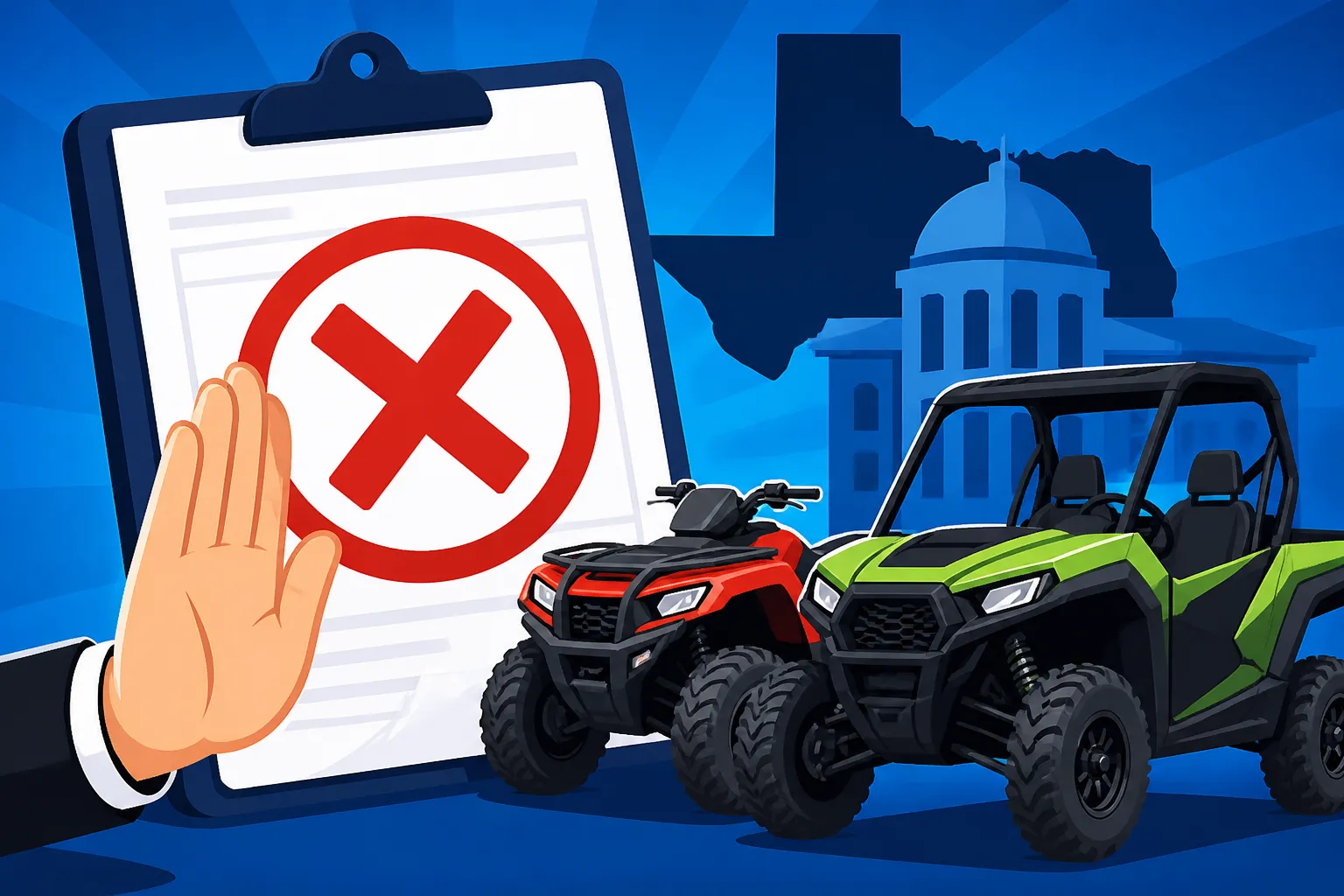
What a County Clerk Rejects on a Title Application
You’ve just made the exciting leap, maybe purchasing that sleek ATV you’ve been dreaming of, or perhaps a workhorse UTV to make ranch life easier. You gather all your paperwork, head to your local county tax office, full of anticipation to get that title in your hand, and then… rejection. The clerk looks at your meticulously collected documents, shakes their head, and points out a small, seemingly insignificant error that brings your whole process to a grinding halt. It’s a truly frustrating experience, often leading to delays, repeat trips, and that sinking feeling of wasted time. This guide is here to walk you through the most common reasons a Texas county clerk might reject your ATV or UTV title application and, more importantly, how to avoid those disheartening setbacks.
Understanding the Clerk's Role and Their Checklist
When you walk into the county tax assessor-collector’s office to title your off-highway vehicle (OHV), it can feel like you're facing an unyielding bureaucratic wall. It’s easy to get frustrated when a clerk rejects your application over what seems like a minor detail. However, understanding their role helps put things into perspective. They aren't trying to make your life difficult; they are simply following strict state mandates designed to prevent fraud and ensure proper adherence to Texas laws.
The Clerk's Mandate: Enforcing State Rules
The county clerks, or more accurately, the county tax assessor-collectors and their staff, act as frontline agents for the Texas Department of Motor Vehicles (TxDMV) and the Texas Comptroller of Public Accounts. Their primary responsibility is to meticulously review every title application to ensure it complies with the precise rules and regulations set forth by the state. This means they are looking for absolute accuracy and completeness in every document you present. They don't have the discretion to waive rules, even if your story is sympathetic or the error seems trivial to you. If a form requires a signature in a specific spot, and it's missing, they must reject it. If the VIN on your bill of sale doesn't perfectly match the one on your previous title, it's a stop sign.
Their rigorous approach is essential for maintaining the integrity of vehicle ownership records across Texas. Without such strict checks, it would be far too easy for stolen machines to be retitled or for individuals to avoid paying their fair share of sales or use taxes. So, while it can feel like nitpicking, their adherence to procedure is what ultimately protects legitimate buyers and sellers. They are trained to scrutinize every detail, knowing that What a County Clerk Rejects on a Title Application is often based on subtle inconsistencies.
The Critical Document Checklist
When you present your application, the clerk is mentally (and sometimes physically) going through a comprehensive checklist of required documents and their specific criteria. This list typically includes a fully completed [The Texas Title Application Every OHV Buyer Files], proof of ownership (which could be a previous title, a Manufacturer's Statement of Origin (MSO) for new vehicles, or a robust [A Texas Bill of Sale for an ATV]), your personal identification, and crucial proof that you've paid or are exempt from sales or use tax.
Any missing item from this list is an immediate and absolute barrier to getting your title. It's not just about having the documents; it's about having them correctly executed. For instance, a previous title might be present, but if the seller didn't properly sign it over to you or left certain fields blank, it’s as good as missing. Likewise, if you're attempting to title a machine that was never titled before, or a custom build, the requirements for proving ownership can become even more stringent, requiring meticulous documentation.
Common Mistakes with Required Forms
Even when you think you have all the right forms, seemingly minor errors can lead to immediate rejection. One of the most common pitfalls involves simple oversights on the forms themselves. This could be anything from a missed signature – perhaps you signed but the seller's signature is absent, or vice-versa – to an incorrect date that creates a discrepancy with your bill of sale. Illegible handwriting can also be an issue; if the clerk can’t clearly read a name, address, or VIN, they can’t process the application accurately. It's not uncommon for people to rush through [Filling Out Texas Form 130-U for an OHV] and overlook a checkbox or fill in a field incorrectly.
Another frequent problem is using an outdated version of a form. State forms are periodically updated, and even if the changes seem minimal, the county office must use the most current version. Always download the latest forms directly from the TxDMV website just before your visit to ensure you have the correct edition. A good rule of thumb is to treat every blank field as if it must be filled out, even if it’s just with "N/A" where appropriate, to avoid any ambiguity that could lead to rejection.
Specific Reasons for Rejection: The Paperwork Pitfalls
Beyond general form errors, there are several specific document-related issues that commonly lead to a rejected title application. These often stem from misunderstandings about what constitutes valid proof, proper execution, or accurate tax reporting. Addressing these points upfront is key to a smooth titling process.
Incomplete or Incorrect Form 130-U
The Application for Texas Title and/or Registration, commonly known as Form 130-U, is the cornerstone of your title application for any OHV. Any mistakes on this form are almost guaranteed to lead to rejection. One of the most prevalent issues is missing signatures. Both the buyer and the seller (or their authorized representative) must sign this form, and often in specific sections that correspond to their role in the transaction. If you purchased from a private seller who isn't accompanying you, ensure their signature is present and, in some cases, notarized if your county requires it for certain situations.
Another major red flag is an incorrect Vehicle Identification Number (VIN). This single, unique identifier must precisely match the VIN stamped on the ATV or UTV itself, as well as on all supporting documents like the previous title or bill of sale. A single digit transpose or an extra character will stop the process cold. Clerks are trained to verify this meticulously, as a VIN discrepancy can indicate a stolen vehicle or a fraudulent transaction. Always triple-check the VIN, even using a flashlight to read it clearly from the machine's frame, before filling out your form. [Texas ATV Title Paperwork Checklist] will always highlight the VIN as paramount.
Furthermore, incomplete buyer or seller information can cause problems. Every blank field pertaining to names, addresses, driver's license numbers, or business details for both parties needs to be filled out accurately and completely. Missing an apartment number, an abbreviation in a street name, or an expired ID number can all lead to questions and ultimately, rejection. Similarly, discrepancies in the purchase price or date between the Form 130-U and your bill of sale will trigger scrutiny. These figures are crucial for calculating sales tax and establishing the legal timeline of ownership transfer. Any inconsistency might lead the clerk to believe information is being misrepresented.
Missing or Improper Proof of Ownership
This is often where the rubber meets the road, as proving you legally own the machine is fundamental to getting a title. For used ATVs or UTVs, the previous title, properly assigned to you by the seller, is the gold standard. If the seller merely handed you the old title without signing it over in the designated area, or if they left the buyer's name blank, it's not a valid transfer. Furthermore, if the seller claims they lost the original title, they are the ones who need to apply for a duplicate title before they can legally sell and transfer ownership to you. Trying to title a machine when [Buying a Quad Whose Seller Lost the Title] without this crucial step will always result in rejection.
For machines that are brand new and being titled for the first time, you’ll need the Manufacturer's Statement of Origin (MSO). This document is like a birth certificate for your OHV. It must be pristine, without alterations, and properly assigned to you by the dealer. Any smudges, cross-outs, or incomplete information on an MSO will cause significant issues. If you’re buying from a private party and they somehow acquired an MSO without titling the machine themselves, proceed with extreme caution and verify everything with the manufacturer if possible.
In situations where a previous title isn't available (like for some older machines, homebuilt units, or specific out-of-state purchases), a comprehensive [A Texas Bill of Sale for an ATV] becomes absolutely critical. A simple handwritten receipt with just a price won’t cut it. A robust bill of sale needs to include: the full legal names and addresses of both buyer and seller, the exact VIN of the machine, the purchase price, the date of sale, and clear signatures from both parties. Tools like those provided by LawDepot offer detailed, legally sound templates for bills of sale that cover all these necessary fields, significantly increasing the likelihood of acceptance when you’re relying solely on this document for proof of ownership. This can be especially helpful if you’re [Getting a First Title for a Never-Titled Quad].
Finally, a major sticking point can be an unreleased lien. If the previous owner financed the ATV or UTV and still had an outstanding loan when they sold it to you, the lienholder (the bank or finance company) must formally release their interest. Without a lien release document—usually a specific form from the lienholder or a signed-off title—the clerk cannot issue you a clear title, because the machine technically still has an encumbrance. It is absolutely vital to ensure the seller takes care of [Releasing a Lien Before a Sale] before the transaction is finalized.
Issues with Sales Tax or Use Tax Documentation
Taxes are a non-negotiable part of the titling process, and any missteps here will certainly lead to rejection. If you purchase an ATV or UTV from a private seller in Texas, you are responsible for paying the sales tax directly to the county tax assessor-collector’s office when you apply for your title. Many buyers overlook this, assuming sales tax was part of the purchase price, but often it's not when buying from a private party. If you arrive without the calculated tax amount or funds, your application will be put on hold until this is settled.
For machines purchased out of state, Texas imposes a "use tax" which essentially functions like sales tax to ensure fairness and prevent buyers from avoiding Texas sales tax by purchasing elsewhere. You need to prove you’ve paid this use tax, or be prepared to pay it at the county office. This often involves completing a separate Use Tax Return form with the Texas Comptroller of Public Accounts before you even visit the county office, or understanding how to report and pay it when you title. The [March 2020 Use Tax Rule] brought clarity and stricter enforcement to this process, making [Proof of Use Tax Before a Texas Title] a critical step for out-of-state purchases.
If you are attempting to claim an agricultural (Ag) or timber exemption to avoid sales tax on your OHV purchase, you must have a valid Ag/Timber number issued by the Texas Comptroller’s office and the proper documentation to back up your claim. Simply writing "Ag Exemption" on the form without the corresponding number and proof of eligibility will not be accepted. The clerk will require you to either provide the valid exemption details or pay the full sales tax amount. Understanding [Ag and Timber Exemptions on Form 130-U] is crucial for anyone using an OHV primarily for farm or timber operations.
Finally, clerks are also on the lookout for undervaluation. If the purchase price you declare on Form 130-U is suspiciously low for the type, make, and model of ATV or UTV you’re titling, the county clerk has the authority to challenge it. Texas law includes provisions, sometimes referred to as "presumptive value," to prevent individuals from declaring an unrealistically low sale price solely to reduce the sales tax owed. If the declared value falls significantly below market rates, the clerk may require you to pay tax based on a state-determined fair market value, leading to unexpected costs and delays.
Preventing Rejection: Your Pre-Application Strategy
Facing a rejection at the county office is disheartening and a waste of your valuable time. The good news is that most rejections are entirely preventable with a bit of proactive planning and meticulous attention to detail. A solid pre-application strategy is your best defense against those common bureaucratic roadblocks.
Double-Checking Every Detail
Before you even think about leaving your driveway, commit to a thorough review of every single line on every single document you plan to present. It might sound tedious, but this step alone can save you hours of frustration and repeat trips. Start by comparing the Vehicle Identification Number (VIN) on your ATV or UTV's frame to the VIN listed on your bill of sale, the previous title, and your completed Form 130-U. Even a single transposed digit is enough for an immediate rejection. Use a magnifying glass or a flashlight if needed to ensure absolute accuracy.
Next, verify that all names, addresses, and dates are consistent across all documents. A minor typo in an address on one form, or a date discrepancy between your bill of sale and your title application, can raise red flags. Ensure that all required signatures are present and in the correct places, especially on the previous title and Form 130-U. If you're using a bill of sale, like one from LawDepot, confirm all fields are filled completely, including details about the machine's condition and any warranties (or lack thereof). Printing a blank [Texas ATV Title Paperwork Checklist] and physically ticking off each item as you review your documents can be incredibly helpful in catching these small but critical errors.
Organizing Your Documents Before You Go
Don't just arrive at the county office with a loose stack of papers. A well-organized packet not only speeds up your process but also makes a positive impression on the clerk. Arrange your documents in a logical order that mirrors the typical application process. A good sequence would be: your completed Form 130-U on top, followed by your primary proof of ownership (e.g., the previous title or MSO), then your bill of sale, followed by any tax-related documents (like proof of use tax payment or exemption certificates), and finally, your personal identification.
Before you go, make a complete set of photocopies of all your documents for your own records. While the county office will often make their own copies for their files, having your own backup provides peace of mind in case anything gets misplaced or if you need to reference a document later. Presenting clean, unfolded, and clearly legible documents also helps. Avoid excessive scribbling or correction fluid; if you make a significant mistake on a form, it's often better to start fresh with a new, blank copy. Being this prepared demonstrates to the staff at [Titling at a Texas County Tax Office] that you are serious and respectful of their time and process.
Seeking Clarification Before Submission
If your titling situation is anything but straightforward – for example, you’re trying to title a homebuilt buggy, a machine with no previous title whatsoever, or one that has a complex chain of ownership – it's always a wise move to call your local county tax assessor-collector’s office before you make your trip. Explain your unique circumstances clearly. Their staff can provide invaluable guidance on specific requirements, often saving you a wasted visit.
While they cannot offer legal advice, they can tell you exactly what additional documents or forms you might need for unique situations like [Titling a Homebuilt Buggy] or how to proceed if you’re [Getting a First Title for a Never-Titled Quad]. Sometimes, counties have slightly different local procedures or require particular supporting affidavits for unusual cases. Don't be afraid to ask for these specifics. If you're using a generic bill of sale or other legal form, ensure it’s compliant with Texas requirements; templates from resources like LawDepot can often be customized to fit particular needs, but a pre-call can confirm if any special clauses or details are needed for your unique transaction. Taking this proactive step can transform a potentially frustrating rejection into a smooth, successful title application.
| Rejection Reason | Common Cause | Solution |
|---|---|---|
| Incomplete Form 130-U | Missing signatures, blank mandatory fields, incorrect dates, outdated form. | Double-check every field for accuracy and completion; use the latest version from TxDMV website; ensure all parties sign where required. |
| Improper Proof of Ownership | Missing title, unassigned title, unreleased lien, insufficient bill of sale. | Obtain original assigned title or MSO; get a lien release; use a comprehensive bill of sale (e.g., from LawDepot); seller gets duplicate title if lost. |
| Sales/Use Tax Issues | Unpaid tax, missing exemption proof, declared undervaluation. | Calculate tax beforehand; bring payment; provide valid Ag/Timber exemption number; declare fair market value; pay use tax for out-of-state purchases. |
| VIN Discrepancy | VIN on documents doesn't match machine or other papers, typos in VIN. | Verify VIN on machine, title, bill of sale, and Form 130-U; ensure exact match across all documents and correct any typos. |
| Illegible Handwriting | Unclear names, dates, or numbers on forms. | Print clearly in black ink; avoid scratching out or using correction fluid; start with a fresh form if mistakes are made. |
| Outdated Forms | Using an older version of a state form. | Always download the latest forms directly from the Texas DMV or Comptroller websites immediately before your visit. |
Getting your ATV or UTV titled in Texas doesn't have to be a headache. By understanding the common pitfalls and preparing thoroughly, you can navigate the process with confidence, avoiding the frustration of a rejected application. A little extra effort upfront ensures you get your title the first time, freeing you up to hit the trails or tackle that ranch work much sooner.
Disclaimer
This article is for general informational purposes only and does not constitute professional advice. Laws, prices and regulations vary by location and change over time. Consult a qualified professional for guidance on your specific situation.