Filing at the Tax Assessor-Collector
If you're new to the world of off-highway vehicles (OHVs) in Texas, or perhaps just moved here from another state, trying to figure out how to get your ATV or UTV legally titled can feel like navigating a maze blindfolded. Many folks automatically think "DMV" for anything vehicle-related, but Texas has a unique approach for our beloved quads, side-by-sides, and other off-road machines. This guide is here to cut through the confusion and walk you step-by-step through the process of filing your OHV title at your local Texas County Tax Assessor-Collector's office, ensuring you're prepared and confident.
Why Your Local County Tax Office Is Your Go-To for OHV Titling
It’s easy to assume that all vehicle-related paperwork goes through the Texas Department of Motor Vehicles (TxDMV) directly, or perhaps the local Department of Public Safety (DPS) office. After all, that’s where you handle your car registration and driver’s license, right? But for your ATV, UTV, or other off-highway vehicle, the path is a little different, and knowing this upfront saves a lot of wasted trips and frustration.
The Difference Between OHV and Road Vehicle Titling
The critical distinction lies in how Texas classifies these machines. Unlike cars, trucks, and even golf carts or Neighborhood Electric Vehicles (NEVs) that are designed for road use and require full registration, ATVs and UTVs are primarily intended for off-road operation. This fundamental difference means they fall under different sections of the Texas Transportation Code and, consequently, a different administrative process. Texas doesn't register OHVs for general road use, and this immediately sets them apart from your daily driver. This is a common point of bewilderment for many, especially those who have purchased a machine out of state where registration might be mandatory or where the titling process is integrated with on-road vehicles. Understanding [Why Texas Titles But Never Registers an OHV] is key to making sense of the system.
Because OHVs aren't registered for the road, they don't follow the typical vehicle registration channels you might be used to. This can lead to a lot of head-scratching when you first look up where to go. People often arrive at a TxDMV regional office or even a DPS branch only to be politely, or sometimes not-so-politely, redirected. It's a classic case of assuming one size fits all for vehicle administration, which simply isn't true in Texas when it comes to off-road machines.
Understanding the Role of the Tax Assessor-Collector
In Texas, the County Tax Assessor-Collector's office is a multifaceted local government entity. While they are indeed responsible for collecting property taxes and handling voter registration in some areas, they also serve as the local agents for vehicle registration for road vehicles and, crucially for us, OHV titling. Think of them as the front line for many state-level administrative tasks, including processing your off-highway vehicle's ownership documents. They work in conjunction with [The Texas Department of Motor Vehicles and OHVs] but are your direct point of contact for getting that title in your hand.
Every one of Texas's 254 counties has a Tax Assessor-Collector, and this is where you'll be doing your OHV title work. These offices are equipped to process title applications, collect necessary fees and taxes, and submit the paperwork to the state TxDMV for final title issuance. It’s important to remember that while the state sets the rules, it's these local offices that implement them day-to-day. This decentralized approach means that while the core requirements are uniform statewide, the specific experience, wait times, and even minor procedural nuances can vary slightly from one county office to another. This is why when you're ready to get your title sorted, you'll be [Titling at a Texas County Tax Office], rather than trying to find a dedicated OHV department.
Essential Documents and Information You'll Need to File
Getting your ATV or UTV titled isn't a complex ritual, but it does demand attention to detail and having all your ducks in a row. Nothing is more frustrating than making a trip to the county office, waiting in line, and then being told you're missing a crucial piece of paper. To avoid that headache, let's break down exactly what you'll need to bring with you.
The Texas Title Application (Form 130-U) and How to Complete It
At the heart of every OHV title application is the Texas Application for Texas Title and/or Registration, commonly known as Form 130-U. This isn't just a suggestion; it's mandatory. You can usually find this form on the TxDMV website, and it's highly recommended you print it out and fill it in before you even leave the house. Trying to fill it out at the counter, under pressure, often leads to mistakes. This form collects all the vital information about the transaction, the vehicle, and both the buyer and seller.
Key sections on Form 130-U include comprehensive details about both the buyer and seller (names, addresses, driver's license numbers), a thorough description of the vehicle itself (Vehicle Identification Number or VIN, make, model, year, body style, odometer reading – though for off-road machines, odometer accuracy can be less critical but still required if present), and the purchase price. Accuracy here is paramount; a VIN that doesn't match the machine or a name misspelled can cause immediate rejection. Make sure all signatures are present where required. If you're a bit unsure about how to fill out any section, don't hesitate to consult resources like LawDepot for guidance on similar legal documents, or call your county tax office for clarification. They can't fill it out for you, but they can answer questions. Getting it right ensures a smooth process, and you'll want to thoroughly review [Filling Out Texas Form 130-U for an OHV] before your visit.
Proof of Ownership and Tax Payment
Beyond the Form 130-U, proving you legitimately own the OHV and have paid your due taxes are the next biggest hurdles. The type of proof varies based on whether your machine is new or used, and where you bought it.
If you're buying a brand-new ATV or UTV from a licensed dealer, they will typically provide you with a Manufacturer's Certificate of Origin (MCO) or Manufacturer's Statement of Origin (MSO). This is essentially the birth certificate for your machine and is the primary document proving its first ownership. The dealer will often help you complete some of the titling paperwork and might even submit it on your behalf, but always confirm this.
For a used machine purchased from a private seller within Texas, the seller must sign over their existing Texas title to you. The back of the title has specific sections for the seller's signature, printed name, and the sale date, as well as the purchase price. It’s absolutely critical that these sections are filled out completely and accurately, as any missing information can hold up your transfer. If you're [Buying a Used ATV in Texas], always ensure you get the signed title.
If you're purchasing a used OHV from an out-of-state seller, you'll typically need their out-of-state title, or in some cases, a registration certificate if that state doesn't issue titles for OHVs, along with a robust bill of sale. Regardless of where you buy it, a comprehensive [A Texas Bill of Sale for an ATV] is always a good idea, even if it's just to clearly document the sale price and condition. You can find reliable templates for a bill of sale through services like LawDepot to ensure all the necessary details are captured, protecting both you and the seller.
Finally, there’s the matter of sales or use tax. Texas charges a sales tax on OHVs, just like any other merchandise. If you buy from a dealer, they will collect this tax at the time of sale. However, if you buy from a private party or an out-of-state seller who didn't collect Texas sales tax, you are responsible for remitting what's called "use tax" to the Texas Comptroller of Public Accounts. You'll need to show [Proof of Use Tax Before a Texas Title] at the county office. This rule became particularly important with [The March 2020 Use Tax Rule], which clarified requirements for many OHV buyers. This often involves completing a separate form (usually the Texas Motor Vehicle Tax Statement, Form 14-312) and sometimes paying the tax directly to the Comptroller before you go to the county tax office. If you're dealing with [Texas Use Tax on an Out-of-State OHV], be especially diligent.
The Titling Process: What to Expect at the Counter
You've gathered all your documents, filled out Form 130-U, and you're feeling prepared. Now it's time to head to the county Tax Assessor-Collector's office. While the atmosphere might vary from bustling to quiet depending on the day and location, the general process you'll go through at the counter is fairly consistent across the state.
The Counter Interaction and Common Issues
Upon arrival, you'll likely take a number and wait your turn. When called, present all your meticulously prepared documents to the clerk. Their job is to review everything for completeness, accuracy, and compliance with Texas law. They'll cross-reference information, look for signatures, and ensure all required fields are filled. This is the moment where any missing detail, no matter how small, can bring the process to a halt.
Common reasons for a title application to be rejected include incomplete forms (a missed signature, an empty field for the purchase price), discrepancies in the Vehicle Identification Number (VIN) between the machine and the paperwork, or an unreleased lien on an existing title. If the OHV you're buying still has a lien against it (meaning the previous owner hasn't fully paid off a loan on it), you absolutely must have a lien release document from the lender. Without it, the title cannot be transferred. Similarly, if you purchased an out-of-state machine and haven't paid the Texas use tax directly to the Comptroller, the clerk will often direct you to do so before proceeding. Getting an understanding of [What a County Clerk Rejects on a Title Application] can help you proactively address potential issues. Don't be discouraged if something minor is flagged; the clerks are there to ensure everything is correct, which ultimately protects you as the new owner.
Fees, Taxes, and Optional OHV Plate
Once your documents pass muster, the clerk will calculate the total amount due. This typically includes a few key components:
- Titling Fee: There's a statutory fee for processing the title itself. This is a relatively small, fixed charge.
- Sales/Use Tax: If the tax wasn't collected by a dealer or paid directly to the Comptroller already, you'll pay the sales or use tax here. Texas state sales tax for OHVs is 6.25% of the purchase price. Some local jurisdictions may add additional taxes, but the combined rate is capped. For example, if you stated a purchase price of $5,000, the state tax alone would be $312.50. This can be a significant portion of your total cost, so budget for it.
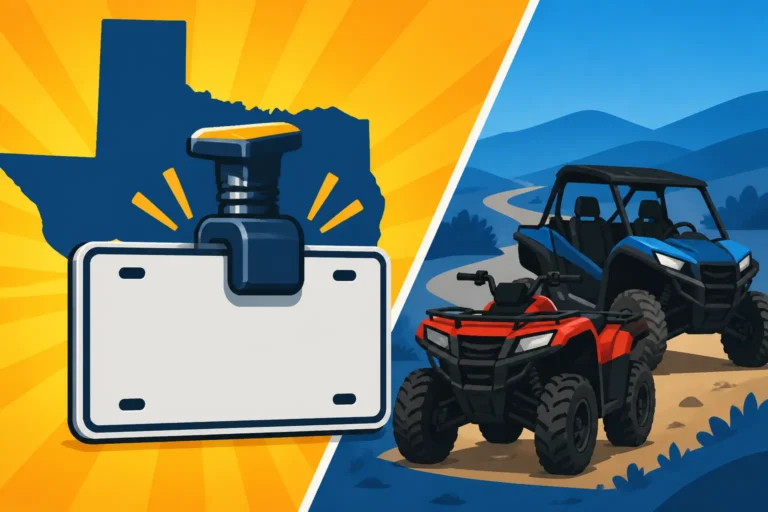
- Optional OHV Plate: This is a crucial distinction: the OHV license plate is optional and must be specifically requested. Many people assume it comes automatically, but it doesn't. This small, rectangular plate is issued for identification when using designated public OHV trails that require it, such as those in national forests. The fee for this plate is minimal, usually capped at $10 plus a small processing fee.
Here's a simplified breakdown of potential costs you might encounter at the counter:
| Item | Description | Cost (Shape) |
|---|---|---|
| Title Fee | Statutory fee for processing the title application. | Small, fixed |
| Sales/Use Tax | 6.25% of purchase price (state rate) + local if applicable. | Varies based on purchase price |
| OHV Plate Fee | Optional plate for identification on public trails. | Small, fixed (e.g., ~$10) |
| Service/Processing Fee | Small charge for the county office's services. | Very small |
Remember, prices can vary slightly by county due to local processing fees, and tax amounts depend directly on your purchase price. For current figures, always check with your specific county's Tax Assessor-Collector. Understanding [Texas ATV Title Cost] and [Texas OHV License Plate Cost] will help you budget appropriately.
Receiving Your Title and Plate
After paying all applicable fees and taxes, the clerk will give you a receipt and typically a temporary operating permit for your OHV, if needed, though for an OHV primarily used off-road, this is less common than for a road vehicle. The actual paper title for your ATV or UTV will not be issued on the spot. Instead, it will be processed by the TxDMV and mailed to you from the state office, usually within 2-4 weeks, though sometimes longer during peak seasons.
The optional [The Texas Off-Highway Vehicle License Plate], if you requested and paid for it, is often issued to you right there at the counter. In some cases, it might also be mailed separately. This small plate is a one-time issue and, a great perk for riders, [Why a Texas OHV Plate Never Expires], meaning you won't have to renew it annually like a car registration. Once you receive your title, make sure to review it carefully to ensure all the information (your name, the VIN, etc.) is correct. Keep your title in a safe place, as it is the ultimate proof of ownership for your off-highway vehicle in Texas.
Special Scenarios and Pro Tips for a Smooth Process
While the standard titling process covers most situations, there are a few special scenarios that might require extra steps. Being aware of these can save you a lot of time and potential headaches.
Navigating Purchases Without a Previous Title
Sometimes you might acquire an OHV that, for one reason or another, doesn't have an existing title. This could be a very old machine from before titling was consistently enforced, a home-built buggy, or even an OHV from a state that didn't title these types of vehicles. This situation presents a unique challenge, but it's not insurmountable. You'll need to demonstrate legitimate ownership to the county.
For very old machines, you might need to provide a chain of bills of sale or affidavits from previous owners. If it’s a home-built machine, you’ll likely need to provide receipts for major components, a detailed description, and potentially an affidavit confirming its construction. In some cases, if there’s no clear ownership history, the state might require a bonded title process, where you purchase a surety bond to protect against any unknown prior claims of ownership. This is definitely a scenario where it pays to contact your county tax office ahead of time to understand their specific requirements. For a deeper dive, read [Texas ATV Title With No Previous Title]. It's a bit more involved, but with patience and the right documentation, you can get it done.
Dealing with Liens and Inherited Machines
Two other common special circumstances involve machines with existing liens or those acquired through inheritance.
If you are buying an OHV that still has a loan against it, the seller must first pay off that loan. The lender will then issue a "lien release" document, officially stating that their interest in the vehicle has been satisfied. You must have this lien release, along with the properly assigned title, to transfer ownership into your name. Without it, the county will not process your title transfer. This is a critical step to ensure you get a clear title, free of any encumbrances. Always ensure you address [Titling a Machine With a Lien in Texas] and secure the [Texas ATV Title Lien Release] before completing a purchase.
For machines acquired through inheritance, the process depends on whether the deceased owner had a will and if the estate went through probate. If there's a will and a court has appointed an executor, that individual can typically sign over the title using specific court documents. If there's no will or no probate, you might need an Affidavit of Heirship or other legal documents to prove your right to inherit the machine. It’s always best to consult with the county office or a legal professional to ensure you have the correct documentation for [Titling an Inherited Machine in Texas].
Pro Tips for a Stress-Free Visit
To make your trip to the Tax Assessor-Collector as smooth as possible, keep these pro tips in mind:
- Call Ahead: Before you go, give your specific county's Tax Assessor-Collector's office a call. Confirm their hours, what forms you need, and if they have any specific local requirements or advice. This simple step can prevent wasted time.
- Bring Originals and Copies: Always bring the original documents, but having a set of copies on hand can be incredibly useful, both for your own records and in case the office needs one.
- Fill Out Forms Clearly and Completely: As mentioned earlier, prepare Form 130-U and any other necessary paperwork at home. Use black or blue ink, write legibly, and double-check every field and signature line. Incomplete forms are the most common reason for delays.
- Utilize Online Resources: Websites like LawDepot can be invaluable for understanding legal templates like bills of sale or general contracts, helping you ensure your documentation is robust and legally sound.
- Verify the VIN: Always, always, always physically verify the VIN on the OHV against the VIN on the title or MCO and all other paperwork. A mismatch, even a single digit, will stop the process cold. Our guide on [Checking a VIN Before a Texas Purchase] offers more detail on this critical step.
- Be Patient: County offices can be busy, especially during certain times of the month or year. Factor in potential wait times and bring something to occupy yourself. A friendly and patient demeanor can go a long way.
Getting your off-highway vehicle titled in Texas doesn't have to be a bewildering experience. By understanding the correct office to visit, preparing all your documents meticulously, and knowing what to expect, you can navigate the process efficiently and confidently. A properly titled OHV ensures you're a responsible owner and can enjoy the vast off-road opportunities Texas has to offer without any legal worries looming over your head.
Disclaimer
This article is for general informational purposes only and does not constitute professional advice. Laws, prices and regulations vary by location and change over time. Consult a qualified professional for guidance on your specific situation.