Texas ATV Title for a Sand Rail
Getting a title for your beloved sand rail in Texas can feel like trying to fit a square peg into a round hole. Many folks invest countless hours and resources into building or buying these unique off-road machines, only to be met with confusion at the county office because a sand rail isn't exactly a typical car or even a standard ATV. This guide is here to cut through that confusion, clearly outlining how Texas law applies to sand rails and providing a step-by-step path to successfully obtain a Texas Off-Highway Vehicle (OHV) title for your machine.
Decoding Texas's Off-Highway Vehicle Definition for Your Sand Rail
The first hurdle many sand rail owners face is understanding how their machine, which might be custom-built or simply unconventional, fits into Texas's vehicle classifications. The good news is that Texas law has a specific category for off-highway vehicles, and sand rails often fall squarely within it, making titling a clear, though sometimes detailed, process.
The Legal Framework That Includes Sand Rails
Texas, like many states, has a system for identifying and regulating vehicles that aren't intended for highway use but still require official documentation for ownership tracking and transfer. For sand rails, the key is understanding the Texas Transportation Code's definition of an "off-highway vehicle." This isn't about calling your sand rail an "ATV" in the traditional sense, but rather recognizing it as a type of machine that fits the broader OHV category. The Texas Department of Motor Vehicles (TxDMV) oversees this process, but the actual titling happens at your local county tax office. You'll find that the same rules apply to your sand rail as they do to other off-road machines like quads or side-by-sides when it comes to getting that official paper in your hand.
The legal definition focuses on characteristics rather than specific names. If your sand rail is primarily designed for off-road operation, has non-highway tires, and lacks features required for typical highway driving, it's very likely an OHV. This distinction is crucial because it dictates the type of title you'll receive – an OHV title – rather than a standard motor vehicle title that implies street legality. This focus on use and design is what ultimately determines its classification for titling purposes. Understanding this framework early on will save you a lot of headache and ensure you're asking for the correct type of title when you walk into the county office. You can learn more about this by reading [What Texas Counts as an Off-Highway Vehicle].
What Makes a Sand Rail an OHV in Texas
So, what specifically about your sand rail makes it an off-highway vehicle in the eyes of Texas law? Generally, an OHV is defined as a motor vehicle that is not designed by the manufacturer for operation on a highway. This is a critical distinction. While you might build a custom sand rail with incredible horsepower and speed, its fundamental design is for traversing dunes, trails, or open fields, not cruising down I-35. Features like exposed chassis, large knobby tires, suspension travel optimized for rough terrain, and a lack of traditional road-legal equipment (like turn signals, proper headlights/taillights for highway use, and mirrors) are all indicators that it's an OHV.
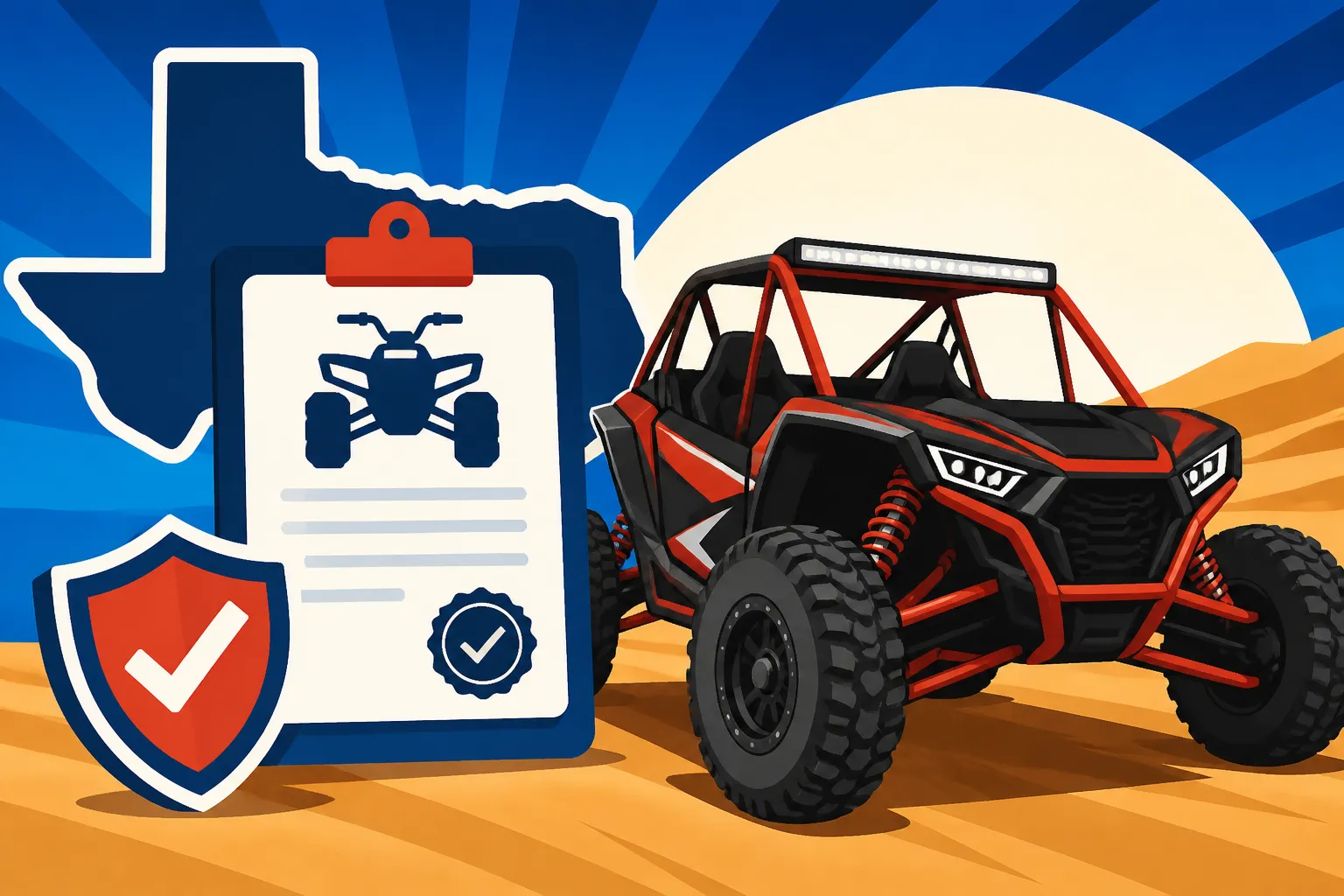
Even if your sand rail started life as parts from a street-legal vehicle, once assembled into a custom, off-road specific configuration, it changes its classification. The state isn't looking at the individual components as much as the final assembled form and its intended use. Many custom-built machines, often affectionately called "buggies" or "rails," are fantastic for tearing up the sand or tackling rugged trails. The definition is broad enough to encompass a wide array of these specialized machines, ensuring that even unique builds can be properly titled. Texas has specifically outlined [Sand Rails on a Texas Title] as falling under this OHV umbrella.
Why Your Sand Rail Needs a Texas OHV Title
You might be thinking, "If I'm only riding my sand rail on private land or at designated off-road parks, do I really need a title?" The answer is a resounding yes. A Texas OHV title is more than just a piece of paper; it's your official proof of ownership. This is absolutely essential for several key reasons. Firstly, it protects you legally. If your sand rail is ever stolen, a title is paramount for reporting it to law enforcement and for potential recovery. Without a title, proving it's yours becomes incredibly difficult, leaving you vulnerable to theft and loss.
Secondly, a title is critical for transferring ownership. If you ever decide to sell your sand rail, the buyer will undoubtedly ask for a clean title. Without one, the sale process becomes complicated, often devaluing your machine and making buyers wary. It's the official record that links you as the owner to that specific vehicle identification number (VIN). Thirdly, some off-road parks or organized events might require proof of ownership, and a title serves that purpose. While Texas does not register OHVs for road use, a title is still the foundational document for your machine. Think of it as the birth certificate for your sand rail; it establishes its identity and your legal claim to it.
Your Comprehensive Guide to Titling a Sand Rail in Texas
The process of titling an off-highway vehicle in Texas is primarily handled through your county tax assessor-collector's office. While it might seem daunting, breaking it down into manageable steps makes it much clearer. The key is to arrive prepared with all necessary documentation.
Essential Documents You'll Need to Gather
Being prepared is half the battle when dealing with any government office. For titling your sand rail, you'll need a specific set of documents. The absolute cornerstone is the Texas Application for Texas Title and/or Registration, commonly known as Form 130-U. This form requires detailed information about your sand rail and yourself. You'll also need proof of ownership. If you bought your sand rail from a dealer, this would be the manufacturer's statement of origin (MSO) or a properly assigned title. If you bought it from a private seller, you'll need a bill of sale that clearly identifies the sand rail by its VIN and states the purchase price. A robust bill of sale from a reputable source like LawDepot can be invaluable here, especially for private transactions.
Here's a list of commonly required documents:
| Document Type | Description | Notes |
|---|---|---|
| Form 130-U | Application for Texas Title and/or Registration. | Must be completely filled out, signed, and dated. Available online from TxDMV or at the county office. Filing at the Tax Assessor-Collector discusses this form. |
| Proof of Ownership | Manufacturer's Statement of Origin (MSO), previous title (if applicable), or Bill of Sale. | For a used sand rail, a properly assigned previous title is ideal. For new or homebuilt, an MSO or bill of sale is crucial. |
| Bill of Sale (if applicable) | Details seller, buyer, purchase price, date, and VIN. | Essential for private sales, especially if no previous title exists. Ensure it's clear and detailed. You can find templates on platforms like LawDepot. |
| Photo ID | Current, valid driver's license or state-issued identification. | To verify your identity as the applicant. |
| Proof of Inspection | If required (typically for road-legal vehicles, usually not OHVs, but always good to confirm locally). | Generally not needed for OHVs, but check with your specific county as rules can vary slightly. |
| Evidence of Sales Tax Payment | Receipt from a dealer, or proof of payment to the Texas Comptroller if bought out of state or privately. | Texas sales tax (or use tax for out-of-state purchases) is typically due. |
For a homebuilt sand rail, proving ownership can be trickier, often requiring a statement of facts, receipts for major components, and potentially a special VIN assignment process through TxDMV before you even get to the titling step. Always call your local county tax office first to confirm their specific requirements for homebuilt vehicles, as this can vary. Knowing the requirements beforehand for [Documents to Bring for a First Title] can save you a trip.
Navigating the County Tax Assessor-Collector's Office
Once you have all your paperwork in order, your next stop is the county tax assessor-collector's office in the county where you reside. This is the local hub for all vehicle titling and registration matters, including OHVs. It's not the TxDMV directly, but rather their local partner that handles these transactions. I highly recommend calling ahead or checking their website for current hours and any specific appointment requirements. Some offices, especially in larger metropolitan areas, might require you to book a time slot to avoid long waits. This is a common frustration, so planning ahead is key.
When you arrive, you'll present your completed Form 130-U, your proof of ownership, and your identification. The clerk will review your documents for accuracy and completeness. This is where attention to detail on your part pays off; any missing signatures, incorrect VINs, or incomplete sections on the 130-U can lead to delays or rejection. Be prepared to pay any applicable title fees and sales tax at this time. The process is generally straightforward for most OHVs, but sand rails, being somewhat unique, might sometimes prompt extra questions from the clerk. Simply be patient and provide the information requested. They are just following their procedures. Further details can be found under [Titling at a Texas County Tax Office].
Special Considerations for Homebuilt or Previously Untitled Sand Rails
Titling a sand rail that you've built from the ground up or one that has simply never had a title can add a few extra steps to the process. For homebuilt machines, the biggest hurdle is establishing a verifiable VIN. If your frame doesn't have a factory-assigned VIN, you will likely need to go through the TxDMV's process to obtain an assigned VIN before you can even apply for a title. This involves an inspection to ensure the machine is properly constructed and to verify its identity. This can be a separate application process and might require bringing your sand rail to a TxDMV regional office or a designated inspection station.
For a sand rail that's used but has no previous title, the situation is similar to a homebuilt. You'll need substantial proof of ownership, often including a notarized bill of sale, a statement of facts explaining why there's no title, and potentially receipts for major components. The county clerk may ask for additional documentation or require a VIN verification, especially if there's any doubt about the machine's origin. In some cases, if the chain of ownership is unclear, you might even need to pursue a bonded title, which is a more complex legal process. Be upfront and honest about the sand rail's history, and gather as much supporting evidence as you possibly can. This extra diligence helps in [Getting a First Title for a Never-Titled Quad] or a sand rail, for that matter.
Understanding the Costs and Common Hurdles in the Titling Journey
Beyond the paperwork, understanding the financial aspects and potential challenges can make your titling experience much smoother. It's not just about the title fee; there are other costs and common issues that can arise.
A Breakdown of the Expected Fees
When you title your sand rail in Texas, you'll encounter a few specific fees. The primary one is the title application fee itself. This is a state-mandated fee that covers the administrative cost of processing your application and issuing the new title. In addition to this, Texas imposes sales tax (or use tax if purchased out of state) on the purchase price of your off-highway vehicle. This is usually 6.25% of the sales price, and you'll pay this directly at the county tax office unless it was collected by a Texas dealer at the time of purchase. Even if you bought the sand rail used from a private party, you're still responsible for paying this sales tax based on the purchase price.
It's also worth noting that if you request an off-highway vehicle license plate (which is optional for OHVs not used on public roads, but sometimes desired), there's a separate fee for that. This plate, however, is capped by statute at a very low cost, typically a nominal fee that remains the same across counties. Some counties may also have small administrative fees. It's always a good idea to contact your specific county tax office beforehand to get a precise breakdown of the current fees, as totals can fluctuate slightly depending on local processing charges. Knowing the general [Texas ATV Title Cost] will help you budget effectively.
Preparing for Potential Application Issues
Even with all your documents in order, you might encounter some common issues. The most frequent problem is incomplete or incorrect paperwork. A single missed signature, an improperly filled-out section on Form 130-U, or an unclear bill of sale can lead to your application being rejected. For sand rails, clerks might be less familiar with the specific vehicle type, leading to more scrutiny. Ensure your VIN is clearly visible and correctly transcribed on all documents. If the VIN on your bill of sale doesn't exactly match the VIN on the machine, you've got a problem. [What a County Clerk Rejects on a Title Application] often comes down to these small details.
Another potential hurdle is proving the value for sales tax purposes, especially if you bought your sand rail for a very low price or it was gifted. Texas has rules to prevent tax evasion, so if the stated purchase price seems unusually low, the county might assess the tax based on a fair market value rather than your stated price. Be prepared to justify your purchase price with an appraisal or comparable sales, if necessary. For homebuilt machines, be ready to provide a list of major components and their costs to help establish value. Patience and politeness go a long way in resolving these issues.
The Benefits of a Properly Titled Sand Rail
While the titling process might feel like a chore, securing a proper Texas OHV title for your sand rail offers significant benefits that far outweigh the effort. Foremost, it solidifies your legal ownership. This isn't just about avoiding legal headaches; it's about having peace of mind that your substantial investment is officially recognized as yours. It protects you from claims of prior ownership and acts as undisputed evidence in case of theft or dispute.
Furthermore, a clean title dramatically simplifies future transactions. When you're ready to upgrade or move on from your sand rail, having that title in hand makes the sale smooth and efficient. Buyers are far more confident purchasing a titled machine, knowing they won't inherit any ownership issues. This often translates to a better resale value for your sand rail. Finally, while Texas OHV titles do not enable street legal registration, they do provide the necessary legal foundation for your off-road adventures, ensuring you're compliant with state regulations concerning vehicle ownership, even if you never put a wheel on a public road.
Disclaimer
This article is for general informational purposes only and does not constitute professional advice. Laws, prices and regulations vary by location and change over time. Consult a qualified professional for guidance on your specific situation.