Riding to a Deer Blind Before Dawn
A pre-dawn ride to a deer blind can feel routine until a dark trail, a narrow ranch road, or a short stretch of public pavement changes the risk. In Texas, where you may ride depends on who controls the land and whether your route uses a public road. This guide covers the legal checks, lighting, gear, and practical habits that make an early trip safer.
Check the route before you leave
Private land and lease roads are not the same as public roads
If your route stays on private property, get permission from the landowner or lease manager and find out which roads and trails you may use. A hunting lease may have its own rules about vehicle access, gates, speed, noise, and when machines can be driven. Permission to hunt does not automatically mean permission to ride anywhere on the property.
Ask about the exact route to your blind, not just general access. A ranch road may cross another owner’s land, pass through a closed pasture, or lead onto a public right of way. Mark the route in daylight, and make sure you know which gate to use. A route that seems obvious in the afternoon can be surprisingly difficult to follow before sunrise.
Private land also does not remove the need for care. Cattle, fences, ditches, washouts, and other riders may be hard to see in the dark. Follow the property’s speed and access rules, close gates as instructed, and avoid creating new tracks around wet or fragile ground. For more on access and permission, see [Texas Rules for Riding Private Land With Permission] and [Texas Rules for Riding a Hunting Lease].
Treat any public-road section as a separate legal question
A public road is not just another ranch trail. Texas generally restricts OHV use on public streets and highways, with limited exceptions. The fact that the trip is short, that you are traveling to a hunting spot, or that the road looks quiet does not by itself make riding there legal. Local rules and the road’s status can matter, too.
Before your trip, identify every place your route touches a public road, including a farm road, subdivision street, or paved crossing. If you cannot confirm that a specific exception applies to your situation, plan a route that avoids the road or transport the ATV or UTV by trailer. A brief shortcut can create a legal and safety problem that is much bigger than the extra distance around it.
For a closer look at the road-use limits and exceptions, read [Texas Rules for Riding After Dark], [Texas Rules for Riding a Farm Road], and [Texas Rules for Getting Across a Road]. Do not assume that a rule allowing a particular kind of daytime or agricultural use also permits a pre-dawn trip.
Confirm the destination’s rules, not just the route
Public hunting land, a privately managed lease, and a commercial riding area may all have different access rules. Some places restrict vehicles to marked routes, limit hours, or prohibit riding near hunting activity. A route that is allowed during a regular trail ride may not be allowed during hunting season.
Check with the land manager or property contact before you go. Ask whether your machine is permitted, where it can be parked, and whether there are restrictions on travel before sunrise. If you are riding on public land, check its current access rules directly rather than relying on a friend’s description from a prior season.
A little planning prevents the awkward moment of reaching a closed gate in the dark, or worse, arriving somewhere your machine should not be. [Texas Rules for Riding During Hunting Season] offers related context on how hunting activity can affect where and when riding is appropriate.
Make the machine visible and predictable
Check the lights before the trip
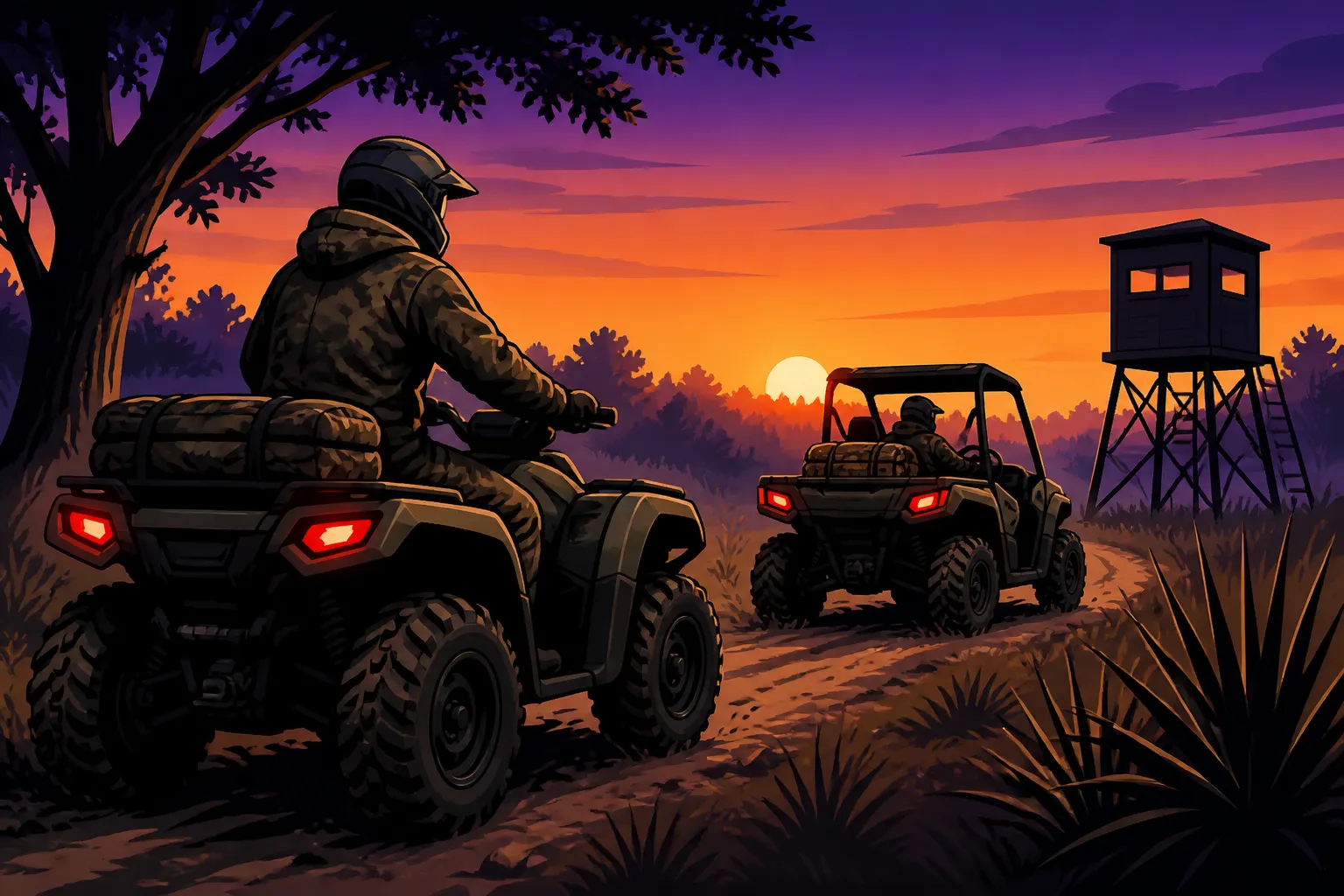
Before every early ride, test the headlights, taillights, and brake lights if your machine has them. Clean off mud, dust, or dried grass that could block a lens, and check that the battery is holding a charge. A light that worked in the garage may not be useful if it is aimed at the ground, pointed into treetops, or obscured by a dirty cover.
Do not count on an accessory light to make a restricted road route legal. Lighting requirements are only one part of the rules, and extra brightness does not replace permission or a legal exception. On private trails, choose a beam that helps you read the ground without washing out the view for another rider. If you are considering aftermarket equipment, SuperATV is one brand riders may encounter when looking at ATV and UTV accessories; check whether a product fits your exact machine and follow the landowner’s rules.
A quick pre-ride check is more useful than discovering a problem halfway to the blind. Switch on each light, have someone confirm that the rear lights work, and carry a small backup light for roadside or trail-side checks. For more detail on equipment, see [Texas Lighting Requirements for OHVs].
Keep the ride slow enough for what your lights reveal
A headlight shows only part of the terrain, and the useful distance may shrink on a winding trail, in dust, or in thick brush. Ride at a speed that lets you stop within the area you can clearly see. If you cannot identify what is ahead, slow down rather than assuming it is a rut, branch, or familiar landmark.
Leave extra space between machines. Dust from the ATV or UTV in front can reflect light back at you and make the trail harder to read. On a group ride, agree on simple signals and a stopping plan before leaving. Avoid following so closely that a sudden stop, animal, or washed-out section becomes a collision.
Do not use bright auxiliary lights in a way that blinds another rider or driver. If you meet someone coming the other way, slow down and give them room; switch off or redirect auxiliary lighting if it is causing glare. SuperATV may come up again when comparing accessory options, but the practical priority is a setup that helps you see without making the route harder for everyone else.
Think about what other people can see
A machine can be difficult to spot from the front, side, or behind, especially at dawn when the sky is brightening but the ground is still dark. Wear visible outer layers where appropriate, keep lights clean, and avoid stopping just over a rise or around a blind corner. If you need to pause, pull completely clear of the trail when you can do so safely.
At a trail entrance or property crossing, stop and look for other riders, vehicles, livestock, and people on foot. Do not assume that an empty-looking road is clear just because you cannot hear traffic. A quiet rural road can still have a fast-moving pickup or farm vehicle approaching.
A flag may be required in some riding areas, and some land managers set their own visibility rules. Check the specific site’s requirements before departure rather than assuming that one park’s rules apply to another. Visibility measures help, but they do not make an otherwise prohibited public-road trip permissible.
Prepare riders and machine for a dark start
Use the right protective gear and seating
Wear a properly fitted helmet and any other protective gear suited to your machine and terrain. In a side-by-side, use the seat belts and keep arms and legs inside the vehicle. On an ATV, ride only in the seating position the machine is designed for; carrying an extra person on a single-rider quad can put both riders at risk and may violate applicable rules.
Passengers should understand where to hold on, how to sit, and what to do if the vehicle stops. In a UTV, confirm that every person has a proper seat and restraint before moving. Do not let someone ride on a cargo bed, fender, or other improvised spot, even for a short trip to the blind.
Rules can differ by machine, road, and location, so check the details that apply to your ride. See [Texas Helmet Law for ATV Riders] and [Texas Passenger Rules on an ATV] for related guidance. A helmet and seat belt cannot prevent every injury, but they are basic protections that should not be skipped because the trip is familiar.
Inspect the vehicle before loading hunting gear
A pre-dawn trip is a poor time to discover a soft tire, weak battery, loose tie-down, or low fuel. Check tire condition and pressure, brakes, steering, controls, and the lights before loading. Make sure any hunting equipment is secured so it cannot shift, snag, or interfere with the driver.
Pack only what you can secure safely. A rifle, bow, or other hunting equipment should be transported in a way that complies with the applicable rules and does not block the driver’s view or access to controls. Keep firearms handled safely and separately from the business of navigating a rough trail. Do not rely on a passenger to hold loose gear in place over bumps.
If the vehicle has been sitting for a while, start it early enough to catch a problem before departure. Check the fuel level, and bring water, a phone, and a basic tool or recovery kit appropriate to the route. A short trip can take much longer if a machine gets stuck or will not restart.
Plan for fatigue, cold, and the return ride
Getting up early can make even an experienced rider less alert. If you are tired, cold, or distracted, give yourself more time and ride more slowly. Choose a driver who is rested and sober, and do not let the pressure to reach a blind before legal shooting light turn into rushed driving.
Bring a warm layer that will not interfere with controls or restraints. Check the weather and ground conditions, since rain can make clay, grass, and rutted tracks slippery. Tell someone where you are going and when you expect to return, especially if the property is remote or phone coverage is unreliable.
Plan the return trip as carefully as the ride in. Dawn can bring more people, vehicles, and wildlife onto roads and trails, while daylight may reveal hazards you could not see on the way out. If the route has changed because of mud, a closed gate, or hunting activity, stop and reassess rather than improvising a shortcut.
Build a simple pre-dawn routine
Do the route check in daylight when possible
A familiar route can look different in darkness. Walk or ride it in daylight beforehand if it is unfamiliar, and note turns, gates, steep grades, and places where the trail narrows. Save a map or offline directions if phone service may drop out, and do not assume a GPS line confirms that a trail is open or that you have permission to use it.
Tell your hunting group which route you intend to take and where you will park. Agree that everyone will stop if the lead machine stops, and decide what to do if the group gets separated. If you are riding alone, share your expected return time with someone who can check in if you do not arrive.
If a lease road has a locked gate or posted restrictions, do not bypass them. Contact the person responsible for access and get clear instructions. [Riding a Lease Road at First Light] is a useful related topic when planning access on ranch or lease property.
Follow a repeatable pre-ride checklist
A checklist reduces the chance that a small omission becomes a serious problem. Use the same sequence each time, even when you are in a hurry:
- Confirm permission, access hours, and the route to the blind.
- Check whether any part of the route uses a public road and verify that your planned use is allowed.
- Test lights, brakes, steering, tires, and fuel.
- Secure hunting gear and any loose equipment.
- Confirm helmets, seat belts, and passenger seating.
- Tell someone where you are going and when you expect to return.
- Ride slowly enough to stop within the visible trail.
A short checklist is especially helpful when several people are loading machines in the dark. One person can check the lights while another confirms that gear is secured; then the driver can make the final route and safety check. Do not let a group’s momentum pressure you into leaving before the machine is ready.
Know when to turn around
Turn back if the route is blocked, the lights fail, visibility becomes too poor, or you are unsure whether you are on permitted property. The same goes for a trail that has become slick, a creek crossing that looks different after rain, or a machine that is making an unfamiliar noise. Reaching the blind is not worth pushing into a situation you cannot judge safely.
If you discover that the only route requires an uncertain public-road section, park and contact the landowner or manager rather than guessing. A trailer may be the safer, simpler option. SuperATV accessories cannot replace a lawful route, sound judgment, or permission to cross private property.
The best pre-dawn ride is often the uneventful one: the machine is checked, the route is known, everyone is visible and restrained, and the group arrives without rushing. Keep the rules for your exact land and road in view, and make the decision to delay or turn around when conditions call for it.
Disclaimer
This article is for general informational purposes only and does not constitute professional advice. Laws, prices and regulations vary by location and change over time. Consult a qualified professional for guidance on your specific situation.