Proving You Paid the Comptroller
It’s a scenario many Texas off-highway vehicle (OHV) enthusiasts have encountered: you’ve finally purchased that dream ATV or UTV, you’ve gathered all your paperwork, and you head down to the county tax office, only to be told you’re missing something crucial – proof you’ve paid the state sales or use tax to the Comptroller. This oversight can derail your day, leaving you frustrated and confused about a seemingly straightforward process. This guide is here to unravel the mystery, explain why this proof is essential, and walk you through how to ensure you have everything you need before your next trip to the county counter.
Why Texas Requires Proof of Sales or Use Tax Payment
When you purchase an off-highway vehicle in Texas, whether it's a quad, a side-by-side, or even a sand rail, it's considered merchandise, just like a washing machine or a piece of furniture. And just like any other taxable item, it's subject to Texas sales tax. The county tax assessor-collector’s office, while handling the titling of your OHV, acts as an agent for the Texas Comptroller of Public Accounts to ensure these taxes are collected. This isn't just a formality; it's a critical step in the state's revenue collection process.
Think about it this way: the state wants its share of the transaction, and the titling process is the most reliable point to ensure that happens. Unlike on-road vehicles that often have specific motor vehicle sales tax rules, OHVs fall under the general sales tax provisions. This means the rules can sometimes feel a bit less intuitive if you're used to how cars and trucks are handled. The aim is to prevent situations where a sale goes unrecorded for tax purposes, particularly in private party transactions. It’s all about accountability and ensuring that the proper funds are remitted to the state treasury. For a deeper dive into this, you might find [Why Texas Taxes OHVs as Merchandise] insightful.
The County Office and the Comptroller's Role
Your local county tax assessor-collector’s office is where the rubber meets the road for your OHV title application. They are the frontline agents for the Texas Department of Motor Vehicles (TxDMV) when it comes to processing titles, but they also have a direct mandate to verify tax payment for the Comptroller. When you present your application, they're looking for confirmation that the sales tax (or use tax, if applicable) associated with your purchase has already been handled.
Without this confirmation, their hands are tied. They can't issue you a title or process the transfer because they haven't verified the tax component. It’s a checks and balances system designed to keep things orderly and ensure that state coffers receive what they're due. So, while you might feel like you’re just trying to get a piece of paper for your new toy, from the state’s perspective, it’s a tax-collecting event.
The Pivotal March 2020 Use Tax Rule
Before March 2020, the process for proving tax payment, especially for vehicles purchased out-of-state or in certain private sales, could sometimes be a bit more ambiguous. Many county offices might have allowed you to pay the sales or use tax directly at their counter when you submitted your title application. While this seemed convenient, it also created inconsistencies and sometimes delays in the Comptroller receiving their due.
The March 2020 rule change, specifically related to use tax, significantly tightened these requirements. It clarified that in many scenarios, particularly for out-of-state purchases or certain private transactions where sales tax wasn't collected by a licensed Texas dealer, the purchaser is responsible for remitting the use tax directly to the Texas Comptroller before presenting their title application to the county. This change was implemented to streamline tax collection and reduce the burden on county offices to act as primary tax collectors for these specific types of transactions. It essentially shifted the responsibility for proactive tax payment and proof onto the buyer. Understanding this rule is key to avoiding unnecessary trips and delays. You can learn more about its specifics in [The March 2020 Use Tax Rule].
How to Obtain Proof of Payment from the Comptroller
Navigating the tax payment process depends heavily on where and how you purchased your OHV. Each scenario has its own steps, and knowing them upfront can save you a lot of headache.
Dealer Purchases: When the Seller Does It For You
This is often the smoothest route. When you buy a new or used OHV from a licensed dealer here in Texas, they are generally responsible for collecting the sales tax from you at the time of purchase and then remitting it to the Texas Comptroller. Your proof of payment, in this case, will typically be clearly itemized on your purchase invoice or bill of sale from the dealer. This document serves as sufficient evidence for the county tax office that the sales tax has been handled.
However, if you're purchasing from an out-of-state dealer, the situation changes. Many out-of-state dealers won't collect Texas sales tax, even if you tell them you're taking the OHV to Texas. They're only responsible for their home state's tax laws. In these instances, you, the buyer, become responsible for paying the Texas use tax directly to the Comptroller. Don't assume an out-of-state dealer "took care of it" unless it's explicitly shown on an invoice as Texas sales tax collected on behalf of the Texas Comptroller. When dealing with out-of-state purchases, things can get a bit more intricate, so it’s worth reviewing [Titling a Quad With an Out-of-State Dealer Invoice].
Private Party Sales: Handling Sales Tax Yourself
This is where many buyers hit a snag. When you buy an ATV or UTV from a private individual in Texas, that seller is typically not collecting sales tax on behalf of the state. Therefore, the responsibility for remitting the sales tax falls squarely on your shoulders as the buyer. Many people mistakenly believe they can just show up at the county tax office with their [A Texas Bill of Sale for an ATV] and pay the tax there. While this was sometimes possible for specific scenarios before March 2020, it's generally not the case now.
For private sales, you need to proactively pay the sales tax directly to the Texas Comptroller of Public Accounts. This often involves visiting the Comptroller’s website or contacting their office to make the payment. You’ll need information from your bill of sale, such as the purchase price and date of sale. Once you've paid the tax, the Comptroller's office will provide you with a receipt or confirmation of payment. This is the document you will bring to the county tax assessor-collector along with your filled-out [Filling Out Texas Form 130-U for an OHV] and other required title transfer documents. To make sure your bill of sale is robust enough to provide all the necessary details for tax remittance, online services like LawDepot can be incredibly helpful for generating a comprehensive and legally sound document that covers all your bases. This is particularly important for demonstrating the true sale price, which is what the tax is based on. More on this topic can be found in [Texas Sales Tax on a Private Sale] and [Filing a Use Tax Return Yourself].
Out-of-State Purchases: The "Use Tax" Scenario
If you bought your OHV outside of Texas and are bringing it into the state for use, you owe Texas "use tax" on that purchase. Conceptually, use tax is like sales tax; it's designed to ensure that goods purchased outside the state but consumed or used within it contribute to the state's revenue. The tax rate is the same as the sales tax rate.
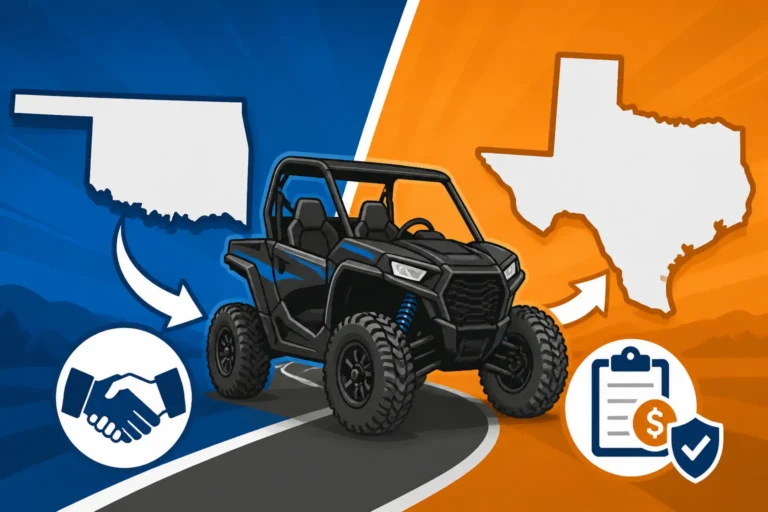
Similar to private party sales within Texas, the responsibility for remitting this use tax lies with you, the buyer. You must pay this tax directly to the Texas Comptroller of Public Accounts before you can successfully title your OHV at the county office. You'll typically do this through the Comptroller's website or by contacting them directly. Be prepared to provide purchase documentation, such as a bill of sale or an invoice from the out-of-state seller. Once paid, the Comptroller will issue you a confirmation or receipt, which is your crucial proof of payment for the county. For those who bought an OHV in a neighboring state, like a quad from New Mexico, understanding [Bringing a Quad Home From New Mexico] is vital. When drafting purchase agreements for out-of-state transactions, especially if you want to ensure all details are clearly laid out for Texas tax purposes, resources like LawDepot can assist in creating comprehensive documentation.
To help visualize these different scenarios, here’s a quick overview:
| Purchase Scenario | Who Collects/Remits Tax | Where to Get Proof of Payment | Key Document for County Office |
|---|---|---|---|
| Licensed Texas Dealer | Texas Dealer | Dealer Invoice/Bill of Sale | Itemized Dealer Invoice |
| Private Party (in Texas) | You, the Buyer (to Comptroller) | Comptroller's Payment Confirmation | Comptroller's Receipt + Bill of Sale |
| Out-of-State Dealer | You, the Buyer (to Comptroller) | Comptroller's Payment Confirmation | Comptroller's Receipt + Dealer Invoice |
| Out-of-State Private Party | You, the Buyer (to Comptroller) | Comptroller's Payment Confirmation | Comptroller's Receipt + Bill of Sale |
What Happens If You Don't Have Proof of Payment
The worst-case scenario isn't a fine right off the bat, but rather the immense frustration of being unable to complete your titling process. It’s a common pitfall that can turn an exciting day into a bureaucratic nightmare.
Rejection at the County Tax Office
Picture this: you’ve taken time off work, driven to the county tax assessor-collector’s office, waited in line, and finally get to the counter, only to be told, "I'm sorry, we can't process this without proof of tax payment from the Comptroller." This isn't the county clerk trying to be difficult; they are simply following established state procedures. The county office is explicitly instructed not to process title applications where the required sales or use tax hasn't been properly remitted or proven.
This means your title application will be rejected, and you’ll have to leave without your title. It's a delay that could stretch into days or even weeks, depending on how quickly you can rectify the situation with the Comptroller’s office. It can be particularly annoying if you've already paid the machine and just want to finalize ownership. Knowing [What a County Clerk Rejects on a Title Application] can help you prepare.
Steps to Take When You're Stuck
If you find yourself in this situation, don't despair, but do act quickly. Your immediate next step is to contact the Texas Comptroller of Public Accounts directly. You'll need to explain your situation, detailing when and where you purchased the OHV, and be ready to provide all documentation you have, such as your bill of sale or purchase invoice.
The Comptroller's office will guide you through the process of remitting the sales or use tax. They might direct you to an online portal, provide forms to mail in, or give you instructions for payment over the phone. Be prepared with your OHV's VIN, the date of purchase, and the agreed-upon sale price. Once you successfully pay the tax, the Comptroller will issue you the necessary proof of payment—a confirmation number, a printed receipt, or a letter. This is the document you absolutely must bring back to your county tax assessor-collector's office to complete your titling process.
To prevent getting stuck in the first place, or to help get unstuck, clear and comprehensive documentation is your best friend. Even for a private sale, a well-drafted bill of sale that details the buyer, seller, OHV description, VIN, and purchase price is essential. Online platforms like LawDepot offer templates for a [Texas Bill of Sale for an ATV] that can help you create a professional document, ensuring you have all the critical information needed when you interact with the Comptroller. Having this ready will make the process of proving your purchase details and remitting tax much smoother.
Disclaimer
This article is for general informational purposes only and does not constitute professional advice. Laws, prices and regulations vary by location and change over time. Consult a qualified professional for guidance on your specific situation.