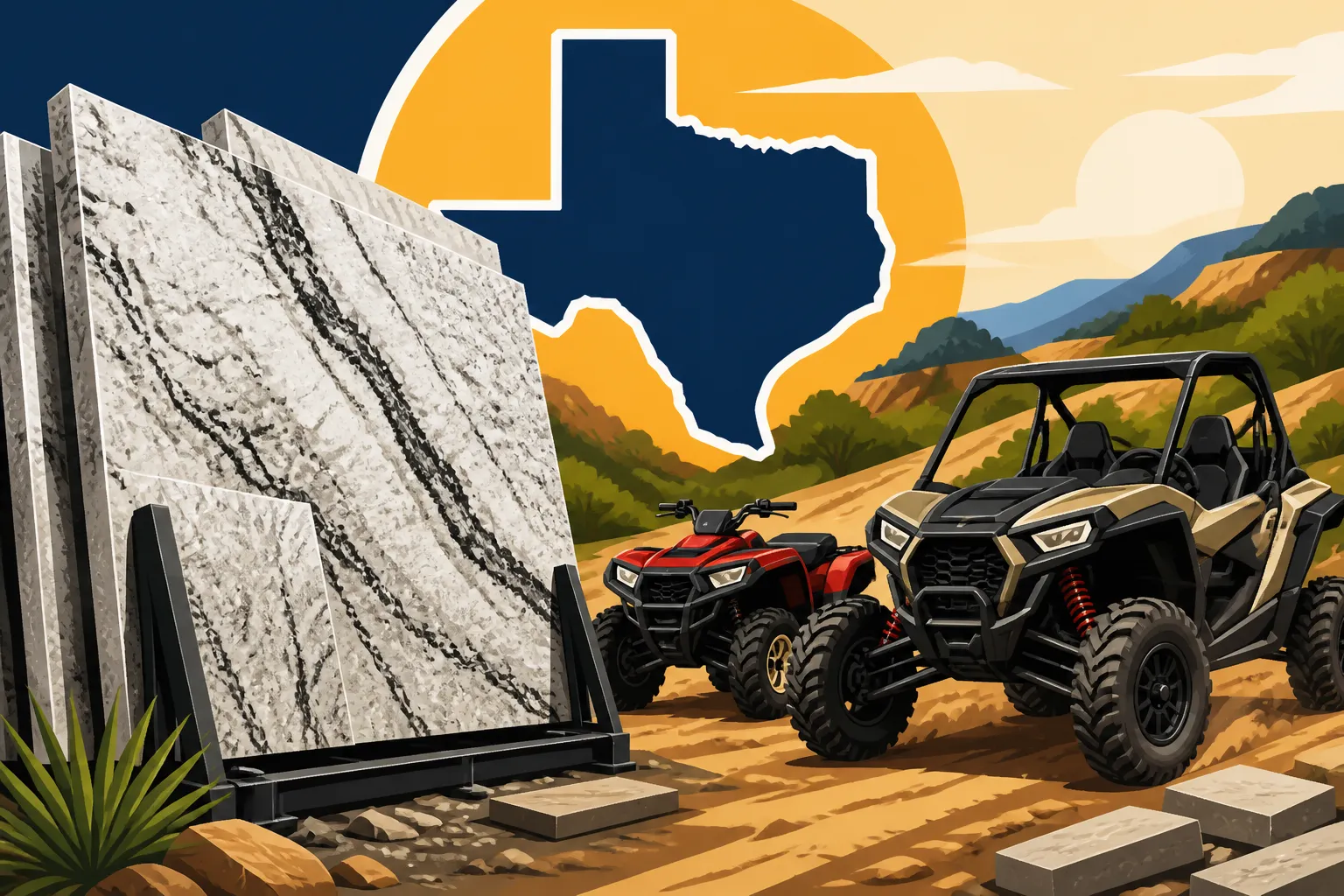
Granite Slabs in Mason County
Granite slabs can turn a Texas ATV or UTV ride into a careful exercise in tire placement, traction, and patience. In Mason County, the rocky Hill Country landscape is part of the appeal—but it also makes route choice and access planning especially important. This guide explains what to expect, how to prepare, and how to ride the area more safely.
What makes Mason County granite riding different
Expect exposed rock, ledges, and changing traction
Mason County’s granite terrain feels different from the loose sand, mud, and wooded trails riders may know elsewhere in Texas. Instead of simply following a defined track, you may be choosing a line across broad rock surfaces, easing over ledges, and adjusting for uneven transitions between stone and soil.
Granite can offer solid traction when it is dry and your tires are in good condition, but that does not make every slab predictable. Dust, loose gravel, damp patches, and worn tire tread can all change how a machine grips. A slope that looks manageable from the bottom may have a steeper break or an awkward landing near the top.
The terrain also puts more emphasis on speed control than horsepower. A short, steady climb in low range is often easier to manage than a fast approach that leaves you bouncing or searching for a line. If you are new to rock riding, begin with modest obstacles and watch experienced riders before trying a more technical route.
Treat route difficulty as a personal decision
There is no single difficulty rating that works for every rider. A route that feels comfortable on a short, light ATV may be challenging in a wider, heavier side-by-side. Tire condition, wheelbase, ground clearance, passenger load, and the driver’s experience all affect what a machine can safely attempt.
Before a group heads out, agree on a realistic pace and make it clear that anyone can bypass an obstacle. A rider should not feel pressured to follow a more experienced friend onto a ledge just because the rest of the group has climbed it. That pressure is a common way a fun ride turns into a damaged machine or an injury.
Use Texas Trail Difficulty by Park as a reminder to match terrain with your experience and equipment, rather than assuming a trail is suitable just because it is open to off-road vehicles. If you are comparing rocky destinations, Katemcy Rocks on an Open Date can also help you think through how a scheduled rock-riding area differs from casual, unplanned trail access.
Plan access before you haul the machine
Confirm whether the riding area is open
Granite country does not mean unrestricted riding. Land in the region may be privately owned or managed, and access can depend on permission, event schedules, operating rules, or specific open dates. Do not assume that a visible track, an old map marker, or a social media post means you can legally ride there today.
Katemcy Rocks is a named Mason County riding destination, but riders should confirm its current access arrangements directly before traveling. Check whether the area is open to visitors on your planned date, what types of machines are accepted, where to check in, and which areas are off limits. The post Katemcy Rocks and Its Scheduled Dates is a useful starting point for understanding why timing matters.
A mapping app can help with orientation, but it does not grant permission to cross private land. onX Offroad may help you review mapped routes and property boundaries while planning, but use that information as a planning aid—not as proof that a route is open or authorized. If a boundary or access point is unclear, stop and ask the land manager rather than guessing.
Check the rules for the land you are entering
Rules can vary between a privately operated riding area, public land, and a route that crosses more than one kind of property. Ask about check-in procedures, permitted riding zones, required protective equipment, noise rules, passenger limits, and whether any trails or obstacles are closed. The rules at the entrance are more important than assumptions based on how another park operates.
On private land, permission is the essential starting point. Texas Rules for Riding Private Land With Permission offers helpful context on why a landowner’s authorization matters. A Texas OHV decal requirement can depend on where you ride and whether the land has a particular public-land status; don’t assume a decal is either always required or never required simply because the terrain is off-road. For a broader explanation, see The Texas OHV Decal Explained.
| Planning question | What to confirm before leaving |
|---|---|
| Is the area open? | The date, hours, and visitor-access arrangements |
| Is your machine allowed? | ATV or UTV acceptance, width limits, and any machine restrictions |
| Where do you check in? | The entrance, parking area, and any required registration process |
| What safety rules apply? | Helmet, passenger, sound, and equipment requirements |
| Are routes closed? | Current closures, weather-related restrictions, and restricted zones |
| What do you need to bring? | Water, recovery gear, tools, emergency contacts, and required documents |
A little verification can prevent a long drive that ends at a closed gate. It can also keep you from accidentally riding onto land where you do not have permission.
Prepare your ATV or UTV for granite
Inspect the machine before the ride
Rock riding puts repeated stress on tires, wheels, suspension, skid plates, and undercarriage components. Before departure, check tire pressure and tread condition, inspect the sidewalls for cuts, and look for loose fasteners or damage underneath the machine. On a UTV, check that the belts, seat belts, and rollover protection are in good condition. On an ATV, make sure the controls and brakes feel normal before you start climbing.
Carry a basic repair and recovery kit suited to your machine and riding group. Depending on the trip, that might include a tire repair kit, a properly rated way to recover a disabled machine, gloves, a small tool kit, and drinking water. A winch can be useful on some machines, but having one does not make every obstacle safe to attempt. Recovery equipment needs to be used carefully, with people kept clear of tensioned lines and moving vehicles.
A quick pre-ride conversation can catch practical problems too. If a rider has never used a winch, explain the safe setup before the group reaches a difficult climb. If someone is driving a newly purchased UTV, give them time to learn its turning radius and braking response on easier ground.
Choose lines slowly and communicate clearly
Approach unfamiliar rock features at a controlled speed. Look at the full line—not just the first ledge—and decide where the machine will go after it reaches the top. If you cannot see the landing area, get out and inspect it from a safe position before committing. A spotter can help, but the driver should agree on clear hand signals or another simple way to communicate.
Keep people out of the vehicle’s direct path and away from the side where it could slide or tip. Avoid stopping on a steep or unstable surface if you can choose a safer staging point. If a machine starts to lose traction, avoid abrupt steering or throttle inputs that can make the situation worse. Backing out may be the sensible choice, even if another rider has already made the climb.
For the route itself, onX Offroad can be useful for organizing a planned track or checking your position against mapped features. Save important information before the ride if you expect weak cell service, and carry a backup way to navigate. A phone app should support good judgment—not replace attention to the terrain, posted directions, or a property manager’s instructions.
Ride responsibly in Hill Country conditions
Match the day to the weather and your group
Rock riding can be demanding even when the route is short. Heat, sun exposure, and the concentration required to pick lines can wear riders down faster than they expect. Start with enough water for everyone, take breaks before people feel depleted, and do not treat a shaded spot as a substitute for a proper hydration plan.
Rain changes the character of a ride, especially where dirt, clay, or loose material sits on top of exposed rock. A surface that seemed manageable in dry weather may become slippery, and low areas can hold water. Check conditions before you go and respect any closure or land-manager instruction. Texas Riding Seasons and Heat offers broader planning context for dealing with demanding Texas riding conditions, while Texas Trail Closures to Check First is a useful reminder to confirm that your destination and route remain available.
Keep children and less experienced riders on terrain suited to their skills. Give new drivers time to practice before attempting steep or uneven features. In a group, the most capable rider should not set the pace for everyone else; plan around the least experienced person and make sure the group can stay together without rushing.
Leave the area in good condition
Stay on authorized routes and avoid widening a trail to get around an obstacle. Driving around a difficult feature can damage plants and soil, create a new route that other riders may mistake for an approved trail, or take you beyond the permitted riding area. If a section looks beyond your ability, turn around rather than carving a new line.
Pack out everything you bring in, including food wrappers, broken parts, and tire-repair materials. Secure loose items in the vehicle before riding so they do not fall onto the trail. Keep noise under control near homes, ranch activity, and other visitors, and follow any instructions about gates, livestock, or restricted areas.
Before the group leaves, check that every rider and machine has made it back to the designated area. If someone is delayed, avoid sending one person off alone to search without a plan. Set a regrouping point, share route expectations, and make sure someone knows the day’s plan. For a destination with scheduled access, respect the operator’s check-out expectations as well as its entry rules.
Mason County’s granite can make for a memorable ride, but the best day is not the one with the boldest obstacle conquered. It is the one where your group chooses appropriate routes, respects access boundaries, and gets home with everyone and every machine in good shape.
Disclaimer
This article is for general informational purposes only and does not constitute professional advice. Laws, prices and regulations vary by location and change over time. Consult a qualified professional for guidance on your specific situation.