Direct Supervision by a Texas Certificate Holder
A child under 14 may be allowed to ride an off-highway vehicle on public land in Texas, but riding alone is not the same as riding under direct supervision. The supervising adult must meet the applicable certificate requirements, and the group needs a plan that keeps the child within safe, effective oversight. Here’s how to understand the rule and prepare for a ride.
Who Must Supervise a Rider Under 14
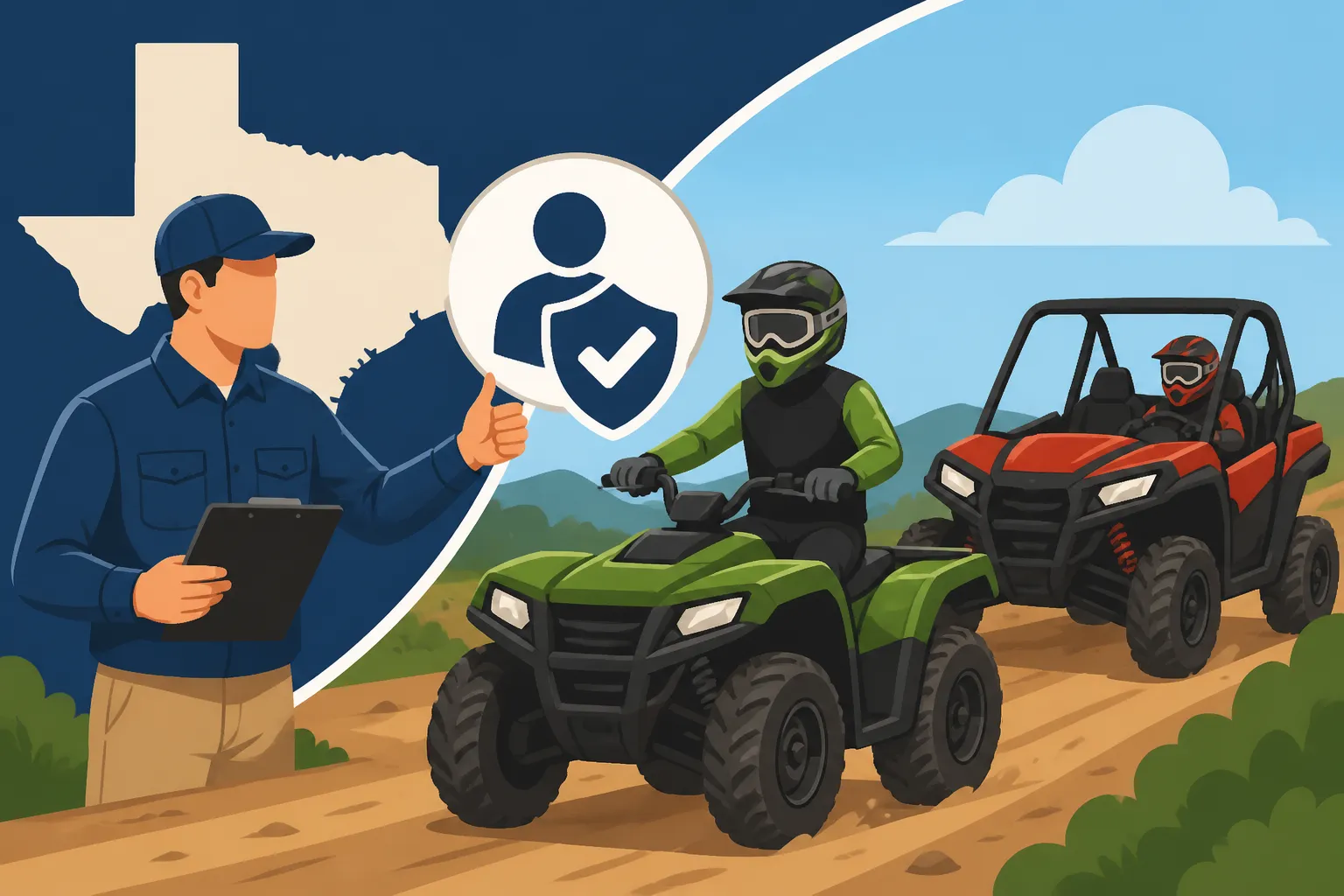
Texas requires a rider under 14 who operates an off-highway vehicle on public land to be accompanied by and under the direct supervision of a qualified adult. The adult must be at least 18 and hold an accepted OHV safety certificate. This requirement is about who supervises the child while they operate; it is separate from the rules about where a vehicle may be ridden.
The age threshold matters. The child is the operator, even if an adult is nearby, riding another machine or helping with the trip. A parent, relative, instructor or other responsible person can be the supervisor if they meet the age and certificate requirements and can provide real oversight. Being present at the trailhead or reachable by phone is not the same as directly supervising the ride.
A certificate does not transfer from adult to child. The supervising adult’s qualification lets them supervise; it does not make the child a certificate holder or remove the under-14 supervision requirement. Conversely, a child’s experience riding at home does not replace the required adult supervision on public land.
The state’s OHV rules apply in settings such as designated trails and other public riding areas where OHV use is allowed. Public land can have additional requirements set by its manager, so a supervisor should check both the statewide rules and the rules for the particular park, forest or recreation area. Start with Texas Rules for Riders Under 14 and Texas Rules for Riding Public Land when sorting out the age and location requirements.
This rule is not permission to ride any public road. Texas generally does not register OHVs for ordinary road use, and a safety certificate does not make an ATV or UTV street legal. Road access is governed by separate, narrow exceptions. For that issue, see Why Texas Will Not Register an ATV for the Road.
There are also requirements that may apply to every machine in the group, regardless of the rider’s age. For example, a state OHV decal and a land manager’s day-use permit or fee are not the same thing as a safety certificate. Check the riding area’s rules before setting out, and see Texas OHV Decal Requirement Explained for how the decal fits into the broader picture.
What Direct Supervision Should Look Like on the Trail
The important practical question is not simply whether the adult is somewhere on the property. Direct supervision means organizing the ride so the certificate holder can monitor the child and respond promptly if the child becomes confused, falls, gets separated or encounters a hazard.
Texas’s supervision requirement should not be treated as a universal distance rule. A fixed number of feet would not account for different terrain, visibility, speeds, traffic on the trail or a child’s riding ability. Instead, plan around continuous awareness and the ability to intervene. A winding trail, thick vegetation or a hill can block sightlines quickly, even when the adult and child started close together.
A useful approach is to keep the group small and the route manageable. The supervisor can ride ahead only when the child stays in view and can follow safely, or ride behind when that gives a better view of the child’s control and pace. If the trail bends, climbs or divides, regroup before the child is out of sight. Avoid sending the child ahead to find the group or letting them ride out of communication range.
The right position depends on the machine and the terrain. A UTV and an ATV have different handling and visibility, and a supervising adult may be more effective beside a child on a separate machine, behind them on a clear trail, or in an approved passenger seat when the vehicle is designed for passengers. Do not carry a passenger on a machine that is not built for one. A child riding as a passenger is also not the same situation as a child operating their own vehicle.
Before starting, agree on simple trail signals and stop points. A young rider should know to stop safely and wait if the adult is no longer visible, rather than continuing to search. The adult should know how the child will signal trouble and where the group will regroup if separated. Phones and radios can help, but they do not replace direct supervision: devices can lose signal, batteries can fail, and a child may not be able to explain their location under stress.
Keep the riding pace within the child’s ability. A supervisor who is racing ahead, focused on navigating or managing several other riders may not be able to supervise effectively. The adult also needs to be sober, alert and capable of responding. If the child is frightened, tired, overheated or struggling with the terrain, pause or end the ride rather than relying on the certificate as a substitute for judgment.
The Certificate: What It Does and What to Check
The certificate is evidence that the supervising adult completed an accepted OHV safety education course. It does not guarantee that the person knows every trail’s hazards, that a particular machine suits a particular child, or that the ride is safe under current conditions. The adult remains responsible for making sensible decisions and following the land manager’s rules.
Texas’s OHV safety education requirements are distinct from a driver’s license and from the vehicle’s title or plate. They are also distinct from a park admission ticket or an OHV decal. A rider might need to meet more than one requirement during the same outing. The overview at [Texas OHV Safety Certificate Requirements] explains how the certificate requirement fits with the rules for young riders.
If the adult completed a course outside Texas, do not assume the card is automatically invalid or automatically accepted. Texas recognizes qualifying certificates issued by other states, but the certificate must be the kind that meets the applicable OHV safety requirement. Check the issuing state, the course type and the proof the adult has available. Certificates Issued by Another State covers the reciprocity question.
A certificate from a course that is unrelated to OHV operation may not serve the same purpose. Likewise, a receipt, registration confirmation or a photograph of a course brochure is not necessarily proof of completion. Keep the actual certificate or acceptable documentation available during the ride. See Carrying the Certificate on a Texas Ride for practical guidance on having proof ready.
If the adult still needs a qualifying course, use the current information for Texas’s approved rider education options rather than relying on an old listing or an informal online resource. Course availability and enrollment details can change. Where to Take a Texas ATV Safety Course is a useful next step.
A certificate holder who is supervising should be able to explain the basic safety rules to the child, not just produce a card. Before riding, cover the controls, braking, throttle, turning, stopping, trail signs, safe following distance and what to do if the machine stalls. For a UTV, review seat belts and the vehicle’s passenger setup. For an ATV, explain how body position and speed affect handling. A course provides a foundation; the adult still needs to match instructions to the child’s machine and the conditions.
Preparing the Child, the Machine and the Ride
Good supervision starts before the engine is on. An adult can reduce the chance of a preventable problem by choosing a suitable route, checking equipment and setting clear expectations. This matters especially for a new rider, a child moving up to a larger machine, or a family visiting an unfamiliar riding area.
Match the route to the child
Choose a trail the child can manage without pressure to keep up with faster adults. Consider surface, slope, turns, visibility, traffic, obstacles and the distance to a safe stopping area. A short beginner-friendly route is often a better first outing than a long loop with no easy exit. Ask the land manager about trail difficulty and closures, and do not treat a trail’s label as a guarantee that it will suit every rider.
Weather and ground conditions can change a route’s difficulty. Mud, loose sand, dust, heat and recent rain affect traction and visibility. If a trail is closed or conditions exceed the child’s ability, turn around. An adult who is directly supervising needs to be willing to change the plan even when the group has travelled a long way to ride.
Check the vehicle and protective equipment
The child should be using a machine appropriate to their size, strength and experience. A machine that is too powerful or too large can be difficult to control, while an ill-fitting helmet or controls the child cannot reach can undermine safe operation. Follow the manufacturer’s age and size guidance, and check the machine before each outing.
Inspect the brakes, throttle, tires, steering, controls and fuel or battery system. For a UTV, check seat belts and make sure passengers have manufacturer-designed seating. Make sure the vehicle is not carrying more people than its seating arrangement allows. Explain what to do if a warning light appears, the machine behaves strangely or the child loses control.
Use properly fitted protective equipment appropriate for the machine and riding area. A helmet is central, but it is not the only consideration: eye protection, gloves, sturdy footwear and suitable clothing help address common trail hazards. Check the specific riding area’s equipment requirements as well. A supervisor should confirm that the child can see clearly, reach the controls and move comfortably in their gear.
Set a simple riding plan
Before the ride, tell the child where the group is going, how fast to travel, when to stop and what to do if separated. Keep instructions short enough for the child to remember. A basic plan can include:
- Stay where the supervising adult can see you, and do not pass the adult unless told to.
- Stop in a safe place if you lose sight of the adult, then wait for instructions.
- Do not leave the marked route or follow another group.
- Signal or stop if the machine has a problem, you feel unwell or you are unsure what to do.
- Do not ride again until the adult checks the situation and gives permission.
These steps do not replace the legal requirement. They make it easier to carry out the supervision the rule calls for. The adult should also identify a meeting point, carry basic emergency supplies and know how to contact the riding area’s staff if help is needed.
Common Mistakes and Questions to Resolve Before Riding
A frequent mistake is assuming that a supervising adult only needs to be present somewhere nearby. A person at the campground, parking area or another part of the trail system cannot directly supervise a child who is operating elsewhere. The adult needs to be part of the ride and able to monitor the child.
Another mistake is treating the certificate as a pass for the entire family. The certificate belongs to the person who completed the course. If one adult holds it and another adult takes over supervision, the replacement supervisor must independently meet the applicable requirements. Do not split the group in a way that leaves the child under the care of an unqualified adult.
It is also easy to confuse age rules with vehicle rules. A child’s age may affect supervision requirements, but it does not establish that the child can safely operate every machine. Follow the manufacturer’s guidance and the riding area’s requirements, and choose a machine and route the child can actually control.
Finally, do not assume that a private-property ride and a public-land ride are governed identically. The state public-land certificate and supervision rules described here concern operation on public land. Private property may have different legal requirements, but permission to ride there does not remove the need for safe, responsible adult oversight. If a trip includes both public and private areas, identify where the boundaries are and which rules apply before the child starts riding.
Before leaving home, confirm three things with the riding area: whether the route is open to the machine, what permits or decals are required, and what safety or age rules the land manager adds. Then make sure the adult who will supervise has an accepted certificate and can keep the child within effective oversight for the whole ride. If any of those pieces is uncertain, resolve it before unloading the machines.
Frequently Asked Questions
Can a parent supervise a child without an OHV certificate?
A parent or guardian does not qualify solely because of their relationship to the child. For the public-land rule, the supervising adult must meet the applicable age and certificate requirements.
Does the child need to hold the adult’s certificate?
No. The adult’s certificate qualifies that adult to supervise; it does not belong to the child and does not remove the supervision requirement for a rider under 14.
Can a certificate from another state count?
A qualifying out-of-state OHV safety certificate may be accepted in Texas. Confirm that the course and certificate meet the applicable requirement, and carry proof of completion.
Is a safety certificate the same as an OHV decal?
No. A safety certificate relates to rider education and supervision. An OHV decal or land-use permit is a separate requirement, and the rules depend on where the machine will be ridden.
Does direct supervision mean the adult must ride the same vehicle?
Not necessarily. The adult must be able to supervise the child’s operation effectively. That generally means staying involved, maintaining awareness and being able to respond—not merely being somewhere on the property.
Disclaimer
This article is for general informational purposes only and does not constitute professional advice. Laws, prices and regulations vary by location and change over time. Consult a qualified professional for guidance on your specific situation.