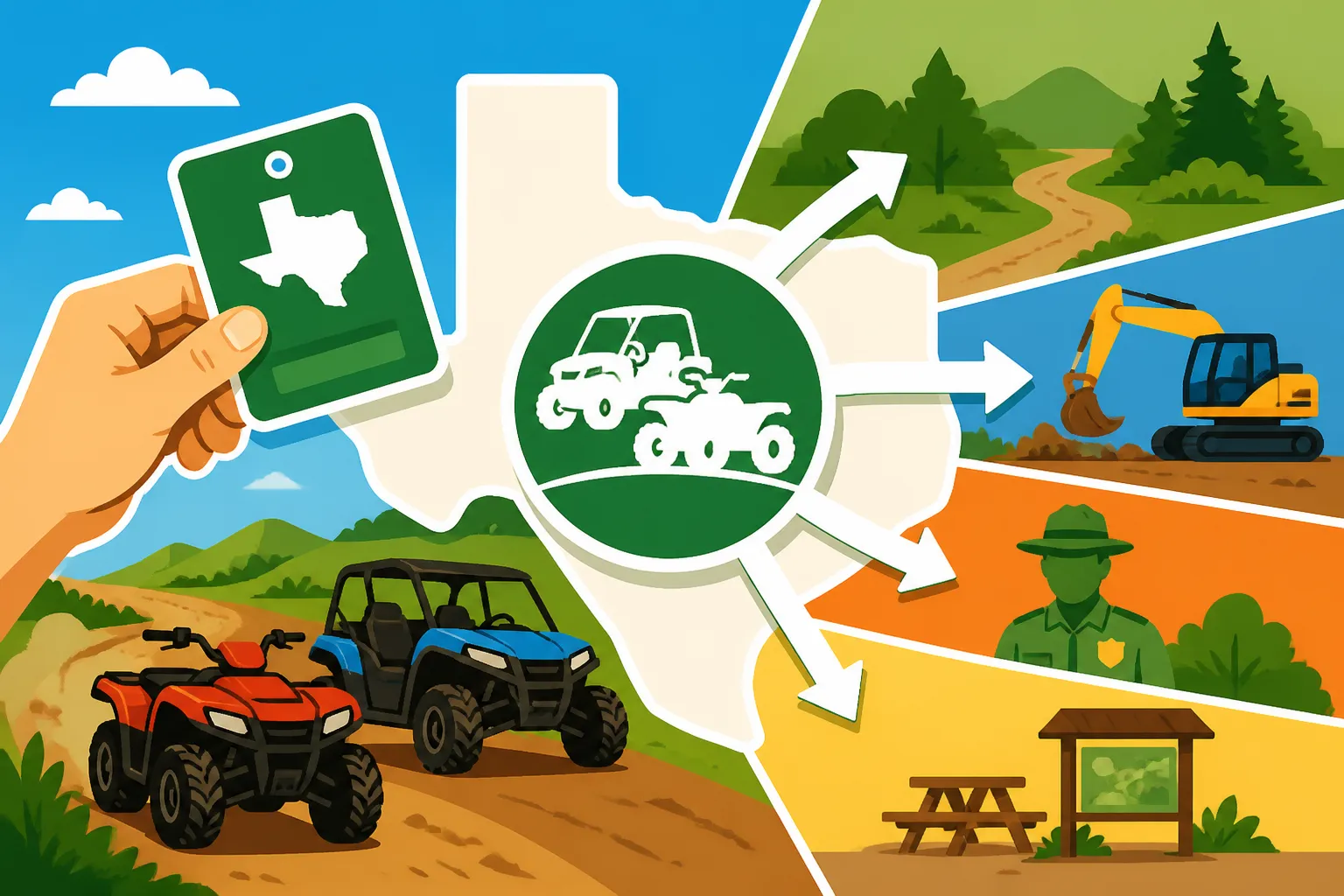
Where Texas OHV Decal Money Goes
Texas riders see the OHV decal requirement, but the sticker can feel like just another charge when you are planning a ride. The useful question is what that money supports, who controls it, and whether the park you visit benefits. Here is how the funding system works, what it can pay for, and how to check the rules and fees that apply to your next trip.
The short answer: decal money supports OHV recreation
Texas’s OHV decal program is intended to support off-highway vehicle recreation, not to register a machine for ordinary road use. Money associated with the decal program helps fund eligible projects and services for OHV riding, including grants that can help public and nonprofit organizations provide places and facilities for riders.
That does not mean every dollar you pay at a trailhead goes into the decal program, or that every OHV park receives a share. The decal is one part of a broader system. A land manager may also charge its own admission or camping fees, receive grant funding from other sources, or operate without an OHV grant.
The decal requirement also depends on where and how a machine is being used. It is not a general state registration sticker, and a rider should not assume that buying one grants access to every public property. Before a trip, check both the decal rules and the site’s separate entry requirements. The Texas OHV Decal Explained covers the decal itself, while Where a Texas OHV Decal Is Required helps distinguish the places where it matters.
| Payment or requirement | What it generally does | What it does not automatically do |
|---|---|---|
| Texas OHV decal | Supports the state’s OHV recreation program and helps meet the decal requirement where it applies | Provide universal access to public land or replace a site’s admission fee |
| Park admission or riding fee | Pays for access under that park or land manager’s rules | Count as a Texas OHV decal unless the program expressly says so |
| Camping charge | Pays for a campsite or overnight stay under the site’s system | Cover riding access or a separate decal requirement |
| National forest day-use fee or pass | Applies to the relevant federal recreation area and its fee rules | Replace the Texas OHV decal or other required credentials |
| Title or license plate charge | Relates to titling or the limited OHV plate system | Fund a regular vehicle registration for road use |
The practical takeaway is that the decal is a statewide program contribution, while access and services are managed at individual sites. A rider may need to budget for several distinct items for one outing.
How the funding system works
The decal program links riders’ required decal purchases with funding intended to improve or support OHV recreation in Texas. One of the main ways that support reaches riding areas is through grants. The Texas Parks and Wildlife Department administers the OHV program and its grant process, while the organization that owns or manages a particular riding area may be a different public agency or nonprofit.
That distinction matters. A state agency can administer a grant program without owning or directly operating every place that receives assistance. A local government, public land manager, or nonprofit organization may propose a project, receive support if it meets the program’s requirements, and then handle the work at the site. The state’s role is not necessarily to staff the gate, maintain every trail, or set that site’s day fee.
The Texas Parks and Wildlife Grant Program explains the grant framework in more detail. For riders, the essential point is that decal funding can help eligible organizations build or improve recreation opportunities, but the money is administered through a process rather than handed out automatically to every park.
Grants are project support, not a promise of free riding
A grant may help a land manager address needs such as trail development, trail maintenance, rider facilities, safety or education work, or other eligible recreation improvements. The kinds of projects that qualify depend on the program’s current rules and the specific grant opportunity. Applicants may need to show what they plan to do, who will benefit, how the project will be managed, and how they will meet the grant’s conditions.
A funded project can make a real difference without eliminating the site’s operating costs. A park may still need to pay for staff, insurance, equipment, utilities, waste removal, road upkeep, and routine repairs. A grant might cover only part of a project or apply to a particular improvement rather than the park’s entire budget.
For example, a grant could help a manager develop a marked route or improve a rider facility. That would not necessarily pay the ongoing cost of keeping the property open every day. The operator may therefore continue charging admission or camping fees, and may close trails when conditions or maintenance needs require it.
Funding is not necessarily a direct rebate to the rider
The benefit from decal money may be indirect. A rider may not see a separate discount at the gate, receive a credit for a particular trip, or notice an itemized decal-funded improvement during a visit. Funding may go toward planning, construction, repair, education, or other approved work that benefits a site or rider community over time.
The same is true when a project supports a place you have never visited. The program is intended to support OHV recreation broadly, so the location of a rider’s purchase does not necessarily determine which park receives support. It is better to think of the decal as contributing to a statewide recreation program than as buying admission to a particular trail system.
Administrative work is part of running a grant program
A grant system takes administration. Applications have to be reviewed, funding has to be tracked, and project conditions have to be managed. Do not assume that every dollar paid for a decal is spent immediately on trail construction, or that a public summary will show a simple one-to-one link between a particular purchase and a particular improvement.
If you want to understand what funds are available, what projects were supported, or what categories are eligible, look for the current program materials and grant information from the administering agency. The program’s rules, application cycles, and reporting details can change. For current specifics, use the official program information rather than relying on an old park post or a rider’s recollection.
What decal-funded support can mean on the ground
The word “funding” can sound abstract. For a rider, its value is easier to understand by looking at the kinds of needs a riding area may have and how assistance can contribute to them.
Trails and riding infrastructure
An OHV trail is more than a line on a map. It may need route planning, signs, barriers, drainage work, erosion control, surfaces that can withstand regular use, and repairs after storms or heavy traffic. A site might also need staging areas, parking, trailhead information, or facilities that keep vehicles and visitors in appropriate areas.
Funding can help an eligible manager address some of these needs. But trail work is highly site-specific. A rocky route, a sandy riding area, and a wooded trail system have different maintenance problems. Even a well-funded project cannot prevent every closure: wet soil, fire danger, unsafe conditions, or environmental protection needs can still make temporary restrictions necessary.
Rider facilities and visitor information
A safe, usable riding destination often depends on facilities that are easy to overlook until they are missing. Riders benefit from clear maps, route markers, information at the entrance, designated unloading areas, and facilities that help visitors understand where they may ride and what the site expects.
Some projects may support this kind of infrastructure or visitor communication if it fits the current grant rules. Good signs can reduce accidental wrong turns and help riders avoid sensitive or closed areas. They can also make it easier for a first-time visitor to understand which routes fit their machine and skill level.
Safety, education, and responsible riding
Funding may support eligible work that helps riders use OHV areas safely and responsibly. Depending on the program’s current criteria, that could involve education, safety-related improvements, or information that encourages compliance with site rules. It is important not to infer that every safety program or local riding event is paid for by decal proceeds. Funding eligibility is determined under the program, not by whether an activity sounds useful.
Riders can do their part by learning the rules before arriving, carrying required documents, and respecting marked routes. If you keep a paper copy of your riding credentials or trip details, a waterproof document pouch can be useful; Amazon is one place riders may look for basic storage gear, but any durable pouch that fits your needs will do. A pouch does not replace a decal that must be displayed on a machine, and it cannot make an otherwise prohibited ride legal.
Improvements do not guarantee a site will stay open
A grant can support recreation, but it cannot guarantee that a property will remain open indefinitely. Land ownership, budgets, environmental conditions, local decisions, and operating capacity all affect whether a site is available. A project’s completion does not mean that every trail will stay open in every season.
Likewise, a site may receive assistance and still have limited hours, capacity, or services. A rider planning a long drive should check the operator’s current status information before leaving, especially after heavy rain or during periods when fire or trail conditions can change quickly.
Why some parks benefit while others do not
A common misunderstanding is that buying a Texas OHV decal gives the rider access to every Texas OHV park or guarantees that the rider’s favorite park receives funding. Neither conclusion follows from the decal alone.
A park may be eligible for a grant but never apply. It may apply but not receive an award. It may receive support for one project while covering other costs through admissions, donations, memberships, local budgets, or other grants. The application process and available funding can affect which projects move forward.
A property’s ownership and operating structure also matter. Some sites are managed by government agencies; others are run by nonprofits or local organizations. Their budgets, staff, maintenance responsibilities, and ability to apply for funding may differ. A grant does not make the state the operator of the site, and it does not necessarily give the state day-to-day control over the trails.
Why Texas Funds Parks It Does Not Run explains this separation between state support and local operation. It is a useful distinction when a rider wonders why a park has a state-related funding source but still sets its own admission rules or posts its own closures.
A grant award is not the same as a standing operating subsidy
A project grant generally has a defined purpose. It may help with a particular improvement, rather than covering all ordinary expenses year after year. If the park needs money to maintain a facility after the project is complete, the operator may need to use other resources.
This is one reason that grant-funded locations may still charge visitors. An admission fee can help cover day-to-day expenses that were not part of the grant, or that continue after the funded work is completed. A site’s fee structure should be checked with the operator; the decal payment does not automatically entitle the rider to a free visit.
Not every place where ATVs are used is an OHV recreation site
A machine may be used on private property, a ranch, a hunting lease, or a work site without that location functioning as a public riding area. Private land use and public recreation access are different situations. A decal does not create permission to enter someone else’s land, and a private property owner does not become part of the grant system simply because riders use OHVs there.
Likewise, a publicly accessible road or property is not necessarily an OHV trail. Access depends on the land manager’s rules, the type of land, and the applicable laws. For information on where the decal is relevant, start with Where a Texas OHV Decal Is Required, then confirm access directly with the land manager.
Check a park’s funding history carefully
If you want to know whether a particular property has benefited from the program, look for official grant announcements or project information from the administering agency and the site operator. Search by the park’s exact name and, if available, by the managing organization. A rider forum post can point you toward a question, but it may be outdated or confuse a state grant with another funding source.
Texas Lands That Received an OHV Grant is a relevant place to start when researching examples of grant-supported lands. Still, a past award does not necessarily describe a site’s current budget, status, or access rules. Confirm the property’s current information before making plans.
What the decal does not pay for or replace
Understanding the limits of the decal prevents two common surprises: expecting a single purchase to cover every fee, and assuming that the sticker provides permission to ride anywhere.
It is not a park pass
A decal is not automatically an entry pass, membership, campsite reservation, or ticket for an organized event. Individual operators may charge for access and set separate rules for reservations, camping, vehicles, and visitors. Some may offer memberships or other passes; whether those options save money depends on how often you visit and what they include.
If you are comparing the decal with a park fee, treat them as separate lines in your trip budget unless the site’s official instructions clearly say otherwise. Texas OHV Decal Cost discusses the decal’s cost structure, while the park or land manager is the right source for its own current charges.
It is not the same as a federal land fee
Some federal recreation areas have their own day-use fees, passes, permits, or other conditions. A Texas OHV decal does not replace those federal requirements. Conversely, paying a federal fee does not necessarily satisfy the state decal requirement where that requirement applies.
The Sam Houston National Forest trail system is an example of why riders need to check requirements by location. Before heading out, confirm the trail’s current status, the applicable federal fee or pass rules, machine-width requirements, and Texas decal requirements. Texas National Forest OHV Fee and Does an OHV Decal Cover the Forest Day-Use Fee? address the difference between these costs.
It is not title, registration, or permission for road use
The OHV decal is different from an OHV license plate, a title, and ordinary motor-vehicle registration. Texas titling and plate rules have their own purposes and processes. A decal does not make an ATV or UTV road-legal, and an OHV plate is not a general substitute for road registration.
The decal also does not cure a title or ownership problem. A machine’s paperwork and its permission to be used on a particular trail are separate questions. For those issues, see Why a Texas OHV Plate Never Expires and Why Registration Is Not Available in Texas.
It does not override the land manager’s rules
Even with the required decal, a rider must follow posted rules and the site’s access conditions. A park can restrict certain machine widths, close routes, set hours, require helmets or other equipment, limit passenger use, or prohibit particular activities. Public land may have seasonal restrictions, and a trail can close when the ground is too wet or conditions are unsafe.
For practical planning, treat the decal as one requirement in a checklist, not as a permission slip for all sites. Confirm the operator’s current rules before loading the trailer.
How to check where the money went
If you want more than the general explanation, use a simple research process. This helps separate official program information from assumptions, and it is especially useful when a rider asks whether a specific park received support.
- Identify the exact site and operator. A riding area’s commonly used name may differ from the name of the agency or nonprofit that manages it. Find the operator’s official site or contact information.
- Look for the program’s current grant materials. The administering agency’s OHV program pages are the best starting point for current eligibility, application guidance, award information, and reports.
- Search the site name and managing organization. An award or project may be listed under the recipient organization rather than the trail’s familiar name.
- Check the date and project scope. A past grant may have funded a specific improvement, not current daily operations. Make sure you understand what the award covered.
- Ask the operator about the project. The site manager can clarify whether an improvement was grant-supported, what work was completed, and whether it affects current access.
- Confirm today’s riding conditions separately. Funding records do not tell you whether a route is open, whether a fee has changed, or whether reservations are needed.
A useful question to ask a park is not just, “Did you get decal money?” Try asking: “Was this trail or facility supported by an OHV grant, and are there current access restrictions I should know about?” That gives the operator room to explain the project and the practical details for your visit.
When reviewing a public grant document, look for the recipient, project description, location, and the period or stage of work. If an award is listed for a general recreation program, do not assume that it paid for every trail at the property. If you cannot tell whether a project has been completed, ask the operator rather than treating an award announcement as proof that the work is finished.
Keep your own trip costs organized
The decal is only one part of a riding budget. A useful trip checklist can separate state decal expenses from park admission, camping, fuel, equipment, and any federal fees. Keeping receipts and confirmation messages together can make it easier to resolve a question at the entrance or plan the next visit.
A small folder or waterproof sleeve can help protect printed confirmations and safety-course documents. Amazon may have basic options for document storage, but a zip pouch or folder you already own works just as well if it keeps papers readable and dry. You can also keep a simple phone note with the site’s official contact details and the date you checked its status.
For riders who make frequent trips, recording each park’s fee categories and required documents is more useful than remembering a single total. A cost can vary depending on whether you camp, bring multiple machines, use a day pass, or visit on a special event day. Check the operator for current figures rather than relying on an old receipt or online comment.
Ask about funding without assuming a direct discount
A park employee may be able to tell you whether a trail or facility received grant assistance, but they may not have a simple accounting of every decal dollar. The program’s funds are managed through grants and other program procedures, and a specific rider’s purchase is not normally tracked to a particular project.
If you are looking for a practical impact, ask about concrete outcomes: whether a route was developed or improved, whether signage was installed, or whether a facility is maintained under a grant-supported project. That gives you a more useful answer than expecting a line-by-line accounting of the decal revenue at the gate.
What riders should do before the next trip
Knowing where decal money goes is useful, but it does not replace trip planning. The best way to avoid a wasted drive is to check the decal requirement, the site’s own rules, and current conditions independently.
Before leaving, confirm:
- Whether your machine needs a Texas OHV decal for the location you plan to ride.
- Whether the site requires separate admission, a permit, a pass, or a reservation.
- Whether the trails are open and suitable for your machine’s size and type.
- Whether camping, fuel, or other facilities are available.
- Which safety rules apply to riders and passengers.
- Whether the land manager has posted weather-related closures or temporary restrictions.
If you have not bought a decal yet, use the official sales information to check where it is available and how it should be displayed. The decal requirement can be distinct from a park’s own check-in process. Where to Buy a Texas OHV Decal and Texas OHV Decal Renewal can help with the purchase and timing questions. When buying through a park or other seller, confirm whether the purchase method changes the documentation you should keep.
If you are riding at a place that may have received grant support, remember that funding does not guarantee that the trails are open on your chosen day. Conversely, the absence of a grant mention on a park’s website does not prove that the site has never benefited from the program. Look for current official information, and ask the site manager when the answer affects your plans.
Finally, keep expectations practical. The decal contributes to a program intended to support OHV recreation across Texas. Grants can help create and improve opportunities, but they do not turn every public property into a riding area, make every visit free, or replace the responsibilities of a local land manager. Treat the decal as one part of a larger system: it helps fund recreation, while individual sites still need to manage access, maintenance, safety, and costs.
For riders, that system works best when the funding side and the on-the-ground rules are both understood. Buy the required decal, verify the location’s separate requirements, follow posted restrictions, and check official information before you travel. That way, you know what your payment supports without expecting it to cover things it was never meant to cover.
Disclaimer
This article is for general informational purposes only and does not constitute professional advice. Laws, prices and regulations vary by location and change over time. Consult a qualified professional for guidance on your specific situation.