Flags Required on Every Quad at Meredith
A missing whip flag can turn an exciting ride at Lake Meredith into a frustrating trip back to the truck. At Rosita Flats, every quad needs its own clearly visible flag, not one shared by the group. This guide explains what to bring, how to mount the flag, and what else to check before riding in the Texas Panhandle.
Why every quad needs a flag at Lake Meredith
One flag per machine, not one per group
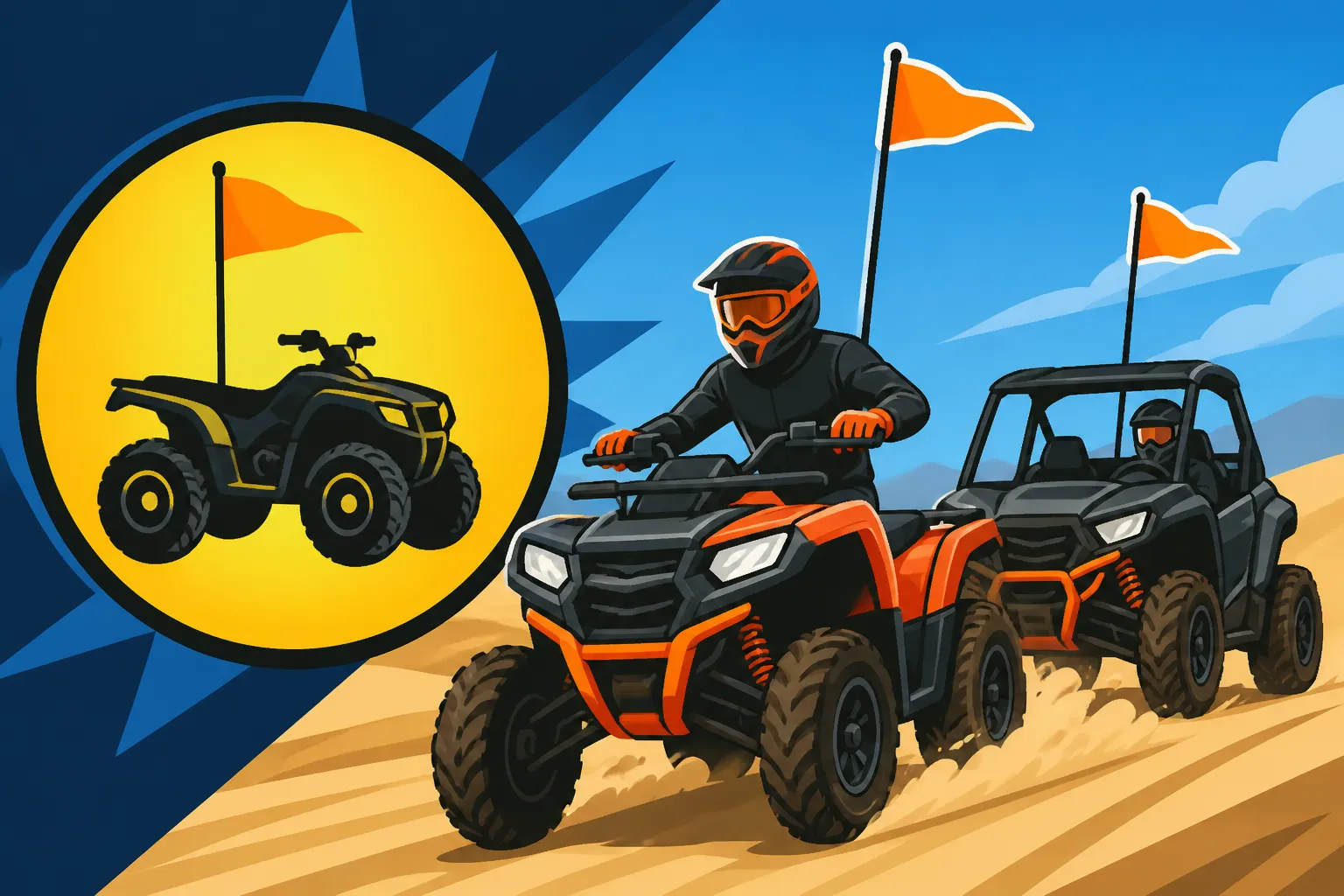
At Rosita Flats, plan on putting a safety flag on every quad. A flag attached to the lead rider’s machine does not make the rest of the group easy to spot. Riders can spread out, take different lines, or disappear briefly behind a rise. If one machine has no flag, other riders may not see it until they are close.
This matters especially on open, sandy terrain. A quad can drop out of view behind a dune or cross another rider’s path while both people are focused on the ground ahead. A tall, high-visibility flag helps other riders notice a machine sooner. It is a simple piece of gear, but it supports safer spacing and fewer unpleasant surprises.
Think about a family heading out with three quads. If they bring one whip flag and attach it to the adult’s machine, the two smaller machines remain harder to see. Check each quad individually before leaving the staging area. For a closer look at the location and riding context, see [Riding the Rosita Flats OHV Area].
A flag is a visibility aid, not permission to ride anywhere
A safety flag helps make a machine more visible. It does not make a closed route legal, give riders the right of way, or replace careful control. Stay within permitted riding areas and follow posted notices, barriers, and park directions. Rules for public land can differ from rules on private property, so review [Texas Rules for Riding Public Land] before you head out.
Also, do not assume that a flag makes it safe to ride over a blind dune at speed. Visibility works both ways: your flag can help someone see you, but the terrain may still hide what is beyond the crest. Approach rises cautiously, leave room between machines, and avoid following another quad so closely that you cannot respond if it slows or turns.
Choosing and mounting a whip flag
Look for visibility and a secure fit
Choose a high-visibility safety flag and a whip or mount designed to stay attached to your particular quad. Before the trip, check that the flag is easy to spot against the landscape and that the whip is not bent, cracked, or loose. A flag that has faded, torn, or become tangled may be less useful, even if it is still attached.
Mount the whip securely at the location recommended for the machine and the mount. The flag should remain visible while the quad is moving and should not interfere with the rider, controls, tires, or other equipment. Give the assembly a careful tug before riding. If it rotates freely, leans sharply, or slips out of place, fix the mount rather than hoping it stays put over bumps.
Follow the height and equipment requirements that apply to the riding area. Texas rules address whip flags, but a park may also post instructions for its site. Check [Texas Rules for Riding With a Whip Flag] and follow any more specific directions you encounter at Lake Meredith. Do not guess that a short antenna or a flag carried loose on the machine meets the requirement.
Check the flag before every ride
A flag can look fine in the garage and still be unreliable after transport. Tie-downs may press against a whip, a mount can loosen in the trailer, and a fabric flag can wrap around the pole. Add a quick inspection to your unloading routine: check the attachment, straighten the whip, untangle the flag, and make sure it can be seen from multiple directions.
If you are riding with children or newer riders, make this a shared pre-ride task. Ask each rider to point out the flag on their own quad and check that it is secure. That small routine is easier than discovering a missing flag after the group has already reached the trail. It also gives you a natural moment to confirm helmets, water, and other essentials.
| Before you ride | What to check | Why it matters |
|---|---|---|
| Each quad | Its own flag and whip | A group flag does not make every machine visible |
| Mount | Tight attachment with no obvious damage | Loose hardware can shift or come off during a ride |
| Flag | High visibility, untangled, and in usable condition | A folded or damaged flag is harder to spot |
| Height and setup | Compliance with park directions and applicable rules | Local instructions may be more specific |
| Riding area | Open routes and current notices | A flag does not authorize entry into a closed area |
Planning a Rosita Flats trip
Sort out permits and access before unloading
A flag is only one part of preparing for a Lake Meredith ride. Check the requirements for the area and make sure each machine has whatever permit or decal is required before you ride. The fact that a permit may be free does not mean it can be skipped. Review [Why Lake Meredith's Free Permit Is Still Required] and [The Lake Meredith Decal That Changes Color Each Year] so you know what to look for and can avoid a last-minute scramble.
Plan your route to the riding area as well. Road conditions, access points, and directions can affect how smoothly the day starts, particularly if you are towing a trailer. [Blue Creek and the Road In] and [Driving From Amarillo to Rosita Flats at Fritch] can help you think through the approach. Once there, follow signs and park instructions rather than relying on a map pin alone.
A navigation app can be useful for trip planning, but it should not replace posted closures or official directions. Some riders use onX Offroad to review mapped routes and orient themselves before setting out. You can also save useful map information before leaving areas with dependable cell service. Treat any digital map as a planning aid, not confirmation that a particular track is open or authorized.
Prepare for changing terrain and weather
The Texas Panhandle can feel very different from the driveway where you loaded the quads. Wind, heat, dust, and changing ground conditions can affect comfort and visibility. Carry enough drinking water for the group, bring eye protection, and consider how dust may affect the riders following behind. A flag improves visibility, but it does not prevent dust from limiting what you can see.
Check conditions before you travel and again before riding. Recent rain can make some routes unsuitable, while dry weather can mean loose, dusty ground. Respect closures and do not ride around a barrier just because a route looks passable. For practical reminders about conditions, read [Texas Trails After Heavy Rain] and [Texas Rules for Riding a Closed Trail].
Keep your group together without crowding. Agree on a meeting point, decide how riders will signal a stop, and make sure everyone knows not to leave the marked riding area to catch up. onX Offroad can help a group discuss a planned route in advance, but the safest choice is to follow park signs and instructions on the ground. If a route or junction is unclear, pause and confirm before continuing.
A practical pre-ride checklist
Do a machine-by-machine walkaround
Before the first ride, walk around each quad rather than assuming the group’s equipment is ready. Confirm that its flag and whip are attached, visible, and secure. Check tires, controls, fuel, and protective gear, too. If someone is borrowing a machine, ask them to point out the flag and explain how it is mounted before they head out.
A quick walkaround is particularly helpful when several people are unloading at once. One rider may be adjusting a helmet while another is searching for a missing strap, and it is easy for the flag check to get lost in the shuffle. Give one person responsibility for checking each machine, then have the rider confirm it. That simple double-check can catch a loose mount before it becomes a trail problem.
If you use onX Offroad to plan, save the map information you expect to need before you lose a reliable connection. Keep the app’s role in perspective: it can help with orientation, but it cannot tell you to ignore a closure or supersede park instructions. Bring whatever offline navigation and emergency supplies your group needs, and make sure someone knows the day’s plan.
Make the last check at the riding area
Once you reach the staging area, take a moment to look around for posted requirements and current notices. Confirm that every quad still has its own flag after the drive. A whip can loosen in transit, and a flag can become wrapped around itself while the machine is strapped down. Fix any issue before riding instead of promising to sort it out later.
Then review the plan with the group: stay within permitted areas, keep a safe distance, and stop somewhere visible if anyone needs help. If one rider turns back, make sure the others know rather than assuming everyone is following the same track. Good communication matters just as much as equipment when the group is spread across open terrain.
For more specific flag guidance, [Flags Required on Every Quad at Meredith] is a useful related topic to review alongside the park’s own posted directions. The central habit is straightforward: equip and inspect each quad separately, follow the required flag setup, and treat visibility gear as one part of responsible riding—not a substitute for paying attention.
Disclaimer
This article is for general informational purposes only and does not constitute professional advice. Laws, prices and regulations vary by location and change over time. Consult a qualified professional for guidance on your specific situation.