Riding 2 Miles From Where You Park
There's nothing quite as frustrating as needing to move your ATV or UTV just a short distance on a public road in Texas, only to feel like you're navigating a legal minefield. You might be at your deer lease, trying to get from your camp to a back pasture access gate a mile down a county road, or maybe you're at a friend's ranch, needing to cross a quiet street to reach another section of property. The common wisdom, or perhaps the rumor, often circulates about being able to ride "2 miles from where you park." But what exactly does that mean in the eyes of Texas law, and can you really rely on it? This guide is here to clear up that confusion and help you understand the very specific, and often misunderstood, exceptions for short-distance OHV travel on Texas roads.
The Core Rule: Why "2 Miles From Where You Park" Matters in Texas
Texas generally has a pretty firm stance: off-highway vehicles (OHVs) like ATVs and UTVs are not designed for, nor allowed on, public roads. This isn't just a suggestion; it's law, and it’s meant to keep everyone safe because these machines simply aren't built with the same safety features as street-legal vehicles. But, like many rules, there are very narrow exceptions that can sometimes feel like a lifeline when you just need to get your machine a short hop from point A to point B.
Understanding the Limited Road Use Exception
The idea of being able to travel "2 miles from where it is parked" comes from a specific legislative allowance. It's not a blanket permission slip to run to the corner store for a soda. Instead, it’s a highly conditional exception, primarily designed for situations where an OHV is being used for agricultural purposes, utility work, or in certain designated communities. For the average recreational rider, this exception is much more restrictive than many people realize.
Imagine you're at your private property, ready to hit a specific trail. The trailhead, however, is across a quiet, low-speed county road. The law acknowledges that it's often impractical to load up your machine onto a trailer for such a short hop. So, it carves out this small window, allowing a machine to briefly operate on a public road. The key here is "briefly" and "specifically." This isn't about convenience; it's about necessity under very controlled circumstances. Most importantly, this limited exception doesn't magically turn your OHV into a street-legal vehicle, nor does it override the general prohibition against operating them on most public roadways. For a deeper dive into why Texas is so strict, you can read [Why Texas Will Not Register an ATV for the Road].
The "Parking" Conundrum and What It Implies
When the law talks about "2 miles from where it is parked," what exactly constitutes "parked"? This isn't just about pulling over on the shoulder for a minute. Generally, "parked" in this context refers to a location where your OHV is stored or based, typically private property, a ranch, a lease, or a designated off-road park's staging area. It's the starting point of your very limited journey.
Let's say your hunting camp is just off County Road 123. Your UTV is parked right by your cabin. You need to access a deer stand that requires you to drive about a mile down CR 123 and then turn onto a private access road. In this scenario, your camp is "where it is parked." The two-mile limit starts the moment you pull out onto CR 123. It implies a direct, purposeful movement to an adjacent, contiguous, or nearby off-highway area. It absolutely does not mean you can park at a Wal-Mart and then cruise around town for two miles. The spirit of the law is to facilitate access to off-road areas or support specific work, not to expand recreational street use. This distinction is crucial, and misunderstanding it can lead to trouble.
Navigating the Specific Conditions for Short-Distance Travel
Even if your situation seems to fit the "2 miles from where you park" exception, you can't just hop on and go. Texas law lays out further conditions that must be met to legally utilize this very narrow window of road access. Ignoring these conditions means you’re essentially operating illegally, regardless of how short your trip might be.
Daylight Only and Speed Limits
One of the most critical conditions for this limited road use is that it must occur during daylight hours. Forget about those early morning or late evening trips to check on livestock or retrieve game; if you're on a public road, even for a short distance under this exception, it needs to be when the sun is up. This is a common-sense safety measure, as OHVs can be harder to see in low light conditions, and their lighting systems often aren't designed for road visibility.
Beyond daylight, there's also a strict speed limit caveat. The exception generally applies only to roads with a posted speed limit of 35 miles per hour or less. This immediately narrows down the type of public roads you can use. Many county roads, even quiet ones, might have speed limits of 45 or 55 mph, instantly disqualifying them for this exception. You absolutely cannot exceed the posted speed limit, nor can you operate your OHV at a speed that is unsafe for the conditions. Imagine trying to move your side-by-side along a curvy country road with a 45 mph limit; even if you drive slowly, the posted limit makes it non-compliant. Always verify the posted speed limit before attempting any road travel, no matter how brief. For more context on this, you can look into [Texas Rules for Riding on a 35 mph Road].
Equipment Requirements for This Exception
Just because you're traveling a short distance doesn't mean you're exempt from basic safety equipment requirements. When operating on a public road under this exception, your OHV still needs certain functional equipment to be compliant. This typically includes:
- Working Headlights and Taillights: Even if it's daylight, these need to be present and functional. This ensures that if conditions change, or if you're misjudged, your machine has basic visibility.
- Brake Lights: Essential for signaling your intentions to any other vehicles that might be on the road.
- Muffler and Spark Arrester: To minimize noise pollution and fire risk, especially important if you're moving through areas with dry vegetation.
- A Visible Orange Flag: This is a big one in Texas for OHVs. The law often requires an orange or red flag that is at least 6 feet above ground level, attached to the highest point of the vehicle. This helps other drivers spot your relatively small OHV from a distance, particularly over hills or around bends. Many riders turn to aftermarket suppliers like SuperATV for sturdy flag mounts and bright flags to meet this requirement. [The 6-Foot Orange Flag Texas Requires] has more details.
While you don't need to go full "street legal" with turn signals, rearview mirrors, and DOT-approved tires for this specific short-distance exception, having these basic safety features in working order is non-negotiable. If you're pulled over and lack these, your brief, legal trip instantly becomes an illegal one. It's always a good idea to ensure your machine is well-maintained and equipped for maximum safety. SuperATV offers a range of lighting and accessory options that can enhance your visibility and ensure compliance for these limited road uses.
Driver and Passenger Rules Under the Exception
Even for a quick jaunt down a county road, the general rules for ATV and UTV riders and passengers don't magically disappear. These are crucial for safety and avoiding fines:
- Helmet Laws: While there are some nuances, especially for enclosed UTVs with roll cages and seatbelts, many riders on ATVs are still required to wear a helmet, even for short road stints. Always prioritize head protection. [Texas Safety Apparel Rules for ATV Riders] can provide more information on this.
- Eye Protection: If your machine doesn't have a windshield, eye protection (goggles or a face shield) is generally required.
- Passenger Rules: ATVs are typically designed for one rider unless specifically equipped by the manufacturer for a passenger. Carrying an extra person on a single-seat ATV is illegal and extremely dangerous, regardless of how short the trip. UTVs, with their bench or bucket seating, are designed for multiple passengers, but everyone must have a proper seat and wear a seatbelt if available.
- Driver's License: While you might not need a special OHV endorsement, you do need a valid driver's license to operate any motorized vehicle on a public road in Texas, even under these exceptions.
These rules are in place for a reason: your safety and the safety of others. Cutting corners on them, even for a "quick two miles," isn't worth the risk or the potential legal trouble.
Common Misunderstandings and Real-World Consequences
The "2 miles from where you park" rule is one of the most frequently misunderstood aspects of Texas OHV law, often leading riders into sticky situations. It's easy to hear a snippet of the law and assume it applies more broadly than it actually does.
The Myth of "Just a Little Ways Down the Road"
One pervasive myth is that as long as you're "just going a little ways" or "only crossing the street," it's fine. This simply isn't true for ATVs and UTVs in most cases. The "2 miles" rule is highly specific and, as we've discussed, comes with a host of other conditions like daylight-only operation and speed limits under 35 mph. It's not a generic leniency for any short trip.
Many riders confuse this state-level exception with local ordinances that some small towns or master-planned communities might pass to allow golf carts or even certain OHVs on their specific local streets. However, these local rules are usually very limited in scope, often apply only to golf carts or Low-Speed Vehicles (LSVs), and rarely extend to general-purpose ATVs or UTVs, especially on state-maintained roads passing through those areas. A county road, for instance, even if it runs through a tiny town, is usually not subject to that town's local OHV rules unless the county itself has a specific, broader exception in place, which is rare for ATVs. [Texas Rules for Riding a County Road] can offer more insight into typical county restrictions. Furthermore, [Why Modifying an ATV Will Not Make It Street Legal] emphasizes that simply adding lights and a horn doesn't transform your OHV into a street-legal vehicle for general road use.
Penalties for Exceeding the Limits or Misinterpreting the Law
Operating an OHV on a public road in Texas outside of the very specific, narrow exceptions is typically classified as a Class C misdemeanor. While this isn't a felony, a Class C misdemeanor can still carry significant consequences, including fines that can range from $25 up to $500, plus court costs. Beyond the immediate financial hit, there's the inconvenience of dealing with law enforcement, potential impoundment of your machine, and a mark on your record.
Law enforcement officers often have little patience for OHVs on public roads because of the inherent safety risks they pose when mixed with traditional vehicle traffic. They are trained to enforce these laws strictly. A rural deputy isn't going to spend time debating whether your one-and-a-half-mile trip was "close enough" to two miles, or if your headlights were bright enough. If you're on a 45 mph road, or if it's past sunset, you're in violation. It's simply not worth the risk. For a detailed breakdown of potential costs, check out [What a Class C Misdemeanor Costs a Rider].
When a Trailer or Alternative Transport is the Only Safe Option
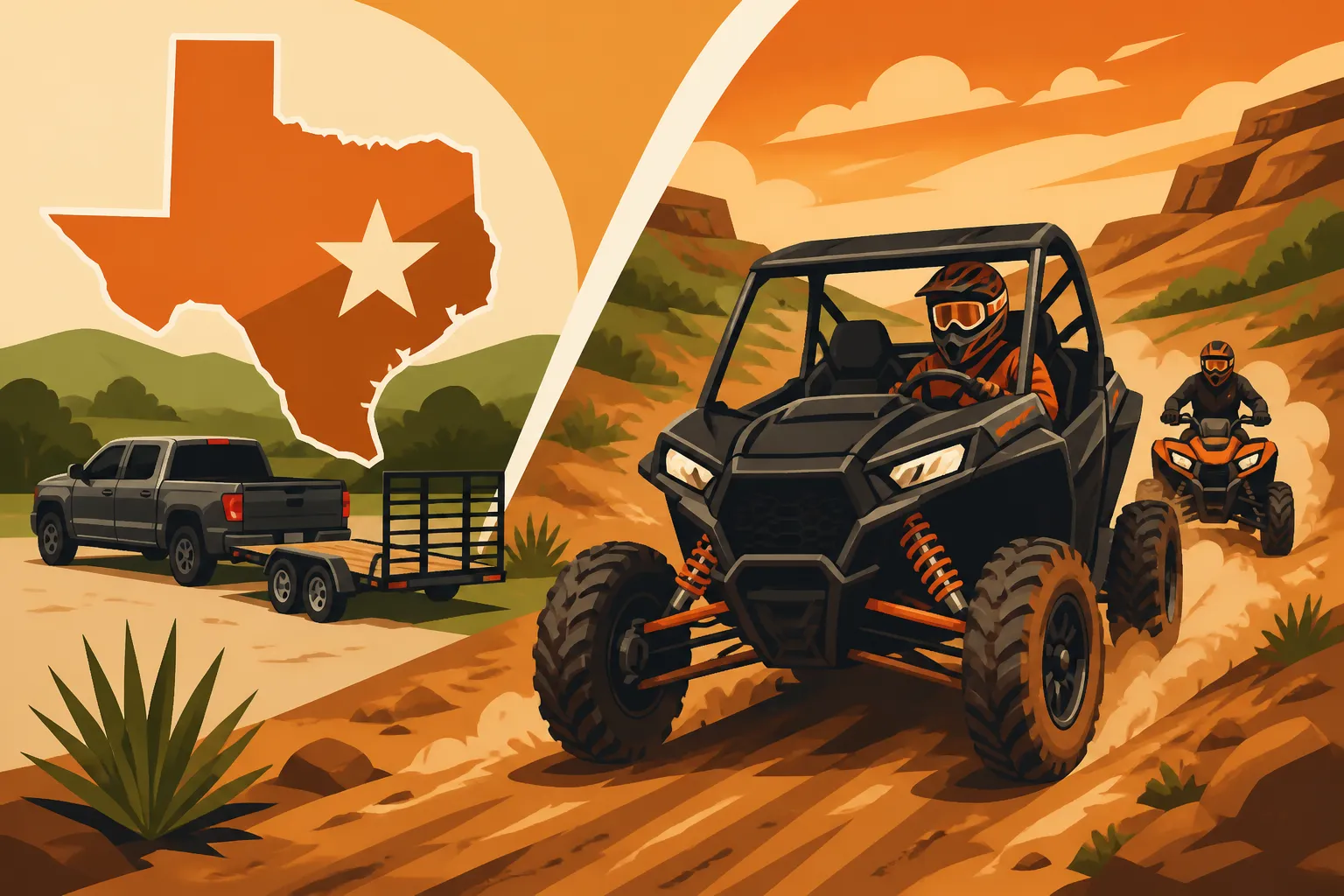
Ultimately, if there's any doubt about whether your specific situation qualifies for the "2 miles from where you park" exception, or any other limited road use, the safest and most legally sound course of action is to avoid public roads altogether. This usually means using a trailer, a truck bed, or another street-legal vehicle for transport.
This might seem like a hassle for a short distance, but it eliminates all legal risk and ensures maximum safety. Many serious ATV and UTV enthusiasts invest in reliable trailers and proper tie-down equipment precisely for this reason. Even if you've added some street-style accessories from SuperATV to make your machine more visible or functional off-road, remember that these upgrades don't change its legal status for general road use. Sometimes, the best accessory for road travel is a heavy-duty trailer.
| Aspect | "2 Miles from Where You Park" Exception | General Road Use Prohibition |
|---|---|---|
| Purpose | Limited access to adjacent private land, agricultural, utility work | Protect public safety, prevent unsuitable vehicles on roads |
| Distance | Max 2 miles from designated parking/base | Unlimited (but illegal for OHVs) |
| Time of Day | Daylight hours ONLY | N/A (always illegal for OHVs) |
| Road Speed Limit | 35 mph or less | N/A (always illegal for OHVs) |
| Equipment Required | Headlights, taillights, brake lights, muffler, spark arrester, 6ft orange flag | N/A (OHVs not designed for road safety) |
| Driver's License | Required | N/A (always illegal for OHVs) |
| Helmet/Eye Protection | Often required (ATVs), recommended | N/A (always illegal for OHVs) |
| Passenger Restrictions | Follow manufacturer guidelines for seating | N/A (always illegal for OHVs) |
| Typical Road Type | Quiet county roads, specific low-speed areas | All public streets, highways, interstates |
| Penalty for Violation | Class C Misdemeanor, fines | Class C Misdemeanor, fines |
Remember, the goal is to enjoy your OHV safely and legally. Understanding these nuances of Texas law is key to avoiding unnecessary headaches and keeping your machine where it belongs: off the beaten path, or briefly on it, only when absolutely necessary and compliant.
Disclaimer
This article is for general informational purposes only and does not constitute professional advice. Laws, prices and regulations vary by location and change over time. Consult a qualified professional for guidance on your specific situation.