The 10-Mile Limit on Texas Farm Road Riding
Trying to figure out where you can legally ride your ATV or UTV on Texas roads can feel like navigating a maze blindfolded. You hear whispers about farm roads, speed limits, and flags, but pinning down the real rules feels impossible. This guide is here to untangle the confusion, specifically diving deep into the often-misunderstood 10-mile limit for riding off-highway vehicles on Texas farm roads, so you can ride confidently and legally.
Texas's General Stance on OHV Road Use
Let's start with the elephant in the room: Texas is generally not keen on off-highway vehicles (OHVs) like ATVs and UTVs cruising down public roads. This isn't just some arbitrary rule; it's deeply ingrained in how the state classifies and regulates these machines. The law is designed to keep the difference clear between vehicles built for pavement and those designed for the dirt, rocks, and trails.
The state understands that sometimes, for practical reasons, you might need to briefly access a road. However, these exceptions are narrow and come with very specific stipulations. It's not a free pass to make your quad or side-by-side into a street-legal commuter, no matter how many mirrors or turn signals you bolt on. Understanding this foundational principle is key to avoiding legal trouble.
Why Texas Will Not Register an OHV for the Road
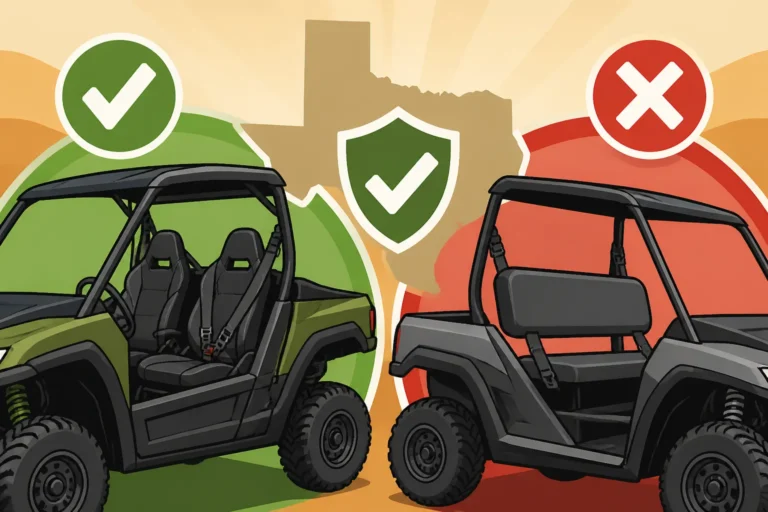
One of the biggest frustrations for many OHV owners is the inability to register their machines for general road use. You might think, "If I add all the required street-legal equipment, why can't I get a license plate?" The simple truth is, Texas law just doesn't categorize ATVs and UTVs as vehicles that are eligible for standard motor vehicle registration that would allow unlimited street access. The state has a clear definition of what constitutes an off-highway vehicle, and that definition inherently limits its use to off-road environments, with only a handful of specific, conditional exceptions.
This policy isn't unique to Texas, but it's often a point of confusion for new residents or those coming from states with different regulations. The Texas Department of Motor Vehicles simply isn't set up to title and register these machines for general public road use. Their systems and legal framework are built around a different set of vehicle classifications, which places OHVs squarely in the "off-road only" category. This is why you'll often see distinct rules for things like golf carts and low-speed vehicles, which do have pathways to limited road use and registration, but those pathways don't extend to typical ATVs and UTVs. For a deeper dive, check out [Why Texas Will Not Register an ATV for the Road].
The Core Philosophy: Off-Highway Use Only Stamped on the Paper
When you get a title for your ATV or UTV in Texas, you'll notice a significant remark on it: "OFF-HIGHWAY USE ONLY." This isn't just a suggestion; it's a legal declaration of the vehicle's intended purpose and limitations. This stamp is the state's way of emphatically stating that, by design, this machine is not for public paved roads. It's meant for fields, trails, private land, and designated off-road parks.
This remark carries legal weight. It serves as a constant reminder to the owner, and to any law enforcement officer who might review it, that the vehicle is inherently restricted from typical road use. While there are, as we'll explore, very specific and limited exceptions that allow momentary or agricultural road use, these exceptions do not negate the "off-highway use only" status. It means you can't simply add street-legal components and ignore the title's declaration. The core identity of your machine, in the eyes of Texas law, remains an off-highway vehicle. You can read more about what this means for you in [Off-Highway Use Only Stamped on the Paper].
The Farm Road Exception: What It Actually Means
Now, let's get into one of the most talked-about exceptions: riding on farm roads. This isn't a blanket permission to take your side-by-side on any rural route; it's a highly specific provision designed to support agricultural operations. Many riders mistakenly believe they can just hop on any farm-to-market road for a quick jaunt, but the law is much narrower than that. This exception is directly tied to the purpose of your ride and the nature of the vehicle's use, emphasizing its role as a tool for farm and ranch work.
It’s easy to get confused by the term "farm road" itself, as it evokes images of quiet country lanes. However, in the context of OHV law, it's not just about the road type, but why you're on it. The state wants to ensure that farmers and ranchers can move their essential equipment efficiently, without forcing them to trailer their OHVs for every short trip between properties or to a nearby field.
Who Qualifies for Agricultural Use
The crucial element of the farm road exception is the concept of "agricultural use." This isn't just about owning a piece of rural land; it's about actively engaging in farming, ranching, or timber production. The law specifically allows for the operation of an OHV on a public road if it is being used for a bona fide agricultural purpose. This includes things like hauling feed, checking fences, moving livestock, or transporting tools and equipment essential to the daily operations of a farm or ranch. It is not intended for recreational rides, joyriding, or simply getting from your house to a friend's house in the country, even if both are on farm roads.
To qualify, you generally need to be able to demonstrate that the use of the OHV is directly related to your agricultural or timber operation. This might involve carrying supplies, or having an agricultural number if you've claimed tax exemptions on the purchase of the machine. The spirit of the law is to facilitate necessary farm work, not to create a loophole for general road access. For more on the specific exemptions, look into [Texas Agricultural Exemption for ATVs on Roads].
Defining a Farm Road for OHV Access
When the law talks about a "farm road," it's generally referring to roads designated as such by the state, often referred to as Farm-to-Market (FM) roads or Ranch-to-Market (RM) roads. These are state-maintained roads that typically connect rural areas to market towns. However, the legal definition for OHV use can also extend to certain county roads that primarily serve agricultural purposes. What's vital to remember is that this exception does not typically extend to busy state highways, federal interstates, or city streets, even if they happen to run through rural areas.
The intent is to permit passage on the roads most directly associated with connecting agricultural properties and operations. You still need to exercise extreme caution, as these roads are shared with regular vehicle traffic. It’s also wise to be familiar with the local ordinances in your specific county, as some counties might have additional rules or interpretations regarding OHV use on their local roads, although state law generally supersedes. However, it's important not to assume that just because a road looks like a "farm road" that it automatically falls under this exception.
The 10-Mile Limit Origin to Destination
This is the core of our discussion: the 10-mile limit. If you qualify for agricultural use and are on a designated farm road or suitable county road, you are permitted to operate your OHV for a distance not exceeding 10 miles from its "point of origin to its point of destination." This means the total one-way trip cannot be more than 10 miles. It's not 10 miles in one direction and then another 10 back; it's the entire journey from where you start to where you finish the specific task.
This limit is designed to allow for practical movement between fields, barns, or nearby properties without excessive travel on public roads. It's a pragmatic concession for agricultural efficiency. If your task requires you to travel more than 10 miles on public roads, the expectation is that you would trailer your OHV to the destination, or utilize a different method of transportation. This limit is strictly enforced, and exceeding it can result in a citation. This particular rule about [The 10-Mile Limit on Texas Farm Road Riding] is central to understanding responsible agricultural OHV use.
Navigating the 10-Mile Limit: Practical Applications
Understanding the 10-mile limit in theory is one thing, but applying it in real-world agricultural scenarios requires careful consideration. It’s easy to inadvertently exceed the limit or misuse the exception if you’re not tracking your mileage and the purpose of your journey. Many riders are caught off guard because they don't fully grasp that this isn't about how far you feel you've gone, but the measurable distance from start to finish for a specific agricultural task.
For serious ranch or farm operations, having a good GPS or mapping tool on your phone can be a game-changer. You can even consider rugged devices or mounts for your UTV, perhaps from a company like SuperATV, to keep your navigation secure and visible while working. This allows you to plan routes that stay within the legal bounds and ensures you're not guessing your way to a ticket.
Practical Scenarios for Farm Road Riding
Let's imagine a few real-life situations where the 10-mile limit comes into play for agricultural purposes. Perhaps you need to move a sprayer attachment from your main barn to a field five miles down an FM road. This falls squarely within the limit. Or maybe you're checking cattle on a remote pasture that's seven miles from your home base, requiring you to briefly use a county road. Both of these scenarios fit the spirit and letter of the law, as long as the use is agricultural and the distance is respected.
However, consider if you wanted to take your UTV to a town 12 miles away to pick up feed, even if it's all on farm roads. This would exceed the limit and put you in violation. Similarly, using your quad to visit a friend who lives 8 miles away, even if both of you are farmers, wouldn't qualify if the purpose isn't directly related to an agricultural operation. The key is always the combination of agricultural intent and staying within that critical 10-mile radius.
Beyond the Property Line: When the Clock Starts Ticking
The "point of origin" for the 10-mile limit essentially begins the moment your OHV leaves private property and enters a public road. This means that if you have a sprawling ranch and travel five miles on your private dirt roads before hitting a public farm road, those five private miles don't count towards your 10-mile public road limit. The clock starts when you hit that first inch of public pavement or gravel.
Conversely, the "point of destination" is where you finally turn off the public road back onto private property to complete your agricultural task. So, if you're taking your UTV 8 miles down a county road to reach another section of your ranch, those 8 miles are what count. It's crucial to understand this distinction, as it directly impacts how you measure and adhere to the limit. For clarity, think of it as public road mileage only, for a specific agricultural purpose. More on this can be found in [Texas Rules for Riding a Farm Road].
Keeping Track of Your Distance
Accurately tracking your distance is paramount to staying compliant with the 10-mile limit. Modern OHVs often come equipped with odometers, and many riders use GPS devices or smartphone apps to track their routes. It’s a good practice to know the exact mileage between your various fields, barns, and other agricultural points of interest that require public road access. Don't eyeball it; know it for certain.
If you're making frequent trips, especially to different locations, consider keeping a simple log of your public road mileage. This isn't legally required, but it can be a helpful personal record if you're ever questioned by law enforcement about your route and purpose. Being able to confidently state your origin, destination, and the measured distance can go a long way in demonstrating compliance and responsible operation of your OHV for agricultural use.
Beyond the Farm Road: Other Limited Road Use Scenarios
While the farm road exception with its 10-mile limit is a significant allowance for agricultural workers, it's not the only instance where an OHV might legally touch a public road in Texas. There are other very specific, limited circumstances where operating your ATV or UTV on a public thoroughfare is permitted. These are often misunderstood or overlooked, leading to either unnecessary restrictions on riders or, more commonly, unintentional violations. It’s important to distinguish these from the agricultural exemption, as they come with their own unique set of rules and limitations.
It’s never about making your machine fully "street legal." These are always about temporary, necessary, or locally authorized situations. Thinking about essential upgrades for safety? Companies like SuperATV offer a range of accessories, from mirrors to turn signal kits, which while they don't magically make an OHV street legal, can certainly enhance visibility and safety during these brief, legally permitted road uses.
Crossing a Highway on an ATV in Texas
One of the most common and often unavoidable situations is needing to cross a public road or highway to get from one section of private property to another. Texas law generally allows an OHV to cross a public road, street, or highway. However, this isn't a casual cruise. The crossing must be made at an angle of approximately 90 degrees to the road, meaning you cross straight across, not diagonally or longitudinally.
You must come to a complete stop before entering the roadway, and you must yield to all other traffic. This is about minimizing your time on the public road as much as possible, for safety and legal compliance. You can't just drive down the shoulder for a bit to find a better crossing point; it's a direct, perpendicular crossing. For detailed rules on this, refer to [Crossing a Highway on an ATV in Texas].
Roads Posted Thirty-Five or Less in Texas
Some public roads with a posted speed limit of 35 miles per hour or less may also be accessible to OHVs under specific conditions, primarily within certain authorized counties or municipalities. This is not a statewide blanket rule. It often requires action by a local governing body, such as a county commissioners court or city council, to specifically permit OHV use on these lower-speed roads within their jurisdiction. Even then, there are usually restrictions on the time of day, equipment, and purpose of the ride.
It's critical to check with the local county or city authorities if you believe this exception might apply in your area. You cannot simply assume that because a road's speed limit is 35 mph or less, you're free to ride your OHV on it. Absent a specific local ordinance allowing it, the general prohibition on OHV road use still applies. This particular provision is often misunderstood, so knowing about [Roads Posted Thirty-Five or Less in Texas] is essential.
Master Planned Communities and Uniform Covenants
Another interesting, albeit highly localized, exception can be found in certain "master planned communities" that have adopted uniform covenants and have approval from the Texas Department of Transportation. In these specific, often private, communities, OHVs (sometimes limited to UTVs or golf carts) may be allowed on public streets within the community's boundaries. The key here is the "master planned community" status and the existence of specific, approved covenants that permit such use.
These communities are typically self-contained, with their own internal road networks, and the allowances are designed for the convenience of residents within that controlled environment. This exception does not mean you can drive your OHV out of the community and onto state or federal roads. It's a very narrow exception tied to the unique legal and planning structure of these specific types of developments.
Equipment and Safety Requirements for Limited Road Use
Even when operating your ATV or UTV under one of the permissible road use exceptions in Texas, you're not exempt from safety and equipment requirements. In fact, due to the inherent risks of sharing roads with heavier, faster traffic, these requirements become even more critical. Ignoring them can not only lead to fines and citations but significantly increase your risk of an accident. The state mandates specific items to enhance visibility and operator safety during these limited interactions with public roads.
Whether you're moving equipment on a farm road or making a quick crossing, equipping your machine properly is non-negotiable. Many riders will consider upgrading their factory components with more robust options from aftermarket providers. Companies like SuperATV, for instance, offer a wide array of lighting, mirrors, and safety gear that can make a big difference when you briefly need to operate on shared roadways, ensuring you're seen and can see others.
The 6-Foot Orange Flag Texas Requires
If you are operating an OHV on a public road under one of the exceptions, Texas law requires you to display a safety flag. This flag must be at least 6 feet above the ground, mounted to the OHV. It needs to be a bright orange or red, and at least 18 inches wide and 12 inches tall. This requirement is purely about visibility. On a road, especially with varied terrain or other vehicles around, OHVs can be harder to spot than a full-sized truck. The flag helps alert other drivers to your presence, giving them more time to react.
Think of it as an extra layer of protection, particularly when you're on a crest of a hill or rounding a bend. The higher the flag, the sooner you're seen. For anyone engaging in these limited road uses, mounting and maintaining this flag is a simple, yet incredibly important, safety measure. More information about this specific requirement can be found here: [The 6-Foot Orange Flag Texas Requires].
Headlights and Taillights in Daylight
While it might seem counterintuitive to need lights during the day, Texas law for OHV road use is quite specific: if you are operating your ATV or UTV on a public road under an exception, you must have your headlights and taillights on, even in broad daylight. This, much like the safety flag, is a visibility enhancement. Even on the brightest day, illuminated lights make your vehicle more conspicuous to oncoming and following traffic.
Many newer UTVs come with adequate lighting from the factory, but some older ATVs might have weaker lights or lack proper taillights. If your machine doesn't meet robust visibility standards, upgrading to brighter LED headlights and clear taillights is a smart investment. Always ensure your lights are functional and clean before heading onto any public road, regardless of the time of day. This requirement is covered in detail in [Headlights and Taillights in Daylight].
Texas Helmet Law for UTV Drivers and ATV Riders
Safety gear is paramount, and Texas has specific helmet laws that apply when riding an OHV. For ATV riders, a helmet is generally required when operating on public land or under public road exceptions. For UTV drivers and passengers, while a roll cage offers some protection, helmets are still often required, especially for riders under a certain age, or in specific circumstances.
The law aims to protect riders from head injuries in the event of an accident, which can be particularly severe when interacting with road traffic. Always wear appropriate safety gear, including a DOT-approved helmet, eye protection, and sturdy riding apparel. Even if an exception allows you on a road, that road is still a dangerous place, and protecting yourself and any passengers should be your top priority. You can learn more about the specific requirements in [Texas Helmet Law for ATV Riders] and [Texas Helmet Law for UTV Drivers].
Consequences of Breaking Texas OHV Road Rules
Ignoring Texas's rules regarding ATV and UTV use on public roads isn't just a minor infraction; it can lead to significant legal and financial consequences. The state takes these regulations seriously, primarily for public safety. When an OHV is operated illegally on a road, it poses a risk not only to the rider but also to other motorists, pedestrians, and property. The penalties are designed to deter such unauthorized use and reinforce the "off-highway use only" principle. It's far better to understand and adhere to the rules than to face the repercussions.
Class C Misdemeanors Under Texas OHV Law
Operating an ATV or UTV illegally on a public road in Texas is typically classified as a Class C misdemeanor. While this is the lowest classification of misdemeanor, it still carries a range of potential penalties. A conviction can result in a fine, which can add up quickly, especially if you're cited for multiple violations (e.g., no flag, no lights, illegal road use). Additionally, a Class C misdemeanor goes on your criminal record, which can have long-term implications, even for seemingly minor offenses.
Beyond the immediate fine, repeat offenses or dangerous driving behaviors could lead to more severe charges or even vehicle impoundment. Understanding [Class C Misdemeanors Under Texas OHV Law] is crucial for any OHV owner considering road use. The bottom line is that violating these laws is not just a slap on the wrist; it's a legal matter that can affect your wallet and your record.
Why an Altered Quad Still Cannot Be Plated
A common misconception among OHV owners is that if they add "street-legal" accessories—like turn signals, horns, windshields, and DOT-approved tires—they can then apply for a standard license plate and magically make their ATV or UTV street legal. This simply isn't the case in Texas. As previously discussed, the core classification of an ATV or UTV is "off-highway use only." No amount of aftermarket modification will change that fundamental classification or make it eligible for general motor vehicle registration.
The state's vehicle codes have specific definitions for what qualifies as a "motor vehicle" for general road use, and ATVs and UTVs, even highly customized ones, do not fit these definitions. While accessories from a company like SuperATV can certainly enhance safety and functionality off-road, they do not confer street-legal status for general road use. The "off-highway use only" remark on your title remains, regardless of modifications. For more on this, see [Why an Altered Quad Still Cannot Be Plated].
The Importance of Knowing Your Local Rules
While state law provides the overarching framework for OHV use on Texas roads, it's incredibly important to remember that local jurisdictions—counties and cities—can sometimes enact their own specific ordinances regarding OHVs within their boundaries. While these local rules cannot contradict state law, they can sometimes add further restrictions or, in very specific circumstances (like the 35 mph road rule or master planned communities), permit limited use under certain conditions.
This means that what might be permissible on a county road in one part of Texas could be strictly prohibited in a city just a few miles away. Always check with the local sheriff's department or city police department if you plan to operate your OHV on any public road, even under the exceptions discussed here. Being informed about both state and local regulations is your best defense against unintended legal trouble and ensures you're riding respectfully and responsibly.
Summary of Texas OHV Road Use Exceptions
To help you keep track of the various limited road use scenarios for ATVs and UTVs in Texas, here's a quick overview of the key conditions and requirements we've discussed. Remember, these are exceptions to the general rule that OHVs are "OFF-HIGHWAY USE ONLY." Always prioritize safety and verify local rules before heading out.
| Use Case | Key Condition(s) | Distance/Speed Limit | Required Equipment | Primary Purpose |
|---|---|---|---|---|
| Agricultural Use (Farm Roads) | Bona fide agricultural/timber operation | 10 miles (origin to destination) | 6ft orange flag, headlights, taillights | Farm/ranch work |
| Crossing a Highway | Direct crossing at 90 degrees | As short as possible | 6ft orange flag, headlights, taillights | Access property sections |
| Roads 35 mph or less | Local ordinance must permit | Varies by local ordinance | 6ft orange flag, headlights, taillights | Local access (limited) |
| Master Planned Communities | Specific uniform covenants & TxDOT approval | Within community boundaries | Varies by covenant | Resident convenience |
This table is a general guide, and it's always critical to consult the specific Texas Transportation Code sections (e.g., Chapter 663) and any relevant local ordinances for the most precise and up-to-date information.
Disclaimer
This article is for general informational purposes only and does not constitute professional advice. Laws, prices and regulations vary by location and change over time. Consult a qualified professional for guidance on your specific situation.