Why an Altered Quad Still Cannot Be Plated
It's incredibly frustrating, isn't it? You've invested in your off-highway vehicle (OHV), maybe even spent extra money on upgrades like mirrors, turn signals, and a horn, dreaming of the day you can just hop on and ride down to the corner store or cruise the backroads near your property. You see people doing it in other states, or maybe you've spotted a golf cart with a license plate, and you think, "Surely, if I just add these few things, my quad can be street legal in Texas too!" But the reality here in the Lone Star State is often a harsh awakening: even with a pile of street-legal accessories, your ATV or UTV won't get a regular license plate for general road use. This guide is here to help you understand why, what Texas does allow, and what those modifications actually mean for your riding experience.
Understanding Texas's Core Definition of an OHV
The fundamental hurdle for any off-highway vehicle in Texas isn't about what you add to it; it's about what it is at its core, according to the state's legal definitions. This initial classification sets the stage for everything else, regardless of how many bells and whistles you bolt on.
What Texas Considers an Off-Highway Vehicle
In Texas, the definition of an off-highway vehicle (OHV) is quite specific, and it's this definition that determines how your machine is treated under the law. Generally, an OHV is any motor vehicle, other than a boat or a public highway vehicle, that is designed by the manufacturer for off-highway use and that is not capable of being registered for highway use. This broad umbrella covers your typical ATVs (all-terrain vehicles), UTVs (utility terrain vehicles, often called side-by-sides), certain types of golf carts, sand rails, and even some smaller dirt bikes not designed for road travel. The key phrase here is "designed by the manufacturer for off-highway use."
This isn't just bureaucratic jargon; it's the very foundation of why your quad faces such restrictions. No matter how many aftermarket parts you install, you aren't changing the fundamental design intent of the vehicle from the factory. A machine that rolled off the assembly line as an ATV for trail riding or farm work will always be legally considered an ATV in Texas, even if you equip it with every imaginable safety feature available from a company like SuperATV. The state isn't looking at your modifications; it's looking at the original manufacturing purpose. You might find it helpful to dive deeper into [What Texas Counts as an Off-Highway Vehicle] to grasp the full scope of this classification.
The "Off-Highway Use Only" Remark on Your Title
If you've gone through the process of titling your ATV or UTV in Texas, you're likely familiar with a specific, sometimes frustrating, remark: "Off-Highway Use Only" stamped right there on your paper title. This isn't just a suggestion; it's a legal declaration of your vehicle's status. It means exactly what it says: your machine is legally recognized for use off public roads and highways.
This remark serves as a constant reminder of your vehicle's inherent legal limitations. It doesn't matter if you've added blinkers, brake lights, a windshield, or DOT-approved tires; that "Off-Highway Use Only" stamp solidifies its status. It's a permanent part of the vehicle's legal identity in Texas, a direct consequence of how the state defines and titles these machines. This stamp directly prevents the possibility of obtaining a standard vehicle registration or license plate for street use. For more details on this specific issue, check out [The Off-Highway Use Only Remark on a Texas Title]. It really drives home the point that the state has already made up its mind about your machine's primary purpose.
Why Modifications Don't Grant Street Legality
It’s easy to look at a modified ATV and think it looks street legal, especially when it has all the typical equipment cars have. However, in Texas, merely adding these features doesn't change the underlying classification of the vehicle or the state's rules about what can be legally operated on public roads.
The Difference Between Equipment and Classification
One of the biggest misconceptions riders have is confusing equipment requirements with vehicle classification. You can install a full suite of road-legal accessories on your ATV or UTV – LED headlights, brake lights, turn signals, mirrors, a horn, and even a speedometer. Many fantastic aftermarket companies, including SuperATV, offer kits and individual components designed to make your off-road machine safer and more visible, which is great for certain permitted road uses or simply for enhanced safety on the trail.
However, equipping your OHV with these items, while making it look more like a street vehicle, does not magically reclassify it in the eyes of the Texas Department of Motor Vehicles (TxDMV). The state doesn't look at a list of features and then grant street legality. Instead, it classifies vehicles based on their original design and purpose. A vehicle designed as an OHV remains an OHV, regardless of modifications. While these additions might be necessary for the limited road uses Texas does permit (which we'll discuss later), they are insufficient to earn a standard street plate. Think of it this way: you can put racing tires on a sedan, but it doesn't make it a race car in a legal sense for public roads.
Texas's Stance on Registering OHVs for Roads
Texas has a very clear and steadfast stance: it simply does not offer a registration class for ATVs or UTVs for general public road use. This isn't a loophole you can find; it's a fundamental aspect of Texas motor vehicle law. The state sees these machines as primarily recreational or utility vehicles designed for off-highway terrain. As such, there's no path to getting a traditional "street legal" license plate.
Many states have specific laws that allow for the registration of OHVs as "low-speed vehicles" or have provisions for "street legal conversions." Texas, by and large, does not. This can be a huge source of frustration for riders who move from states with more lenient laws or who just want the convenience of road access. The bottom line is that the Texas Legislature has not enacted laws to create a pathway for ATVs and UTVs to be registered as street-legal vehicles. This is a crucial distinction, and understanding [Why Texas Will Not Register an ATV for the Road] can help clarify the state's position.
Exceptions and Their Strict Limitations
Now, while general street legality is off the table, Texas does have some very specific, tightly regulated exceptions where OHVs are permitted on public roads. It's vital to understand that these are exceptions, not a pathway to making your machine street legal in the common sense. These situations include:
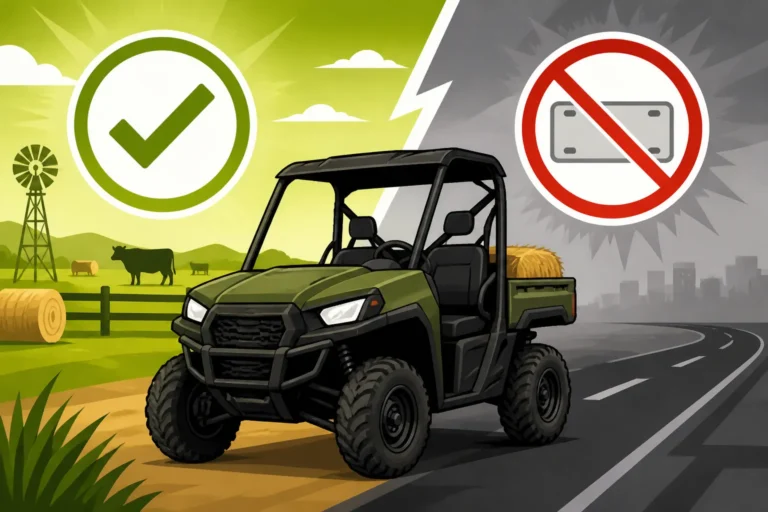
- Agricultural Use: Farmers and ranchers can operate OHVs on public roads for agricultural purposes, such as moving between fields or hauling feed, provided they follow certain rules like displaying an orange flag, having headlights and taillights, and staying within a certain distance from their farm. This is strictly tied to agricultural operations and not for joyriding. For more on this, look into [Texas Agricultural Exemption for ATVs on Roads].
- Road Crossings: You are allowed to cross a public road, highway, or street on an OHV, but only under very specific conditions. This involves coming to a complete stop, crossing at a 90-degree angle, yielding to traffic, and ensuring clear sightlines. It's a quick traverse, not sustained travel. We’ll delve into the specifics in a later section. You can also find additional information about [Crossing a Highway on an ATV in Texas].
- Master Planned Communities: In some specifically designated master-planned communities, with proper uniform covenants and approved plats, residents may be allowed to operate golf carts or UTVs on community streets. This is highly localized and only applies within the confines of these specific developments. Learn more about [Texas Rules for Riding in a Master Planned Community].
- Certain Counties/Cities: A few, very limited counties and cities have exercised options under state law to allow OHV use on certain low-speed public roads. These are rare, often depend on population size or geographic location (like Red River counties or some barrier islands), and typically restrict use to daylight hours and low-speed limits. This is far from a statewide free pass.
It's crucial to remember that even in these exceptional cases, your vehicle is not "plated" for general road use. These are highly conditional permissions, and exceeding their scope can lead to fines and penalties.
What You Can Do with Your Modified Quad in Texas
So, if your altered quad can't be plated for the street, what is the point of all those modifications? The good news is that those upgrades are incredibly valuable for their intended purpose: enhancing your off-road experience and ensuring you meet requirements for specific off-road contexts.
Riding on Private Land and OHV Parks
This is where your modified quad truly shines! Texas boasts a fantastic array of private lands and dedicated off-highway vehicle parks where your souped-up machine can perform exactly as it's designed. Whether you've added a lift kit, heavy-duty suspension, improved lighting, or upgraded tires, these modifications from companies like SuperATV are specifically engineered to conquer challenging trails, mud, sand, and rocks.
On private land, with the owner's permission, you generally have a lot more freedom to ride as you please, limited only by local noise ordinances or common-sense safety. For organized riding, Texas has numerous excellent OHV parks, such as Barnwell Mountain Recreation Area and Hidden Falls Adventure Park, that cater to all types of off-road enthusiasts. These parks often have specific rules, including safety gear requirements, but they provide a legal and exciting environment to push your machine's capabilities. Your modifications contribute directly to a safer, more capable, and more enjoyable experience in these environments.
Transporting Your Machine Legally
Since you can't drive your OHV on most public roads, transporting it legally becomes paramount. This means using a trailer and a suitable tow vehicle. Your modified quad, even if it looks like it could drive itself, must be trailered to and from all riding destinations, whether that's an OHV park, a friend's ranch, or a hunting lease.
When choosing a trailer, make sure it's rated for the weight of your ATV or UTV, especially if you've added substantial aftermarket parts that increase its heft. Secure your machine properly with appropriate tie-downs to prevent shifting during transit. Always ensure your trailer lights are working and your hitch is secure. Think of your truck and trailer as the only legal "street legal" way for your OHV to travel distances on Texas roads. This is a non-negotiable aspect of responsible OHV ownership in a state with strict road-use laws.
The Texas OHV Decal vs. Road Plates
It's easy to confuse the various stickers and plates required for vehicles, but it's crucial to understand the difference between the Texas OHV Decal and a standard road plate. A road plate (license plate) signifies that a vehicle is registered for public highway use. The Texas OHV Decal, on the other hand, is not a license plate and does not grant street legality.
The [Texas OHV Decal Explained] is required for any OHV operating on public lands or properties that have received state or federal funding for OHV trails. This decal shows that you've paid a small fee that helps fund the maintenance and development of these very trails. It's typically an annual sticker that you affix to your machine. Importantly, it's about supporting off-road infrastructure, not about permitting street use. You might buy your decal at an OHV park entrance, a local dealer, or through the Texas Parks and Wildlife Department. This decal is entirely separate from any vehicle registration and does not alter the "Off-Highway Use Only" status of your vehicle.
Navigating the Texas Road Rules for OHVs
While driving your OHV down a public road for a joyride is almost universally prohibited in Texas, there are very specific and limited circumstances where your machine might briefly touch asphalt. Understanding these rules is critical to avoid fines and ensure safety.
Understanding Permitted Road Crossings
Texas law does allow for off-highway vehicles to cross public roads, but these crossings are tightly regulated. This isn't a general permission to drive on the road; it's a brief, controlled maneuver. Here’s what you need to know:
- Complete Stop: Before attempting any crossing, you must bring your OHV to a complete stop at the shoulder of the road.
- Yield to Traffic: You must yield the right-of-way to all approaching traffic. Your safety, and the safety of others, is paramount. Do not cross until the path is clear.
- Right Angle Crossing: The law specifies that you must cross at an angle of approximately 90 degrees to the roadway. This means going straight across, not diagonally.
- Clear Sightlines: You need to ensure you have clear sightlines in both directions, free from obstructions, so you can see oncoming traffic and drivers can see you.
- Divided Highways: If you're crossing a divided highway, you must make a complete stop on the median before proceeding to cross the second roadway.
These rules are designed for quick, necessary movements, such as moving from one section of a ranch to another, or accessing a trail across a road. They absolutely do not permit continuous travel on the road. For a more exhaustive guide, be sure to read [Crossing a Highway on an ATV in Texas]. Ignoring these rules can lead to serious accidents and legal trouble.
Agricultural and Master Planned Community Exemptions
As mentioned earlier, there are specific exemptions that allow for more extended, though still limited, road use for OHVs. These are not about general street legality, but about practicality for specific tasks or within defined areas.
- Agricultural Operations: If you're using your ATV or UTV solely for legitimate agricultural purposes – for example, moving between fields, transporting tools or feed on a farm or ranch – Texas law provides an exemption. This usually requires certain safety equipment, like a red or orange flag mounted at least 6 feet high, and functional headlights and taillights. You're typically limited to public roads within a certain distance of your agricultural operation. This exemption is tied directly to the use of the vehicle, not its inherent roadworthiness. For instance, hauling feed for livestock falls under this, but taking your kids to school in the UTV does not. For more details, consult [Texas Agricultural Exemption for ATVs on Roads].
- Master Planned Communities: In very particular master-planned communities, sometimes referred to as "golf cart friendly" communities, local ordinances may permit the use of UTVs or golf carts on specific streets. These communities often have uniform covenants and approved plats that designate these areas for such use. However, these are strictly confined to the community's boundaries and do not extend to surrounding public roads or highways. It's crucial to verify if your specific community qualifies and what its precise rules are. This is typically for low-speed, daylight-only travel within the neighborhood. For additional context, review [Texas Rules for Riding in a Master Planned Community].
The Limits of Local Ordinances
You might hear whispers or read online about certain Texas cities or counties that allow OHVs on their roads. While there are a few very limited instances where local jurisdictions can, by specific state statute, opt to permit OHV use on certain low-speed roads, these are exceedingly rare and come with significant restrictions.
Most Texas cities and counties simply cannot override state law to allow general street use for ATVs and UTVs. Any local ordinance that appears to do so must align with narrowly defined state exceptions, which often relate to population size, proximity to specific natural features (like barrier islands), or designations as "Red River counties." Even when allowed, these local rules typically impose strict speed limits (often 35 mph or less), daylight-only operation, and specific safety equipment requirements (which your SuperATV accessories might help you meet). It's never a blanket permission, and you certainly won't be issued a standard license plate for broader travel. Always check with the specific local authority and the TxDMV if you hear about such an allowance, as misinformation is rampant. Without specific legislative action from the state, your altered quad remains largely off-limits for public road travel, except for those very narrow, clearly defined exceptions. Be aware of the constraints, and remember that [Texas Cities That Ban ATVs on the Beach] illustrates how local authorities can restrict use, not broadly permit it. Even when specific [Texas Rules for Riding a County Road] might exist, they are exceptions and not general allowances.
Here’s a quick overview of how modifications interact with Texas OHV road rules:
| Modification Type | Purpose | Does it allow a Texas Street Plate? | Relevance in Texas (Legal) |
|---|---|---|---|
| Headlights/Taillights | Visibility, safety | No | Required for permitted road use/crossings |
| Turn Signals | Signalling intentions | No | Enhances safety for permitted road use |
| Brake Lights | Signalling stopping | No | Required for permitted road use/crossings |
| Horn | Alerting others | No | Required for permitted road use/crossings |
| Side/Rearview Mirrors | Enhancing situational awareness | No | Enhances safety for permitted road use |
| Windshield | Rider protection | No | Enhances comfort/safety (off-road) |
| DOT Approved Tires | Road grip, durability | No | May be helpful for limited road use, but not sufficient |
| License Plate Bracket | For displaying a plate | No | Irrelevant, as no general plate issued |
| Spark Arrester | Fire prevention | No | Required for public land use |
As you can see, almost every modification serves a purpose related to safety or off-road performance, or meeting specific requirements for limited road use, but none of them unlock general street legality in Texas.
Disclaimer
This article is for general informational purposes only and does not constitute professional advice. Laws, prices and regulations vary by location and change over time. Consult a qualified professional for guidance on your specific situation.