Texas Equipment Rules for an ATV on a Road
Trying to figure out exactly what equipment your ATV or UTV needs to be "legal" on any Texas road can feel like navigating a maze blindfolded. The rules are notoriously specific, often misunderstood, and can lead to a lot of frustration and even hefty fines if you get it wrong. This guide aims to clear up the confusion, walking you through the precise equipment requirements for those very limited situations where your off-highway vehicle might touch Texas pavement, helping you stay compliant and safe.
The Underlying Texas Road Rules for OHVs
First, let's tackle the elephant in the room. Many riders dream of making their ATV or UTV "street legal" in Texas, like they see in other states, but the reality here is quite different. Texas law has very specific definitions and limitations for off-highway vehicles (OHVs), which include most ATVs and UTVs.
Why Street Legal is a Misnomer for Most OHVs
In Texas, the term "street legal" as it applies to cars or motorcycles simply doesn't translate to the vast majority of ATVs and UTVs. Texas law doesn't provide a path for these machines to be fully registered for routine road use. You can get a title for your OHV, which is proof of ownership, but that's a different animal entirely from vehicle registration for public roads. This means that even if you spend a fortune adding every conceivable street-legal accessory, like blinkers, horns, and automotive-grade tires, it doesn't change the fundamental classification of your machine in the eyes of the law.
The state explicitly states that an off-highway vehicle, by its very definition, is "not designed or manufactured for operation on a public highway." This distinction is critical because it dictates how Texas treats these vehicles on public roadways. Unlike a car that gets a registration sticker and plates, your ATV or UTV gets a title, and if you request it, an off-highway license plate which serves as an identifier for off-road use, not a permit for public road travel. This is why you'll often hear that [Why Texas Will Not Register an ATV for the Road]. It’s a frustrating reality for many, but it's the core principle that governs all other rules.
Limited Exceptions for Road Use
Despite the general prohibition, Texas law does carve out some very narrow exceptions where an OHV might legally operate on a public road. These aren't loopholes to make your machine fully street legal, but rather specific use cases that come with their own set of rules and equipment requirements. Understanding these exceptions is crucial, as they are the only times you should ever consider putting your OHV on a public road.
One of the most common exceptions is for agricultural purposes. If you're using your ATV or UTV for farming, ranching, or timber operations, you might be allowed to cross or travel short distances on certain public roads to get between fields or parts of your property. This isn't a carte blanche to joyride on public roads; it's strictly tied to the agricultural activity. Similarly, in certain master planned communities or near golf courses, local ordinances may permit low-speed use on specific, designated roads. These rules are hyper-local and come with very strict speed limits, often [Roads Posted Thirty-Five or Less in Texas], and may even be limited to daylight hours.
Beyond these specific use cases, there are also provisions for briefly crossing a public highway at an intersection, or traveling alongside one to access private property. These are typically short, direct transitions, not prolonged travel. It’s vital to remember that these exceptions are precisely that—exceptions—and don't grant full road privileges. Understanding [The Two Exceptions to the Texas Road Ban] is fundamental before you even consider what equipment you might need.
Essential Equipment for Permitted Road Use
Even within the very limited scenarios where an ATV or UTV can legally touch a public road in Texas, specific equipment requirements often come into play. These aren't just suggestions; they're legal mandates designed to ensure the safety of both the OHV operator and other road users.
Lighting Requirements
When your OHV is operating on a public road, even for a brief moment, visibility becomes paramount. Texas law generally requires certain lighting to be functional and in use during permitted road travel, especially during crossing or agricultural operations.
You'll need functional headlights and taillights. These aren't just for your own visibility in low light; they make your machine visible to others on the road. Even if you're out in broad daylight, it's often a good practice, and sometimes required, to have your headlights and taillights on when traveling on public roads. This applies even to the short jaunts across a road or moving between pastures on a farm-to-market road. If your machine is older or has seen some rough use, it's a good idea to inspect these lights regularly and ensure they're bright and in good working order.
For certain golf course or master-planned community exceptions, the rules might explicitly state "Daylight Only," which could seem to negate the need for lights. However, even in daylight, a bright, flashing taillight or always-on headlights can significantly improve your visibility to other drivers, especially on roads shared with heavier traffic. The goal is to be seen, and robust lighting, even if your machine won't ever be "street legal," enhances safety during those permitted on-road moments.
Safety Gear for the Rider
Beyond the machine itself, Texas has strict rules about what the rider must wear, particularly when operating on public roads or public lands where road access might occur. This is where personal protective equipment (PPE) becomes non-negotiable.
For any rider under the age of 15 operating an ATV, a helmet is absolutely required. However, the Texas helmet law for OHVs goes further. While many people think helmets are only for youth, if you're operating your ATV on any public road, you are generally required to wear a helmet, regardless of age, unless specific exemptions apply (like being enclosed in a UTV with a roll cage and seatbelt). This applies even if you're just crossing a highway or driving a short distance on a permitted road segment. Make sure your helmet is properly fitted and DOT-approved. This is one of the most critical [Texas Helmet Law for ATV Riders] to remember.
Eye protection is another crucial piece of gear. If your ATV or UTV doesn't have a windshield, or if you're riding an open ATV, you must wear eye protection. Goggles or a full-face helmet visor are ideal. This isn't just about preventing bugs or dust from getting in your eyes; it's about protecting your vision from flying debris, which is far more prevalent when sharing roads with other vehicles. A branch off a truck, a rock flung from a tire – these can cause serious injury if your eyes aren't protected. Good eye protection is as important as a helmet for preventing injuries, aligning with [Texas Eye Protection Requirement for Riders]. For UTVs, if you have a full windshield, it typically satisfies the eye protection requirement, but even then, a rider might choose to wear glasses or goggles for comfort and additional protection from dust from the sides.
If you're operating a side-by-side or UTV, and it's equipped with seatbelts from the manufacturer, those seatbelts must be worn by all occupants. This is a common-sense rule that echoes passenger vehicle safety. Some UTVs also have roll cages, which provide an added layer of protection. In certain situations, this combination of a roll cage and seatbelt can sometimes (but not always) exempt an adult operator from the helmet requirement, but it’s crucial to know the exact local and state rules for your specific scenario before assuming such an exemption applies.
Exhaust, Spark Arresters, and Noise Levels
While often overlooked, the exhaust system of your ATV or UTV also falls under scrutiny when operating, however briefly, on public roads or public lands. These rules are primarily about environmental protection and public nuisance.
Spark Arrester Mandates
A spark arrester is a critical safety device designed to prevent hot carbon particles from escaping your exhaust system. These particles can easily ignite dry grass, leaves, or other flammable materials, leading to devastating wildfires.
Texas law, especially when operating on public lands or properties that might abut public roads, often requires your ATV or UTV to be equipped with a functional spark arrester. This is particularly true if you ever ride in or around federal lands, such as the Sam Houston National Forest OHV trail. The U.S. Forest Service has stringent requirements for spark arresters, and generally, Texas defers to these standards for off-road use. If your machine is relatively new and came from a reputable manufacturer, it likely has an approved spark arrester built-in. However, if you've modified your exhaust or are riding an older machine, it's essential to verify its presence and functionality.
Having a Forest Service-qualified spark arrester isn't just about avoiding a ticket; it's about being a responsible land user and preventing catastrophic fires that impact everyone. Regular maintenance, including checking and cleaning your spark arrester, is a small effort that yields huge benefits in safety and environmental protection.
Muffler and Noise Regulations
Texas law generally requires vehicles to have a muffler that is in good working order and prevents "excessive or unusual noise." For ATVs and UTVs, this means that highly modified or open exhaust systems that produce significantly more noise than factory standards are likely to be in violation.
While there isn't a universally posted decibel limit specifically for ATVs on limited road use in Texas, the general principle is that your machine should not be creating a nuisance. If you've removed your muffler, cut baffles, or installed an aftermarket exhaust that drastically increases sound output, you run the risk of attracting unwanted attention from law enforcement, even during a short, permitted road crossing. It's not just about the law; excessive noise can also annoy residents and potentially lead to more restrictive local ordinances against OHV use.
Maintaining your factory exhaust system or choosing aftermarket options that are specifically designed to meet noise standards is always the safest bet. Many manufacturers, and even aftermarket companies like SuperATV, offer exhaust solutions that enhance performance while still adhering to reasonable noise levels. Think about it: a loud exhaust might sound cool on the trail, but it can quickly become a liability on a public road where others expect quieter operation. This aligns with the spirit of [Texas Muffler Requirements for OHVs] to minimize disturbance and ensure public safety.
Other Crucial Components and Modifications
While the core rules prevent an OHV from becoming street legal, certain additional components become important for safety and compliance during those limited road uses, and some modifications simply don't pass muster.
Mirrors and Turn Signals (When Applicable)
While mirrors and turn signals aren't universally required for all limited OHV road use exceptions in Texas, they are incredibly useful for safety and are often recommended or even required for specific low-speed vehicle categories or certain local road permits.
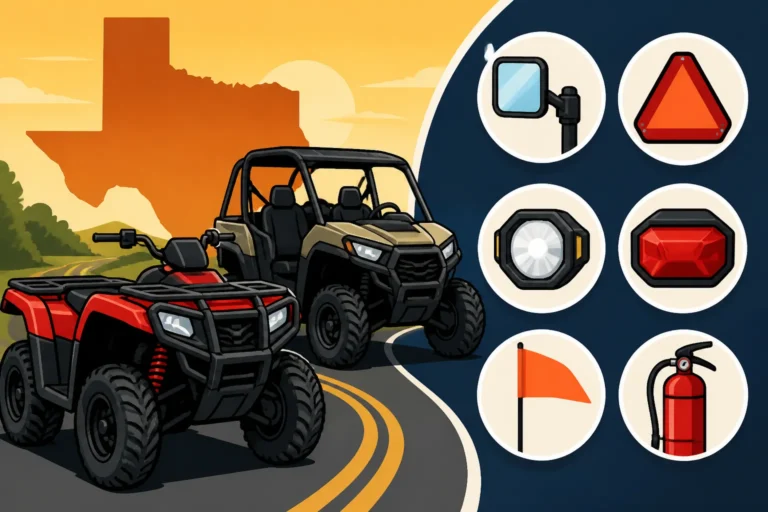
Even if not strictly mandated for your specific agricultural road travel or community golf cart path, having mirrors—at least one on the left side, ideally both side mirrors and a rearview mirror—significantly enhances your situational awareness. When you're crossing a road or traveling along a shoulder, being able to see traffic approaching from behind without twisting your body can prevent accidents. Many UTVs come with mirrors, and for ATVs, aftermarket mirrors are readily available.
Turn signals are a bit more nuanced. For a standard ATV briefly crossing a highway, turn signals are typically not required, as the maneuver is meant to be quick and direct, with hand signals being the more common communication method if needed. However, if you're operating a vehicle that, due to local ordinance or its classification (like a neighborhood electric vehicle or modified golf cart), is permitted more extensive low-speed road use, then turn signals often become a mandatory piece of equipment. Companies like SuperATV offer universal turn signal kits and mirror options that can be added to your UTV or ATV, providing a greater margin of safety and meeting potential local requirements, especially for those who frequent community roads or designated golf cart paths. It’s all about enhancing visibility and predictability for other drivers.
Passenger Seating and Occupant Safety
Texas law is very clear about how passengers can be carried on an OHV, especially when operating on or near public roads. This isn't just about comfort; it's about structural integrity and accident prevention.
An ATV or UTV passenger must only be carried in a seat designed by the manufacturer for a passenger. This means no riding double on a single-seat ATV, no extra people squeezed into a UTV beyond its designed capacity, and definitely no passengers riding on fenders, cargo racks, or laps. These positions are incredibly dangerous, as they can unbalance the machine, obstruct the operator's view, and offer no protection in the event of a sudden stop or collision. The manufacturer's design accounts for weight distribution, stability, and proper restraint points.
For UTVs, which typically come with multiple seats and seatbelts, all occupants must be properly belted in. Overloading a UTV with more passengers than it was designed for not only violates safety rules but also compromises the vehicle's handling and braking capabilities. Always check your machine's owner's manual for its specific passenger capacity. This rule, outlined in [Texas Passenger Rules on an ATV], is a fundamental safety measure intended to protect everyone on board, particularly when operating where other vehicles are present.
Specific Road Use Cases and Their Equipment Nuances
The type of limited road use you're engaging in can subtly shift the equipment rules. Understanding these nuances is key to staying compliant.
Agricultural and Timber Operations
For those using their ATVs or UTVs primarily for farm, ranch, or timber work, Texas offers specific exemptions for road use. However, these exemptions come with their own set of equipment requirements to ensure safety on public roads.
If you're driving your machine on a public road for agricultural or timber purposes, even for a short distance, lights are generally required. This means your headlights and taillights must be on, even during daylight hours. This is crucial for visibility to other motorists, especially when your slow-moving OHV might be sharing the road with faster traffic. Additionally, Texas law often requires an agricultural vehicle, which can include an OHV used for these purposes, to display a slow-moving vehicle emblem (the orange triangle) and/or a bright orange flag. The flag, if required, usually needs to be mounted at least six feet above the ground, making your machine more visible over obstacles or hills.
Many ranchers and farmers find UTVs particularly useful for these tasks, and manufacturers like SuperATV offer a range of utility beds, cargo accessories, and specialized lighting that can enhance the functionality and safety of your machine for farm-specific applications. These additions not only make your work easier but also help you comply with the spirit of the law when briefly transitioning onto public roads. Claiming the [Texas Agricultural Exemption for ATVs on Roads] means taking responsibility for operating safely and visibly.
Crossing Highways and Intersections
One of the most common, and riskiest, forms of OHV road use is simply crossing a public highway or intersection to get from one section of private property to another. Texas law permits this under very specific conditions, and while the equipment list isn't extensive, adherence to proper procedures is paramount.
When crossing a public road, you must come to a complete stop before entering the roadway. You should cross at a right angle to the traffic flow, proceed only when the way is clear, and cross quickly and directly. While dedicated turn signals might not be required for this brief maneuver, it's wise to have your headlights and taillights on to maximize your visibility to any approaching traffic. Think of it as being hyper-aware and making yourself as obvious as possible to other drivers who might not expect an OHV on the road.
Visibility is your best friend when crossing a busy road. Wearing bright colors, ensuring your lights are functional, and exercising extreme caution are more important than any specific equipment in this scenario. Even if your machine is technically compliant with all its equipment, a momentary lapse in judgment or an unobservant driver can lead to disaster. These rules are detailed in statutes like [Crossing a Highway on an ATV in Texas], emphasizing safe passage.
Beyond the Basics – What Doesn't Make it Street Legal
Despite what you might see online or hear from well-meaning friends, there's a stubborn misconception that you can "make" an ATV or UTV truly street legal in Texas by adding certain parts. This is simply not true for the vast majority of machines.
Why Adding Car Parts Isn't Enough
Many riders, eager to expand their riding horizons, will invest heavily in adding automotive-style components to their ATVs or UTVs. This often includes things like automotive headlights, DOT-approved tires, turn signals, brake lights, horns, windshield wipers, and even full enclosures. While these modifications might make a vehicle look more like a car, they fundamentally do not change its legal classification in Texas.
Texas law defines an off-highway vehicle based on its original design and manufacturing intent. If it wasn't designed and manufactured for road use, adding a bunch of accessories won't suddenly turn it into a street-legal vehicle. The Texas Department of Motor Vehicles (TxDMV) typically will not register an OHV for public highway travel, regardless of how many "street legal" accessories you bolt on. This is a critical point that many riders miss, and it can lead to wasted money and legal trouble. Understanding [Why an Altered Quad Still Cannot Be Plated] is key to avoiding this pitfall. You might have the best, brightest, and most compliant lights on the market, but if the core vehicle type isn't approved for road registration, those accessories are for off-road safety, not street legality. Ultimately, [Why Modifying an ATV Will Not Make It Street Legal] is about state-level definitions, not aftermarket parts.
The Cost of Non-Compliance
Ignoring Texas's OHV road rules, or attempting to circumvent them through improper modifications, can lead to significant financial and legal consequences. The state takes these regulations seriously, primarily for public safety.
Operating an OHV illegally on a public road in Texas can result in a Class C misdemeanor. While these are typically the lowest class of criminal offense, they still carry fines that can range from $25 to $500, plus court costs. And that's just for the initial offense. Repeated violations, or violations that involve property damage or injury, can escalate quickly. Beyond fines, your machine could be impounded, leading to towing and storage fees that quickly add up. You might also face increased insurance rates or even have your driving privileges affected.
More severely, if you're involved in an accident while illegally operating your OHV on a public road, your insurance policy might deny coverage, leaving you personally liable for damages, medical bills, and legal fees. This risk alone should be enough to deter anyone from attempting to operate their OHV on Texas roads outside of the very narrow, legally defined exceptions. It's a costly lesson to learn, and avoiding [Texas Fines for Illegal ATV Road Use] starts with understanding and respecting the law.
Disclaimer
This article is for general informational purposes only and does not constitute professional advice. Laws, prices and regulations vary by location and change over time. Consult a qualified professional for guidance on your specific situation.