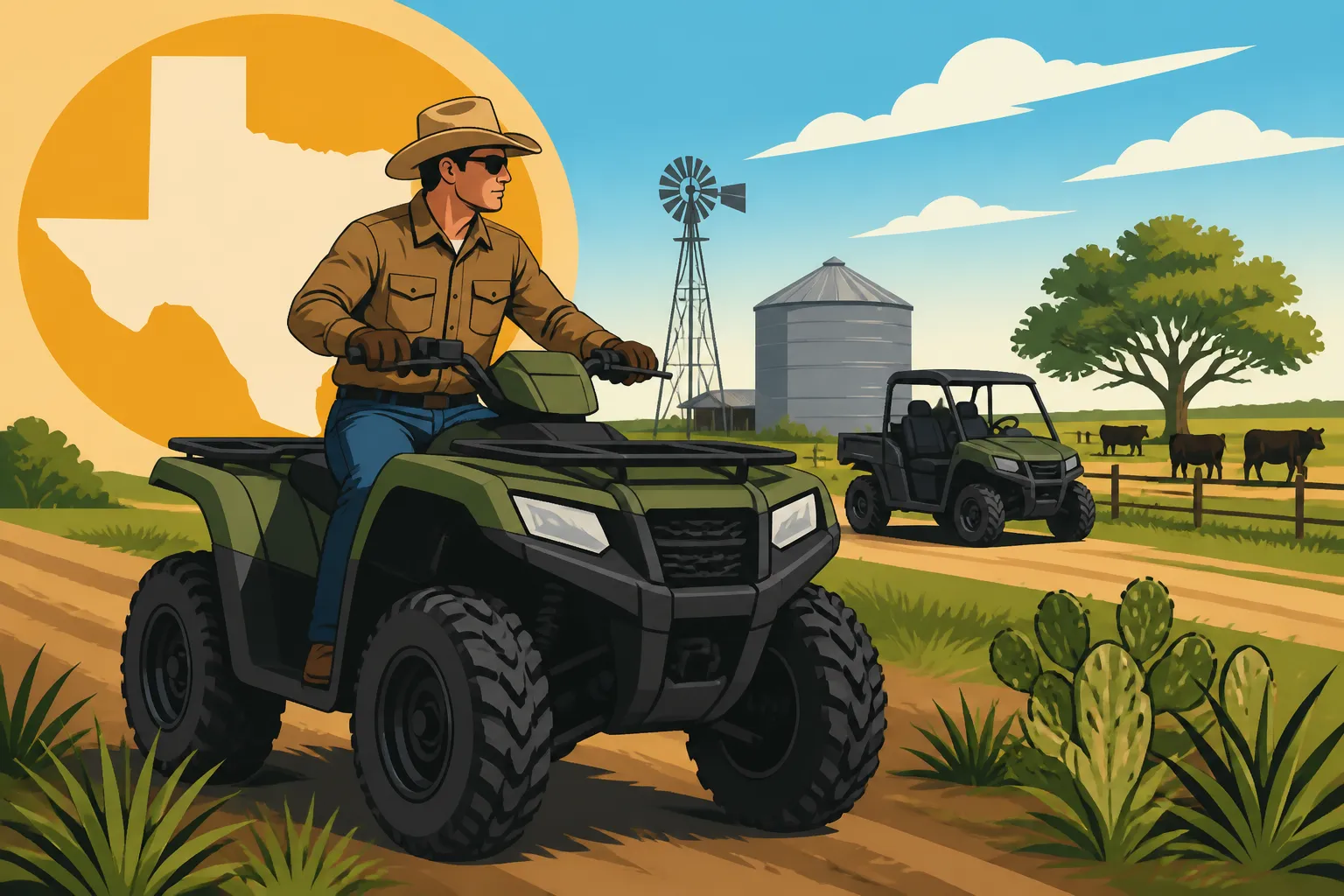
Riding an ATV for a Texas Agricultural Operation
It can be incredibly frustrating when you've got a ranch full of tasks, a trusty ATV or UTV ready to work, but you're constantly second-guessing whether you can legally take it down the road for a quick trip. Texas law around off-highway vehicles (OHVs) and public roads can feel like a tangled barbed-wire fence, especially for those of us trying to use our machines for legitimate agricultural work. This guide is here to untangle those rules, clarify your rights, and help you understand exactly when and how your ATV or UTV can legally hit the pavement for your Texas agricultural operation.
The Basics of Agricultural Use Exemptions
When you’re out on the ranch, your ATV or UTV isn't just a recreational toy; it's a vital piece of equipment, a workhorse that helps you manage livestock, haul feed, repair fences, and tackle a million other jobs. Texas law acknowledges this crucial difference, offering specific exemptions for vehicles used in agricultural operations. It’s not a free pass to ride anywhere, anytime, but it does provide necessary allowances that recreational riders don’t enjoy. Understanding these foundational exemptions is key to staying compliant and productive.
What Qualifies as an "Agricultural Operation"?
The term "agricultural operation" in Texas isn't just limited to growing crops. It's a broad definition that covers a wide range of activities essential to farming, ranching, and even timber production. Think about all the tasks you perform daily, weekly, or seasonally on your land. This could include moving cattle from one pasture to another, hauling tools to a distant fence line that borders a public road, transporting feed to troughs, or spraying pesticides in fields. It also extends to timber operations, like moving small equipment or surveying land. The key is that the activity must be directly related to the production of food, fiber, or timber. [Texas Agricultural Exemption for ATVs on Roads] delves deeper into these specific classifications.
A common scenario might involve a rancher needing to take their side-by-side a quarter-mile down a county road to access a separate section of their property where the cows are grazing. Another example is a farmer needing to quickly check irrigation lines along a field that runs parallel to a farm-to-market road. These aren't joyrides; they are necessary movements for the day-to-day management and maintenance of an active agricultural business. It's about efficiency and practicality, allowing you to get the job done without having to load your machine onto a trailer for a short hop.
The Core Exemption: Why Your Ranch Quad Isn't Just Any OHV
The main reason your ranch quad or UTV gets special treatment is because it's considered an implement of husbandry or machinery used for agricultural purposes, rather than solely a recreational off-highway vehicle. The Texas Transportation Code makes clear distinctions here. For recreational riders, off-highway vehicles are generally prohibited from public roads, with only very specific and limited exceptions. However, when your machine is genuinely serving an agricultural purpose, the state recognizes its utility and allows for controlled use on certain public thoroughfares.
This exemption is designed to support the agricultural community, recognizing that ranchers and farmers often need to traverse short distances on public roads to connect parts of their property or access fields. It's a pragmatic approach to a rural reality. Without these provisions, agricultural operations would face significant logistical hurdles and increased costs, having to transport vehicles by truck and trailer for every minor road crossing or short drive. It highlights the state's commitment to enabling efficient agricultural practices, distinguishing true work vehicles from weekend playthings. [Why Even a Pasture Machine Gets Titled] explains why even these workhorses need a proper title.
Navigating Public Roads for Farm Work
So, you've established your ATV or UTV is being used for a legitimate agricultural operation. That's a huge step! But it doesn't mean every road is open to you. Texas law is quite specific about which public roads you can use, and under what conditions. It's about knowing the boundaries and understanding the limitations to ensure you're always operating within the law. Breaking these rules, even with good intentions, can lead to fines and headaches you don't need when you've got work to do.
Specific Road Types You Can Use
Texas law identifies several categories of roads where OHVs used for agricultural purposes are permitted, often with specific caveats. The most common are farm-to-market roads, ranch-to-market roads, county roads, and sometimes certain city streets or subdivision roads, particularly in rural or master-planned communities that have opted in. The key factor often revolves around speed limits and the nature of the road. Roads with posted speed limits of 35 miles per hour or less are generally more permissible, as they represent lower traffic volumes and slower speeds, making OHV use less disruptive and safer. [Texas Rules for Riding a Farm Road] offers more detail on these specific road classifications.
For example, if your ranch borders a county road with a 30 mph speed limit, you can likely use your UTV to check fences along that stretch or move hay from one field to another that's across the road. However, you generally can't take that same UTV onto a major state highway, even if it's agricultural work. The intent is to allow necessary agricultural movement on lower-traffic, lower-speed roads where the impact on general public safety is minimal. Always double-check local ordinances for city streets or subdivision roads, as some municipalities might have their own specific rules or prohibitions, even within the broader state allowances.
Distance Limitations and Exceptions
This is where it can get a little tricky, as different scenarios come with different distance rules. For general agricultural use, there's often a general understanding that the travel should be "incidental to the normal operation of the farm or ranch." While the law doesn't always specify a hard mileage limit for every single instance, it emphasizes that the road use must be directly tied to the farm work and not just convenient for personal travel.
However, there are clearer guidelines for certain situations. For example, if you're riding to move feed or supplies, or to access different parts of your property, the travel is often limited to a reasonable distance necessary to complete the agricultural task. For volunteer firefighters responding to an emergency, they may ride up to 10 miles from their station. For utility workers, it's typically 25 miles from their point of origin to their destination. For a rancher, think about the most direct and shortest route possible. If you need to haul equipment that's 5 miles away, that's likely permissible. If you're driving 20 miles to a town for groceries, even if you pass your farm, that's likely not covered. The emphasis is always on the purpose and necessity of the journey for the agricultural operation itself.
Crossing Highways and Divided Roads
Sometimes, your agricultural operation requires you to get from one side of a major road to another. This is perhaps one of the most hazardous maneuvers an OHV operator can make, and Texas law has very specific requirements to ensure safety. You cannot simply drive across a busy highway willy-nilly. The rules mandate a highly cautious approach to minimize risk for both the OHV operator and other motorists. [Crossing a Highway on an ATV in Texas] provides a full breakdown of these critical safety measures.
When crossing a highway, you must approach the road at a point where you have clear sight lines in both directions, allowing you to safely assess oncoming traffic. You are required to come to a complete stop before entering the main lanes of traffic, ideally on the shoulder or at a designated crossing point. The law also stipulates that you must cross at a right angle to the lanes of traffic. This means heading straight across, not attempting to merge or make a diagonal turn into traffic. This ninety-degree approach minimizes your time in the travel lanes and makes your intentions clearer to other drivers. Furthermore, if you are crossing a divided highway, you must treat each side as a separate crossing, stopping in the median before proceeding across the second set of lanes, ensuring safety at every stage. This isn't just a suggestion; it's a legal requirement aimed at preventing serious accidents.
Essential Equipment and Rider Requirements
Just because you're using your ATV or UTV for agricultural work doesn't mean you can throw caution to the wind. Safety is paramount, and Texas law outlines specific equipment and rider requirements that remain in place, even under agricultural exemptions. These rules are designed to protect you, your passengers, and other drivers on the road. It’s about making your presence known and ensuring you have adequate protection should an incident occur.
Visibility and Lighting
When you're operating an OHV on a public road, even for agricultural purposes, being seen is critical. Other vehicles, especially larger and faster ones, might not expect an ATV or UTV to be on the pavement. Texas law addresses this by requiring certain visibility enhancements. The most notable is the requirement for a bright orange flag. This flag must be mounted on a staff or pole that extends at least 6 feet above the ground, making your vehicle more noticeable, particularly in areas with tall crops or uneven terrain that might obscure your machine. [The 6-Foot Orange Flag Texas Requires] explains how to properly install and use this flag.
Beyond the flag, your OHV must be equipped with headlights and taillights. While agricultural use often occurs during daylight hours, these lights should be functional and used, especially if visibility is poor due to weather conditions or if you anticipate operating near dusk or dawn. The law states that even during daylight hours, if an OHV is being operated on a public road, its headlights and taillights should be on. This is an additional layer of safety to ensure you're as visible as possible to other motorists. While many aftermarket companies, including SuperATV, offer fantastic lighting upgrades for off-road visibility, ensure any road-specific lighting modifications meet legal requirements and don't create glare for other drivers.
Helmet and Eye Protection Rules
This is one area where agricultural use often differs significantly from recreational riding. For most recreational OHV use on public land or designated trails, Texas law mandates helmets for all riders under the age of 18, and eye protection for all riders (unless the vehicle has a windshield). However, for ATVs and UTVs used strictly for agricultural purposes on public roads, the helmet requirement is often waived, particularly for adults. [When Farm Work Waives the Texas Helmet Rule] goes into depth about these waivers.
This waiver acknowledges the practicalities of farm work, where adults might be constantly dismounting and remounting their machines for short tasks. However, it's crucial to understand the limitations. If your vehicle has a roll cage, and you are wearing a seat belt, this also often exempts you from helmet requirements while operating on an agricultural excursion. While the helmet may not be legally required for adults in these specific agricultural scenarios, eye protection is still generally a wise choice and often legally required if your vehicle doesn't have a windshield. Flying dust, debris, or insects can seriously impair your vision and cause an accident. Always prioritize safety, even when a legal exemption applies.
Passenger and Cargo Rules
Carrying passengers and cargo on an ATV or UTV for agricultural work also has specific guidelines. The fundamental rule is that any passenger must be seated in a manufacturer-designed and designated seating area. This means no riding on the fenders, handlebars, or standing in the bed of a UTV while it's in motion on a public road. These rules are in place for obvious safety reasons; improperly seated passengers are at a much higher risk of injury in the event of a sudden stop or turn, let alone an accident.
When it comes to cargo, you can certainly use your ATV or UTV to transport feed, tools, fencing materials, or other supplies essential for your farm. However, the cargo must be properly secured and not extend beyond the vehicle in a way that creates a hazard. Overhanging loads that block lights, obscure your view, or pose a risk to other vehicles are prohibited. The weight of the cargo must also be within the manufacturer's specified limits for your machine. Overloading can compromise steering, braking, and stability, making your OHV dangerous to operate, especially on paved surfaces. Think about distributing weight evenly and using tie-downs to prevent shifting during transit.
Title, Plate, and Decal Considerations for Ag Machines
Even if your ATV or UTV is a dedicated ranch machine, only ever seeing dirt and dusty roads, it still has to fit into Texas's vehicle classification system. This often brings up questions about titles, license plates, and OHV decals, which can be confusing given the agricultural exemptions. The good news is that the state tries to make it straightforward for producers, but it requires you to understand the specific paperwork that applies to your situation.
Why a Title is Still Necessary
Many ranchers and farmers operate under the impression that if a machine never leaves private land, it doesn't need a title. This is a common misconception. In Texas, all new off-highway vehicles (OHVs), including ATVs and UTVs, must be titled. This isn't primarily about road use; it's about establishing ownership, much like a deed for land. A title provides legal proof that you are the rightful owner of the machine. This is crucial for several reasons: if the vehicle is stolen, for insurance purposes, or most importantly, when you eventually go to sell it. [Titling an ATV in Texas] outlines the entire process.
Even if your "pasture machine" literally never leaves your property, having a title is your best protection. Imagine trying to sell an ATV without a title – it immediately raises red flags for potential buyers and significantly complicates the sale, often forcing you to sell it for less than it's worth. The titling process itself is fairly simple, typically done through your county tax assessor-collector's office. It's a one-time process for the life of the machine in Texas, and it's well worth the effort for the peace of mind and legal clarity it provides.
The Texas OHV Plate and Agricultural Exemption
This is where agricultural operations get a significant break. Texas has an "Off-Highway Use Only" license plate, often referred to as an OHV plate, that is issued for ATVs, UTVs, and other OHVs. This plate is generally required if you plan to operate your OHV on public roads for recreational purposes in the few specific scenarios where it's allowed (like crossing roads or in certain open communities). However, for legitimate agricultural operations, an OHV plate is typically not required for the incidental road use we've been discussing. [Why a Texas OHV Plate Never Expires] clarifies the nature of this unique plate.
This means you don't have to worry about applying for and displaying an OHV plate on your ranch quad or UTV if its road use is strictly for farm-related tasks. The agricultural exemption for road use essentially bypasses the need for this particular plate. This saves you a step and a fee, streamlining the process for those whose machines are primarily tools for their livelihood. It's a key distinction that separates agricultural operators from recreational riders in terms of road-legal requirements.
Sales Tax Exemptions for Ag Purchases
One of the most valuable financial benefits for agricultural operators purchasing ATVs or UTVs is the potential for sales tax exemption. Texas law allows for certain purchases of machinery and equipment used primarily for agricultural production to be exempt from state sales tax. This can represent a substantial saving on a new machine. To claim this exemption, you'll need to demonstrate that the ATV or UTV is being used for qualifying agricultural or timber operations.
This is typically done by presenting an "Ag/Timber Number" issued by the Texas Comptroller of Public Accounts when you purchase the machine. When you're filling out the necessary forms, like the Texas Title Application (Form 130-U), there's a specific section to enter this Ag/Timber Number if you're claiming the exemption. If you buy from a dealer, they will usually guide you through this. If you purchase from a private seller, you'll still need to ensure you have your Ag/Timber Number and properly document the sale as tax-exempt on your paperwork. [Ag and Timber Exemptions on Form 130-U] and [Entering an Ag Number on the Form] are essential reads if you plan to claim this benefit. It's important to keep accurate records to support your claim, should the state ever audit your use of the exemption.
Common Misconceptions and Practical Advice
The rules around using ATVs and UTVs for agricultural operations in Texas, while intended to be helpful, can still lead to confusion. There are many myths and misunderstandings floating around that can land you in hot water if you're not careful. Let's clear up some of those common pitfalls and offer some practical advice to ensure you're always operating safely and legally.
What Doesn't Make Your ATV Street Legal for Ag Use
A frequent misconception is that by adding certain accessories or making modifications, you can somehow turn your agricultural OHV into a fully street-legal vehicle for any purpose. This simply isn't true in Texas. Adding turn signals, a horn, mirrors, or even a windshield, while potentially increasing safety, does not magically transform your ATV or UTV into a vehicle that can be registered for general road use. The agricultural exemption is for its purpose and limited use on specific roads, not because the vehicle itself has been "converted." While a company like SuperATV offers fantastic aftermarket accessories for off-road performance, these won't typically alter its legal status for road use under ag exemptions.
Texas law is very clear: ATVs and UTVs, by their fundamental design, are considered off-highway vehicles. They lack many of the safety and emissions features required for regular street registration, and the state does not offer a pathway to make them generally street-legal. The agricultural use exemptions are precisely that—exemptions for specific circumstances, not a means to bypass the core classification of the vehicle. Trying to stretch these exemptions beyond their intent or hoping modifications will change their legal status is a recipe for tickets and potential liability issues.
Proving Agricultural Use if Questioned
If a law enforcement officer pulls you over while you're operating your ATV or UTV on a public road under an agricultural exemption, you'll need to be able to demonstrate that your use is legitimate. This isn't typically an issue for bona fide farmers and ranchers, but it's good to be prepared. The most straightforward way to prove agricultural use is by having the machine titled in your name with a clear history of agricultural work. Your Ag/Timber Number, if you have one and used it for purchase, can also serve as supporting documentation.
Furthermore, the context of your operation will speak volumes. If you're hauling fencing supplies, moving livestock, or transporting equipment between fields, it's evident that it's for an agricultural purpose. You should be able to articulate what specific task you are performing and how it relates to your farm or ranch operation. Having some basic identification, like your driver's license, and being able to show proof of ownership (your title or registration receipt) for the machine are always good practices. An officer is generally looking to distinguish genuine agricultural work from someone trying to use the exemption for recreational travel.
Best Practices for Safety and Compliance
Operating an OHV on any public road, even under agricultural exemptions, carries inherent risks. Beyond simply complying with the law, adopting best practices for safety and compliance is crucial.
| Aspect of Use | Best Practice for Ag Operations |
|---|---|
| Route Planning | Always choose the shortest, lowest-traffic route. Avoid busy highways. |
| Visibility | Use your orange flag, keep headlights/taillights on (even during day). Wear bright clothing. |
| Speed | Adhere strictly to posted speed limits, especially 35 mph or less roads. Adjust for conditions. |
| Cargo Management | Secure all loads, distribute weight evenly, stay within manufacturer limits. Don't obstruct view. |
| Rider Safety | Wear appropriate PPE (eye protection always, helmet if desired), ensure passengers are in designated seats. |
| Vehicle Condition | Ensure brakes, tires, and lights are in good working order before road use. |
| Documentation | Carry your driver's license, proof of OHV ownership (title/registration). Be ready to explain your agricultural task. |
| Local Ordinances | Always check with your county or local municipality for any specific local rules for OHVs on roads. |
Always remember that these exemptions are a privilege, and misusing them can lead to their revocation or stricter enforcement. Stay alert, drive defensively, and make your agricultural operations as safe and efficient as possible while respecting Texas law.
Disclaimer
This article is for general informational purposes only and does not constitute professional advice. Laws, prices and regulations vary by location and change over time. Consult a qualified professional for guidance on your specific situation.