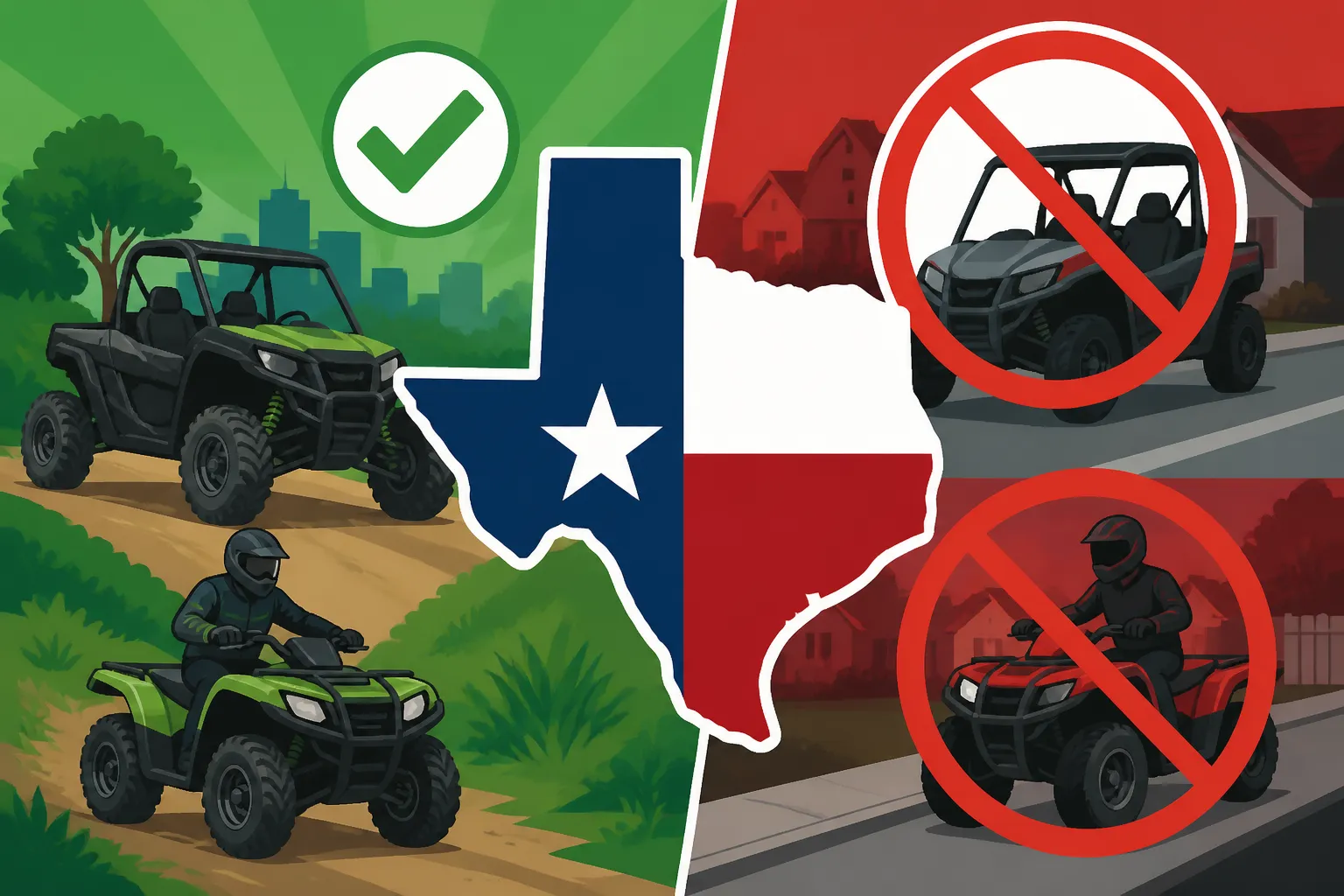
What Texas Cities Can and Cannot Allow
It can feel incredibly frustrating to own an ATV or UTV in Texas and constantly wonder if you can legally take it down the street to a friend's house, the corner store, or even just to move it from one part of your property to another. The rules around off-highway vehicles (OHVs) on public roads in Texas are notoriously complex, with a mix of state laws, county decisions, and city ordinances that can leave your head spinning. This guide will cut through the confusion, explaining precisely what Texas cities can and cannot allow when it comes to riding your off-road machine on their streets.
The Blanket State Law Against OHVs on Public Roads
Let's start with the foundational truth: Texas state law generally takes a pretty firm stance against ATVs and UTVs operating on public roads. This isn't just a suggestion; it's the default legal position, and it's the biggest hurdle for anyone hoping to make their off-roader a regular street machine.
Understanding the Core Prohibition
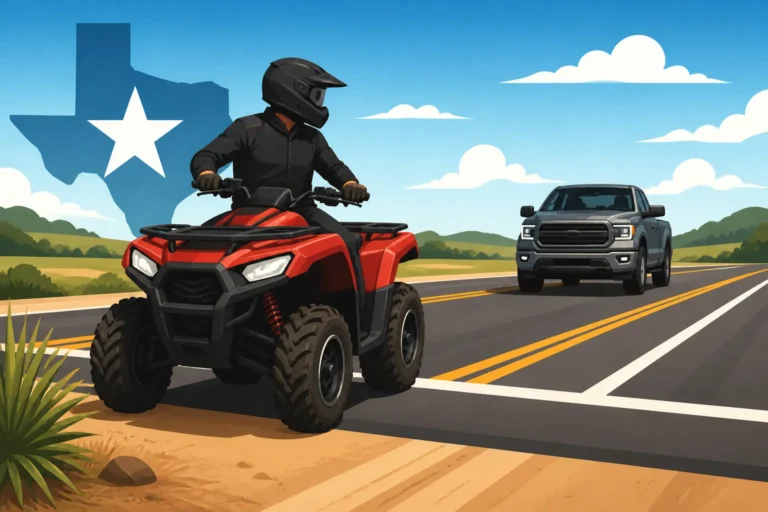
The Texas Transportation Code is quite clear: an off-highway vehicle is generally prohibited from operating on a public road, street, or highway. When we talk about "public roads," we're not just referring to major highways; this includes virtually all city streets, county roads, and state-maintained routes. The reasoning behind this prohibition is rooted in safety and the fundamental design of these vehicles. ATVs and UTVs are built for rugged, uneven terrain, not for the smooth, high-speed, multi-directional flow of typical road traffic. They often lack critical safety equipment required for street vehicles, such as turn signals, proper headlights and taillights for night use, rearview mirrors, and, crucially, a vehicle identification number (VIN) that qualifies them for street registration.
It's a tough pill to swallow for many owners who invest heavily in their machines, but the state's primary concern is preventing accidents between these specialized vehicles and conventional road traffic. This blanket prohibition is why so many people get confused, as it truly feels like a hard "no" no matter what. If you've ever asked, [Are ATVs Street Legal in Texas: The Short Answer] is generally a resounding "no" for good reason.
Why Cities Can't Just Say "Yes" to Everything
Cities in Texas operate within the framework of state law. While many Texas cities are "home rule" cities, meaning they have a greater degree of self-governance than "general law" cities, this autonomy does not grant them the power to override state statutes regarding vehicle operation on public roads. A city cannot simply pass an ordinance that says, "All ATVs and UTVs are welcome on our streets!" if state law prohibits it. Their authority to permit OHV use on roads is limited to specific exceptions carved out by the state Legislature.
This creates immense frustration for residents. You might live in a small town with minimal traffic and perfectly good roads, wondering why you can't just run to the gas station on your UTV. It feels illogical when your machine, perhaps a well-equipped UTV, seems perfectly capable. However, the city council's hands are often tied. They can only create ordinances that are consistent with, or specifically permitted by, state law. So, while it might seem like a local issue, the fundamental "yes" or "no" for general street use often comes from Austin, not your city hall.
Specific State-Mandated Exceptions Cities Must Honor
Despite the general prohibition, Texas state law does include a handful of very specific exceptions that allow OHVs on public roads under certain circumstances. Crucially, cities cannot prevent OHV use when these state-mandated exemptions apply, though they can, and often do, enforce the strict conditions attached to them.
Agricultural and Timber Operations
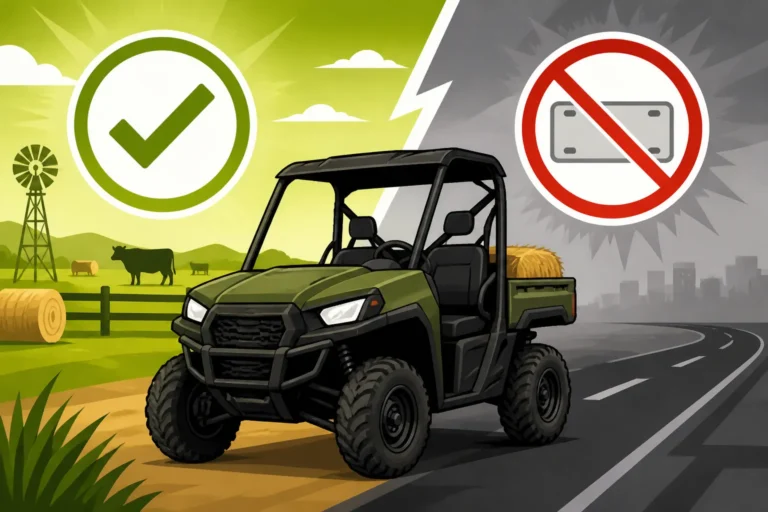
One of the most common and vital exemptions in Texas is for agricultural and timber operations. If you're using your ATV or UTV primarily for work on a farm, ranch, or timberland, the state allows you to operate it on public roads to travel between properties or to access fields, provided you meet certain conditions. This is a huge relief for ranchers and farmers who often need to move equipment or check livestock across public rights-of-way.
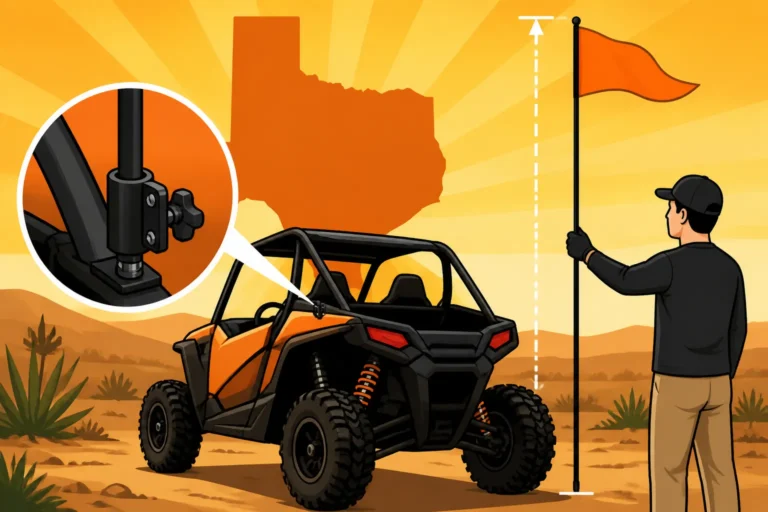
However, "agricultural use" isn't a free pass. The machine must be operated during daylight hours, cannot exceed 25 miles from its point of origin to its destination, and must have specific lighting and a 6-foot orange safety flag mounted high enough to be seen. You also can't just take it for a joyride under the guise of "agricultural use." Cities cannot prohibit this type of use within their limits, but they absolutely will ticket you if you're caught breaking the conditions. For example, a rancher driving their side-by-side across a two-lane county road that briefly enters city limits to get to another pasture is generally permissible under these rules, provided they adhere to all the safety and distance requirements. Understanding [Texas Agricultural Exemption for ATVs on Roads] is key for rural landowners.
Utility and Emergency Response Vehicles
Another critical state-level exemption exists for OHVs used by utility service providers and emergency response personnel. Think of a power company crew using a UTV to access a hard-to-reach power line after a storm, or a fire department deploying a specialized ATV for wildfire response or medical emergencies in rugged terrain. These vehicles are considered essential for public safety and infrastructure maintenance.
Cities cannot pass ordinances that restrict these specific types of OHV operations on their streets. When a utility company needs to get to a downed pole in a residential subdivision, or a search and rescue team needs to navigate floodwaters, they can utilize their OHVs on public roads. Again, these are not blanket permissions for anyone; they are tied directly to the performance of official, critical duties. If you've ever seen a utility crew on a UTV in town, it's almost certainly operating under this specific state exemption. For more details, look up [Texas Rules for Riding a Utility Right of Way].
Limited Local Discretion for Specific Vehicle Types and Areas
While cities generally can't open all roads to all OHVs, the state has granted them limited discretion to allow certain types of vehicles, or OHVs in very specific geographical contexts, on public streets. This is where a lot of the local variation and confusion comes into play.
Golf Carts and Low-Speed Vehicles (LSVs)
This is a big one and often conflated with ATVs and UTVs, leading to misunderstandings. Golf carts and Low-Speed Vehicles (LSVs) are treated differently under Texas law and have their own set of regulations. An LSV, for instance, is a four-wheeled vehicle with a top speed of 20-25 mph that meets specific federal safety standards, including headlights, taillights, turn signals, mirrors, and seatbelts. Golf carts, on the other hand, typically have a top speed of 20 mph or less and fewer mandated safety features.
Texas law allows cities and counties to pass ordinances permitting golf carts and LSVs on certain public streets. These ordinances usually come with strict conditions: they might only apply to roads with speed limits of 35 mph or less, require the vehicle to be operated during daylight hours, and often restrict their use to within a certain distance of the owner's home or a golf course (e.g., 2 miles from where the machine is parked). So, if you see your neighbor tooling around town in a golf cart, it's likely because your city has passed a specific ordinance allowing it, not because all OHVs are suddenly street legal. It's crucial to understand that these rules are distinct from those governing ATVs and UTVs. For those interested in the specifics, [Texas Golf Cart Plate Rules] can offer clarity.
Master Planned Communities
Another unique carve-out in Texas law applies to master-planned communities. These are typically large residential developments with their own internal road networks, often featuring amenities like golf courses, parks, and retail centers. The state allows for OHVs (including ATVs and UTVs) to be operated on roads within these communities, provided the development was created with an approved plat and includes uniform covenants that permit such use.
The city's role here is usually in the initial approval of the master plat, which includes the provisions for OHV use. Once approved, the community's own rules (the covenants) govern the operation of these vehicles on what might otherwise appear to be public streets. This isn't a city-wide permission, but rather a localized exception within a very specific type of private development that often mimics public infrastructure. For residents in these areas, it means they might be able to use their UTVs to visit neighbors or access community facilities. If you're fortunate enough to live in such a community, upgrading your UTV with a sturdy windshield from a reputable brand like SuperATV, or adding a turn signal kit, can greatly enhance safety and usability within those approved boundaries. These modifications make sense when you have a legal avenue to use your machine on designated community roads, allowing you to ride your UTV to the clubhouse and back with added peace of mind. Check out [What an Approved Plat Means for Street Riding] for more details.
Where Cities Have the Power to Open Roads Under Strict Conditions
Beyond golf carts and master-planned communities, there are very limited, geographically specific circumstances where Texas law allows cities (or counties) to open certain roads to OHV traffic. These are highly specific exceptions that often lead to frustration for those living outside these areas, as they highlight the inconsistencies in state law.
Red River Counties and Guadalupe River Counties
This is where things get truly niche. Texas law has, in very specific instances, allowed counties and the cities within them to "opt-in" to allowing OHVs on certain public roads. For example, some counties adjacent to the Red River (the border with Oklahoma) have been granted the authority to permit OHVs on public roads with speed limits of 35 mph or less, under certain conditions. This was largely to accommodate the unique recreational opportunities and cross-border traffic patterns in those areas.
Similarly, there's a specific and complex set of rules for counties that include a barrier island and have a portion of the Guadalupe River flowing through them. These counties, and their constituent cities, may be able to allow OHVs on certain roads. These are not widespread, statewide options; they are legislative responses to unique regional circumstances. If you don't live in one of these specific counties, your city likely doesn't have this particular power. It's incredibly frustrating for residents in other parts of the state to see these allowances, because it makes the rules feel arbitrary and unfair. You might ask, [Riding Roads in a Red River County] or [Which Guadalupe County Roads an ATV May Use] – and the answer is that these are very particular situations.
Small Counties (Population Under 37,000)
Another specific legislative allowance is for counties with a population of less than 37,000. These smaller, more rural counties can, by official action of their Commissioners Court, permit the operation of OHVs on public roads with a posted speed limit of 35 mph or less. If a county takes this action, the cities within that county are generally bound by it and cannot prohibit OHV use on those designated county roads within their city limits.
However, just because a county can do this doesn't mean it will. Many still choose not to, citing safety concerns or simply a lack of public demand. Even if a county does permit it, the same conditions about daylight operation, proper lighting, and adherence to speed limits typically apply. This provides a glimmer of hope for some Texans in less populated areas, but it requires local government action and is not automatic. If you reside in such a county, it's worth checking with your County Clerk or Commissioner's Court. [Counties Under Thirty-Seven Thousand People] details this particular exemption.
What Cities Absolutely Cannot Allow
While cities have some limited discretion, there are fundamental aspects of OHV road use that they simply do not have the authority to permit. Understanding these limitations is just as important as knowing the exceptions.
General Street-Legal Conversion
A common misconception is that if you add enough aftermarket parts—like a horn, mirrors, turn signals, and a windshield—your ATV or UTV becomes "street legal," and a city can then allow you to drive it anywhere. This is unequivocally false for general public road use. Adding accessories, no matter how comprehensive, does not change the fundamental classification of an off-highway vehicle under Texas state law. These machines do not meet the federal motor vehicle safety standards (FMVSS) required for registration as a street-legal vehicle, nor do they typically have a VIN that can be registered for highway use.
A city cannot declare your modified ATV or UTV "street legal" or grant you permission to operate it on roads unless it falls under one of the state-defined exceptions we've discussed. It doesn't matter if you've put hundreds of dollars into making your UTV look like a mini-truck; if the state says it's an OHV and not compliant for road use, a city cannot magically change that. This is why [Why an Altered Quad Still Cannot Be Plated] is a crucial piece of knowledge for any enthusiastic modifier. While reputable brands like SuperATV offer fantastic aftermarket parts that enhance safety and utility for off-road riding, these parts alone do not confer street legality on a machine in Texas.
Allowing OHVs on State or Federal Highways
Cities operate within their municipal boundaries, but even within those boundaries, their authority isn't absolute. Texas state highways (like U.S. routes, state highways, and even many Farm-to-Market roads, which often pass through city limits) and federal roads are entirely under the jurisdiction of the state (Texas Department of Transportation) or federal government.
A city cannot pass an ordinance permitting OHVs on these state or federal roads. The few exceptions that exist for OHV use on these types of roads (e.g., for agricultural purposes, utility work, or in very specific "red river" or "barrier island" counties) are state-level exceptions that cities simply enforce or acknowledge. They do not have the power to create new ones. If you're on a major thoroughfare that happens to run through a city, chances are the rules are dictated by TxDOT, not the local city council. This is a common point of confusion, particularly when a farmer needs to cross a state highway. For more on this, check out [Crossing a Highway on an ATV in Texas].
Navigating Local Ordinances and Staying Legal
Given the patchwork of state laws and local discretions, how can you, as an ATV or UTV owner, confidently know what's allowed in your area? It boils down to diligent research and a clear understanding of consequences.
Researching Your Local Rules
The absolute best advice is to never assume. If you're considering riding your ATV or UTV on any public road within a city or county, you must do your homework. Start by checking the municipal code or ordinances on your city's official website. Look for sections related to "off-highway vehicles," "golf carts," or "motorized vehicles." If the website isn't clear, contact your city clerk's office or the local police department. They are the best resources for current, hyper-local information.
Remember that rules can vary wildly even between neighboring towns. What's allowed in one small town in a specific county might be strictly prohibited just a few miles down the road in another city. Asking neighbors or relying on outdated information from online forums is risky. Always get information directly from official sources to ensure you are compliant with the most up-to-date regulations.
Consequences of Illegal Use
Riding an ATV or UTV on a public road where it's not permitted can lead to significant consequences. Typically, these violations are treated as Class C misdemeanors under Texas law, which can result in substantial fines. Beyond the financial penalties, your vehicle could be impounded, leading to additional towing and storage fees. More importantly, illegal road use poses a significant safety risk. The consequences of an accident involving an OHV on a public road can be severe, not only for the rider but for other motorists and pedestrians.
It's tempting to think you might "just quickly" run to the store or cut across a street, but the risks are real. Law enforcement agencies are generally well aware of the state's OHV laws and local ordinances, and they will enforce them to ensure public safety. Don't let a moment of convenience turn into a costly and potentially dangerous legal headache. Knowing [Class C Misdemeanors Under Texas OHV Law] is a good deterrent.
| Category | State Law Default | City Discretion (State-Granted) | What Cities Cannot Allow |
|---|---|---|---|
| General OHV Road Use | Prohibited | Limited exceptions only (see below) | Blanket "street legal" conversion by adding accessories |
| Agricultural/Timber Use | Permitted (under strict conditions) | Cities must honor this state exception | Prohibiting legitimate agricultural/timber use |
| Utility/Emergency Use | Permitted (for official duties) | Cities must honor this state exception | Prohibiting essential utility/emergency use |
| Golf Carts/LSVs | Separate category, more flexible state rules | Can permit on specific low-speed roads (ordinance needed) | Allowing golf carts/LSVs on high-speed roads |
| Master Planned Communities | Specific state allowance for these developments | Can approve plats with OHV provisions | Opening all city roads based on this specific rule |
| Red River/Guadalupe/Small Counties | Niche state allowances for specific regions | Can opt-in to allow OHVs on 35 mph roads (by county/city) | Extending these exceptions to other counties/cities |
| State/Federal Highways | Prohibited (except state-level exemptions) | Cities have no jurisdiction | Allowing OHVs on state or federal highways |
Disclaimer
This article is for general informational purposes only and does not constitute professional advice. Laws, prices and regulations vary by location and change over time. Consult a qualified professional for guidance on your specific situation.