Why Texas Will Not Register an OHV for the Road
It's incredibly frustrating when you invest in a fantastic off-highway vehicle (OHV) in Texas, whether it's an ATV, UTV, or sand rail, and then discover that despite having a title, you absolutely cannot register it for regular street use. Many folks move here from other states where street-legal conversions are common, only to hit a brick wall with Texas law. This guide will meticulously break down exactly why Texas stands firm on its "off-highway use only" stance for these machines, helping you understand the legal, safety, and practical reasons behind it.
The Core Definition of an Off-Highway Vehicle in Texas
Understanding why Texas prohibits the registration of OHVs for road use begins with how the state defines these machines in the first place. It's not just a casual term; it's a legal classification that fundamentally dictates their purpose and limitations. This definition is the bedrock of all subsequent rules and restrictions.
What Texas Counts as an Off-Highway Vehicle
In Texas, an off-highway vehicle is legally defined in a way that clearly sets it apart from vehicles intended for public roadways. Generally, this definition encompasses all-terrain vehicles (ATVs), recreational off-highway vehicles (ROVs) – which include most modern side-by-sides (UTVs) – and even some custom-built machines like sand rails. The common thread among these is their design: they are engineered specifically for travel over unimproved terrain, not paved streets. This means their suspension, tire type, ground clearance, and even their braking systems are optimized for dirt, mud, sand, and rocks, not high-speed asphalt driving or navigating traffic. You can dive deeper into this specific classification by reading [What Texas Counts as an Off-Highway Vehicle].
For instance, think about the aggressive, knobby tires on your typical ATV. While perfect for gripping loose soil or climbing over obstacles, these tires wear down rapidly on asphalt, reduce braking efficiency, and can make handling unpredictable at road speeds. Similarly, the suspension travel on a UTV designed to soak up massive bumps on a trail would feel floaty and unstable during a sudden lane change on the highway. These are not minor design differences; they are fundamental distinctions that make OHVs ill-suited for the demands of public roads.
The state's legal definition focuses on these inherent design characteristics, recognizing that an ATV or UTV is built for a completely different environment than a car or truck. It's not simply a matter of adding a few accessories; the core engineering of the machine prevents it from meeting the stringent safety standards required for street-legal vehicles. This foundational understanding is crucial for grasping why street registration remains elusive.
The "Off-Highway Use Only" Remark on the Title
When you go to [Titling an ATV in Texas] or a UTV in Texas, you'll notice a significant detail on the official paper title: it's often stamped or marked with "Off-Highway Use Only." This isn't just a suggestion; it's a clear, unequivocal legal declaration of the vehicle's intended purpose and legal limitations within the state. This remark serves as a permanent identifier that the vehicle, by its very design and classification under Texas law, is restricted from regular use on public roads.
This mark is a constant reminder that no matter what modifications you make, or how much you wish it were otherwise, the state considers that machine strictly for off-road environments. It acts as a clear warning to potential buyers and current owners alike, leaving no room for ambiguity about the vehicle's legal status. Even if you've purchased your machine out of state where such a remark might not be common, when you bring it to Texas for titling, this designation will be applied if it falls under the state's OHV definition. You can learn more about this specific designation by checking out [The Off-Highway Use Only Remark on a Texas Title].
This critical notation ensures consistency across all OHV titles issued in Texas, regardless of the vehicle's age, brand, or original point of sale. It's part of Texas's legislative effort to prevent confusion and enforce the distinct separation between vehicles designed for trails and those designed for traffic. It signifies that the machine has been properly identified and categorized by the state as unsuitable for the public road system.
Texas's Fundamental Road Use Philosophy for OHVs
Texas's approach to OHVs on public roads isn't just about technical definitions; it's rooted in a fundamental philosophy regarding public safety and the appropriate use of its infrastructure. The state views its public roads as designed for conventional vehicles that meet specific safety and operational standards, which OHVs, by their nature, generally do not. This underlying principle guides all relevant legislation.
The Statutory Ban on Registration for Public Roads
Texas law explicitly prohibits the registration of off-highway vehicles for use on public roads. This isn't a loophole or an oversight; it's a direct statutory mandate. The Texas Transportation Code clearly outlines the classifications of vehicles permitted on public highways, and ATVs, UTVs, and other OHVs are simply not included among them. While they are recognized for titling purposes, this recognition is purely for ownership tracking and theft prevention, not for granting permission to operate on state roads. This is why you will see titles being issued but never a corresponding road registration.
This ban ensures a consistent legal framework across the entire state, preventing individual interpretations or localized exceptions that could compromise safety or create confusion. It's a clear line in the sand, drawn to maintain the integrity of the state's road network for vehicles designed and built to navigate it safely alongside cars, trucks, and motorcycles. The intention is to keep vehicles that lack the necessary safety features and operational characteristics for public roads off of them entirely.
The legislative decision reflects a comprehensive assessment of risks and responsibilities. By maintaining this strict separation, Texas aims to reduce accidents, simplify enforcement, and protect both OHV riders and the general motoring public. It’s a policy designed to safeguard everyone who shares the road, acknowledging the inherent differences in vehicle design and function.
Why Texas Never Registers an OHV
The question of "Why Texas Never Registers an OHV" boils down to the inherent distinction between what a title represents and what a registration grants. A title in Texas serves primarily as proof of ownership, a document that establishes who legally owns the vehicle. It's essential for buying, selling, and proving legitimate possession of your ATV or UTV, much like a title for a car or truck. However, registration is an entirely different matter.
Registration, in the context of conventional motor vehicles, is what grants a vehicle permission to operate on public roads and highways. It involves demonstrating that the vehicle meets specific safety standards, has valid insurance (if required), and pays applicable fees that contribute to road maintenance and other public services. Because OHVs are fundamentally designed for off-highway use and do not meet the criteria for roadworthiness in Texas, they cannot fulfill the requirements for road registration. You can explore this more in [Why Texas Titles But Never Registers an OHV].
This distinction is crucial: just because you have a title doesn't mean your machine is street legal. Think of it like a boat title – you own the boat, but that title doesn't give you permission to drive it down Main Street. The same principle applies here: the title is for ownership, while registration is for road access, and OHVs simply don't qualify for the latter in Texas.
Safety Concerns and Design Limitations
One of the most significant factors driving Texas's stance against street-legal OHVs is a deeply rooted concern for safety. Off-highway vehicles are engineered with a specific environment in mind, and that environment is vastly different from the conditions found on public roads. The design compromises made for off-road prowess often translate into significant safety liabilities on pavement.
Manufacturer Design for Off-Road Terrain
The very DNA of an ATV or UTV is optimized for challenging, uneven, and often unpredictable off-road terrain. Manufacturers engineer these machines with long-travel suspension systems that absorb impacts, high ground clearance to navigate obstacles, and specialized differentials or four-wheel-drive systems for maximum traction on loose surfaces. Their tires are typically aggressive, deep-lugged, and designed to dig into dirt, sand, or mud, not to provide smooth, quiet, and stable contact on asphalt at higher speeds.
This specialized design, while excellent for the trails, creates inherent disadvantages on public roads. For instance, the soft, long-travel suspension that makes a UTV comfortable over rocky trails can lead to excessive body roll and instability when making sharp turns on pavement. The aggressive tires, essential for grip off-road, can cause a noisy, bumpy, and even dangerous ride on the highway, reducing traction and increasing braking distances on hard surfaces. These are not flaws in the design; they are features optimized for their intended purpose, making them fundamentally incompatible with road conditions.
Manufacturers are very clear about the intended use of their vehicles, often including warnings in owner's manuals against operating them on public roads. This guidance reinforces the state's position that these machines are not built to safely interact with standard road traffic. Even with the best intentions, modifying an OHV can't change these fundamental engineering principles.
Lack of Standard Safety Features for Roadways
Unlike cars and trucks, off-highway vehicles typically lack many of the standard safety features that are legally mandated for road-going vehicles. We're talking about things like properly integrated turn signals, brake lights that are visible in all conditions, headlights with appropriate beam patterns for street use, rearview mirrors that provide adequate visibility, and even robust crumple zones or airbags. While many aftermarket companies, including well-known brands like SuperATV, offer accessories that simulate some of these features for trail riding convenience, these additions do not magically transform an OHV into a vehicle that meets federal motor vehicle safety standards (FMVSS) for street use.
Consider the basic requirements: street-legal vehicles need safety glass windshields, defined seatbelt systems for all occupants that meet crash standards, and even specific emissions controls for sustained road use. Most ATVs have none of these, and while many UTVs now come with roll cages and seatbelts, these are primarily designed for rollovers on trails, not high-speed collisions with heavier road vehicles. The absence of these integrated safety systems is a major red flag for Texas lawmakers and safety advocates, making street registration untenable.
The design gap isn't just about what's missing; it's about what's present but inadequate. For example, OHV lighting systems are typically designed for off-road visibility, not for signaling intentions to other drivers on a busy highway or illuminating the road safely at speed. This lack of inherent road safety features is a critical reason why Texas maintains its strict "off-highway use only" policy.
Rider Skills and Road Environments
Beyond the mechanical design, the skill set required to safely operate an OHV differs significantly from what's needed for driving a car or truck on public roads. OHVs demand active, engaged riding or driving, often involving shifting weight, navigating obstacles, and reacting quickly to changing terrain. This dynamic operation is vastly different from the relatively stable and predictable environment of a paved road.
Introducing an OHV into the complexities of road traffic – with its higher speeds, multi-lane situations, traffic signals, and interactions with larger, faster vehicles – creates a dangerous mismatch. Many OHV riders, while highly skilled off-road, may not possess the specific defensive driving techniques, traffic awareness, and quick decision-making needed for road conditions. The limited visibility from many OHVs, combined with the often loud engine noise, can also make it harder for riders to perceive and react to other vehicles, and for other drivers to perceive the OHV.
Furthermore, the physical demands of controlling an OHV, especially an ATV, for extended periods on pavement can lead to rider fatigue and a loss of control. The constant vibrations, the need to actively steer, and the lack of enclosed protection make them physically taxing over distance. Texas's prohibition reflects an understanding that placing these machines and their riders in a road environment for which they are not prepared would pose an unacceptable risk to everyone.
Legislative History and the "Off-Highway Use Only" Mandate
The current state of Texas law regarding OHVs is not arbitrary; it's the result of specific legislative actions and a long-standing commitment to defining and regulating these vehicles for their intended purpose. Understanding this history helps clarify why the "off-highway use only" mandate is so deeply entrenched.
Evolution of Texas OHV Laws
Texas has had laws pertaining to off-highway vehicles for many years, but these laws have evolved to address new types of vehicles and growing popularity. Originally, many OHVs might have fallen into less defined categories, but as ATVs and UTVs became more prevalent, especially in recreational and agricultural settings, the state recognized the need for clearer regulations. These regulations were primarily aimed at ensuring safe operation off-road, preventing theft, and establishing a clear ownership trail through titling.
A significant shift occurred with the implementation of House Bill 1548 in 2019, which effectively repealed and replaced Chapter 663 of the Texas Transportation Code with a new Chapter 668. This updated legislation explicitly defined OHVs, established titling requirements, and reinforced the "off-highway use only" status. This legislative update didn't introduce the ban on road registration, but rather solidified and clarified the existing prohibition, ensuring that modern OHVs like UTVs were explicitly covered under the same framework as traditional ATVs. This is why you might see older guides referencing the wrong chapter, but the underlying prohibition on street registration has remained consistent.
This evolution demonstrates a clear legislative intent: to create a robust system for identifying and tracking OHVs while firmly distinguishing them from street-legal vehicles. The state's consistent legislative updates have always reinforced the idea that these machines belong on trails and private land, not public thoroughfares.
The Purpose of the Title System
When you obtain a Texas title for your ATV or UTV, it’s a crucial legal document. However, its purpose is often misunderstood. The state's title system for OHVs is primarily designed to establish clear ownership, facilitate legitimate sales and transfers, and aid in the recovery of stolen vehicles. It creates a paper trail for the machine, much like a title for any other valuable asset. This system helps combat theft and ensures that when you buy or sell an OHV, there’s a proper legal record of the transaction. You can read more about the title application process in [The Texas Title Application Every OHV Buyer Files].
The title system also helps the state collect sales or use tax on these purchases, contributing to state revenue. However, and this is the critical point, the existence of a title does not automatically confer the right to operate the vehicle on public roads. It's a document of ownership, not a license for road use. Many people mistakenly believe that once they have a title, they’ve cleared the biggest hurdle to street legality, but this is simply not the case in Texas.
In essence, the title system exists to regulate the ownership and transfer of OHVs as property within Texas, providing a legal framework for these transactions. It’s distinct from a registration system, which would grant permission for operation on public highways. This fundamental separation in purpose is central to understanding [Why Texas Titles But Never Registers an OHV].
Common Misconceptions and What Doesn't Work
It's natural to want to make your OHV as versatile as possible, especially if you live in a rural area or frequently need to traverse short distances on paved roads. This desire often leads to common misconceptions about how to achieve street legality in Texas. Unfortunately, many popular ideas simply don't align with state law.
Why Modifying an ATV Will Not Make It Street Legal
One of the most persistent myths is that by adding certain aftermarket parts – like turn signals, mirrors, a horn, or a DOT-approved windshield – you can somehow transform your ATV or UTV into a street-legal vehicle in Texas. This is a tempting idea, especially when you see companies advertising conversion kits or street-legal accessories. However, it's critical to understand that simply bolting on these items does not change the vehicle's fundamental classification under Texas law. The "Off-Highway Use Only" remark on your title remains, and the statutory prohibition on road registration still applies. You can explore this further in [Why Modifying an ATV Will Not Make It Street Legal].
The issue isn't just about having the parts; it's about meeting the comprehensive federal and state safety standards that a vehicle must adhere to from the factory to be considered street legal. These standards cover everything from crashworthiness to emissions, and they are designed for vehicles specifically engineered for prolonged, high-speed road use. An ATV or UTV, even with all the bells and whistles, typically cannot meet these foundational design requirements.
So, while those high-quality LED turn signals or a rugged rearview mirror from a brand like SuperATV might enhance safety and convenience during off-road excursions or help you in specific, limited road crossing scenarios, they won't make your machine street legal for general road use in Texas. The modifications simply don't override the vehicle's original classification or the state's legal framework.
The Myth of Aftermarket Kits for Road Legality
Following closely on the heels of individual modifications is the widespread belief in "street legal conversion kits" for ATVs and UTVs in Texas. You might find these kits advertised online or hear anecdotes from fellow riders about successfully "plating" their machines in other states using such kits. It's important to clarify that while these kits often include useful components like lights, horns, and mirrors, they are designed to fulfill the requirements of other states or specific, very narrow exceptions within Texas, not to grant general street legality on all public roads.
In Texas, installing an aftermarket kit, no matter how comprehensive, does not change the statutory definition of your vehicle or allow you to register it as a street-legal motor vehicle. There is no provision in the Texas Transportation Code that allows an OHV to be reclassified as a street-legal vehicle through modifications. The state's stance is firm: if it was manufactured as an OHV, it remains an OHV for registration purposes.
This myth can be particularly frustrating and costly for owners who invest significant money and effort into these conversions, only to be met with disappointment and potential legal issues if they attempt to use their "converted" machine on public roads for anything beyond the very specific, limited exceptions allowed by law. It’s crucial to separate the marketing of such kits from the reality of Texas statutes.
Limited Exceptions for Road Use
Despite the general prohibition against street registration, Texas law does recognize a few highly specific and narrowly defined circumstances where off-highway vehicles may be operated on public roads. It's crucial to understand that these are exceptions to the operating ban, not pathways to full street legality or road registration.
Agricultural and Timber Operations
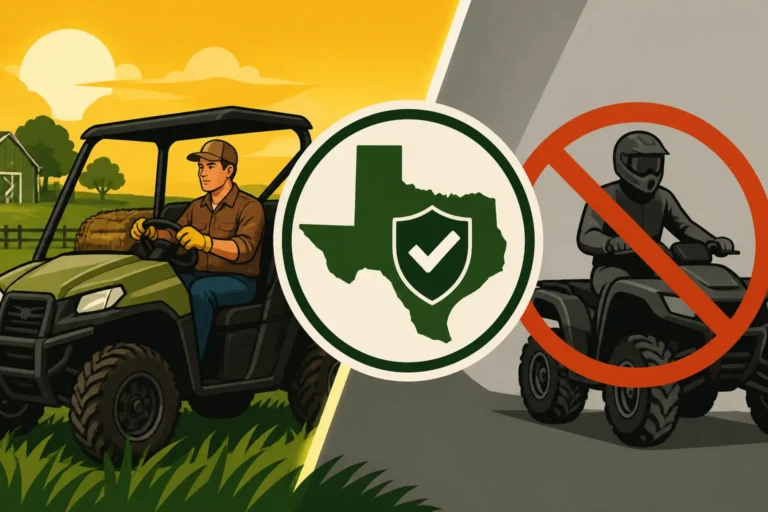
One of the most common exceptions for OHV road use in Texas is tied to agricultural or timber operations. If you're using your ATV or UTV for bona fide farm, ranch, or timber work, you may be permitted to operate it on public roads under specific conditions. This often involves traveling between fields, hauling feed, or performing other tasks directly related to the operation. This allowance recognizes the practical necessity of using these machines as utility tools in rural environments. You can get more details by checking [Texas Rules for Riding a Farm Road].
However, this isn't a free pass for joyriding. The use must be directly related to the agricultural or timber purpose, and there are often restrictions on the type of road (e.g., roads with a posted speed limit of 35 mph or less), the distance traveled, and even the time of day (daylight hours only). For example, you might be able to drive your UTV down a county road to check fence lines on an adjacent pasture, but you couldn't take it into town for groceries, even if you just finished working the fields. It's also important to note that even in these scenarios, the machine is typically exempt from the OHV license plate requirement and often from the OHV decal requirement, precisely because its use is operational, not recreational on public lands. This exemption is distinct from actual road registration, which still isn't available.
To qualify for an agricultural or timber exemption from sales tax when purchasing the machine, you typically need to hold a valid agricultural or timber registration number from the Texas Comptroller of Public Accounts. This further underscores that these are work-related exemptions, not a blanket permission for street use. More information about tax exemptions can be found in [Texas Agricultural Exemption on an ATV Purchase].
Crossing Public Roads and Low-Speed Road Use
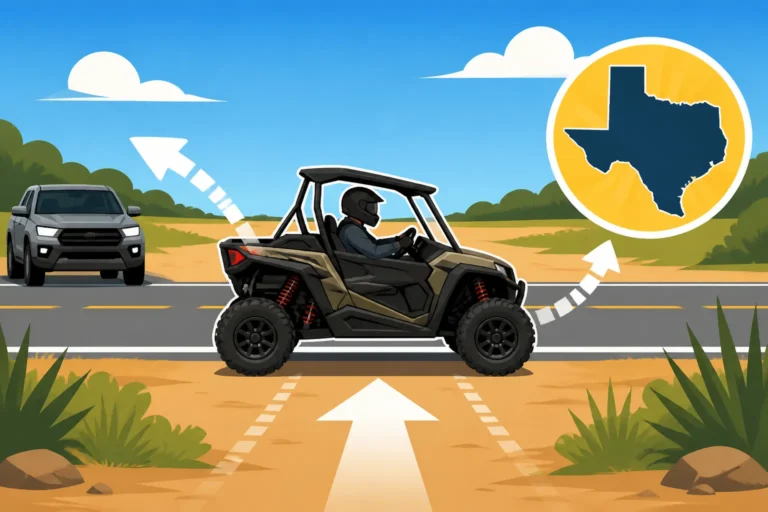
Texas law also permits OHVs to cross certain public roads under very specific circumstances. This is typically allowed when an OHV trail or private property is bisected by a public roadway. The crossing must be made as directly and safely as possible, often at a 90-degree angle to the road, and after yielding to all traffic. This is about facilitating access to continuous off-road areas, not about general road travel. Furthermore, the machine must be equipped with certain safety features like working headlights and taillights, even if it's during the day, to enhance visibility to other motorists. You can find more detailed rules on this specific scenario in [Texas Rules for Crossing a Highway on an ATV].
Beyond crossings, some limited low-speed road use may be permitted in very specific situations, such as on roads with a speed limit of 35 mph or less, and sometimes only for short distances (e.g., up to two miles from where the machine is usually parked or housed). These are rare, often localized allowances, and they come with strict requirements for the vehicle to be equipped with basic safety items like headlamps, taillamps, and reflectors. Again, this is not a form of street registration; it is a grudging acknowledgment of practical realities in certain areas, strictly limited in scope and duration.
It's crucial to consult local ordinances and the Texas Transportation Code directly to understand the exact parameters of these exceptions in your specific location, as they are often very nuanced. Misinterpreting these narrow allowances can lead to fines and legal trouble.
Master Planned Communities and Golf Carts
While this article focuses on ATVs and UTVs, it's worth briefly touching on other low-speed vehicles that sometimes get confused with OHVs in the context of street legality: golf carts and similar machines in master planned communities. Texas law has distinct provisions for golf carts, which are not considered OHVs, allowing them limited road use in specific situations, often within golf course communities or other areas designated by local ordinance. These communities sometimes have private roads or specially designated public roads where golf carts can operate under specific rules, usually during daylight hours and on roads with low-speed limits.
However, it's important to stress that these rules apply to golf carts and sometimes Neighborhood Electric Vehicles (NEVs), which are purpose-built for low-speed street use, and not to typical ATVs or UTVs. A UTV, even if used on a ranch, will likely not fall under the golf cart exception for road use, regardless of how slow you drive it. This distinction is vital because the legal framework for golf carts is entirely separate from that of OHVs.
The existence of golf cart rules often creates confusion for OHV owners, who might assume similar allowances exist for their ATVs or UTVs. Unfortunately, Texas treats these vehicle types very differently under the law, and the strict "off-highway use only" rule for ATVs and UTVs remains largely unaffected by golf cart regulations. You can learn more about this distinct category by checking [Texas Rules for Riding in a Master Planned Community].
The Role of Local Jurisdictions
While the state of Texas maintains a clear stance against registering OHVs for road use, local jurisdictions—counties and cities—do have some limited authority to regulate OHV operation within their boundaries. This local control, however, never overrides the state's fundamental prohibition on general road registration; it merely adds specific nuances to where and how OHVs can be operated in certain areas.
County and City Ordinances
Texas counties and cities may enact ordinances that further restrict or, in very specific cases, allow limited operation of OHVs on certain public roads within their jurisdiction. For example, some very rural counties might have ordinances that permit OHVs on specific low-traffic county roads for access to private property or for agricultural purposes. Conversely, many urban and suburban cities have outright bans on OHV operation on any public street, even for short distances, due to safety concerns and traffic density.
These local rules are often developed to address the unique needs and challenges of a particular area. For instance, counties along the Red River or near specific natural areas might have different rules for riverbed access or specific trails. However, it’s critical to understand that any local ordinance permitting OHV use on a public road is a limited exception to the operating ban, not a form of state registration. It doesn't transform your OHV into a street-legal vehicle for all of Texas; it merely allows its use under strict conditions within that specific locality. Riders must always check with local authorities for the most current and specific regulations before operating an OHV on any public road, even briefly.
Such local rules are often enacted under specific provisions of the Transportation Code that allow local governing bodies to exercise discretion over certain types of vehicles on roads with low speed limits. But this discretion is always within the bounds of state law, which means general road registration for OHVs is still off the table.
How Local Rules Differ from State Registration
It's absolutely essential to distinguish between a local ordinance that might permit limited OHV operation on a specific stretch of road and what state-level registration entails. A county or city ordinance, no matter how permissive, can never grant your OHV statewide street-legal status. It cannot change the fundamental "Off-Highway Use Only" designation on your Texas title, nor can it force the Texas Department of Motor Vehicles (TxDMV) to issue you a standard road registration plate.
The difference lies in the scope and authority. State registration is a formal process that integrates a vehicle into the public road system, requiring it to meet a host of safety and operational standards for widespread use across all public roads in Texas. A local ordinance, on the other hand, is a localized rule, limited in geographic scope and often in the duration or conditions of use. It's an agreement that under these specific conditions, in this specific place, you might be able to move your OHV on a road. This is a very different animal from a vehicle that can legally travel anywhere on public roads, such as a car or truck.
Relying solely on a local ordinance without understanding its limitations can lead to serious legal consequences if you venture outside the permitted area or conditions. Texas's state law on OHVs is designed to provide a uniform baseline, and while local jurisdictions can add specific layers of regulation, they cannot fundamentally alter the statewide classification of an OHV as a non-roadworthy vehicle for general use.
The Distinction Between Titling and Registering
One of the biggest sources of confusion for OHV owners in Texas stems from the difference between having a title for their machine and being able to register it for public road use. These are two fundamentally different processes with distinct legal implications, and understanding this difference is key to grasping why your ATV or UTV won't get a regular license plate for the street.
The Difference Between a Title and Registration
Let's break it down simply: a title is a document that proves you own your ATV or UTV. It establishes legal ownership, much like a deed to a house or a title to a car. When you buy a new or used OHV in Texas, you go through a process at your [Titling at a Texas County Tax Office] to get the title transferred into your name. This title is critical for preventing theft, ensuring smooth sales, and documenting any liens on the machine. It’s about property ownership.
Registration, on the other hand, is the process of officially recording a vehicle with the state and obtaining a license plate that permits it to be operated on public roads and highways. For conventional vehicles, this process involves proving that the vehicle meets safety and emissions standards, has current insurance, and that you've paid all applicable fees and taxes. Registration essentially grants you permission to use the public road infrastructure. For OHVs in Texas, this type of road registration simply does not exist because these vehicles are not classified as roadworthy.
The critical takeaway is that having a Texas title for your OHV doesn't automatically mean you can register it for the street. The state has intentionally separated these functions, providing titles for ownership tracking while strictly prohibiting road registration due to the inherent off-road nature of the machines.
The Texas Off-Highway Vehicle License Plate
You might be thinking, "But I've seen an OHV with a plate on it in Texas!" And you're absolutely right, you might have. However, the "Texas Off-Highway Vehicle License Plate" is not a standard road registration plate. It is a specific, limited-use plate issued by the state, primarily for OHVs used in very specific agricultural or timber operations, or for crossing certain low-speed public roads as part of an off-road journey. It's often referred to as the "Off-Highway Plate" or simply the "OHV Plate." You can learn more about this unique plate by checking [The Texas Off-Highway Vehicle License Plate].
This plate serves a very narrow function: it provides a visible identifier that the vehicle is operating under one of the limited legal exceptions for road use. It helps law enforcement quickly identify that the vehicle is (theoretically) operating within its legal boundaries, rather than being used illegally on the street. Crucially, this plate does not confer general street-legal status. It's not a green light to drive your UTV to the grocery store or commute to work on city streets. It's permission for a highly specific, restricted type of road access.
The OHV plate is explicitly limited to roads with a speed limit of 35 mph or less, typically for agricultural or timber purposes, or for crossing. It's also often issued upon request rather than being a mandatory part of titling. It never expires in the way a car's registration sticker does, again highlighting its different nature. This plate is a key component of Texas's strategy to allow for very specific, practical OHV road use without blurring the line on overall street legality.
Comparative Overview: OHVs vs. Street-Legal Vehicles
To further solidify why Texas maintains its "off-highway use only" stance, it's helpful to look at a direct comparison of the design characteristics and intended use of typical OHVs versus vehicles that are legally allowed on public roads. This table highlights the fundamental differences that prevent OHVs from being registered for the street.
| Feature | Typical Off-Highway Vehicle (ATV/UTV) | Typical Street-Legal Vehicle (Car/Truck) |
|---|---|---|
| Intended Use | Off-road recreation, utility work on unpaved terrain | Transportation on public roads, highways, and paved surfaces |
| Suspension System | Long-travel, soft, designed for absorbing bumps and uneven terrain | Shorter travel, firmer, designed for stability, handling, and comfort on pavement |
| Tires | Aggressive, knobby tread for traction on loose surfaces; lower air pressure | Smooth tread for grip on pavement, channeling water; higher air pressure |
| Steering | Often direct, responsive, can feel "light" or sensitive at higher speeds | Precise, stable, predictable; designed for consistent road feedback |
| Braking System | Optimized for low-speed off-road stops; can fade or lock up on pavement | Designed for consistent, high-speed stops on various paved surfaces; ABS common |
| Lighting | Basic headlights/taillights for off-road visibility; often limited signaling | Comprehensive system: headlights (high/low beam), brake lights, turn signals, DRLs |
| Safety Features | Roll cages (UTV), seatbelts (UTV), limited occupant protection | Airbags, crumple zones, reinforced cabins, safety glass, advanced driver aids |
| Emissions | Often less stringent, designed for intermittent, off-road operation | Strict emissions controls for sustained, long-term road use |
| Speed Capability | Varied, but often not designed for sustained highway speeds (>55 mph) | Designed for sustained operation at highway speeds |
| Visibility | Can be limited by riding position, machine size; open cabins (ATV) | Designed for clear, broad visibility with mirrors, windows, and driver position |
This comparison clearly illustrates that the design choices made for an OHV's exceptional off-road performance inherently make it unsuitable for the rigors and safety demands of public road use. It's these fundamental differences, not a lack of interest or desire, that dictate Texas's strict stance against street registration.
Disclaimer
This article is for general informational purposes only and does not constitute professional advice. Laws, prices and regulations vary by location and change over time. Consult a qualified professional for guidance on your specific situation.