Proof You Paid the Day Use
A day-use receipt is easy to confuse with the Texas OHV decal or a safety certificate, but they serve different purposes. If you ride the Sam Houston National Forest Multiple-Use Trail System, you need to keep proof of day-use payment with you while riding. Here’s what that means, what to keep handy, and how to avoid arriving with the wrong document.
What proof of day-use payment means
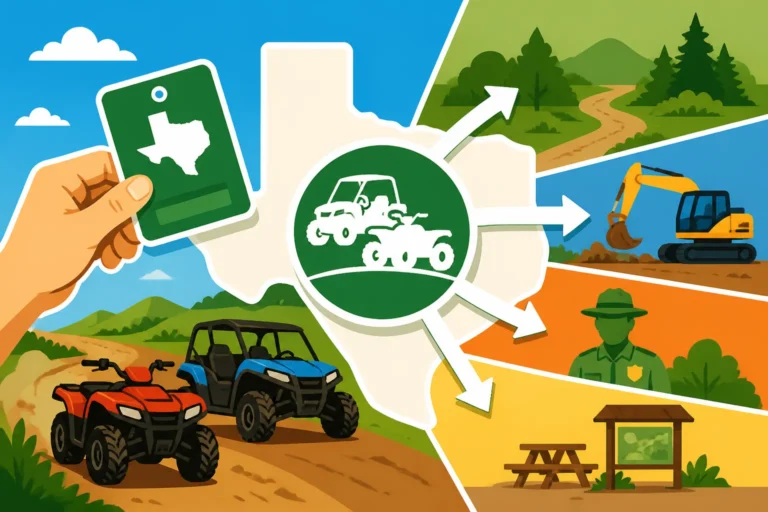
The USDA Forest Service requires riders to carry proof of day-use payment while operating on the Multiple-Use Trail System. The Sam Houston National Forest OHV trail system is managed by the USDA Forest Service, so riders should treat day-use payment proof as a separate item to bring on the trail.
“Carry proof” means you should be able to produce evidence that the required day-use payment has been made if asked. The exact format can depend on how payment was arranged. Keep the official receipt, confirmation, or other proof provided when you pay, and check with the Forest Service about which formats it accepts. Don’t assume that having paid is enough if you cannot show evidence of it.
The day-use proof requirement is not the same as the Texas OHV decal requirement. The Texas Parks and Wildlife Department administers the OHV decal program, and the department requires a valid Texas OHV decal to be displayed when riding in Texas state parks. A decal does not, by itself, prove that you paid day-use charges for a National Forest trail.
Nor does a day-use receipt replace a safety certificate. Texas Parks and Wildlife Department requires riders to carry a valid safety certification and show it upon request while operating an OHV on public land in Texas. Keep each document available for its own purpose.
| What you need to show | What it covers | Who sets or administers the requirement |
|---|---|---|
| Proof of day-use payment | Payment for riding on the Multiple-Use Trail System | USDA Forest Service |
| Texas OHV decal | The Texas OHV decal requirement for applicable public-land riding | Texas Parks and Wildlife Department |
| Safety certification | Rider safety-training requirement and proof when requested | Texas Parks and Wildlife Department |
If you’re planning a trip to the Sam Houston trail, What Texas Riders Must Show at Sam Houston covers the documents and checks riders may need to plan for. For the broader distinction between Forest Service charges and the state decal, see Does an OHV Decal Cover the Forest Day-Use Fee?.
Keep the payment proof separate from your other riding documents
A common source of confusion is carrying one valid document and assuming it covers every requirement. It doesn’t. A trail day-use payment, a Texas OHV decal, and a safety certificate are separate things. One might be checked at a trailhead, while another relates to the vehicle or rider. Organize them so you can find the right one without sorting through a pile of papers at the gate.
What to keep with you
Keep the proof issued for your day-use payment with you while riding, rather than leaving it in a vehicle parked away from the trail. If the proof is paper, protect it from dust, moisture, and damage. A small document sleeve or waterproof phone pouch can help; retailers such as Amazon may carry those, but the important point is simply that your proof remains readable and accessible.
If the proof is electronic, make sure you can retrieve it during the ride. Save the confirmation somewhere easy to open, and consider whether you can access it without a reliable mobile connection. A screenshot can be a useful backup for your own records, but don’t assume that a screenshot is an accepted substitute for the official proof. Confirm acceptable formats with the USDA Forest Service before relying on one.
If your group has several riders or machines, make sure each person understands which documents they need to carry and how the payment proof is connected to the day’s riding. Don’t rely on another rider to hold the only copy unless the Forest Service confirms that arrangement is acceptable.
What not to treat as day-use proof
A Texas OHV decal shows that the machine meets the decal requirement; it does not establish that day-use payment was made for a particular trail visit. The Texas Parks and Wildlife Department also says a valid Texas decal must be displayed on the vehicle, or proof of purchase or a receipt must be readily available if the decal has not yet arrived. That decal-related receipt is not automatically proof of Forest Service day-use payment.
A Texas title is different again. Texas residents must title off-highway vehicles with the Texas Department of Motor Vehicles, but an OHV title does not function as a trail pass or payment receipt. For the title process, see Titling an ATV in Texas.
Likewise, a safety certificate proves training, not payment. Texas Parks and Wildlife Department recognizes certificates showing completion of the ATV Safety Institute’s ATV RiderCourse, including hands-on training, or equivalent certificates issued under the authority of Texas or another state. Keep the certificate available for its own requirement, but don’t present it as day-use payment proof.
Before you ride the Sam Houston trail
The easiest way to avoid a problem is to check the current trail and payment instructions before leaving home. The USDA Forest Service manages the Sam Houston National Forest OHV trail system, and its instructions are the place to confirm current payment arrangements, the proof it issues, and what riders should carry. Don’t rely on an old receipt or an informal summary if the payment process has changed.
The day-use payment process and the Texas OHV decal process are separate. Texas Parks and Wildlife Department administers the decal program, while the USDA Forest Service manages the Sam Houston trail system. For an overview of Forest Service requirements, see Texas National Forest Permits. If you want to prepare for online payment, Buying a Forest Pass Online may help you understand the separate pass-related process, but verify the current trail instructions before your trip.
Use this checklist before setting out:
- Confirm that the trail is open and check any current access or payment instructions. Calling the Trail Status Line is useful when you need to check conditions before driving to the trailhead.
- Pay the required day-use charge using the method currently authorized by the Forest Service.
- Save or collect the proof issued for that payment.
- Put the proof somewhere you can access while riding, not only in a vehicle you may leave behind.
- Check that each rider has the separate documents that apply to them, including any required safety certification.
- Confirm that the OHV decal is displayed or that the appropriate decal purchase proof is available if the decal has not arrived.
The checklist is a planning aid, not a substitute for the Forest Service’s current directions. If payment confirmation is unclear, ask the Forest Service what to retain and how it must be shown. If a receipt lists a date, location, or other details, keep those details intact rather than editing or cropping the record.
Trail conditions matter too. The Forest Service may close trails when conditions make riding unsuitable, so check before traveling and again if weather changes. When the Sam Houston Trail Shuts for Wet Soil explains why a trail can be unavailable even when a rider has paid. Payment proof does not grant access to a closed trail.
What to do if you are asked to show proof
If an official asks for proof of day-use payment, show the document or confirmation issued for that payment. Keep your response straightforward: have the proof ready, make sure the relevant details are visible, and follow the official’s directions. A Texas OHV decal, title, or safety certificate may be relevant to other requirements, but it does not answer the day-use payment question.
If you cannot find your proof, explain the situation and ask what the official needs you to do. Do not assume that a bank transaction, a text message, or a screenshot will count unless the Forest Service accepts it. The best way to avoid being in that position is to save the official confirmation when you pay and check that you can retrieve it before starting the ride.
If you paid but never received a confirmation, contact the provider or Forest Service through its current official channels before riding. Keep any response you receive. If the payment method gives you a paper receipt, don’t leave it in a hot vehicle or a place where it can be damaged. If you use an electronic record, consider keeping a second copy accessible offline.
It also helps to check the trail’s rules as a whole rather than focusing only on payment. Texas Parks and Wildlife Department requires helmets meeting United States Department of Transportation standards for ATV operators and passengers on public lands. It also requires seat belts to be worn in UTVs on public lands when the vehicle is equipped with them. These requirements are not proof-of-payment rules, but they illustrate why a receipt alone is not a complete riding checklist.
For a Sam Houston trail ride, remember the practical distinction: carry proof of day-use payment while on the Multiple-Use Trail System, and keep that proof separate from the Texas OHV decal and safety certificate. Check the Forest Service’s current instructions before you leave so you know what proof to retain and can show it when asked.
Sources
- Texas Parks & Wildlife Department — Buy Decals — Texas Parks & Wildlife Department (checked November 2, 2026)
- United States Department of Agriculture Forest Service — National Forests and Grasslands in Texas | Sam Houston National Forest – USDA Forest Service (checked November 2, 2026)
- Texas Parks & Wildlife Department — Eisenhower State Park OHVs (checked November 2, 2026)
- Texas Parks and Wildlife Department — Off-Highway Vehicle Program (OHV) (checked November 2, 2026)
- Texas Parks and Wildlife Department — Off-Highway Vehicle Program (OHV) – Texas Parks and Wildlife (checked November 2, 2026)
- USDA Forest Service — National Forests and Grasslands in Texas | Sam Houston Multiple-Use Trails (checked November 2, 2026)
Disclaimer
This article is for general informational purposes only and does not constitute professional advice. Laws, prices and regulations vary by location and change over time. Consult a qualified professional for guidance on your specific situation.