Riding Alongside Your Child Under Direct Supervision
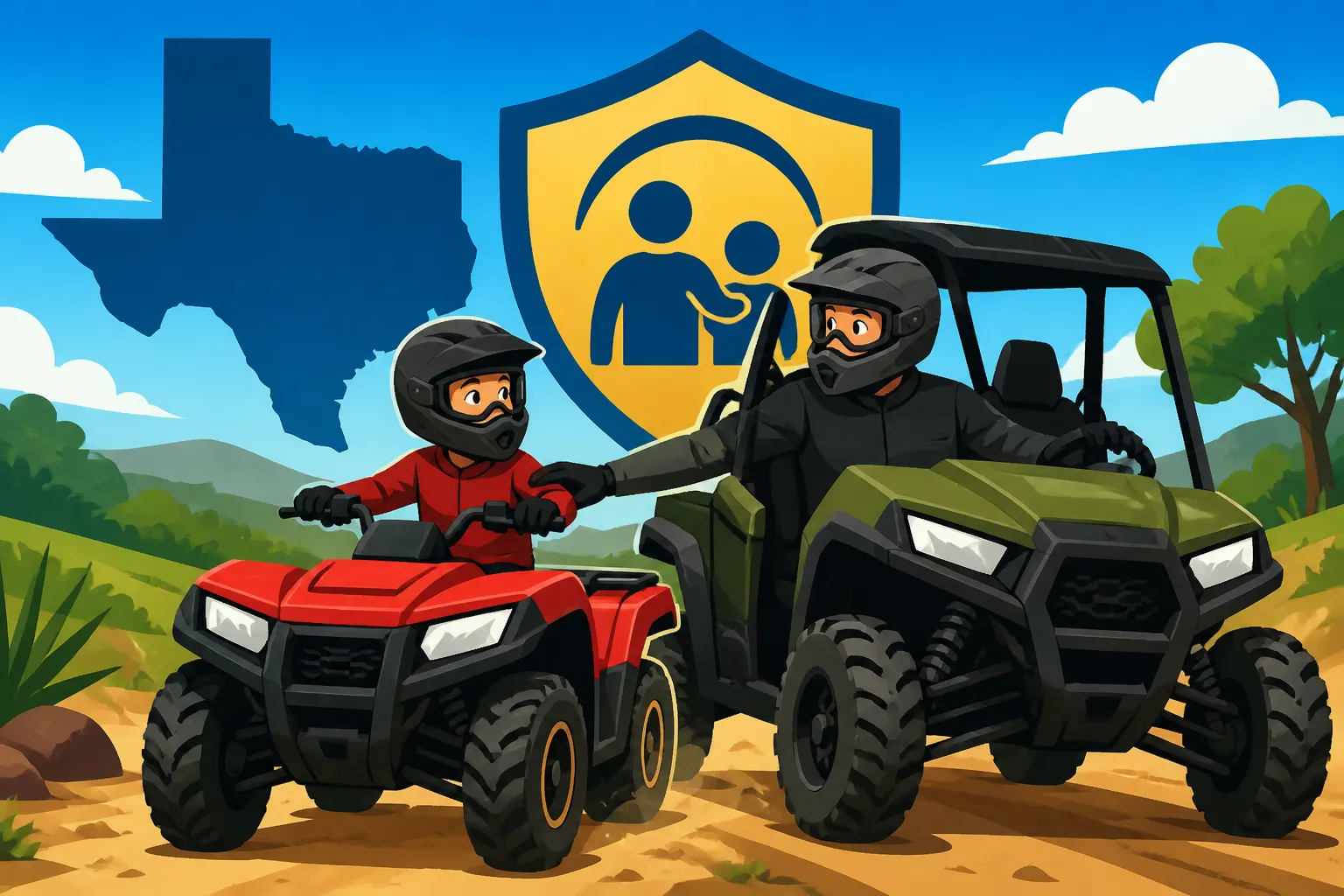
Taking a child on an ATV ride in Texas means more than keeping them within sight. On public land, riders under 14 must be accompanied by and under the direct supervision of a parent, guardian, or authorized adult. Here’s what that means in practice, how to prepare, and which rules to check before you head out.
What direct supervision means on a public-land ride
Texas law sets a clear age rule for children operating ATVs on public land. According to the Texas Legislature, anyone under 14 operating an ATV on public land must be accompanied by and under the direct supervision of a parent, guardian, or authorized adult. The Texas Parks and Wildlife Department also says a person must be at least 14 to operate an ATV on public land without adult supervision, provided they hold a safety certificate.
The law names who must supervise, but the facts provided here do not define a specific distance, line-of-sight standard, or riding formation. Don’t assume that being somewhere in the same park—or riding elsewhere on the trail—is enough. Plan to stay close enough to keep your child under active supervision, see what they are doing, and respond promptly if they need help. Ask the land manager or park staff if you need clarification about how supervision is applied at a particular site.
Direct supervision is an adult’s responsibility throughout the ride, not just at the trailhead. Before moving, agree on a simple way to communicate, decide when to stop, and make sure your child knows not to continue out of sight or ride ahead beyond your control. If terrain, traffic, dust, or other riders make it hard to supervise, slow down or stop until the situation is manageable.
A useful distinction: accompanying a child does not mean carrying them as a passenger on your ATV. According to the Texas Legislature, a person operating an ATV on public property may not carry a passenger unless the vehicle was specifically designed by its manufacturer to transport one. That restriction applies regardless of the passenger’s age. A child riding their own ATV alongside an adult is different from a child riding as a passenger, but the child still needs to meet the applicable age, vehicle, supervision, and safety requirements.
For more detail on the age rule and how it relates to certificates, see What Texas Requires of Riders Under 14, Texas Supervision Rules for Young Riders, and Texas Minimum Age for a Safety Certificate.
Supervision and safety certificates are related, but not interchangeable
Texas recognizes safety certificates showing successful completion of the ATV Safety Institute’s ATV RiderCourse, including hands-on training, or equivalent training certificates issued under the authority of Texas or another state, according to the Texas Parks and Wildlife Department. Its guidance also says ATV operators on public lands need a safety training certificate issued by the Texas Department of Public Safety or an equivalent certificate issued under another state’s authority.
Do not treat the adult’s certificate as a substitute for the child’s supervision requirement. The child must still be accompanied and directly supervised if they are under 14. Carry the rider’s valid certificate while operating on public land and show it if requested, as required by the Texas Parks and Wildlife Department. If you are unsure which certificate a child needs for a particular venue, check with the venue or the Texas Parks and Wildlife Department before the trip. The details can matter, especially if the child has completed training outside Texas.
The adult riding alongside should also understand the child’s training and limits. A certificate is evidence of training; it does not guarantee that a child is ready for every trail, machine, or riding condition. Pick a route that matches the rider’s skills, and keep the ride within conditions where you can supervise effectively.
Prepare the child, machine, and riding plan
A smooth ride starts before anyone turns a key. Children benefit from a short pre-ride check and plain, specific instructions. Explain where the group will stop, what to do if someone gets separated, and how to signal that they need help. Have the child demonstrate that they can operate the controls and stop the machine before joining a moving group.
Match the machine to the rider, and follow the manufacturer’s operating instructions. Texas law also restricts children operating or riding ATVs on public land and in state parks according to age and vehicle engine size, according to the Texas Legislature. Because the applicable requirements depend on the rider and machine, confirm them before choosing an ATV. A child’s ability to reach the controls and handle the machine matters alongside legal eligibility.
Use protective gear that fits and stays secure. On public lands in Texas, ATV operators and passengers must wear a safety helmet that complies with United States Department of Transportation standards, according to the Texas Parks and Wildlife Department. Check the helmet’s labeling and fit rather than relying on a product description alone. If you shop on Amazon or another marketplace, verify that the specific helmet meets the stated DOT standard; a listing title or seller claim by itself is not a substitute for checking the product.
Plan for the place you are riding, too. A public trail may have dust, uneven ground, other vehicles, or limited room to pull aside. Choose a manageable pace and keep enough space to avoid following too closely. If the child is struggling, tired, or no longer responding reliably, end the ride or take a break somewhere safe rather than pushing on.
Use this quick check before leaving:
| Before the ride | What to confirm |
|---|---|
| Adult supervision | If the child is under 14 and operating an ATV on public land, the Texas Legislature requires accompaniment and direct supervision by a parent, guardian, or authorized adult. |
| Safety certificate | The Texas Parks and Wildlife Department recognizes qualifying ATV RiderCourse or equivalent certificates; confirm the child’s certificate requirements for the venue. |
| Helmet | The Texas Parks and Wildlife Department requires a DOT-compliant helmet for ATV operators and passengers on public lands. |
| Passenger seating | The Texas Legislature prohibits carrying a passenger on an ATV on public property unless the manufacturer designed it to transport one. |
| Vehicle and route | Check the machine’s fit and operating instructions, then choose a route and pace the child can handle. |
| Decal and documents | The Texas Parks and Wildlife Department requires a valid OHV decal on state park rides and says riders on public land must carry a valid safety certification. |
The rules for riding in a UTV are not identical to those for riding an ATV. According to the Texas Parks and Wildlife Department, occupants must wear seat belts in UTVs on public lands if the vehicle is equipped with them. Don’t assume the ATV passenger rule answers every question about a UTV. Check the vehicle’s seating and restraint requirements, and make sure the child has a designated seat and restraint.
For more on training and riding requirements, see The Texas ATV Safety Certificate Explained, Texas Rules for Riding Public Land, and Texas Rules for a Child in a Side-by-Side.
Decals, documents, and the place you choose
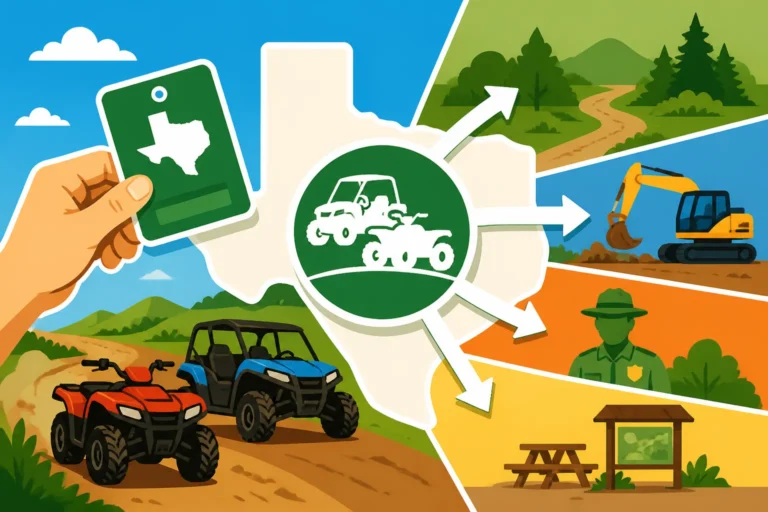
Before the trip, confirm whether the destination is private property, public land, or a venue with its own entry and riding requirements. Texas OHV decals are not required for ATVs and UTVs operated exclusively on private property, according to the Texas Parks and Wildlife Department. Public-land riding is different: a valid Texas OHV decal must be displayed on the vehicle, or proof of purchase or a receipt must be readily available if the decal has not arrived, according to the department.
The Texas Parks and Wildlife Department administers the OHV decal program. The decal costs $16 per fiscal year as of November 2026, according to the department. Check the department’s current information before buying, and verify the rules for the particular land or park where you plan to ride. A decal does not replace a safety certificate or the direct-supervision requirement.
Nonresidents should not assume another state’s decal will work in Texas. The Texas Parks and Wildlife Department says Texas has no reciprocity agreement for out-of-state OHV registrations or decals, so nonresidents riding on public land must purchase a Texas OHV decal. The same department says operators on public land must carry their valid safety certification and show it upon request.
Some public riding areas have additional conditions. For example, the Sam Houston National Forest OHV trail system is managed by the USDA Forest Service. Check the managing agency’s current trail information before travelling; access conditions and local requirements can differ by site. At Texas state parks, OHV regulations are enforced by state park law enforcement and game wardens, according to the Texas Parks and Wildlife Department.
There are also equipment rules to account for. The Texas Legislature requires ATVs and UTVs operated on public property or public lands to have a USFS-qualified spark arrester that has not been removed or modified. According to the Texas Department of Motor Vehicles, an OHV operated on public OHV land must have a headlight and taillight. Texas Parks and Wildlife Department rules also require a lighted headlight and taillight from one-half hour after sunset to one-half hour before sunrise, and whenever visibility is reduced. For the first family ride, daylight and good visibility can make it easier to keep the group together and supervise.
Do not overlook where riding is allowed. According to the Texas Parks and Wildlife Department, operating a motor vehicle such as an ATV in protected public natural areas like stream beds is a Class C misdemeanor, with a fine of up to $500; a third or subsequent offense increases to a Class B misdemeanor. A marked trail or authorized riding area is a safer choice than assuming a natural feature is open to motor vehicles.
If the ride is at a state park, check park-specific requirements before you arrive. Texas Parks and Wildlife Department rules prohibit public display or consumption of alcoholic beverages in state parks, including OHV trail systems, and prohibit operating trail machines while under the influence of alcohol or drugs. Texas law also requires adequate muffler systems in good working condition on ATVs and UTVs operated on public OHV lands, and prohibits muffler cutouts, bypasses, or similar devices, according to the Texas Legislature.
Make the ride manageable for the whole group
Riding alongside a child is a balance between giving them room to operate and staying close enough to supervise. Keep the group small enough that you can track everyone. Avoid letting faster riders pull away or having the child follow a group whose pace is too demanding. If the terrain changes or the child is no longer comfortable, stop and reassess rather than expecting them to keep up.
Set expectations in practical terms. Tell the child to stop if they cannot see the supervising adult, if they are unsure which route to take, or if they feel unsafe. Agree on a meeting point before starting, but don’t use that as a reason to let the child ride out of sight. The goal is continuous supervision, not simply being able to reconnect later.
Build in breaks and check that the child remains alert and in control. A rider who starts out confident may become tired or less focused as the ride goes on. If you cannot keep the child in view or the conditions make communication difficult, choose a safe place to stop and regroup. Supervision is not a race; a shorter ride is better than continuing when the adult cannot reliably monitor the child.
Use a pre-ride routine that is easy to repeat:
- Confirm the destination is open to the type of vehicle you plan to ride.
- Check the child’s training documentation, the machine, and the required decal or receipt.
- Fit the helmet and any other protective equipment before starting.
- Explain the route, stopping plan, and what the child should do if separated.
- Ride at a pace and on terrain that let you maintain direct supervision.
- Stop if the child is tired, uncomfortable, or no longer staying within the agreed riding plan.
For a more complete look at certificates, decals, and other public-land requirements, see Where to Buy a Texas OHV Decal and Texas OHV Safety Certificate Requirements. If the ride is on private property, the public-land decal rules may not apply, but safe supervision and the vehicle’s operating instructions still matter.
Sources
- Texas Legislature — Transportation Code Title 7, Chapter 663. Certain Off-Highway Vehicles (checked November 2, 2026)
- Texas Parks & Wildlife Department — OHV FAQ — Texas Parks & Wildlife Department (checked November 2, 2026)
- Texas Parks and Wildlife Department — Prohibition of Wheeled or Tracked Motor Vehicles in Stream Beds (checked November 2, 2026)
Disclaimer
This article is for general informational purposes only and does not constitute professional advice. Laws, prices and regulations vary by location and change over time. Consult a qualified professional for guidance on your specific situation.