Every Machine in the Group Needs Its Own Decal
Planning a group ride in Texas? The decal question is easy to miss when several ATVs or UTVs are travelling together, especially if the riders have different home states or are borrowing machines. The key is to check each vehicle, not just each rider: qualifying machines need their own Texas OHV decal when used on covered public land or grant-funded venues.
The decal is assigned to the machine, not the group
A Texas OHV decal is not a group pass. According to the Texas Parks and Wildlife Department, every qualifying off-highway vehicle operated on public lands or grant-funded venues in Texas must have its own separate, current decal properly mounted on that vehicle. A decal displayed on one ATV does not cover the other ATVs in the convoy, and a UTV in the group needs its own decal too.
That machine-by-machine rule matters when riders arrive together in a truck and trailer, share a campsite, or travel as a club. The group may have a single trip organizer, but each qualifying vehicle is checked on its own. Before setting off, make sure the decal is attached to the machine it belongs to and is current.
Texas Parks and Wildlife Department administers the state’s OHV decal program. The decal is a requirement for covered off-highway riding, not a standard motor-vehicle registration sticker. Texas residents do have to title their OHVs with the Texas Department of Motor Vehicles, but the department says these vehicles are not eligible for standard motor vehicle registration. For more on that distinction, see The Texas OHV Decal Explained and Why Registration Is Not Available in Texas.
| Group situation | What to check |
|---|---|
| Several ATVs riding together | Each qualifying ATV has its own current Texas OHV decal. |
| A group with ATVs and UTVs | Check the decal on every qualifying machine, regardless of vehicle type. |
| A borrowed or rented machine | Confirm that the machine has the required decal; do not assume another rider’s decal applies. |
| A nonresident joining the ride | Check for a Texas decal rather than relying on an out-of-state decal or registration. |
| Machines used only on private property | Texas OHV decals are not required when the machines are operated exclusively on private property, according to Texas Parks and Wildlife Department. |
The practical distinction is between a machine and the person riding it. The decal is displayed on the vehicle; it is not a wearable pass that riders can transfer between machines. If a rider switches from an ATV to a different machine during the trip, check that second machine separately before taking it onto covered public land.
This also matters when a group has one fully prepared machine and several that are new purchases, borrowed vehicles, or brought in from another state. Do not use the best-prepared machine as a reason to assume everyone is covered. Check the decal on each vehicle before loading the trailer or leaving the staging area.
The fee for a Texas OHV decal is $16.00 per fiscal year, according to the Texas Parks and Wildlife Department, as of November 2026. Check with the department for current purchase details. If you need help understanding where to obtain one, see Where to Buy a Texas OHV Decal.
Where the group needs to check for a decal
The decal rule is tied to where the machine is operated. According to Texas Parks and Wildlife Department, ATVs and recreational off-highway vehicles are not required to have Texas OHV decals when operated exclusively on private property. That exception does not make a decal optional for a machine that will also be taken onto covered public land or a grant-funded venue.
A private ranch ride and a public trail ride can therefore require different preparation, even if the same group and machines are involved. If a machine will be used only on private property, the decal requirement described here does not apply. If the plan includes public land or a venue that received an OHV grant, check the decal status of every qualifying machine in advance.
For state park OHV trail systems, Texas Parks and Wildlife Department requires riders to display a valid Texas OHV decal. A group should not assume that entry arrangements, a reservation, or a payment for other park access automatically covers the decal requirement. Check the decal and the park’s own riding requirements before arriving. Where a Texas OHV Decal Is Required can help clarify the location question.
Nonresidents need to pay attention as well. Texas does not offer reciprocity for out-of-state OHV registrations or decals, according to Texas Parks and Wildlife Department. A machine’s home-state documents do not replace the Texas decal when it is used on covered public lands in Texas. Each qualifying nonresident machine needs its own Texas decal, just like a resident’s machine. See Does a Nonresident Need a Texas OHV Decal? for the visitor-specific issue.
A simple way to avoid a last-minute problem is to sort the group into three categories before the ride:
- Machines that will be used only on private property.
- Machines that will enter Texas public land or a grant-funded venue.
- Machines whose route or destination is still uncertain.
For the first category, the Texas decal is not required if the machines truly remain exclusively on private property, according to Texas Parks and Wildlife Department. For the second, verify a separate current decal on every qualifying machine. For the third, settle the route before departure rather than relying on a private-property exception that may not fit the actual ride.
If the group plans to ride a national forest trail, check that trail’s access and day-use requirements separately from the state decal. The Texas OHV decal and a land manager’s own access rules are not interchangeable. For example, the Sam Houston National Forest OHV trail system is managed by the USDA Forest Service. Review Texas National Forest Permits when the outing includes a national forest trail.
What to do if the decal has not arrived
A missing decal can create confusion if the group bought decals shortly before a trip. Texas Parks and Wildlife Department says a valid Texas OHV decal must be displayed on the vehicle while operating on public land. If the decal has not yet arrived, proof of purchase or a receipt must be readily available.
That temporary proof is not a reason to skip the purchase or assume a decal on a different machine is enough. Keep the purchase record accessible and make sure it clearly relates to the machine being ridden. If the group bought several decals together, organize the records so the rider can show which purchase corresponds to which vehicle.
A practical pre-ride check can be as simple as walking around the machines with a list of the group’s vehicles. Confirm that each required decal is present and properly mounted. If a decal is still in the mail, confirm that the rider has the relevant proof of purchase ready. Do the check before the group reaches a gate or trailhead, when there is more time to resolve a problem.
For a club ride, the organizer can ask each participant to confirm their own machine rather than collecting and holding everyone’s paperwork. The person responsible for a borrowed or rented vehicle should confirm its decal status with the owner or rental provider before the trip. Texas OHV Decal for a Rented Machine covers that situation in more detail.
A small waterproof document pouch, including one purchased through Amazon, can help keep paper receipts together during a dusty or wet ride. Treat it as a way to protect the record, not as a substitute for displaying a decal when one has arrived. Keep any proof readily accessible to the rider using that machine.
If a decal has been lost or damaged, do not assume that a decal on another vehicle can be moved over. Check the replacement process with Texas Parks and Wildlife Department and confirm what proof is acceptable for the ride. [Texas OHV Decal Replacement] is a useful next step.
Check the rest of the group’s riding requirements too
A decal is one part of getting ready for public-land riding. It does not replace safety certification, required protective equipment, or land-specific rules. A group can have every decal in order and still need to pause if a rider lacks the required documentation or a machine is not equipped for the planned ride.
Texas Parks and Wildlife Department recognizes safety certificates showing successful completion of the ATV Safety Institute’s ATV RiderCourse, including hands-on training, or equivalent safety training certificates issued under the authority of Texas or another state. Riders operating on public land must carry their valid safety certification and show it upon request, according to the department. Review Texas OHV Safety Certificate Requirements before bringing new or younger riders along.
Age and supervision requirements are important for families. According to the Texas Legislature, a person under 14 operating an ATV on public land must be accompanied by and under the direct supervision of a parent, guardian, or authorized adult. The Legislature also says riders aged 14 or older may ride without adult supervision if they hold a safety certificate or are under the direct supervision of a certificate holder. Confirm the requirements for each young rider rather than treating the group’s adult supervision as automatically sufficient.
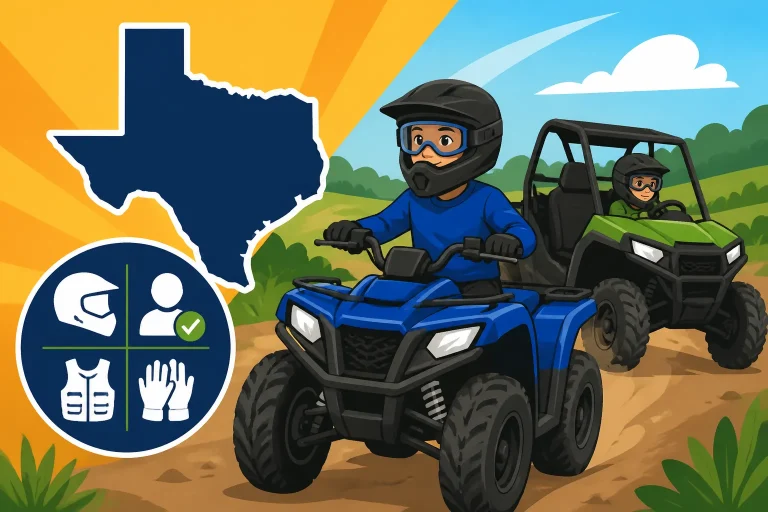
Equipment rules can differ by machine and location. Texas Parks and Wildlife Department requires ATV operators and passengers on public lands to wear helmets that meet United States Department of Transportation standards. The department also says UTV occupants must wear seat belts when the vehicle is equipped with them. These requirements apply to the people riding, not just the vehicle owner.
Lighting is another item to check. Texas Parks and Wildlife says an ATV or UTV operated on public property must display a lighted headlight and taillight from one-half hour after sunset to one-half hour before sunrise, and whenever visibility is reduced. Texas law also requires a USFS-qualified spark arrester that has not been removed or modified on OHVs operated on public property or public lands, according to the Texas Legislature. Check the machine itself rather than assuming that another vehicle’s equipment or paperwork covers it.
Passengers and vehicle design need attention too. Under Texas law, a person operating an ATV on public property may not carry a passenger unless the manufacturer specifically designed that ATV to transport one. Children also face age and engine-size restrictions on public land and in state parks, according to the Texas Legislature. A group ride is not a reason to add a passenger to a machine that was not built for one.
Finally, check the rules for the specific riding area. Texas Parks and Wildlife Department enforces OHV rules within state parks through park law enforcement and game wardens. A public-land trip may also have requirements set by the land manager or the venue. Make the decal check part of a broader pre-ride review: identify where each machine will go, confirm the machine’s decal, and make sure each rider has the equipment and documents needed for that destination.
For the organizer, the simplest dependable approach is to ask each rider to verify their own machine before the group leaves. A short check avoids the mistaken assumption that a single decal, a receipt held by someone else, or an out-of-state sticker covers every vehicle in the party.
Sources
- Texas Legislature — Transportation Code Title 7, Chapter 663. Certain Off-Highway Vehicles (checked November 2, 2026)
- Texas Parks & Wildlife Department — OHV FAQ — Texas Parks & Wildlife Department (checked November 2, 2026)
Disclaimer
This article is for general informational purposes only and does not constitute professional advice. Laws, prices and regulations vary by location and change over time. Consult a qualified professional for guidance on your specific situation.