Texas Rules for a Guided Tour
Booking a guided ATV or UTV tour in Texas can look simple: choose a route, sign a waiver and show up. But a guide’s permission to lead a commercial ride is separate from your own permission to ride, and both depend on where the tour goes. Here’s how to check the land access, permits, decals and rider requirements before you book.
Start by checking who has authority over the route
A guided tour is a commercial activity, not just a group of friends riding together. The operator needs permission to use the land and, where the land manager requires it, authorization for commercial guiding. A trail being open to recreational riders does not automatically mean a business can lead paid tours there.
The first useful question for a tour company is: Who manages the land, and what authorization allows this company to guide tours on it? The answer should identify the landowner or agency and explain whether the tour uses private land, public land, or a mix of both.
Private land and public land are different
On private property, the operator needs the owner’s permission for the tour. That permission may come through a lease or another written agreement, and it may limit where customers can ride, how many machines can be on the property, or when tours can run. A rider’s Texas OHV decal is generally not the key to access on ordinary private land, but the owner can set conditions of entry and riding.
Public land has its own rules. A land manager may allow ordinary recreational riding but require a separate permit, contract or other approval for a paid tour. The operator may also need to follow limits on group size, approved routes, operating hours, parking, noise or event scheduling. An OHV decal, day-use payment or entry pass does not by itself authorize a business to guide customers for a fee.
The distinction matters even when the tour uses a well-known trail. A permit for one purpose does not necessarily cover another. For instance, an individual’s right to ride a trail does not automatically give a tour operator the right to sell guided access there. See Texas Rules for Riding Public Land and Texas Rules for a Commercial Guide for the difference between riding access and commercial use.
A group ride is not always a guided tour
A private club outing and a paid tour can look similar on the trail, but they may be treated differently by the land manager. A gathering organized for members might fall under event rules, while a business charging customers to ride may need commercial authorization. The operator should not rely on a general event approval if the activity is actually a paid guided service.
If you are organizing a group ride yourself, check the land manager’s rules before inviting a large group or collecting money. An organized ride may need approval even when no one is selling a tour. Texas Rules for an Organized Ride covers that separate question. Races and other timed or competitive activities may have additional requirements; a normal guided tour permit should not be assumed to cover them.
Get a clear answer, not a vague assurance
A reliable operator should be able to explain where the tour runs and what kind of access it has. You do not necessarily need to inspect every permit, but you should be wary of answers such as “it’s public land, so anyone can ride” or “we’ve always used this trail.” Public access and commercial authorization are not interchangeable.
Before booking, ask:
- Is the route on private property, public land, or both?
- Who controls access to each part of the route?
- Does the operator have permission for paid guided tours there?
- Are there route, group-size, age or machine restrictions?
- Could weather, closures or land-manager rules change the route?
- If the tour is canceled or rerouted, what happens to your booking?
If a tour crosses property boundaries, the operator needs appropriate access for each segment. Permission to start from a private staging area does not prove that the rest of the route is authorized. Likewise, a public trail connection does not give the group permission to cross nearby private land.
Separate the operator’s authorization from your riding requirements
A guided tour involves two sets of responsibilities. The operator must comply with rules for running the business and accessing the route. Each rider still has to meet the applicable requirements for using the machine and land. Paying for a tour does not transfer the rider’s legal responsibilities to the guide.
The OHV decal is not a guide permit
Texas has an OHV decal program for use in covered riding settings. Where a decal is required, it applies to the machine, not to each person in the tour group. It is not a commercial-guide permit, and it does not authorize a business to use land for paid tours.
Decal requirements depend on where the machine is being operated and the rules that apply to that land. Private property, public land and a facility’s own access rules should not be treated as identical. Ask the operator whether the tour area requires a Texas OHV decal, whether the fee is included, and what proof you should bring. The details are explained in The Texas OHV Decal Explained and Where a Texas OHV Decal Is Required.
A sticker, day-use fee or park pass can meet one requirement while leaving another unmet. For example, proof of a rider’s entry payment is not proof that the operator has authorization to provide commercial tours. Before the trip, confirm both the group’s access requirements and the business’s authorization.
Safety certificates and out-of-state riders
Texas OHV safety-certificate requirements apply in the situations specified by state rules, particularly on public riding areas. The operator should tell participants whether a certificate is needed for the tour and what proof to carry. The certificate is a rider qualification; it does not replace a land-use permit or OHV decal.
Young riders need special attention. A child who is too young to earn a certificate cannot simply be treated as having met the requirement because an adult is on the same tour. Rules may require direct supervision by a qualified adult. Ask the operator how the tour handles age limits, supervision, machine size and parent or guardian participation. See The Texas ATV Safety Certificate Explained for the certificate framework.
Visitors with a safety certificate from another state should check whether it meets the applicable Texas requirement. Texas recognizes qualifying out-of-state certificates under its rules, but that does not mean every document, training card or online course is automatically accepted. Confirm what the tour operator will accept and bring the original card or other required proof. If you are riding in another state later, do not assume Texas reciprocity works both ways; check that state’s rules. Does Texas Accept an Out-of-State Safety Certificate? explains the distinction.
Titles, plates and decals do different jobs
A title is evidence of ownership. It does not provide permission to use a trail or make an ATV or UTV street legal. Texas generally titles off-highway vehicles without offering ordinary road registration for them. A titled machine may still need a decal or other permission for a particular riding area.
Similarly, an OHV plate or title document should not be confused with a tour operator’s land authorization. If a tour uses a machine supplied by the business, the customer may not need to bring ownership paperwork, but the operator should be able to explain what is included and what riders must provide. For more on the state’s distinction between titling and registration, see Why Texas Titles But Never Registers an OHV.
Check machine, passenger and route rules before riding
The exact requirements depend on the tour’s location, the type of vehicle and the activity. A guide can set stricter safety conditions than the minimum legal rules, and a park or land manager can impose additional conditions. Read the tour’s instructions rather than assuming that rules from a different trail or facility apply.
Confirm that the machine fits the route
Ask what type of machine the tour provides or allows. An ATV, side-by-side, youth quad and larger off-road vehicle may have different width, passenger and equipment considerations. Some trails limit machine width, while some routes are unsuitable for inexperienced riders or particular vehicles. A route described as “beginner-friendly” is not a guarantee that every machine or rider can use it safely.
If you bring your own machine, confirm its dimensions and the operator’s requirements in advance. Also ask whether the machine needs a Texas OHV decal, whether it must meet any site-specific equipment rules, and whether the operator will inspect it before departure. A machine’s modifications do not automatically make it legal for every route or public road.
For a rented ATV or UTV, find out what the rental includes and what remains your responsibility. Ask whether the vehicle is supplied with required safety equipment, whether fuel is included, and what to do if a mechanical problem occurs. Texas rules for rental machines and the land manager’s rules still apply; the rental agreement is not a substitute for either. Texas Rules for a Rented Machine is useful background.
Passengers need proper seating
Do not assume a passenger can ride wherever there is room. Use only seating designed by the manufacturer for passengers, and follow the machine’s capacity and age instructions. A passenger riding on a part of the vehicle not intended as a seat can create a serious risk, even on a short, slow tour.
For a side-by-side, ask whether the machine has a seat and restraint for every passenger. For a single-seat ATV, do not expect the guide to make an exception so two people can ride together. The tour company may set a minimum age or height above what a law requires, especially if a child cannot reach controls or stay properly positioned.
Parents should ask whether a child will operate a machine or ride as a passenger, and what supervision is required for each arrangement. A child’s ability to ride safely depends on the vehicle, the route and the child’s size and judgment, not just age.
Road crossings and public-road segments need special scrutiny
A tour described as “off-road” may still approach or cross a road. Do not assume a guided group can ride along a public street simply because the machines have headlights, mirrors or other equipment. Texas generally does not make an ordinary ATV or OHV road-legal through modifications alone. Limited exceptions have specific conditions, and they do not create a general right to use public roads.
Ask whether the route crosses a public road, uses any road segment, or stays entirely on a private trail or authorized off-highway route. If a tour claims to use a road under an exception, ask the operator to explain which rule applies and what conditions the group must follow. The guide’s presence does not exempt riders from road-use restrictions.
A tour that uses National Forest trail systems, for example, must follow the applicable trail and land-manager requirements, not simply the operator’s route plan. Texas Rules for Riding a National Forest Trail explains why public-land rules matter. Check for closures or restrictions before travel, since route conditions and access can change.
Safety requirements can be stricter than the law
Tour companies commonly require helmets, eye protection, closed-toe footwear, long sleeves or other protective gear. Some of these may be legal requirements in particular circumstances; others may be the operator’s safety policy. Follow the stricter instruction for the tour, and ask before arrival if the company supplies gear or expects you to bring your own.
For children, confirm helmet fit, restraint use and supervision arrangements. A helmet that is too large or worn incorrectly is not a useful substitute for a properly fitted one. Ask whether the guide will provide a pre-ride briefing covering controls, hand signals, spacing, stopping and what to do if the group separates.
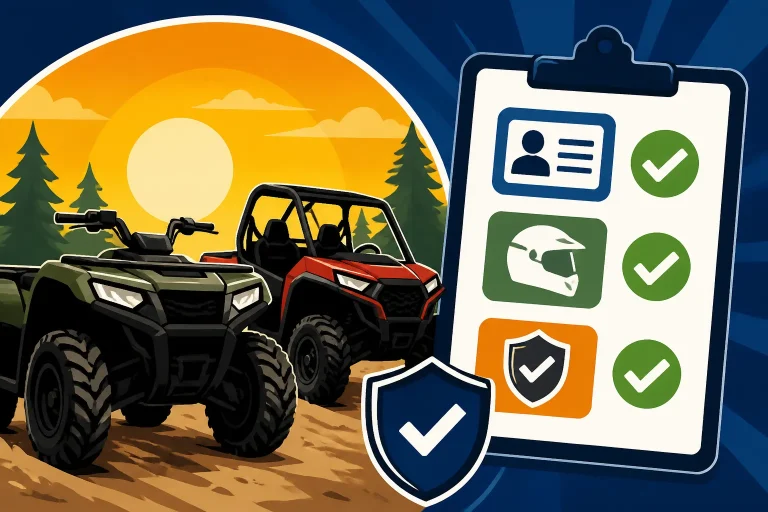
Use a booking checklist to avoid surprises
A few direct questions can reveal whether the operator has thought through the practical details. This is especially useful when the tour is advertised through a booking platform, when the route is not named, or when the tour uses several types of land.
| What to confirm | Why it matters | What a clear answer should cover |
|---|---|---|
| Route and land manager | Different landowners and agencies set different access rules | The general route, land type and responsible manager |
| Commercial authorization | Recreational access does not necessarily allow paid guiding | Whether the operator has approval for commercial tours |
| Decal and entry requirements | Riding access may require a decal, pass or separate payment | Which requirements apply and whether costs are included |
| Safety certificate | Some riders may need proof of training | Who needs a certificate and what documents are accepted |
| Machine and passenger limits | Width, capacity and seating affect route access and safety | Vehicle type, age limits, passenger seats and restraints |
| Road use | A trail tour does not automatically permit road riding | Whether the route crosses or uses public roads |
| Weather and closures | Land managers may restrict access when conditions change | How the operator handles cancellations or alternate routes |
| Equipment and briefing | A guided ride still requires preparation | What to bring, what is supplied and how the safety briefing works |
A practical sequence before the tour
- Identify the operator and route. Get the business name, meeting location and a useful description of where the ride takes place. If the exact route is not shared for safety or operational reasons, the operator should still be able to identify the land manager or explain how access is authorized.
- Ask about commercial permission. Confirm that the company is allowed to lead paid tours on the land. If the ride crosses more than one property or managed area, ask whether access is covered for the full route.
- Confirm rider documents and entry requirements. Ask whether you need an OHV decal, day-use payment, safety certificate, identification or other proof. Find out whether anything must be purchased separately.
- Match the vehicle to the rider. Confirm the machine type, passenger capacity, age restrictions and any experience requirement. Be honest about your riding ability; a tour operator needs accurate information to place riders on a suitable route.
- Read the waiver and booking terms. A liability waiver does not prove that the tour is authorized, and signing it does not cancel land rules. Read the cancellation, damage and equipment terms before paying.
- Recheck conditions close to departure. Ask about weather, trail closures, required gear and meeting instructions. Do not rely on an old social-media post or another rider’s past experience for current access conditions.
Signs to pause before booking
Be cautious if the operator cannot say who controls the route, dismisses questions about commercial permission, or claims that a decal alone authorizes the tour. The same applies if the company encourages riders to ignore posted closures, leave marked routes, carry passengers on an unsuitable machine or use public roads without explaining the legal basis.
A tour can be legitimate even if its permits are not displayed on a website. But the business should be able to explain how it has permission to operate and what riders need to comply with. If a tour is on public land, the relevant land manager is the best source for confirming whether commercial guiding is allowed. If a tour is on private land, the operator should be able to explain that the landowner has authorized the activity.
Remember that a guide’s instructions are important for safety and route management, but they do not override legal restrictions. If the guide changes the route, asks the group to cross private property without permission, or directs riders onto a road that appears closed to OHVs, stop and ask for clarification.
Frequently Asked Questions
Does a Texas OHV decal let a business lead guided tours?
No. A decal may satisfy a machine-related requirement where it applies, but it does not grant commercial access to land. The operator needs any separate permission or authorization required by the landowner or land manager.
Do tour customers need their own safety certificate?
That depends on the rider and the applicable rules for the riding area. Ask the operator which participants need a certificate and what proof is accepted. Riders who qualify for an out-of-state certificate should confirm that it meets Texas requirements and bring documentation.
Can a guided ATV tour use public roads in Texas?
Not automatically. Texas road-use rules for OHVs are limited, and adding equipment does not by itself make an ATV street legal. Ask whether the route uses or crosses public roads and what specific rule applies.
Does the guide take responsibility for every rider’s compliance?
No. The operator has duties related to the tour, access and safety, but riders still need to follow applicable laws, land rules and instructions. Booking a guided tour does not waive those responsibilities.
Disclaimer
This article is for general informational purposes only and does not constitute professional advice. Laws, prices and regulations vary by location and change over time. Consult a qualified professional for guidance on your specific situation.