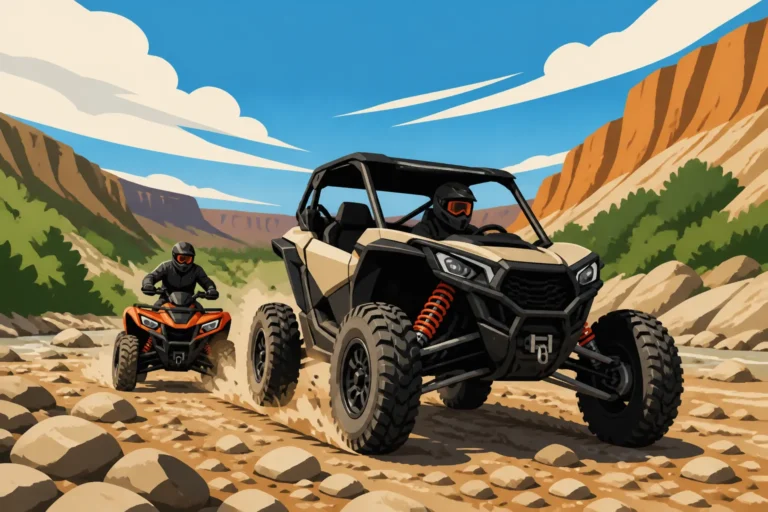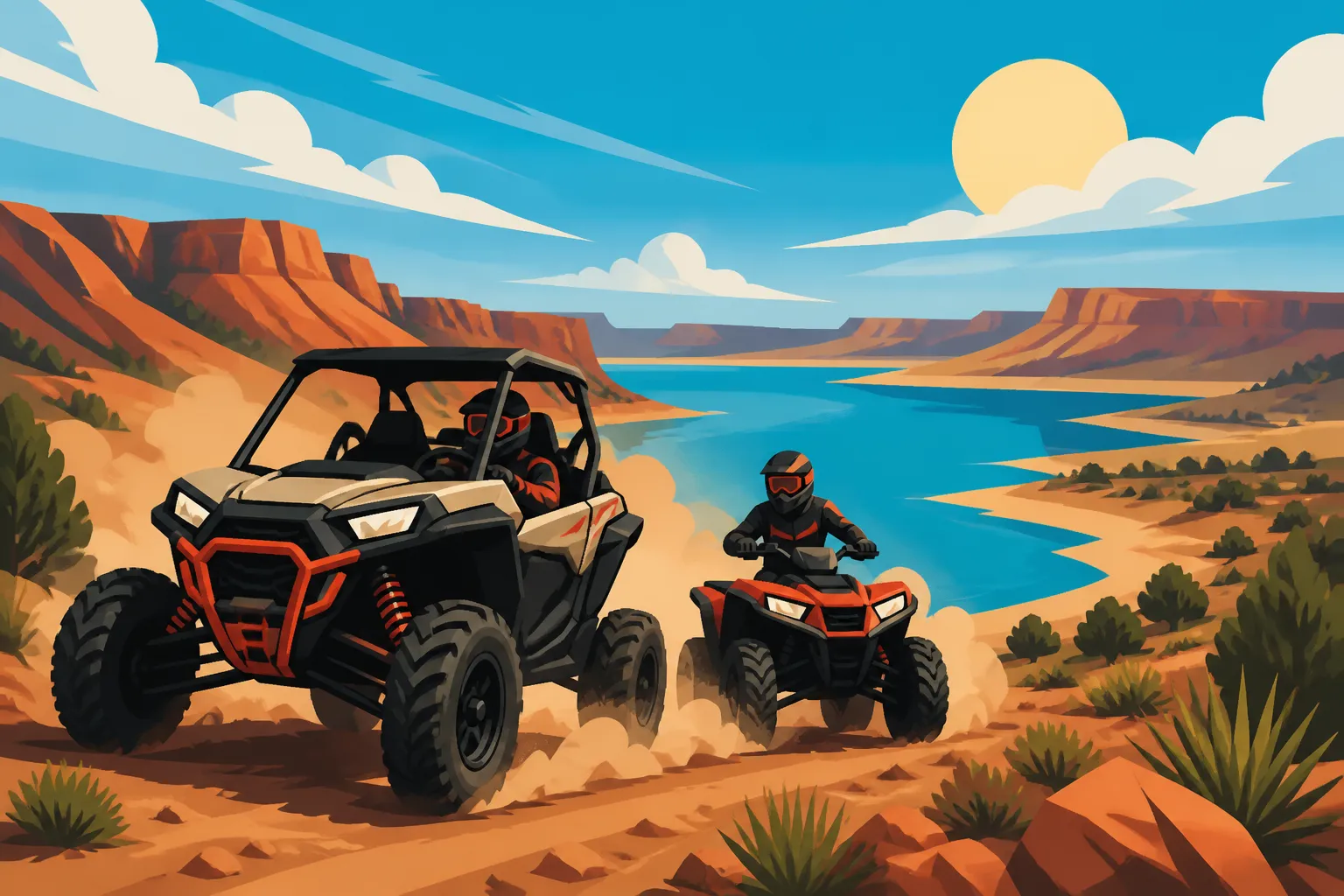
Rosita Flats at Lake Meredith
Rosita Flats can look like an easy place to roam until soft sand, changing shoreline, heat, or an unclear route complicates the day. This guide explains what to expect at the Lake Meredith OHV area near Fritch, how to prepare your machine and group, and what to check before setting out so your ride is safer and less stressful.
What to Expect at Rosita Flats
A riding area beside Lake Meredith
Rosita Flats is a designated off-highway vehicle riding area within Lake Meredith National Recreation Area in the Texas Panhandle. It is near Fritch, northeast of Amarillo, in a landscape shaped by the Canadian River and the reservoir. The riding environment is open and exposed compared with wooded East Texas trails, so riders should expect sun, wind, dust, and broad views rather than dense tree cover.
The surface can include sand, loose soil, and uneven ground. Conditions vary across the riding area, and a route that looks firm from a distance may turn softer or rougher under the tires. Shoreline conditions can also change with water levels and weather. Treat the visible edge of the lake as a boundary to assess carefully, not an invitation to ride onto wet ground or into an unfamiliar wash.
Rosita Flats is not a groomed, predictable loop where every turn leads back to a marked trailhead. It is an open riding area, and it is easy to spend longer exploring than planned. Before leaving the staging area, agree on a turnaround time, decide how the group will regroup if riders become separated, and keep track of where you parked.
For a fuller orientation, see [Riding the Rosita Flats OHV Area]. If you are comparing destinations, the wider guide to [Texas OHV Parks by Region] can help you think through the differences between Panhandle riding and other parts of the state.
The terrain rewards a conservative pace
Open country can create a false sense of security. You may be able to see a long way, but that does not mean the surface ahead is smooth or that another rider will be visible over a rise. Sand can hide ruts and abrupt changes. A small change in traction can matter when a rider is turning, climbing, or braking.
Newer riders should start slowly and stay in terrain that matches their experience. On a quad, avoid making sharp turns at speed in soft sand. On a UTV, keep your speed manageable and leave enough room to stop without relying on a hard, sudden brake. Riders should also leave space between machines so dust does not obscure the view of the person ahead.
A useful first ride is one that leaves plenty of time to learn the area. Rather than trying to cover every visible stretch, make a short loop, check how your machine responds, and return while everyone still has energy and daylight. That approach is especially helpful when riding with children, inexperienced guests, or a mixed group of quads and side-by-sides.
Plan Your Arrival and Check Access
Get directions to the right place
Rosita Flats is associated with Lake Meredith near Fritch, but “Lake Meredith” is not a precise destination for navigation. The recreation area has multiple access points, and a route to another part of the lake may not take you to the OHV riding area. Confirm the intended entrance and road conditions before you leave, especially if you are towing a trailer.
Travelers coming from Amarillo should allow time for the drive through the Panhandle and for the final approach on local roads. Check your route before setting out, rather than depending entirely on mobile service once you are away from town. A paper map or downloaded map can be useful if the signal drops. Some riders use onX Offroad to prepare offline maps and keep a location reference available during a trip, but still confirm that the route is appropriate for your vehicle and leads to the correct public access point.
The drive and the riding area may feel remote, so arrive with fuel, water, food, and basic supplies already sorted. Do not count on finding fuel or a convenient repair option right beside the riding area. Before towing out, check the trailer tires, lights, hitch connection, and tie-downs; a problem discovered at the staging area can quickly eat into the riding day.
For route-planning context, [Driving From Amarillo to Rosita Flats at Fritch] is a useful related topic. Do not assume that directions to a nearby Lake Meredith feature, such as Blue Creek, lead to the same access point; [Getting to Blue Creek Off FM 1913] covers a different destination.
Check closures and access rules before leaving home
Public-land access can change because of weather, road conditions, maintenance, or resource protection. Check the official Lake Meredith National Recreation Area information before you travel, and confirm which locations are open to OHV use. A road visible on a mapping app is not automatically an authorized riding route, and a route shown on a user-generated map should not override posted signs or park direction.
Review the rules for the specific area you intend to ride. Confirm where machines may be unloaded, where riding is allowed, and whether any parts of the area are temporarily closed. If you arrive and find signs or barriers that conflict with your planned route, follow the posted restrictions and choose an open alternative rather than riding around a closure.
It can help to save a map before you lose service and to share the day’s plan with someone who is not riding with you. onX Offroad can be a useful planning aid for organizing a route and saving map information, but it should be treated as a navigation tool—not proof that every mapped line is open, legal, or suitable for your machine. Use official land-management information and on-site signs to resolve uncertainty.
Permits, Decals, and Riding Requirements
Do not assume one permit covers everything
Before unloading, identify the permits or decals required for your machine and for the land where you plan to ride. A Texas OHV decal and a permit or authorization specific to a recreation area are not necessarily the same thing. They may serve different purposes, and carrying one does not automatically mean you have met every requirement for the other.
Check Lake Meredith National Recreation Area’s instructions for the current process, including where to obtain any required permit and how it must be displayed. If a free permit is required, “free” does not mean optional: you still need to complete the required steps. Keep proof of any permit with you, and make sure it is associated with the correct machine and trip where applicable.
Rules can be easy to mix up when a rider has visited other Texas parks or federal recreation areas. Before departure, use a simple checklist: confirm Lake Meredith’s requirements, confirm whether a Texas OHV decal applies, and confirm that the machine is allowed in the area you plan to ride. The related explainer [Why Lake Meredith's Free Permit Is Still Required] addresses the difference between a no-cost permit and no permit at all.
Bring the required equipment and follow posted instructions
Do not leave basic safety equipment to chance. Wear a properly fitted helmet and eye protection, and use protective clothing suitable for sun, dust, and the possibility of a fall. UTV occupants should use the machine’s restraints and seating as designed. Keep passengers within the seating capacity intended by the manufacturer; carrying an extra person in an improvised spot is not a safe workaround.
An orange whip or flag may be required for machines at the recreation area. Check the official instructions for the required flag placement and visibility, and make sure it is firmly attached before riding. A flag can help other riders see a machine in open or uneven terrain, but it does not replace safe speed, good spacing, or attention at rises and intersections. For details, read [Flags Required on Every Quad at Meredith].
Carry the documents and equipment you may need to show during the ride, and brief every person in the group on the rules before starting. If a rider is underage, check the applicable supervision and safety-certificate rules as well as the recreation area’s own requirements. A quick briefing at the vehicle is more useful than trying to explain a rule after the group has spread out across the flats.
| Before you ride | What to check | Why it matters |
|---|---|---|
| Access | Correct entrance, open roads, and designated OHV area | Nearby Lake Meredith destinations may use different access points |
| Permits | Park-specific requirements and any applicable Texas OHV decal | One authorization may not satisfy every rule |
| Machine | Fuel, tires, brakes, cooling, and tie-down condition | Problems are harder to manage away from services |
| Safety gear | Helmet, eye protection, restraints, and required flag | Protects riders and helps improve visibility |
| Navigation | Saved map, meeting point, and turnaround plan | Service may be unreliable, and open terrain can be disorienting |
| Weather | Heat, wind, rain, and recent wet conditions | Surface conditions and comfort can change quickly |
Prepare for Panhandle Weather and Remote Riding
Plan for heat, wind, and limited shade
The Panhandle can feel especially demanding when the sun is strong and shade is scarce. Riders often underestimate how quickly heat, dust, and physical effort add up, particularly when they are stopping often to help with a stuck machine or to navigate unfamiliar terrain. Start with adequate water for every rider, not just the driver, and keep extra supplies in the tow vehicle.
Set a pace that allows for regular breaks. Drink before you feel badly thirsty, and take symptoms such as dizziness, nausea, headache, unusual fatigue, or confusion seriously. If someone is overheating, stop riding, move them to shade or a cooled vehicle if available, and get help as appropriate. A plan to cut the ride short is better than treating exhaustion as something the group has to push through.
Wind can also affect comfort and visibility by moving dust across open ground. Eye protection and a face covering can help make a dusty ride more manageable, but riders still need to slow down when visibility is poor. Keep enough distance from the machine ahead that you are not riding blindly in its dust. For seasonal planning, see [Texas Riding in Summer Heat].
Rain can change the surface and the access roads
Recent rain may affect both the riding surface and the roads used to reach the area. Soft or muddy ground can make traction unpredictable, increase the chance of getting stuck, and leave damage that takes time to recover. A route that was easy on a dry day may be unsuitable after a storm, even if it looks passable from the vehicle.
Check conditions before driving out, and be prepared to change plans. Do not drive around a closure or onto fragile ground just to reach a preferred section. If the surface is visibly soft, waterlogged, or rutted, choose a more durable route or postpone the ride. Getting a trailer stuck on a wet access road can turn a fun outing into a difficult recovery.
When the weather has recently been unsettled, leave extra time and avoid depending on a single route in or out. A mapped route can help you understand the area, but it cannot tell you whether a particular patch of ground is firm enough today. The related guide [Texas Trails After Heavy Rain] offers broader advice on deciding when conditions are too wet for a ride.
Make the Ride Safer and More Enjoyable
Set a group plan before engines start
Agree on simple group rules while everyone is still parked together. Choose a leader and a sweep rider, establish a meeting point, and make sure everyone knows what to do if they cannot see the group. Riders should stop in a safe place if they become separated rather than continuing farther into unfamiliar terrain in the hope of catching up.
Keep the group within the least experienced rider’s comfort level. A fast rider may feel that an open area invites speed, but a newer rider may be concentrating on traction, steering, and the terrain immediately ahead. Let the group’s pace be set by the person who needs the most time, and make sure no one feels pressured to attempt a section they do not want to ride.
Before setting off, confirm that everyone has a charged phone or other agreed means of communication, understands the route plan, and knows the vehicle’s basic controls. If you use a tracking or mapping app such as onX Offroad, ensure the group understands how it fits into the plan and do not assume that every person can see the same live information. A clear rendezvous plan remains important even when phones are working.
Leave the area in good condition
Ride only where permitted, avoid disturbing wildlife, and do not leave trash behind. Pack out food wrappers, broken straps, and any other rubbish from the vehicle. If a machine leaks fluid or breaks down, keep the problem from spreading where possible and follow the recreation area’s instructions for reporting or handling it.
Be considerate of other riders and visitors. Slow down around people on foot, parked vehicles, and staging areas. Give other machines room, avoid cutting close to another rider’s line, and do not assume someone has seen you just because the terrain is open. If dust is affecting another group, reduce speed and allow it to settle before continuing.
Most importantly, finish with enough time and energy to load safely. Check the tires and straps before towing away, account for every person in the group, and make sure no gear has been left behind. A little patience at the end of the day is worthwhile after hours of riding in an exposed landscape.
A practical pre-trip checklist
- Confirm the correct Rosita Flats access point and check official Lake Meredith notices.
- Verify park-specific permit instructions and whether a Texas OHV decal applies to your ride.
- Check weather, recent rain, access roads, and any posted closures.
- Inspect the machine, trailer, fuel supply, tires, brakes, and tie-downs.
- Pack water, sun protection, helmets, eye protection, and any required flag or safety equipment.
- Save a map, agree on a meeting point, choose a turnaround time, and tell someone your plan.
- Review the rules with every rider, then stay on authorized routes and respect signs.
Disclaimer
This article is for general informational purposes only and does not constitute professional advice. Laws, prices and regulations vary by location and change over time. Consult a qualified professional for guidance on your specific situation.