Riding Moss Creek Lake at Big Spring
Moss Creek Lake gives Big Spring-area riders a West Texas place to explore by ATV or UTV, but the first challenge is confirming exactly where motorized riding is allowed. A lake park is not automatically an open riding area, and access, trail conditions, and rules can change. This guide helps you plan a safer visit, check the essentials, and avoid arriving with the wrong assumptions.
Plan your Moss Creek Lake ride before you leave
Confirm where riding is permitted
Moss Creek Lake is near Big Spring in Howard County, in a part of Texas where a trip can involve a long drive between services. Before loading your machine, confirm with the City of Big Spring or the current site operator whether motorized riding is permitted, which areas are designated for it, and whether access is open on your planned date. Do not assume that every road, shoreline, campground, or open-looking patch of ground is available to ATVs and UTVs.
That distinction matters because a destination can include several kinds of land and facilities. A route shown on a navigation app may be a park road, a maintenance track, a closed route, or a road intended for vehicles other than OHVs. A path visible on the ground is not proof that public riding is allowed there. Use official park information to establish the permitted riding area, then treat other maps as planning aids rather than permission.
If you use onX Offroad to look at your route, compare what it shows with the park’s current rules and posted signs. Map layers can help you think through access and navigation, but they do not replace an operator’s instructions or a gate closure notice. Save the park’s contact information before you head out, especially if you expect to have limited cell service.
For broader context about how different areas fit into the state’s riding options, see Texas OHV Parks by Region. It is also useful to understand [Texas Rules for Riding Public Land] before you travel, since public-land requirements can differ from rules on a private riding property.
Check access, facilities, and the route in
A practical pre-trip call can prevent a frustrating drive. Ask whether the riding area is open to the public, where riders should enter, whether there are designated trails or riding zones, and whether you need to check in or obtain a permit. Confirm any restrictions on machine type, vehicle width, passengers, helmets, flags, or sound. If the person you reach cannot confirm a detail, ask who manages the riding area or where the official rules are posted.
Also ask what amenities are available on the day you plan to visit. Do not count on fuel, food, drinking water, repair supplies, or a staffed office being close to the riding area unless you have confirmed it. Big Spring is the logical place to prepare for a day out, but the exact distance from town to your chosen access point and the services available there should be checked as part of your route planning.
Keep a backup plan. If the riding area is closed, muddy, or unavailable to your machine, you do not want to be deciding where to go while parked on the roadside with a trailer. Look for another lawful riding area in advance, or be prepared to turn the trip into a visit to the lake’s other permitted facilities rather than riding somewhere that is not authorized.
Prepare your ATV or UTV and paperwork
Check the decal and riding requirements
Texas OHV decal requirements depend on where you ride. Before your visit, ask whether the Moss Creek Lake riding area requires a state OHV decal, a site-specific permit, or both. A decal requirement is not the same thing as a title or a road registration, and having one does not grant access to a closed trail. Review The Texas OHV Decal Explained and confirm what the particular riding area expects you to display or carry.
Rider requirements matter, too, particularly when children are coming along. Check the site’s rules for safety certificates, supervision, age limits, protective equipment, and passengers. A child who can ride comfortably in a yard may still need additional supervision or a different machine for unfamiliar terrain. Do not rely on a seller’s assurance that a particular vehicle is “good for kids”; match the machine to the rider’s size, experience, and ability to control it.
If a young rider is part of the group, read Texas OHV Safety Certificates before the trip and verify what documentation the riding area expects. Carry the required card or proof in an accessible place rather than buried under luggage. For a family ride, it is easier to sort this out at home than at a gate or trailhead.
Inspect the machine and pack for a remote ride
Give each machine a basic inspection before you tow it to Big Spring. Check tires, brakes, steering, throttle return, lights, fluid levels, battery condition, and the condition of the drive belt if your model uses one. Look for loose fasteners, cracked plastic, fresh leaks, and damage around the frame or suspension. A short test ride near home can reveal a problem that is much less stressful to fix in your driveway than at the trailhead.
Pack tools and supplies that match the machine and the length of your ride. Useful basics may include a tire repair kit, compact air source, tow strap, gloves, eye protection, first-aid supplies, drinking water, and a way to communicate your plan. Bring enough water for the group, not just the driver. In West Texas, exposed riding and warm weather can make a modest outing feel harder than expected, particularly if a machine breaks down or someone needs to walk back.
If your UTV or other machine is wider than a typical quad, verify that the permitted route can accommodate it. Trail width, gates, turns, and surface conditions can all affect whether a larger vehicle is suitable. Texas Rules for a Machine Over 50 Inches offers useful background, but the local operator’s access rules remain the deciding factor.
| Before the ride | What to confirm | Why it matters |
|---|---|---|
| Access | Open status, entrance, check-in process, and riding boundaries | Prevents an unnecessary trip or accidental entry into a closed area |
| Machine | Permitted vehicle types, width limits, and passenger rules | Helps ensure the route suits your ATV or UTV |
| Requirements | Decal, permit, certificates, helmets, and flags | Avoids arriving without required equipment or documentation |
| Conditions | Recent rain, closures, and trail surface | Helps prevent damage, stuck machines, and unsafe riding |
| Support | Water, fuel, communications, and nearby assistance | Makes a breakdown or delayed return easier to manage |
Ride responsibly around Moss Creek Lake
Stay on approved routes and respect other visitors
Once you arrive, follow the signs and any instructions from staff or the site operator. Keep to routes that are clearly designated for motorized use. Do not cut across the shoreline, ride through vegetation, or use an unmarked track simply because it appears to connect two parts of the area. A shortcut can damage the ground, disturb other visitors, or take you somewhere you are not permitted to ride.
Ride at a pace that lets you respond to changing terrain. West Texas ground can vary between hard-packed surfaces, loose material, ruts, and rocky patches, sometimes within a short distance. Slow down when visibility is limited, when dust blocks your view, or when you approach a blind turn. Leave space between machines so the rider behind you can see obstacles and avoid the dust cloud ahead.
Be considerate of people using the lake area for activities other than OHV riding. Keep noise controlled, avoid revving near campsites or parking areas, and give pedestrians and other vehicles room. If the site has separate roads for park traffic and riding routes, keep the two uses separate. Texas road-use rules are not the same as park access rules; an ATV or UTV should not be treated as road-legal just because it has lights or mirrors.
Adjust your plan for heat, wind, and rain
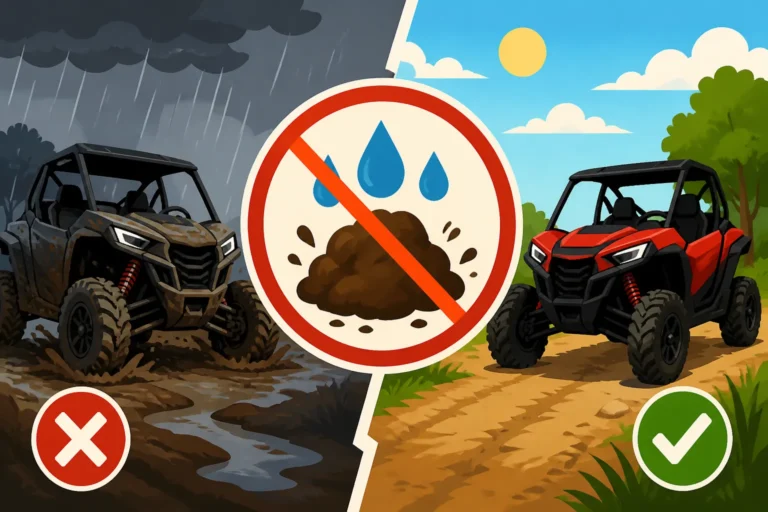
Weather can change how a ride feels and how much distance your group can safely cover. Check the forecast, but also consider the conditions at the riding area itself. Wind can push dust across a route, and a storm can make previously manageable ground slick or rutted. If rain has affected the surface, ask whether the area is open rather than assuming that a trail is suitable because it is still physically passable.
Heat deserves special attention. Start early when conditions are hot, take regular water breaks, and agree on a turnaround time before anyone feels worn down. Avoid planning the longest loop for the hottest part of the day. If someone develops confusion, unusual weakness, nausea, or stops sweating despite the heat, treat it as a potential emergency and get help rather than encouraging them to continue.
A weather change is a good reason to shorten the ride. Texas Riding in Summer Heat and Texas Trails After Heavy Rain offer broader planning guidance that applies well beyond one park. If you are navigating with onX Offroad, download or prepare what you need before leaving reliable coverage, and tell someone at home where you expect to ride and when you plan to return. Keep the app as a navigation aid, not as a substitute for site signs, a group plan, or sound judgment.
Make the day easier for your group
Set expectations before unloading
A smooth visit often starts with a brief conversation in the parking area. Make sure everyone knows the permitted riding zone, the group’s pace, where to regroup, and what to do if someone becomes separated. Choose a lead rider and a sweep rider for a group, and agree that nobody leaves the route or turns back alone. With children or inexperienced riders, keep the group small enough that the lead can check on everyone without losing sight of the slower riders.
Match the route to the least experienced person in the group, not the most confident one. A beginner may need time to get used to braking, steering, and loose ground before tackling longer or rougher sections. Give new riders space and avoid pressuring them to keep up. If a rider is tired or uneasy, take a break or head back; there is no prize for finishing a loop that no longer feels safe.
For visitors who want to camp or make a weekend of the outing, confirm whether overnight stays are allowed at the site and what facilities are actually available. Do not assume that camping permission automatically includes permission to ride after dark or travel between a campsite and a riding zone on an OHV. Camping at a Texas OHV Park can help with general planning, but confirm the rules for Moss Creek Lake directly.
Use a simple pre-ride checklist
Before unloading, take a few minutes to check that the trailer and machine are ready. Confirm that tie-downs are removed before starting the vehicle, the fuel cap is secure, and loose items are stowed. Make sure each rider has a helmet and suitable eye protection, and that any required safety equipment is mounted correctly. A small checklist helps when the group is excited to get moving and someone is tempted to skip the basics.
Before the first lap, review the route and set a conservative turnaround point. Check that every rider has enough water and knows where the group will stop. If a phone has service, share the day’s plan; if coverage is unreliable, do not depend on a call being possible from every part of the area. onX Offroad may be useful for reviewing a planned route, but continue to follow signs and the riding area’s instructions if they differ.
Finally, leave the area as you found it. Take trash with you, avoid disturbing wildlife, and report a damaged sign or hazard to the operator. If the trail is too wet or a route is closed, respect the closure rather than making your own path around it. A responsible visit helps preserve access for other riders and keeps the lake area welcoming to the wider community.
Disclaimer
This article is for general informational purposes only and does not constitute professional advice. Laws, prices and regulations vary by location and change over time. Consult a qualified professional for guidance on your specific situation.