Texas Riding With Small Children
Taking a small child on an ATV or UTV ride can feel like a tug-of-war between sharing the fun and worrying about speed, terrain, helmets, and rules. This guide explains how to choose an age-appropriate ride, understand Texas supervision and safety requirements, and plan a child-friendly outing without assuming every trail or machine is suitable for every family.
Start With the Child, the Machine, and the Riding Area
Match the ride to a child’s real abilities
A child’s age is only one part of deciding whether a ride is appropriate. Consider whether they can sit securely, understand simple safety instructions, tolerate noise and dust, and stay alert for the length of the outing. A child who is tired, frightened, or uncomfortable can have a hard time communicating that clearly once the engine is running.
Start with the machine manufacturer’s age and passenger guidance, then check the rules for the specific place you plan to ride. There is no sensible “one size fits all” answer for a three-year-old, a nine-year-old, and a teenager. A youth quad may be built for one rider, while a side-by-side may have passenger seating and restraints designed for more than one person. Those differences matter more than whether a vehicle looks roomy.
If you are shopping for a child’s first machine, read [Youth Machine Sizes and Texas Rules] and [Matching a Machine to a Child’s Size] before deciding what to buy. A machine that is too powerful or physically large can make basic control difficult. One that is too small can also be a poor fit if the child cannot use the controls properly or has already outgrown it.
Choose the riding area before you choose the route
Texas riding areas vary widely. A family considering the trails at Sam Houston National Forest, for example, needs to think about permitted machine width, trail conditions, and the child’s comfort with a longer ride. At a private park such as Barnwell Mountain or Hidden Falls Adventure Park, trail choices, terrain, and park rules may differ. Never assume that a route suitable for an adult group will also suit a young passenger.
Look for a place where you can make a short, low-pressure first outing and turn back easily. A quiet practice area or an easy, clearly marked trail is generally a better test than a rocky climb, deep mud, or a long loop far from the trailhead. Check the riding area’s own rules before leaving home; operators may set age, passenger, helmet, or equipment requirements that are stricter than a family expects.
A route-planning app such as onX Offroad can help you review an area and discuss the planned route before the ride. Use it as a planning aid, not as a substitute for official park maps, posted signs, or current closure information. If you are weighing parks and trail difficulty, [Texas OHV Parks for Beginners] and [Texas Riding With Small Children] are useful related topics.
Know the difference between private land and public riding areas
A family riding on private land with the owner’s permission faces a different set of access rules from one riding on public land or at a designated OHV area. Private land is not a free pass to ignore machine instructions or basic safety, but public areas may have additional requirements for decals, safety certificates, protective equipment, and where a vehicle may be operated.
Before a trip, confirm whether the site requires a Texas OHV decal, a separate day-use payment, a safety certificate, or a specific type of vehicle. The requirements can depend on who manages the land and how the area is designated. [The Texas OHV Decal Explained] gives useful background, while [Texas Rules for Riding Public Land] helps clarify why a ride on public land should not be planned like a casual spin around a private pasture.
Texas Rules and Supervision for Riders Under 14
Understand the under-14 safety requirement
Texas has specific safety-certificate and supervision rules for younger OHV riders in covered public riding situations. A child under 14 should not be sent out to operate an OHV alone on public riding land. The applicable rules involve direct supervision by a qualified adult, and the riding area may have additional requirements. Check the official rules and the particular site before the trip rather than relying on what another family did at a different park.
A parent or guardian should be close enough to supervise actively, not merely somewhere else on the property. Direct supervision means paying attention to the child’s location, choices, and surroundings. At a busy trail area, that can mean staying with the child, keeping a manageable distance, and choosing terrain where the adult can respond quickly.
The details are worth reviewing before you go. See [Texas Rules for Riders Under 14], [Texas OHV Safety Certificate Requirements], and [Direct Supervision by a Texas Certificate Holder]. If a child is close to an age threshold or the riding setup is unusual, confirm the rule with the land manager or the appropriate Texas agency instead of guessing.
Don’t confuse permission to ride with readiness to ride
Meeting a legal requirement does not automatically make a child ready for every machine or trail. A child may be allowed to ride under supervision but still lack the coordination, confidence, or strength needed for a particular vehicle. Take time to teach stopping, turning, hand signals, and what to do if the child feels uncomfortable.
Before the engine starts, agree on a simple stop signal and a rule that the child must tell you about pain, fear, or fatigue. Practice the signal while the vehicle is stationary. For a young passenger, explain that they should keep their hands and feet inside the vehicle and follow the driver’s directions. For a child operating a youth machine, practice in a controlled area before approaching trails.
A short practice session can reveal problems that are easy to miss at home: a helmet shifting over the eyes, gloves that make controls awkward, a child who cannot comfortably reach the footrests, or a seat position that does not allow a secure hold. Fix those issues before setting out. [The Texas ATV Safety Certificate Explained] covers the certificate topic in more detail.
Check the site’s rules separately
A state rule is not necessarily the only rule that applies. Parks and land managers can set their own conditions for admission and riding, including minimum ages, helmet requirements, machine restrictions, designated routes, and whether passengers are permitted. The safest approach is to check the current rules for the exact location and machine you are bringing.
This matters especially when moving between a private OHV park, a national forest trail, and a public recreation area. A child who can ride in one place may not meet the entry or equipment requirements at another. Keep the park’s contact details and official map available, and confirm any questions about children or passenger seating before paying for a trip.
Keeping a Child Safe as a Passenger
Use only seating designed for a passenger
An ATV is not automatically a two-person vehicle just because an adult and child can squeeze onto the seat. Do not carry a passenger on a machine that is designed for one rider. A passenger needs a proper position, secure handholds, and foot placement that keeps their feet away from moving parts and the ground. Review [Texas Passenger Rules on an ATV] and follow the manufacturer’s instructions for the specific machine.
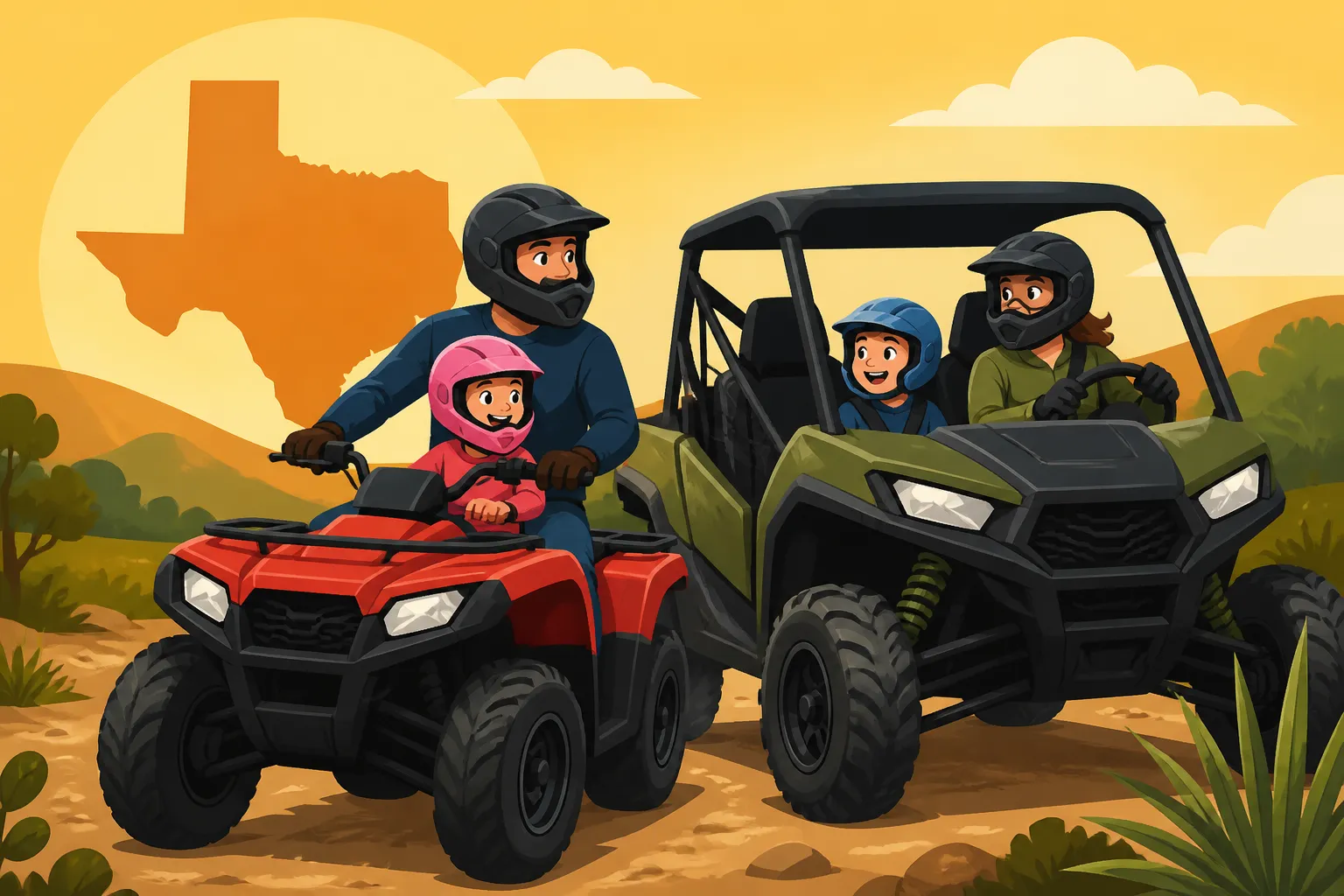
A side-by-side can be a more appropriate way to bring a child along when it has a passenger seat and restraint designed for that passenger. But the extra space does not remove the need to check fit. The child should be able to sit back in the seat and use the belt as intended. If the belt cannot be fitted correctly, or the child cannot stay positioned securely, do not treat the vehicle’s passenger capacity as proof that the child is ready to ride.
For a child riding in a side-by-side, check the vehicle manual and the child’s fit in the seat and restraints before the trip. See [Texas Rules for a Child in a Side-by-Side] for related Texas-specific considerations. Never modify a restraint or add makeshift cushions that change how a belt fits without checking the manufacturer’s guidance.
Make helmets and protective equipment fit properly
A helmet that is too large can move around; one that is too small can be painful and may not sit correctly. Have the child try the helmet on before the ride, fasten the strap, and check that it stays in place when they move their head. Bring eye protection that fits, gloves that allow a secure grip, long sleeves, long pants, and sturdy footwear suitable for the vehicle and riding area.
Do not assume a child’s bicycle helmet is an appropriate substitute for the helmet required or recommended for OHV riding. Check the applicable park rules and use protective equipment intended for the activity. Some riding areas require helmets for everyone, regardless of age or experience. [Texas Parks That Require Helmets at All Times] is a helpful reminder to check for rules that apply to the whole family.
Pack spare gloves and eye protection if you have them. Dust, heat, and a loose strap can turn a fun ride into an uncomfortable one quickly. A child may be reluctant to speak up in front of a group, so build in a brief gear check before starting and another stop soon after the ride begins.
Keep the first outing short and flexible
Young children often tire sooner than adults expect, especially in Texas heat. Begin with a short ride, take breaks in shade, and bring drinking water. Watch for signs that a child is getting too hot or overwhelmed, such as unusual quietness, irritability, flushed skin, or difficulty keeping up with instructions. Stop and reassess rather than pushing through a planned route.
Plan a clear turnaround point and tell the child that asking to stop is always acceptable. Adults sometimes feel pressure to finish the loop because the group is already on the trail or the drive to the park took hours. For a child’s first outing, flexibility is part of good planning: a brief successful ride is more valuable than a long ride that ends with fear or exhaustion.
| Before the ride | What to check |
|---|---|
| Machine | Manufacturer’s age, passenger, and operating guidance |
| Child’s fit | Secure seating, reachable controls if operating, and properly fitted restraints if a passenger |
| Protective gear | Suitable helmet, eye protection, gloves, long clothing, and sturdy footwear |
| Riding area | Age and passenger rules, permitted routes, access requirements, and closures |
| Route | Short, manageable distance with an easy way to stop or turn back |
| Family plan | Stop signal, water breaks, meeting point, and adult supervision |
Planning a More Enjoyable Family Ride
Check conditions and route details before leaving
Texas conditions can change the difficulty of a trail. Recent rain can leave mud and standing water, while dry weather can mean dust and loose surfaces. Rock, sand, narrow wooded trails, and open areas each create different challenges for a young passenger or beginner rider. Check the official riding area information, follow posted closures, and avoid routes that exceed the child’s comfort or the machine’s capability.
When using onX Offroad or another mapping tool, review the route with the family before the ride and identify places where you can pause or turn around. Confirm that the route is actually open to your type of machine and that the map matches the riding area’s posted instructions. Do not rely on a saved route as permission to use a closed trail or cross private land.
If the destination is unfamiliar, look for practical details too: where to park or unload, whether restrooms and drinking water are available, and how far the trailhead is from the staging area. [Texas OHV Parks With Cell Signal] may help you think about connectivity, but a phone should not be your only safety plan. Tell someone where you are going and when you expect to return.
Set family rules before anyone starts the engine
A simple pre-ride conversation can prevent confusion. Tell children to stay with the supervising adult, keep to marked routes, and stop when asked. Explain that they should not follow another group or take a shortcut, even if it looks easy. For a child operating a machine, establish a speed limit appropriate to the terrain and agree that they must stop if they lose sight of the adult.
Adults should also agree on who is supervising each child. If several families are riding together, do not assume that the nearest adult is responsible. Name the supervising person and make sure that person understands the child’s experience level and the planned route. A small group with clear responsibilities is easier to manage than a large ride where everyone expects someone else to keep an eye on the youngest rider.
onX Offroad can be useful for discussing where the group intends to go, but keep the plan grounded in the official trail layout and the family’s abilities. Avoid separating the group just to cover more ground. If the trail becomes rougher, visibility drops, or the child begins to tire, turn around or choose an easier route.
Make room for a no-ride decision
Sometimes the best family decision is to leave the machine parked. A child may be sick, frightened by the sound, uncomfortable in the helmet, or simply not ready that day. Likewise, a trail may be too difficult after rain, a passenger seat may not fit the child, or a required piece of equipment may be missing. Treating those as valid reasons to postpone is part of responsible riding.
If a child decides to stop, respond calmly. Avoid teasing or pressuring them to continue because others are watching. A positive first experience should teach that riding is something the family does carefully, not something a child has to endure to please the adults. That approach makes it more likely that the child will speak up early when something feels wrong.
A relaxed plan, appropriate equipment, active supervision, and a route suited to the youngest rider can make a Texas outing safer and more enjoyable. When in doubt about a specific machine, park rule, or supervision requirement, confirm it before the trip rather than trying to sort it out at the trailhead.
Disclaimer
This article is for general informational purposes only and does not constitute professional advice. Laws, prices and regulations vary by location and change over time. Consult a qualified professional for guidance on your specific situation.