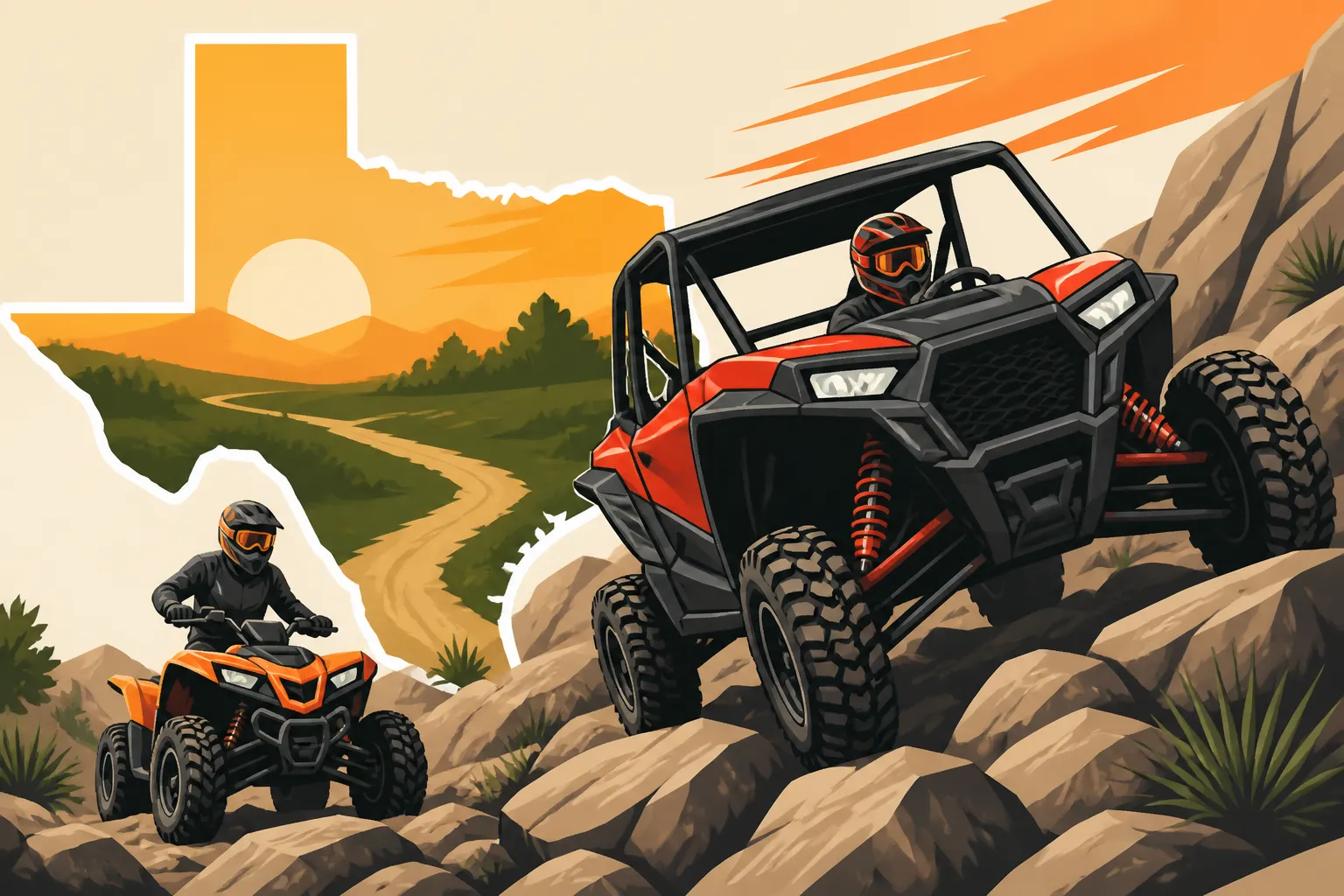
Texas OHV Parks With Rock Crawling
Finding a Texas rock-crawling area that suits your machine and experience can be harder than picking a destination on a map. A rocky trail that feels manageable in a built UTV may be punishing in a stock ATV, and access rules can differ from park to park. This guide compares several Texas riding areas and explains how to plan a safer, more rewarding day.
Texas OHV parks to consider for rock crawling
Texas riding areas vary widely: some have marked trail systems with rocky sections, while others are known for more technical terrain or scheduled access. Before choosing a destination, consider your machine’s clearance, tires, protection, and whether the park welcomes your vehicle type. For a broader look at destinations, see [Texas Parks With Rock Crawling](Texas Parks With Rock Crawling) and [Texas Trail Difficulty by Park](Texas Trail Difficulty by Park).
Hidden Falls Adventure Park near Marble Falls
Hidden Falls Adventure Park, in the Marble Falls area of the Hill Country, is a useful option for riders who want a mix of terrain rather than a day devoted to one kind of obstacle. Its trails can include rocky and uneven sections, so it may suit a group with different experience levels—provided everyone chooses routes appropriate to their vehicles and abilities. Read [Hidden Falls Adventure Park at Marble Falls](Hidden Falls Adventure Park at Marble Falls) when comparing the park with other Texas destinations.
The Hill Country’s exposed rock and elevation changes can make a trail feel very different from a muddy East Texas route. On a rocky climb, traction, a careful line, and controlled speed usually matter more than simply adding throttle. A passenger can help watch tire placement, but the driver should stop and assess an obstacle rather than feel pressured to follow another vehicle through it.
Before setting out, check the park’s current trail map, vehicle rules, opening information, and any closures directly with the operator. Don’t assume that a trail suitable for a side-by-side is appropriate for every ATV, or that a route marked as open is comfortable for a beginner. If your group includes a stock machine, a new driver, or a youth rider, plan a conservative route and treat harder obstacles as optional.
Barnwell Mountain Recreation Area near Gilmer
Barnwell Mountain Recreation Area is an East Texas destination with a developed trail network and varied terrain. Riders looking for rocky features can explore routes that offer a different feel from the steep, exposed Hill Country landscape. The piney woods around Gilmer also bring their own practical considerations: loose material, changing traction, and wet conditions can make a familiar-looking route more challenging.
A helpful way to compare Barnwell Mountain with Hidden Falls is to think about the kind of day you want. Hidden Falls may appeal to riders seeking Hill Country terrain and a range of trail choices; Barnwell Mountain may be a better fit for a group interested in exploring a wooded network and taking on obstacles selectively. The comparison in [Barnwell Mountain or Hidden Falls for a Weekend](Barnwell Mountain or Hidden Falls for a Weekend) can help you narrow the choice.
Rock crawling does not mean every rider needs to attempt the most technical line in the park. On a rocky section, pause where it is safe, check for loose stones and sharp ledges, and look for a route that keeps the machine stable. If a trail becomes more difficult than expected, turning around is a sound riding decision—not a failure. Confirm the park’s vehicle access, trail conditions, and rules before traveling.
Katemcy Rocks in Mason County
Katemcy Rocks, in Mason County, is known for rocky terrain and is often associated with more technical riding. It can be an appealing destination for experienced drivers who want to focus on obstacles, but it is especially important to confirm access arrangements before making the drive. Katemcy has scheduled access rather than the assumption of an always-open public trail system; check the operator’s current information before planning a visit. See [Katemcy Rocks and Its Scheduled Dates](Katemcy Rocks and Its Scheduled Dates) for more on planning around its access schedule.
This is the sort of destination where preparation should begin with an honest conversation about the group. Are drivers comfortable with steep or uneven lines? Does each machine have suitable tires and underbody protection? Can everyone communicate clearly if a vehicle needs spotting or recovery? If the answer to several of those questions is no, consider choosing easier routes or a less technical park for this trip.
A capable machine still doesn’t make every obstacle a good idea. Walk a line when permitted and safe, keep people clear of the vehicle’s path, and avoid placing a spotter where a slipping tire or shifting machine could put them at risk. If you’re visiting with a mixed-experience group, agree in advance that anyone can opt out of an obstacle without being teased or rushed.
Northwest OHV Park near Bridgeport
Northwest OHV Park in Wise County, near Bridgeport, offers another option to investigate when you’re planning a North Texas ride. Look at its official trail information to determine whether the available terrain, machine access, and current conditions fit your group. The overview at [Northwest OHV Park in Texas's Wise County](Northwest OHV Park in Texas's Wise County) is a useful starting point for comparing it with parks farther south or east.
A map may show a network of trails, but that alone won’t tell you whether an individual section matches your machine. Ask the park about trail difficulty, vehicle width limits, and any routes closed to certain machine types. This matters particularly for full-size side-by-sides, which may need more room to turn and may be restricted from trails intended for narrower machines. See [Texas Parks That Allow Full-Size Rigs](Texas Parks That Allow Full-Size Rigs) before assuming your rig can access every route.
If you’re traveling from the Dallas–Fort Worth area, the shorter drive can make Northwest OHV Park attractive for a day trip. Still, arrive with a plan: know where to get park instructions, identify an easier first route, and decide how your group will regroup if vehicles get separated. For any park, follow posted signs and staff directions instead of relying on a route description from an older trip.
| Riding area | What may make it appealing | What to verify before you go |
|---|---|---|
| Hidden Falls near Marble Falls | Hill Country terrain and a variety of trail choices | Current trail conditions, vehicle access, and route difficulty |
| Barnwell Mountain near Gilmer | A wooded trail network with varied terrain | Closures, machine restrictions, and how wet weather affects routes |
| Katemcy Rocks in Mason County | A destination for riders seeking technical rocky terrain | Scheduled access, reservations or entry arrangements, and suitability for your group |
| Northwest OHV Park near Bridgeport | A North Texas option to compare with Hill Country and East Texas parks | Trail access by vehicle type, width restrictions, and current conditions |
Match the trail to your machine and experience
Rock crawling is less about having the most powerful machine and more about matching the obstacle to the vehicle, driver, and conditions. A line that looks straightforward from the driver’s seat can hide a steep drop, a loose rock shelf, or a narrow turn that leaves little room to correct a mistake.
Know what your ATV or UTV can handle
Before a ride, inspect the machine and think realistically about its limits. Ground clearance affects whether the underside can pass over rocks without striking them. Tire condition and pressure influence grip and stability. A UTV’s wheelbase, width, and turning radius affect how it fits between obstacles, while an ATV’s lighter size can help in some tight spots but may offer less protection if it tips or contacts a rock.
Check for loose fasteners, worn tires, damaged steering or suspension components, and anything that could become a problem far from the trailhead. A winch may help with recovery, but it does not make a risky line safe. Carry recovery gear suitable for your vehicle and know how to use it; never stand near a loaded recovery line or between a vehicle and its anchor point.
Accessories can help protect a machine, but upgrades are not a substitute for judgment. A skid plate may reduce damage from an underbody strike, for example, but it cannot prevent every impact or rollover. If you’re comparing parks for a wide machine or a heavily modified UTV, confirm access first and consult [Texas Parks That Allow Full-Size Rigs](Texas Parks That Allow Full-Size Rigs).
Choose obstacles based on the least experienced rider
It’s easy for a group to choose a route based on its most experienced driver. That can leave a beginner struggling to keep up or a less capable machine facing an obstacle it wasn’t prepared for. Instead, make the least experienced rider and least suitable vehicle the starting point for route planning. More experienced drivers can explore harder routes separately if the park allows it and the group has a safe way to reunite.
A spotter can help the driver understand tire placement and what is out of view, but communication needs to be simple and agreed upon. If the driver loses sight of the spotter or is unsure what a signal means, stop. Don’t let spectators gather downhill from a vehicle, beside a tire that could slip, or in a place where the driver can’t see them.
Give your group permission to say, “That line isn’t for me.” This is especially helpful when riders are new to technical terrain, when children are along, or when one machine is less protected than the others. A successful ride is one where everyone gets back to the staging area safely, even if you leave a few obstacles untouched.
Plan a safe Texas rock-crawling day
Good planning makes a technical ride less stressful. A little preparation can prevent common problems such as arriving to find a route closed, discovering that a machine is too wide for the planned trail, or realizing that the group brought no practical recovery equipment.
Check access, maps, and trail conditions
Start with the park’s own information. Confirm operating status, access arrangements, permitted vehicle types, and any restrictions that could affect your group. For destinations with scheduled access, verify the date and entry process before leaving home. A third-party map or app can help you study an area, but it should not replace the park’s rules or current directions.
onX Offroad can be useful for reviewing mapped routes and getting a general sense of the terrain while you plan. Use it as a planning aid rather than proof that a trail is open, legal to ride, or suitable for your machine. Cross-check the route with the operator’s information and follow signs on the ground. If you use onX Offroad to prepare, download or save the information you need before heading into an area with unreliable cell coverage.
Weather deserves special attention. Rain can change traction, wash debris onto a route, or lead a park to close trails to protect the land. Rocky ground may seem less vulnerable than soft soil, but water can still make climbs slippery and obscure hazards. Check [Texas Trails After Heavy Rain](Texas Trails After Heavy Rain) before treating a rainy forecast as a minor inconvenience.
Pack for breakdowns, heat, and getting separated
Bring water, basic first-aid supplies, a charged phone, and any navigation or communication equipment your group relies on. Carry enough water for the day and consider how heat, exertion, and riding gear affect everyone, not just the driver. Take breaks before people become tired or irritable; fatigue makes it harder to judge lines and respond calmly to a changing situation. For seasonal planning, see [Texas Riding Seasons and Heat](Texas Riding Seasons and Heat).
Before leaving the staging area, agree on a simple plan: who leads, who follows, where the group will stop, and what to do if someone falls behind. Keep a safe distance between vehicles so a sudden stop or loose rock doesn’t create a chain reaction. If a vehicle breaks down, move people to a safe location and use a recovery plan that doesn’t put bystanders in the travel path.
Tell someone outside the group where you intend to ride and when you expect to check in. That may feel unnecessary for a day at a managed park, but it is a sensible habit when cell service is limited or a mechanical problem could delay your return. Park-specific procedures take priority, so learn how to contact staff or request help before heading onto the trail.
Make the most of your ride
Build a route with an easy exit
Plan a first loop that lets you assess the terrain before committing to a longer or more technical route. Use an early stop to check how the machine, drivers, and conditions are handling the day. If tires are slipping more than expected, the group is tiring quickly, or a route is more difficult than the map suggested, adjust the plan while you still have plenty of daylight and energy.
It can help to choose a meeting point and a turnaround time before riding. That gives the group a clear point to regroup and prevents the familiar “just one more trail” decision from stretching the day too far. On a technical route, leave room in your schedule for spotting, careful line choices, and minor delays. Rushing through an obstacle to stay on schedule is rarely worth it.
A route plan should include alternatives. If the intended trail is closed or the group finds it too difficult, have an easier option in mind rather than pushing ahead. Reviewing [Barnwell Mountain or Hidden Falls for a Weekend](Barnwell Mountain or Hidden Falls for a Weekend) can also help if you are choosing between a more varied riding weekend and a destination focused on a particular kind of terrain.
Ride with respect for the park and other visitors
Stay on designated routes, obey one-way directions and closures, and avoid creating bypasses around obstacles. A shortcut can damage the area and put other riders in an unexpected position. Keep noise and speed reasonable near staging areas, campsites, and people on foot, and give approaching vehicles room to pass when the trail allows.
If you stop to watch another driver, stand well away from the line and follow any directions from the driver or spotter. Don’t crowd a vehicle attempting a climb or recovery. A driver needs room to make a safe decision, and a bystander can quickly become a hazard if a tire slips or a machine changes direction.
After the ride, check the machine for damage and clean out mud, dust, or debris that could hide a new problem. Make a note of trail conditions and any equipment you wish you had brought. Those small observations make the next trip easier to plan—and help you choose the right level of challenge without turning a day of riding into a repair or recovery job.
Disclaimer
This article is for general informational purposes only and does not constitute professional advice. Laws, prices and regulations vary by location and change over time. Consult a qualified professional for guidance on your specific situation.