Texas OHV Parks Open Year Round
A Texas riding park may welcome riders through every season without being open every day—or every weekend. That distinction matters when you have loaded the trailer, driven across the state, and then discovered a gate closure after heavy rain. This guide explains how year-round access works, which Texas areas to investigate, and what to check before you leave home.
What year-round access means at a Texas OHV park
Open across seasons does not mean open every day
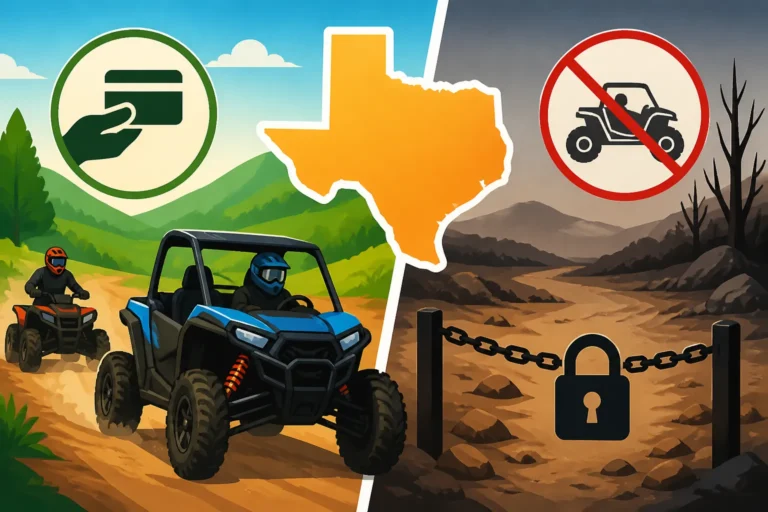
When a park describes itself as open year-round, that usually means it operates in more than one season, not that its gates are open daily. Many Texas riding areas follow set operating days, require advance planning, or adjust access around events and maintenance. A park may offer rides in winter and spring but still be closed on a particular weekday.
That distinction is easy to miss when you are planning around a long weekend or trying to squeeze in a ride between work shifts. The safest approach is to check the park’s own calendar or contact its operator before loading up. Confirm the specific date, arrival time, check-in process, and whether day-use access is available to visitors.
Also ask whether the park is open to your type of machine. Some places have trails or facilities suited to particular vehicle sizes, and a park’s general listing may not tell you whether a full-size side-by-side can use every route. For more on places that accommodate larger machines, see [Texas Parks That Allow Full-Size Rigs].
Weather and trail conditions can override the calendar
Texas weather can change riding plans quickly. A storm may leave clay or wooded trails too soft to use, while prolonged heat can make a summer ride uncomfortable or unsafe. Park managers may close a trail system temporarily to prevent erosion and damage, even if the facility is otherwise operating.
Closures are not just a nuisance. Riding on a saturated trail can deepen ruts, damage the surface, and make recovery difficult. Before leaving, check for a weather-related notice and ask whether the entire park is affected or only particular trails. If conditions are uncertain, a call to the operator can save you a long drive and an even longer muddy recovery.
Keep the specific destination’s rules in mind rather than assuming that every Texas park responds to weather in the same way. For public forest riding, trail status is especially important: [Texas Trails After Heavy Rain] explains why a route that appears on a map may not be open for riding after a storm.
Texas riding areas to investigate for year-round trips
Parks with seasonal riding opportunities
Several well-known Texas facilities are worth investigating when you want to ride outside a short summer season. Barnwell Mountain Recreation Area near Gilmer, Hidden Falls Adventure Park near Marble Falls, and Northwest OHV Park near Bridgeport are recognizable destinations for off-highway riders. Their locations and terrain differ, so the best fit depends on where you are traveling from, what you ride, and how challenging a trail you want.
Treat these as places to check—not as a promise that a particular gate will be open on your chosen date. Operating schedules, event calendars, trail conditions, and access rules can change. Before you book travel or invite a group, confirm directly with the park whether it is accepting riders and whether any restrictions apply to your machine.
If the trip involves camping, check that separately from riding access. A park might allow day riding while camping areas have different availability or reservation requirements. The guide to [Texas OHV Parks With Camping] can help you think through overnight plans, but verify the details with the individual facility.
Public-land trails are a different kind of year-round option
A public trail system is not the same as a privately operated OHV park. For example, the Sam Houston National Forest trail system near New Waverly has its own access requirements and can close when soil conditions are too wet. The forest’s rules, permits, trail-width limits, and status notices may differ from those at a private park.
That means “open year-round” is particularly important to interpret carefully for public land. A trail may be available in multiple seasons but still close temporarily, require a day-use payment or pass, or restrict which vehicles can use it. Check the land manager’s official information before you go, and do not rely on an old social media post or a map pin as proof of current access.
For a closer look at this public-land option, see [Sam Houston National Forest's 85-Mile OHV Trail]. If you are comparing it with other destinations, [Texas OHV Parks by Region] is a useful starting point for narrowing the drive.
| Riding option | What to verify before traveling | Why it matters |
|---|---|---|
| Privately operated OHV park | Operating date, hours, admission process, machine restrictions | A park may operate seasonally but not every day |
| National forest trail | Trail status, fees or passes, width limits, closure notices | Public-land access can change with conditions |
| Park with camping | Campsite availability, reservation rules, check-in details | Riding access and overnight access may be separate |
| Event-based riding area | Event dates, registration, permitted vehicle types | Access may be limited to scheduled events |
How to plan a ride without getting caught by a closure
Check the right information in the right order
Start with the operator or land manager’s official website, social channels, or phone line. Look for the exact date of your visit rather than relying on a general statement that a place is open during a particular season. If you cannot find a clear answer, ask directly. A quick confirmation is more useful than guessing from an old listing.
Next, confirm the details that can derail the day even if the gates are open. Ask whether your machine is allowed, whether there is a width restriction, whether you need a permit or decal, and whether the park has a separate requirement for passengers or younger riders. Public land has its own access rules; for example, review [Texas Rules for Riding a National Forest Trail] before heading to a forest trailhead.
Finally, check practical travel details: where to enter, whether fuel is available nearby, whether the route is suitable for your trailer, and what happens if rain changes conditions overnight. Save the park’s contact information before you leave. Cell service can be unreliable in rural areas, and a screenshot of the access instructions can be handy if you lose reception.
Use maps as a planning aid, not a closure notice
Mapping tools can help you understand where a riding area is, how far it is from a fuel stop, and which roads lead to the entrance. onX Offroad can be useful for organizing route research and viewing off-road mapping information, but a map should not be treated as confirmation that a trail is currently open. Always cross-check with the park or land manager.
That distinction matters when you are navigating unfamiliar country. A route may appear accessible but cross private property, lead to a closed gate, or connect to a trail with a vehicle restriction. Use maps to build your plan, then verify the legal route and current access with the responsible operator.
It also helps to download or save essential information before heading out. Write down the address or entrance instructions, the park’s phone number, your check-in details, and a backup destination. If your preferred area closes, [Texas Riding Areas Worth a Weekend] can help you think about alternatives, but you will still need to confirm the other site’s schedule and conditions.
Choosing a season and preparing for the ride
Match the destination to the weather
A park that is technically available in every season may feel very different in July than in January. Summer rides call for careful heat planning, while cooler months can bring wet ground or short daylight hours. Choose a start time that gives your group room to ride, take breaks, and return before conditions become uncomfortable.
In hot weather, carry more water than you expect to need, take breaks in shade where possible, and watch for signs of heat illness in yourself and other riders. Dust can also become a concern when trails are dry and busy. In cooler or wet conditions, check the forecast and trail status, bring appropriate layers, and be prepared to postpone the trip if the route is closed or unsafe.
For more specific seasonal planning, see [Texas Riding in Summer Heat] and [Texas Riding in Winter]. These considerations matter even when a park’s calendar shows that it is operating: open gates do not guarantee comfortable conditions or a suitable trail surface.
Make a backup plan before loading the trailer
A backup destination is especially helpful if you are driving several hours. Choose an alternative in a different area or one with a different type of operation, then check its rules and schedule in advance. Do not assume that another park nearby will have space, open trails, or the right terrain for your machine.
Before departure, confirm your truck and trailer are ready, secure the machine properly, and bring the safety gear required by the riding area. Make sure every rider understands the plan, including where to check in and what to do if the group gets separated. If you are taking a side-by-side, check passenger seating and restraint requirements rather than assuming every vehicle configuration is acceptable.
If you want a broader comparison of destinations, [Best Places to Ride an ATV in Texas] can help you identify options by region and riding style. Use that research to shortlist places, then verify current access directly. The most reliable year-round plan is not finding a park that never closes; it is building a trip around confirmed access, realistic weather expectations, and a sensible alternative.
Disclaimer
This article is for general informational purposes only and does not constitute professional advice. Laws, prices and regulations vary by location and change over time. Consult a qualified professional for guidance on your specific situation.