Why Texas Trails Close When the Soil Is Wet
A trail can look rideable from the parking area and still be too wet farther in. In Texas, rain affects clay, sand, caliche, and rocky ground differently, so a route may close even when nearby roads seem dry. This guide explains why managers shut trails, what wet riding can damage, how closures are decided, and how to plan a safer alternative.
Why wet soil makes a trail vulnerable
Soil absorbs and releases water differently across Texas
“Wet” does not mean the same thing everywhere. Dense clay can hold water and become slick or deeply rutted, while sandy ground may drain more quickly but still shift under tires. Caliche can turn slippery when wet, and the rocky surfaces around parts of the Hill Country may have patches of mud, exposed stone, and runoff channels all within a short distance.
That variety is one reason a rain total alone cannot tell you whether a trail is ready. A site near the Piney Woods may have soft, saturated ground and shaded sections that dry slowly. A more exposed trail in the Panhandle could seem firm in one area while low spots still hold water. Even within one park, the trailhead may be dry while a shaded ravine or low crossing remains vulnerable.
The practical takeaway is that local conditions matter more than the weather app’s summary. Park staff, land managers, or the organization that maintains the trail can assess where water is pooling and whether the surface can handle traffic. For more on regional conditions and timing, see [Texas Trails After Heavy Rain] and [Texas Riding Seasons and Heat].
Tires can turn soft ground into lasting trail damage
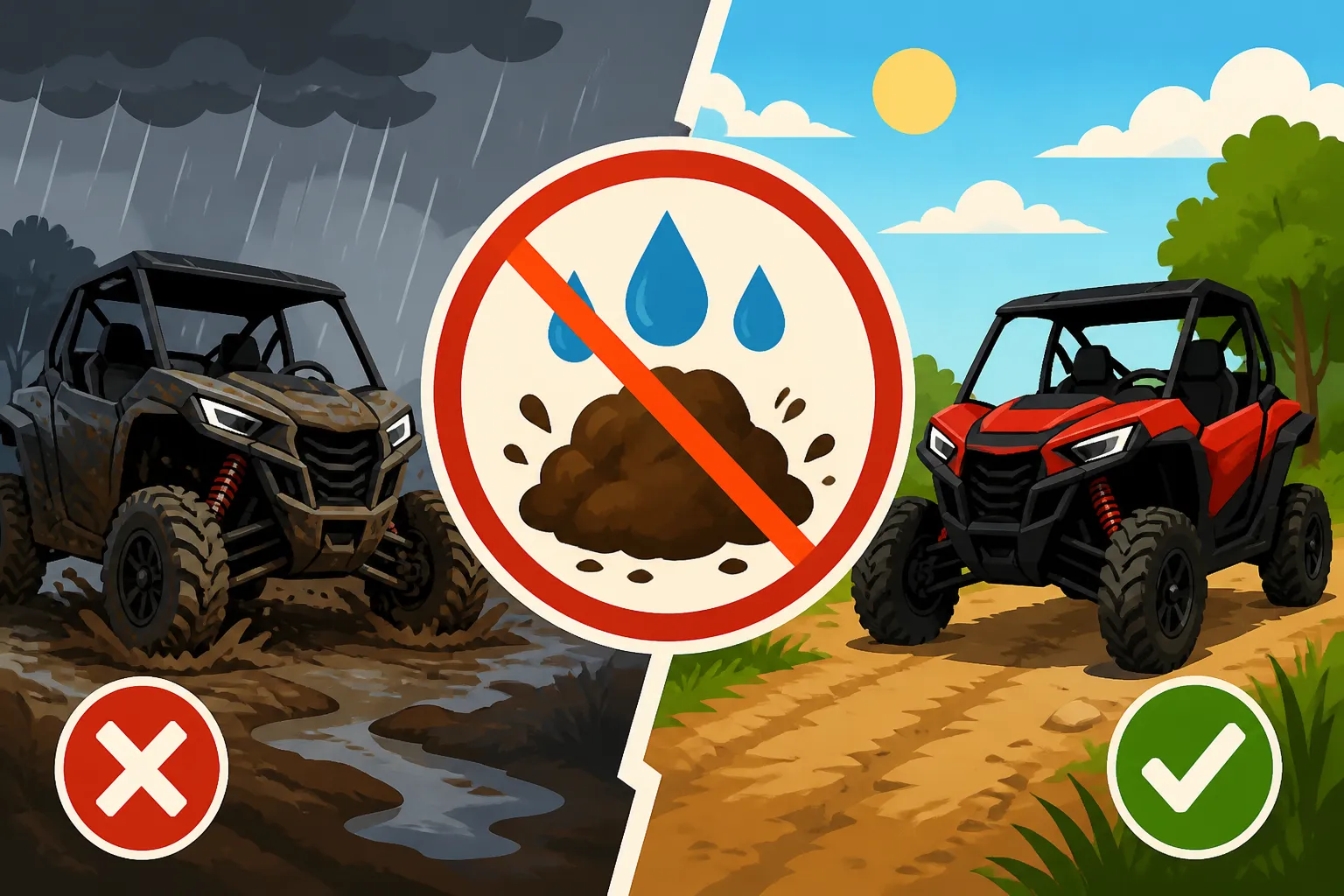
An ATV or UTV concentrates its weight through a small contact area. When the surface is firm, that pressure is usually manageable. When the soil is saturated, tires can sink, push loose material aside, and leave ruts that direct later rainfall into the same grooves.
Ruts can grow quickly once water begins flowing along them. A shallow tire mark may become a channel that carries runoff downhill, washing away soil and exposing roots or rocks. On a slope, repeated passes can make the problem worse: riders may steer around a muddy rut, widening the track and damaging vegetation along its edge.
Trying to power through can also damage the machine and create recovery problems. Spinning tires dig deeper, and a stuck vehicle may need a tow or winch that further churns up the trail. If a trail looks soft enough that you would need momentum to cross it, that is a good reason to turn around rather than test it.
Closure protects more than the tread
A trail is part of a larger landscape. Water that runs off a damaged path can carry sediment toward nearby creeks, ponds, or drainage areas. Repeated disturbance can also affect plants beside the route and make it harder for the trail edge to recover.
Managers may close a route to protect bridges, culverts, stream crossings, or other trail features as well as the soil itself. A crossing that is safe when dry may become slick, fast-flowing, or difficult to see after rain. A short closure can prevent a small problem from becoming a repair project that keeps the route unavailable much longer.
Closures can also reduce risks to riders and staff. Mud can hide holes, washouts, branches, and changes in the trail surface. A rider who loses traction may slide into another vehicle or leave the marked route, while a recovery crew may have trouble reaching a stuck machine without causing more damage.
How trail managers decide when to close
The decision is based on conditions, not a universal rainfall number
There is no single rainfall amount that automatically makes every Texas trail unsafe. Soil type, slope, drainage, shade, trail design, and recent weather all affect how quickly a route becomes vulnerable. A short, intense storm can create runoff and washouts, while steady rain can saturate the ground over a longer period.
Managers may also consider what is coming next. If the forecast suggests more rain, opening a trail too soon could expose it to traffic before the ground has had time to firm up. Conversely, a sunny afternoon does not necessarily mean a shaded or low-lying section has dried enough to reopen.
That is why a closure can feel frustratingly broad or cautious from the parking lot. Staff may be responding to conditions farther along the route, or protecting a section that is especially prone to erosion. A closure notice is not a guarantee that every part of the park is muddy; it means the responsible manager has decided that the route or area should not be used under current conditions.
Some routes are more sensitive than others
Trail layout matters. Steep grades, narrow paths, drainage dips, creek crossings, and low spots can be more vulnerable than broad, well-drained sections. A route that stays firm through light rain may become unsafe after a heavier storm if runoff crosses it or collects in a hollow.
Trail width can matter, too. On a narrow route, a rider may have little room to avoid a soft patch without leaving the marked trail. A wider road or designated staging area may remain usable while a tighter trail loop is closed. Do not assume that an open entrance means every route inside is open; read signs and follow the current route information.
Different facilities can also set different procedures. A state or national forest trail, a city-run riding area, and a privately operated park may have separate staff, access rules, and closure notices. Before making a long drive, check the operator’s official updates rather than relying on an old forum post, a friend’s recollection, or a map showing the route line. [Texas Trail Closures to Check First] offers a useful starting point for building that habit.
Reopening requires more than a dry-looking surface
A trail can look dry at the entrance while deeper soil remains saturated. The surface may firm up in the sun before the ground underneath can support repeated traffic. That mismatch can make a route seem ready, only for tires to break through and create ruts after a few passes.
Managers may inspect trouble spots, confirm that water is draining, and check whether the route has been damaged. If repairs are needed, reopening may take longer than the rain itself. A closure may also remain in place while crews remove debris or stabilize a crossing, even if the rest of the park appears rideable.
When reopening information is unclear, ask the site operator whether the specific trail or area is open. Do not treat an unofficial report as permission to ride around a barrier. The route might be closed for a reason that is not visible from the entrance, and bypassing a closure can put both the trail and future access at risk.
| Trail condition | Why it can be a problem | Sensible response |
|---|---|---|
| Slick clay or caliche | Tires may lose grip, especially on slopes | Avoid steep or visibly slick sections |
| Standing water in low spots | Water may hide ruts, holes, or soft ground | Do not assume the puddle is shallow |
| Deep tire ruts | Runoff can follow and enlarge the grooves | Stay off the route if it is closed or deteriorating |
| Water crossing the trail | Flow can conceal the surface and affect footing | Follow posted closure instructions |
| Dry entrance with wet areas farther in | Conditions can vary by shade, drainage, and elevation | Check the full route status before setting out |
What riders should do before and during a wet-weather trip
Check official conditions before loading up
A little checking before departure can save a long, disappointing drive. Look for updates from the park or land manager, including notices about partial closures, trail conditions, access roads, and weather-related limits. If the information is not clear, contact the operator directly and ask about the specific riding area you plan to use.
Mapping tools can help you understand the layout and plan a backup, but they are not a substitute for an official closure notice. For example, onX Offroad can be part of your route-planning process, while the park or land manager remains the authority on what is open. Check that any route you intend to follow is permitted and currently accessible.
It also helps to make a Plan B before leaving home. If your preferred trail is closed, you might reschedule, choose another permitted area with confirmed conditions, or switch to a non-riding activity nearby. That is less frustrating than arriving at the gate and trying to improvise while trailers are queued behind you.
Read signs and respect barriers on site
Conditions can change between the time you check and the time you arrive. Read signs at the entrance and at trail intersections, and pay attention to staff instructions. A route may be open to one type of vehicle but not another, or a specific loop may be closed while other areas remain available.
A gate, rope, sign, or barrier is not an invitation to find a way around. Riding past it can cause additional damage, create a hazard for other visitors, and complicate the manager’s efforts to reopen the area. If you are unsure whether a trail is closed or simply difficult, stop in a safe place and ask staff rather than proceeding to find out.
Use your map as a reference, not as permission. onX Offroad or another mapping app may show a trail line that remains visible even when access is restricted. The line may be useful for orientation, but current site rules and closure notices take priority. [Texas Rules for Riding a Closed Trail] explains why staying off a closed route matters.
Turn around before a small problem becomes a rescue
If the trail is soft, slick, or visibly rutted, avoid aggressive throttle, repeated attempts, and abrupt turns. Spinning tires can dig a deeper hole, and trying to carry speed through mud can reduce your ability to steer or stop. If you reach a questionable section, pause somewhere stable and decide whether the safest option is to turn around.
Do not ride around a puddle by cutting a new line through plants or soil. That widens the disturbed area and can create a second track that becomes an erosion path. If the established route is impassable, the responsible choice is to back out carefully or return the way you came, as long as doing so is safe.
Riders traveling together should agree on a simple rule before the trip: anyone can call for a turnaround when conditions look unsafe. This helps avoid the pressure to follow the first machine into a muddy section just because the group has already come that far. If a vehicle is stuck, avoid repeated high-throttle recovery attempts; use appropriate recovery equipment and follow the park’s procedures.
Regional conditions and common Texas trail settings
East Texas can stay soft beneath a dry-looking surface
In wooded areas, shade can slow drying, and low spots may retain water after exposed sections begin to firm up. Leaf litter and vegetation can make the ground look deceptively solid, while a vehicle’s tires reveal soft soil underneath. Routes through the Piney Woods may have a mix of firm sections, muddy hollows, and drainage crossings.
A route near the Sam Houston National Forest, for example, should be judged by the trail manager’s current status rather than by conditions in a nearby town. The drive from Houston or Conroe may be dry and sunny while the trail itself is still unsuitable. The [Sam Houston National Forest's 85-Mile OHV Trail] page is a useful related read when planning a visit to that area.
Before setting out, ask whether the trail is open and whether any wet-weather restrictions apply. Also check the access road: a ride can be cancelled by muddy or damaged access even when the main trail network is not the only issue. If conditions are uncertain, it is better to confirm than to arrive and find a closure sign after a long tow.
Hill Country rock does not make every trail rainproof
Rocky terrain may drain differently from dense clay, but it does not eliminate wet-weather hazards. Water can run over rock, making smooth surfaces slick, while soil pockets between rocks remain soft. Steeper grades and uneven terrain can make loss of traction more serious, especially for a heavier side-by-side.
At parks such as Hidden Falls Adventure Park near Marble Falls or Barnwell Mountain near Gilmer, the permitted routes and current conditions depend on the operator. A rocky appearance in one part of a property does not mean every trail is safe or open. Follow the posted rules and use the manager’s updates to decide whether the intended route is suitable.
Check conditions again before heading home if rain begins during the ride. Do not assume that a trail that was open in the morning remains appropriate after a storm moves through. If staff close an area while you are there, follow their directions and leave by the route they designate.
Sand and open terrain still have limits
Sandy ground can feel less sticky than clay, but tires can still churn it, especially when it is wet, loose, or repeatedly driven. Water may collect in low areas, and a machine can become bogged down where the surface looks deceptively smooth. Sand also shifts under steering and braking, so a wet patch can change how a vehicle responds.
In more exposed parts of Texas, wind and sun may dry some surfaces quickly. That does not tell you whether shaded sections, drainage channels, or access roads are ready. A dry-looking route can still have isolated soft areas, and a manager may close a whole section to avoid riders spreading out in search of firm ground.
For route planning, onX Offroad can help you review the general area and think through alternatives, but verify access and closures with the site itself. A map cannot show every recent washout, muddy hollow, or temporary restriction. If you are exploring unfamiliar terrain, use [Texas OHV Parks by Region] to think through where you might ride, then confirm current conditions with the specific operator.
How to keep a wet-weather ride responsible
Choose a flexible date and a realistic backup
If your trip depends on one trail or park, rain can turn a weekend plan into a frustrating scramble. When possible, leave room to change the date, especially during periods when storms are likely. For a group trip, decide ahead of time who will check updates and how you will tell everyone if the route is closed.
Have a backup that is genuinely confirmed, not just another place marked on a map. The alternative should allow your type of machine, be open to visitors, and have current conditions that make riding appropriate. You can compare nearby options using [Texas OHV Parks Near Austin], [Texas OHV Parks Near Houston], or another relevant regional guide, then check each operator’s rules directly.
A flexible plan may mean postponing the ride rather than driving to a different trail. That can feel like a wasted day, particularly when everyone has arranged time off or loaded a trailer. But riding a fragile trail because the group has already made the effort often creates a worse outcome: a stuck machine, damage, or a route that remains closed for repairs.
Protect access by leaving the trail as you found it
Good riding habits matter even when a trail is open. Stay on marked routes, avoid widening the track, and do not create shortcuts around puddles or obstacles. On a wet trail, these choices matter even more because the ground can deform quickly under tires.
If you see fresh damage, a washout, or a hazard that may affect other riders, report it to the site operator. Give a clear location and description, and do not try to repair a public or managed trail unless staff specifically ask you to. Uncoordinated digging or moving debris can make the problem worse or create a new safety risk.
Respecting closures helps maintain access for everyone. Managers need to know that riders will follow temporary restrictions, because reopening depends not only on soil conditions but also on confidence that the route will not be damaged again. The [Texas Trails Close When the Soil Is Wet] topic connects this practical responsibility to the broader issue of keeping riding areas usable.
Use the waiting period to prepare
A closed trail does not have to mean wasted planning time. Inspect your tires, brakes, lights, straps, and recovery gear at home. Wet conditions can expose weaknesses in worn tires or poorly secured cargo, and checking them before the next trip is safer than discovering a problem on the trail.
Review the site’s rules, confirm where riding is permitted, and make sure every rider understands the route plan. If you are bringing a newer rider, talk through what to do when the ground is slick: slow down, leave room, avoid sudden inputs, and stop rather than forcing a questionable crossing. A route that is open can still be challenging after rain.
Then check for an official reopening notice before rescheduling. Use the map to orient yourself, but let current access information guide the final decision. When conditions are uncertain, waiting for confirmation is a small inconvenience compared with damaging a trail or turning a recreation day into a recovery operation.
Disclaimer
This article is for general informational purposes only and does not constitute professional advice. Laws, prices and regulations vary by location and change over time. Consult a qualified professional for guidance on your specific situation.