Counties Under 37,000 People and Their Road Rules
It's incredibly frustrating when you own an ATV or UTV in Texas and feel like you're constantly looking over your shoulder just to get from point A to point B. Most of us know that the general rule in the Lone Star State is a big fat "no" to riding off-highway vehicles on public roads, which can make simple tasks like reaching a trailhead or getting to a neighbor's property feel like a criminal act. This guide is here to shed some light on one specific, often misunderstood exception to that rule: how counties with fewer than 37,000 residents might offer a bit more flexibility, and what you absolutely need to know before you even think about hitting the pavement.
The General Texas Road Rule for Off-Highway Vehicles
Let's be real for a moment: Texas isn't exactly known for being ATV-friendly when it comes to public roads. The default stance under state law is pretty clear – ATVs and UTVs, defined as off-highway vehicles (OHVs), are generally not street-legal. This means that for the vast majority of Texas, riding your quad or side-by-side down a paved street, even a quiet residential one, is against the law and can land you in hot water with local law enforcement. It's a common complaint among riders who just want to access trails or cross a road safely.
Why OHVs Are Usually Restricted
The primary reason for this restriction boils down to safety and the vehicle's design. OHVs, by their very nature, are built for rugged, unpaved terrain. They often lack many of the safety features required for on-road vehicles, such as turn signals, rearview mirrors, proper headlights and taillights for street use, or even the stability needed for higher speeds on asphalt. Texas lawmakers, much like those in many other states, have legislated these machines as distinct from cars, trucks, and even golf carts or low-speed vehicles, which have their own specific rules for road use. This distinction is crucial and is the foundation for why we usually can't just hop on the road. For more on this, you can look into [Why Texas Will Not Register an ATV for the Road].
When you think about it, a knobby-tired quad with a high center of gravity handles vastly different on pavement than a passenger car. The braking distances can be longer, the cornering less stable, and the lack of traditional road-vehicle lighting can make them hard to see, especially at dusk or in heavy traffic. These aren't minor concerns; they're the core issues that state statutes aim to address by keeping OHVs primarily off public thoroughfares. It's not about spoiling your fun, but about maintaining public safety for all road users.
The Frustration of Limited Access
For many Texans, this blanket restriction creates significant logistical headaches. Imagine you live on a large ranch, or your hunting lease is just across a county road. Having to load your UTV onto a trailer every time you need to cross a short stretch of pavement is a hassle, to say the least. It eats into your time, requires additional equipment, and feels incredibly inefficient when the destination is literally just a few hundred yards away. This is where the local nuances and specific county ordinances become so important, as they can sometimes offer a much-needed reprieve from these statewide limitations. Understanding these exceptions is key to expanding your riding opportunities within the bounds of the law.
The Small County Exception: Texas Transportation Code in Detail
Now, let's talk about the glimmer of hope for some riders. Texas law isn't entirely uniform across all 254 counties, especially when it comes to local control over certain types of vehicles. The Texas Transportation Code, specifically Section 551.004(b), carves out a very particular exception related to off-highway vehicles and public roads. This section allows the governing body of a county with a population of less than 37,000 residents to authorize the operation of an OHV on a county road or highway that is not a state highway. This is a big deal, but it comes with critical caveats.
Understanding the 37,000-Resident Threshold
The key here is the population limit. Only counties that fall under the 37,000-person threshold have the ability to make these local rules. This isn't a power every county holds; it's specifically granted to those smaller, often more rural, counties where the traffic volume and road infrastructure might be less complex. For example, a sprawling, sparsely populated county in West Texas might qualify, while a densely populated county in the Houston, Dallas, or Austin metro areas would not. This population figure is usually based on the most recent federal census, so it's a hard and fast number.
It’s important to understand that just because a county can adopt these rules doesn't mean it has. The law provides the authority to create an ordinance, not a mandate. So, even if you live in a qualifying small county, you cannot assume that you're automatically allowed to ride your ATV on county roads. You absolutely have to verify if your specific county has taken the step to enact such an ordinance. This requires a bit of homework, which we'll cover shortly.
The "County Road or Highway That Is Not a State Highway" Clause
Another crucial detail in the statute is that this exception only applies to "a county road or highway that is not a state highway." What does this mean in practical terms? It means those smaller counties can open up their own maintained roads, but they cannot give you permission to ride on roads that are part of the state highway system – think FM (Farm to Market) roads, US highways, or state highways (SH). Even if an FM road runs through a small county, the county commissioners court can't grant access to it for OHVs. Those roads fall under the jurisdiction of the Texas Department of Transportation (TxDOT) and are subject to state-level regulations.
This distinction is vital for safety and legality. State highways generally have higher speed limits, greater traffic volumes, and are designed for different types of vehicles than county roads. Therefore, even in an eligible county, you'd still need to trailer your OHV to get across a state highway or avoid it altogether. The focus of this exception is strictly on roads that the county itself maintains and oversees.
What This Means for Riders: Rules and Limitations
If you're lucky enough to live in a small county that has adopted an ordinance allowing OHVs on certain county roads, there are still very specific rules and limitations you need to adhere to. This isn't a free pass to treat all county roads like trails. Local ordinances will typically include stipulations about when, where, and how you can operate your machine.
Typical Ordinance Requirements
Most counties that allow OHV operation on their roads will impose requirements that mimic, to some extent, the safety standards of on-road vehicles. These can include:
- Lighting: Proper headlights and taillights, possibly turn signals. Some ordinances may require that these lights be on even during daylight hours.
- Mirrors: Rearview mirrors, often requiring one on each side. If you're looking for sturdy, reliable options, companies like SuperATV offer a range of mirrors and lighting kits designed to enhance visibility and safety for UTVs, which can be essential if your county mandates such equipment for road use.
- Brakes: Functioning brake lights.
- Speed Limits: Often, OHV use on county roads is restricted to roads with a speed limit of 35 mph or less. This is a common safety measure to prevent high-speed collisions. You might find similar rules for other vehicles, like those outlined in [Texas Rules for Riding on a 35 mph Road].
- Insurance: While Texas doesn't require insurance for off-road use, an ordinance might mandate liability insurance if you're using your OHV on public roads.
- Driver's License: The operator often needs a valid driver's license.
- Time of Day: Some ordinances might restrict OHV use to daylight hours only.
- Specific Roads: The ordinance might only designate certain county roads, or segments of them, where OHV use is permitted, rather than all county roads.
These requirements are put in place to ensure that even with the local exception, safety remains a priority. It's not enough to just know the county allows it; you need to know the specific conditions they've set.
Navigating Road Crossings and State Highways
Even in a county with a permissive ordinance, remember the golden rule: state highways are off-limits. This means if your route requires crossing an FM road, a US highway, or a state highway, you'll still need to trailer your machine or find an alternative route that avoids these. Crossing a highway, even quickly, is generally not permitted unless explicitly stated in an incredibly rare, specific exception that doesn't usually apply to OHVs. The same applies to divided highways; you can't just zip across them.
When an ordinance does allow road use, it's usually for direct access, short distances, or to connect trails. It's not intended for joyriding through town. Always assume the most restrictive interpretation of the law unless you have explicit confirmation otherwise from local authorities. A quick review of [Texas Rules for Getting Across a Road] might offer some relevant insights, even though OHVs typically face tougher restrictions.
Finding Out If Your County Qualifies and What the Rules Are
So, you suspect you live in a qualifying county, or you're planning a trip to one. How do you actually find out if they've exercised this authority, and what their specific rules are? This requires a bit of legwork, but it's essential to stay on the right side of the law.
Step-by-Step Verification Process
- Check the County Population: First, confirm the population of the county you're interested in. A quick search for "[County Name] Texas population" should give you the latest census figures. Remember, it must be under 37,000.
- Contact the County Clerk's Office: This is your best starting point. The County Clerk's office is responsible for maintaining all county records, including ordinances passed by the Commissioners Court.
- Call or visit their office.
- Clearly state that you are looking for any ordinances related to the operation of off-highway vehicles (ATVs, UTVs) on county roads, specifically those passed under the authority of Texas Transportation Code Section 551.004(b).
- They might refer you to another department, like the County Judge's office or even the Sheriff's Department, but the Clerk's office is the official record keeper.
- Review the Ordinance Language: If an ordinance exists, request a copy of it. Read it thoroughly. Pay close attention to:
- Effective Dates: When did it go into effect?
- Specific Road Designations: Does it allow OHVs on all county roads, or only designated ones?
- Equipment Requirements: What lights, mirrors, flags, or other accessories are mandated? This is where companies like SuperATV can be a real help, offering everything from heavy-duty light bars to complete street-legal kits for UTVs that could meet specific local requirements.
- Operating Conditions: Are there speed limits? Time-of-day restrictions? Helmet requirements?
- Penalties: What are the fines or consequences for non-compliance?
- Confirm with Local Law Enforcement (Optional but Recommended): After reviewing the ordinance, a quick, polite call to the local Sheriff's office or Constable's office can help confirm your understanding of its practical application and enforcement. This can be particularly helpful if the ordinance language is a bit vague or open to interpretation. They are the ones who will be enforcing the rules, so their understanding is paramount.
What to Do If No Ordinance Exists
If, after all your research, you find that a qualifying county has not adopted an ordinance, then the default state law applies: no OHV operation on public roads. Period. It's crucial not to assume that "no rule against it" means "it's allowed." In Texas, if there's no specific law or ordinance allowing it, the general prohibition stands. Don't risk a ticket or, worse, an accident. Fines for illegal road use can be steep, as detailed in [Texas Fines for Illegal ATV Road Use].
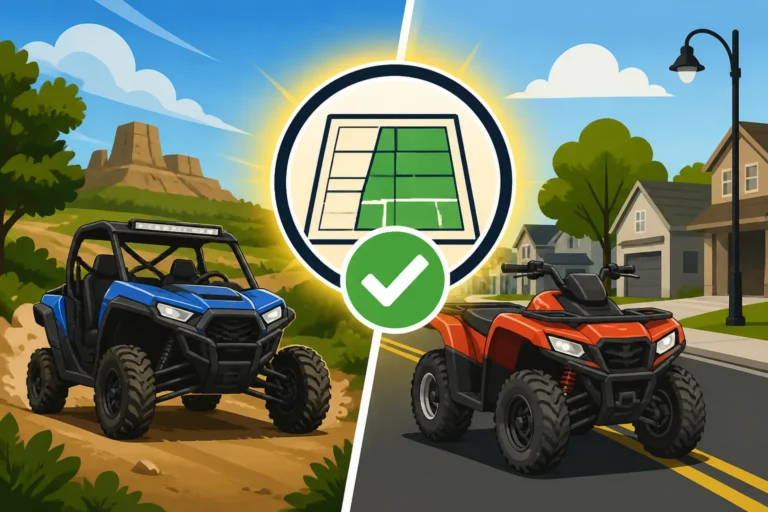
Here's a quick comparison of general vs. potential small-county rules:
| Feature | General Texas State Law (Most Counties) | Potential Small County Ordinance (Under 37,000 Population) |
|---|---|---|
| OHV on Public Roads | Generally Prohibited | MAY be permitted on county roads only if an ordinance is adopted. |
| State Highways | Always Prohibited (FM, US, SH roads) | Always Prohibited (County ordinance has no authority over state highways). |
| Required Equipment | Not specified for road use (since it's prohibited) | Varies by ordinance, but commonly includes headlights, taillights, brake lights, mirrors, possibly turn signals. May require specific aftermarket parts like those from SuperATV. |
| Speed Limit | N/A (prohibited) | Typically restricted to roads with speed limits of 35 mph or less. |
| Driver's License | N/A (prohibited) | Often required. |
| Insurance | Not required for off-road use | May be required for road use under local ordinance. |
| Operating Hours | N/A (prohibited) | May be restricted to daylight hours only. |
| Enforcement | State Troopers, County Sheriffs, Local Police | County Sheriffs, Constables, occasionally Local Police if within city limits that adhere to county ordinance. |
Always, always verify the specific rules for the county you are in or plan to visit. The slight variations can make a huge difference, and staying informed is your best defense against unexpected legal trouble. Remember, the freedom to ride responsibly often starts with understanding the regulations that govern our beloved machines.
Disclaimer
This article is for general informational purposes only and does not constitute professional advice. Laws, prices and regulations vary by location and change over time. Consult a qualified professional for guidance on your specific situation.