Texas Golf Cart Plate Rules
Navigating the rules for golf carts in Texas can feel like trying to hit a moving target – you bought a golf cart to enjoy leisurely rides, maybe around your community or to the local course, but then you hear whispers about plates, registrations, and what's street legal. It’s a common frustration, especially when the regulations seem to blur the lines between an off-highway vehicle and something you can legally drive on city streets. This guide is here to clarify those specific Texas rules, explaining when and how your golf cart might need a license plate, what it takes to get one, and where you can actually take it once it's road-ready.
The Unique World of Texas Golf Cart Plates
It's easy to assume that all smaller, recreational vehicles fall under one big umbrella of "off-highway vehicles" in Texas, but that's simply not the case, especially when it comes to golf carts. The state has very specific definitions and pathways for different types of vehicles, and golf carts often find themselves in a category all their own, which can lead to a lot of head-scratching for owners.
Why Golf Carts Aren't Like ATVs in Texas
One of the biggest sources of confusion is how golf carts are treated differently from ATVs, UTVs, and other dedicated off-highway vehicles (OHVs) under Texas law. For starters, the state defines an "off-highway vehicle" as something designed primarily for off-highway use and not for use on public roads. While a golf cart can be used off-road, its primary design intent usually revolves around golf courses or private property. This fundamental difference means that the entire system of titling, registering, and plating differs significantly. You won't find your golf cart in the same boat as an ATV when you visit the county tax office; they have their own set of rules, often linked to their low-speed nature and how they're intended to operate on certain public thoroughfares, not all. For a deeper dive into how other vehicles are classified, you might want to read [What Texas Counts as an Off-Highway Vehicle].
This distinction is crucial because it means you can't simply apply for an OHV plate for your golf cart. Instead, a golf cart must often meet a higher standard of safety equipment and fall into a different classification, like a Low-Speed Vehicle (LSV) or Neighborhood Electric Vehicle (NEV), to be considered for a plate. This often catches folks off guard who are used to the simpler process for ATVs. The intent behind the regulations is clear: if a vehicle is going to share space with cars and trucks, even on low-speed roads, it needs to meet certain safety thresholds to protect both its occupants and other drivers.
When a Golf Cart Needs a Plate in Texas
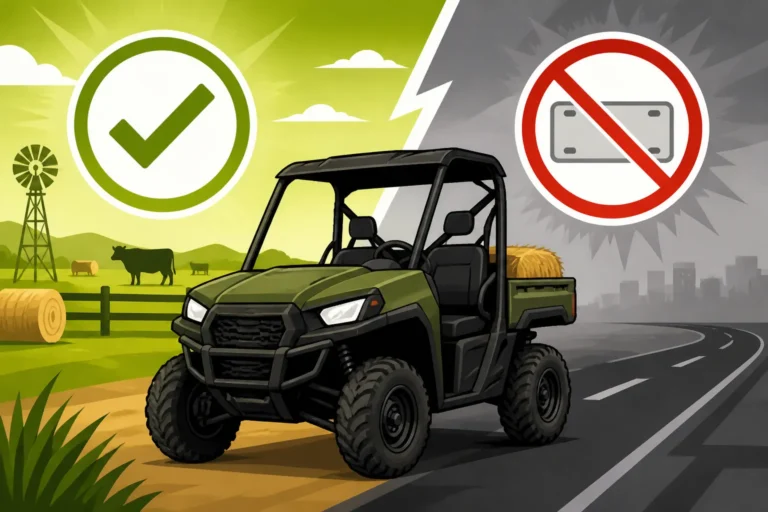
So, when does your trusty golf cart actually need a plate in Texas? It boils down to where and how you intend to operate it. If your golf cart never leaves private property – your ranch, your private golf course, or your gated community with its own private roads – then a plate simply isn't necessary. It's essentially treated as recreational equipment. However, the moment you want to venture onto public roads, even for a short distance, the rules change dramatically.
Texas law generally permits golf carts to be operated on public roads only if they meet certain criteria and are specifically authorized by local ordinance, or if they qualify as a Low-Speed Vehicle (LSV) or Neighborhood Electric Vehicle (NEV). These classifications are key. A golf cart, as defined by Texas law, is built for golf courses, cannot exceed 20-25 mph, and has a particular weight limit. An LSV or NEV, on the other hand, is a vehicle capable of speeds between 20-25 mph and 35 mph, meeting federal safety standards, and designed for street use. If your golf cart has been modified or manufactured to meet these LSV/NEV standards, then it can be titled and registered, just like a regular car, and will be issued a standard license plate. This is the primary path to getting a "plate" for a golf cart that you want to drive on public roads. You can find more information about this distinction in [Texas Golf Cart Titling Rules] and [Why a NEV Is Titled and Registered in Texas].
It's important to understand that a plain old golf cart (one that doesn't meet LSV standards) can sometimes be driven on public roads without being titled and registered as an LSV, but only under very strict conditions. These include driving on roads with a speed limit of 35 mph or less, within certain distances of a golf course, or within a master-planned community that explicitly allows them. In these specific scenarios, a traditional vehicle plate might not be required, but you'll still need to ensure your cart has the necessary safety equipment. However, for true street legality and broader use on public roads, qualifying as an LSV and obtaining a standard vehicle plate is the way to go. This makes a big difference compared to how you might approach, say, a recreational ATV. The distinction between a golf cart and an LSV is critical for understanding Texas Golf Cart Plate Rules.
Navigating the Plate Application Process
If your goal is to make your golf cart truly street-legal by converting it into a Low-Speed Vehicle (LSV) or if it was manufactured as one, the process for getting a plate is similar to that of any other motor vehicle in Texas. It involves a visit to your local county tax assessor-collector's office, but you’ll need to have all your ducks in a row. It’s not just about filling out a form; it’s about meeting specific safety and documentation requirements.
Essential Documents for Your Texas Golf Cart Plate
When you head to the county tax office to apply for a Texas plate for your golf cart (specifically, one that qualifies as an LSV/NEV), you'll need a collection of paperwork. This isn't just a casual stroll to the counter; it's a formal vehicle transaction, and they'll want proof of everything. Typically, you'll need:
- Proof of Ownership: For a new LSV, this will be the Manufacturer's Certificate of Origin (MCO). If it's a used LSV, you'll need the previous Texas title, signed over to you. If you bought it out-of-state, ensure you have the proper title from that state. A bill of sale is important as supporting documentation, especially for demonstrating the purchase price for sales tax purposes, but it's rarely sufficient as sole proof of ownership for titling.
- Application for Texas Title and/or Registration (Form 130-U): This is the fundamental form for nearly all vehicle transactions in Texas. You'll need to fill it out completely, providing information about the vehicle, the seller, and yourself as the buyer. Make sure all sections are accurate to avoid delays. You can usually download this from the Texas Department of Motor Vehicles website.
- Proof of Texas Liability Insurance: Just like any other vehicle operating on public roads, your LSV-qualified golf cart will need a current Texas liability insurance policy. They will not issue a plate without it.
- Valid Identification: You'll need a government-issued photo ID, such as your driver's license.
- Proof of Sales Tax Paid: If you purchased the LSV from a Texas dealer, they would have collected the sales tax. If you bought it from a private seller or out-of-state, you'll pay the Texas motor vehicle sales tax (or use tax) at the tax office when you title it. The state sales tax rate is typically 6.25% of the sales price or the standard presumptive value, whichever is greater. You can read more about this in [Texas Sales Tax on an ATV Purchase], which applies similarly to LSVs.
One common issue people face is incomplete documentation. For example, a handwritten bill of sale might be perfectly fine for a private land transaction, but for a street-legal plate, the county office requires more rigorous proof of ownership and origin. Always double-check the Texas DMV website or call your local county tax office beforehand to confirm the exact documents they'll require for your specific situation. This due diligence can save you a lot of time and frustration.
The Inspection and Equipment Requirements
Before your golf cart can even be considered an LSV eligible for a Texas plate, it absolutely must meet a stringent set of equipment requirements. This isn't just for show; these are federal and state safety standards designed to make these low-speed vehicles visible and safe enough to share the road, even if only at lower speeds. This is where many standard golf carts need significant modifications. SuperATV is a well-known vendor that offers a lot of parts and conversion kits for UTVs and golf carts, specifically for making them road-legal. While their focus is often on larger machines, the types of equipment they sell—like lighting kits and mirrors—are exactly what you’d need for a golf cart conversion.
Here's a list of the typical equipment an LSV needs to have:
- Headlamps: At least two, to illuminate the road ahead.
- Tail Lamps: At least two, visible from the rear.
- Stop Lamps (Brake Lights): At least two, clearly indicating when the brakes are applied.
- Turn Signal Lamps: Front and rear, to signal turns.
- Reflex Reflectors: Rear and side reflectors to enhance visibility.
- Parking Brake: A functioning parking brake to secure the vehicle when stopped.
- Rearview Mirror(s): At least one internal mirror, or two external mirrors (one on each side). Many owners opt for both for maximum visibility.
- Windshield: A safety glass windshield is often required, meeting specific automotive standards.
- Seatbelts: For all designated seating positions.
- Vehicle Identification Number (VIN): A properly assigned VIN is mandatory for titling and registration.
- Horn: An audible warning device.
- Speedometer: To monitor your speed.
- Slow-Moving Vehicle Emblem: Often required for vehicles with maximum speeds under 25 mph, though for LSVs, the full lighting package often supersedes this.
These requirements are what fundamentally separate a typical golf course cart from a vehicle that can get a standard Texas license plate. Many golf cart owners will purchase conversion kits or individual components from aftermarket providers like SuperATV to upgrade their carts to meet these specifications. After the modifications, the vehicle will typically need to pass a safety inspection to confirm all equipment is present and functional before it can be titled and plated. This inspection ensures that the LSV is genuinely ready for public roads, even limited ones. Without meeting these requirements, your golf cart simply won't qualify for a plate, no matter how much you want to drive it to the local store.
Where You Can Legally Ride a Plated Golf Cart in Texas
Even after going through the effort of converting your golf cart into an LSV and getting it plated, you can't just drive it anywhere you please in Texas. The "street legal" aspect comes with significant limitations, primarily concerning speed limits and the types of roads you can access. It's crucial to understand these restrictions to avoid fines, or worse, accidents.
Speed Limits and Road Types
The fundamental rule for Low-Speed Vehicles (LSVs) – which is what your plated golf cart effectively becomes – is that they are generally restricted to roads with a posted speed limit of 35 mph or less. This is a statewide regulation that applies consistently across Texas. You absolutely cannot take an LSV on a highway, freeway, or any road with a speed limit exceeding 35 mph. This means no venturing onto IH-35, Loop 1604, or even a major state highway that typically has higher speeds. The whole point of an LSV is for local, low-speed travel, not for keeping up with traffic on arterial roads.
Beyond the statewide 35 mph rule, individual cities and counties in Texas have the authority to create their own ordinances regarding golf cart (and by extension, LSV) use on public streets. Some municipalities might permit LSVs on certain roads within their jurisdiction, while others might restrict them further or even prohibit them entirely in some areas. This creates a patchwork of rules, so what's legal in one town might not be in the next. It's always a good idea to check with the local city or county government's transportation or police department for specific ordinances in the area where you plan to ride. [What a Texas City Can and Cannot Allow] is an important read to understand these local variations. So, while your LSV has a plate, indicating it can be on a public road, the specific road still needs to meet the 35 mph criteria and any local regulations.
Common Areas for Plated Golf Cart Use
Despite the restrictions, there are many places in Texas where plated golf carts (LSVs) are a fantastic and convenient mode of transportation. These vehicles thrive in environments designed for slower, local traffic.
- Master-Planned Communities: Many modern master-planned communities are designed with golf cart access in mind. They often have networks of roads with 35 mph or lower speed limits, and their covenants or local ordinances may specifically permit LSVs for residents to get to community amenities, neighbors' houses, or local shops. This makes them incredibly popular in places like The Woodlands, Lakeway, or other suburban developments. [Texas Rules for Riding in a Master Planned Community] provides more context on this.
- Small Towns and Coastal Communities: In smaller towns where traffic is generally slower, or in many Texas coastal communities, LSVs are a common sight. Think Galveston, Port Aransas, or South Padre Island, where people use them to get to the beach, local restaurants, or shops. These areas often have specific ordinances to accommodate such vehicles. You might even find dedicated golf cart lanes or crossings in some places.
- Golf Course Access: Naturally, a plated golf cart is ideal for getting to and from the golf course, assuming the route involves roads with speed limits of 35 mph or less. Many communities allow direct access to golf courses via LSVs. This directly relates to [Texas Rules for Riding to a Golf Course].
- Short Local Errands: For quick trips to a neighborhood grocery store, a friend's house a few blocks away, or a local park, an LSV can be perfect. It's a convenient, open-air way to handle short-distance travel without needing a full-sized vehicle.
It’s crucial to remember that while a plate allows use on some public roads, it doesn't grant carte blanche. You still need to obey all traffic laws, including stop signs, yield signs, and speed limits. Furthermore, just like with ATVs, you need to be aware of [Texas Rules for Riding After Dark] and ensure your LSV's lights are fully functional and in compliance if you plan to be out after sunset. The safety equipment, which you probably sourced from a place like SuperATV, is not just for passing inspection; it's for safe riding every time you're on the road.
Costs and Ongoing Considerations for Plated Golf Carts
The journey to getting a Texas plate for your golf cart, and keeping it road-legal, involves more than just the initial application. There are various fees, maintenance considerations, and ongoing responsibilities that owners need to be aware of. It's a commitment that extends beyond the initial purchase or conversion.
Fees Associated with Texas Golf Cart Plates
Getting your golf cart qualified as an LSV and then plated in Texas involves several costs. While I can't give you exact dollar amounts, I can outline the types of fees you'll encounter:
- Vehicle Sales Tax (or Use Tax): This is typically the largest single cost. Texas levies a state motor vehicle sales tax, which applies to LSVs just like cars or trucks. If you buy from a dealer, they'll collect it. If you buy from a private party or out-of-state, you'll pay the use tax directly to the county tax assessor-collector when you title the vehicle. This is usually calculated at 6.25% of the purchase price or the standard presumptive value.
- Title Fee: There's a fee for processing the Texas title, which establishes you as the legal owner of the LSV. This is a standard administrative charge.
- Registration Fee (Plate Fee): When you get your license plates, there's an annual registration fee. This is similar to what you pay for a car or truck, and it must be renewed yearly. Unlike the one-time OHV plates issued for dedicated off-highway vehicles, an LSV plate is a full vehicle registration.
- Inspection Fee: Before your LSV can be registered and plated, it must pass a state safety inspection (and sometimes an emissions inspection, depending on your county). There's a fee for this inspection.
- Modification Costs: This is often the most variable and significant cost for owners converting a standard golf cart. Components like headlights, tail lights, turn signals, mirrors, windshields, and seatbelts can add up quickly. This is where researching parts from vendors like SuperATV, or consulting with a local golf cart dealer specializing in road-legal conversions, becomes essential.
- Insurance Premiums: While not a fee paid to the state, mandatory liability insurance will be an ongoing cost. The premium will vary based on your driving record, location, and the value of your LSV.
It's wise to budget for all these components before committing to making your golf cart street-legal. The initial sticker price of a golf cart can be deceiving once you factor in conversion, titling, and registration costs.
Maintaining Compliance and What to Watch For
Once your golf cart has its Texas plate and is operating as an LSV, maintaining its compliance is an ongoing responsibility. It's not a "set it and forget it" situation.
- Annual Renewals: Your LSV's registration and plate must be renewed annually. This typically involves paying the registration fee and ensuring your vehicle has passed its required state inspection. You'll receive a renewal notice in the mail, just like for any other car.
- Equipment Maintenance: All the safety equipment you installed (headlights, brake lights, turn signals, horn, etc.) must remain in good working order. Regular checks are important. A burned-out bulb could lead to a traffic stop and a citation, even if your vehicle is otherwise legal. This is particularly important for [Texas Lighting Requirements for OHVs] (and LSVs by extension).
- Insurance: Always maintain valid liability insurance. Driving an LSV on public roads without insurance is illegal and carries significant penalties.
- Staying Informed on Local Rules: Keep an eye on local city and county ordinances. While state law provides the broad framework for LSVs, local governments can implement stricter rules or define specific areas where LSVs are permitted or prohibited. What's allowed today might change tomorrow, so it's good practice to stay updated, especially if you live in a master-planned community or a coastal town.
Owning a plated golf cart in Texas is a fantastic way to enjoy your community and run local errands with ease. Just remember that with the privilege of street use comes the responsibility of adhering to all the rules designed to keep everyone on the road safe.
Disclaimer
This article is for general informational purposes only and does not constitute professional advice. Laws, prices and regulations vary by location and change over time. Consult a qualified professional for guidance on your specific situation.