Why the OHV Plate Is Issued Only on Request
It's a common and understandable assumption: when you buy any kind of vehicle in Texas and go through the trouble of titling it, a license plate should just appear with it, right? It feels like part of the package. But when it comes to your beloved ATV or UTV, things are a little different, and many riders find themselves scratching their heads wondering why that little plate isn't automatically handed over. This guide is here to clear up that confusion, explaining precisely why the Texas Off-Highway Vehicle (OHV) plate is only issued upon request and what that means for you.
Understanding Texas's Unique Stance on Off-Highway Vehicles
Texas has a way of doing things that sometimes feels a bit… unique, especially when it comes to vehicles that aren't primarily meant for public roads. Your ATV or UTV falls squarely into this category, and understanding this fundamental distinction is key to grasping why its plate isn't automatic.
The Fundamental Difference: Title vs. Registration
The biggest source of confusion stems from the difference between titling a vehicle and registering it. For most cars and trucks, these two processes go hand-in-hand. You title your vehicle to prove ownership, and you register it annually to get a license plate, allowing it to legally drive on public roads. With an OHV in Texas, you absolutely must title it to establish legal ownership, especially if you ever plan to sell it or need to prove it belongs to you. However, the state has a very clear stance: [Why Texas Titles But Never Registers an OHV].
Unlike a car, your ATV or UTV is explicitly defined as an "off-highway vehicle." This means it's primarily designed and intended for use off public roads, trails, or in specific designated areas. Because of this classification, the state doesn't "register" it for general road use in the same way it would a passenger car. This distinction impacts everything, including how and when a plate is issued. The core of it is that the state simply doesn't want OHVs on roads, so it doesn't create a registration system that would imply otherwise. This is why you'll often hear about [Why Texas Will Not Register an ATV for the Road].
Why No Automatic Plate? It's Not for Road Use
Since the vehicle isn't registered for road use, there's no automatic mechanism to issue a standard "road legal" license plate. The very purpose of a standard vehicle license plate is to identify a vehicle that is legally allowed to operate on public streets and highways. Your ATV or UTV, by its very definition in Texas, generally isn't allowed to do that. The Texas Department of Motor Vehicles even stamps a clear remark on your OHV title that says, "[The Off-Highway Use Only Remark on a Texas Title]". This stamp is a constant reminder of the machine's intended operating environment.
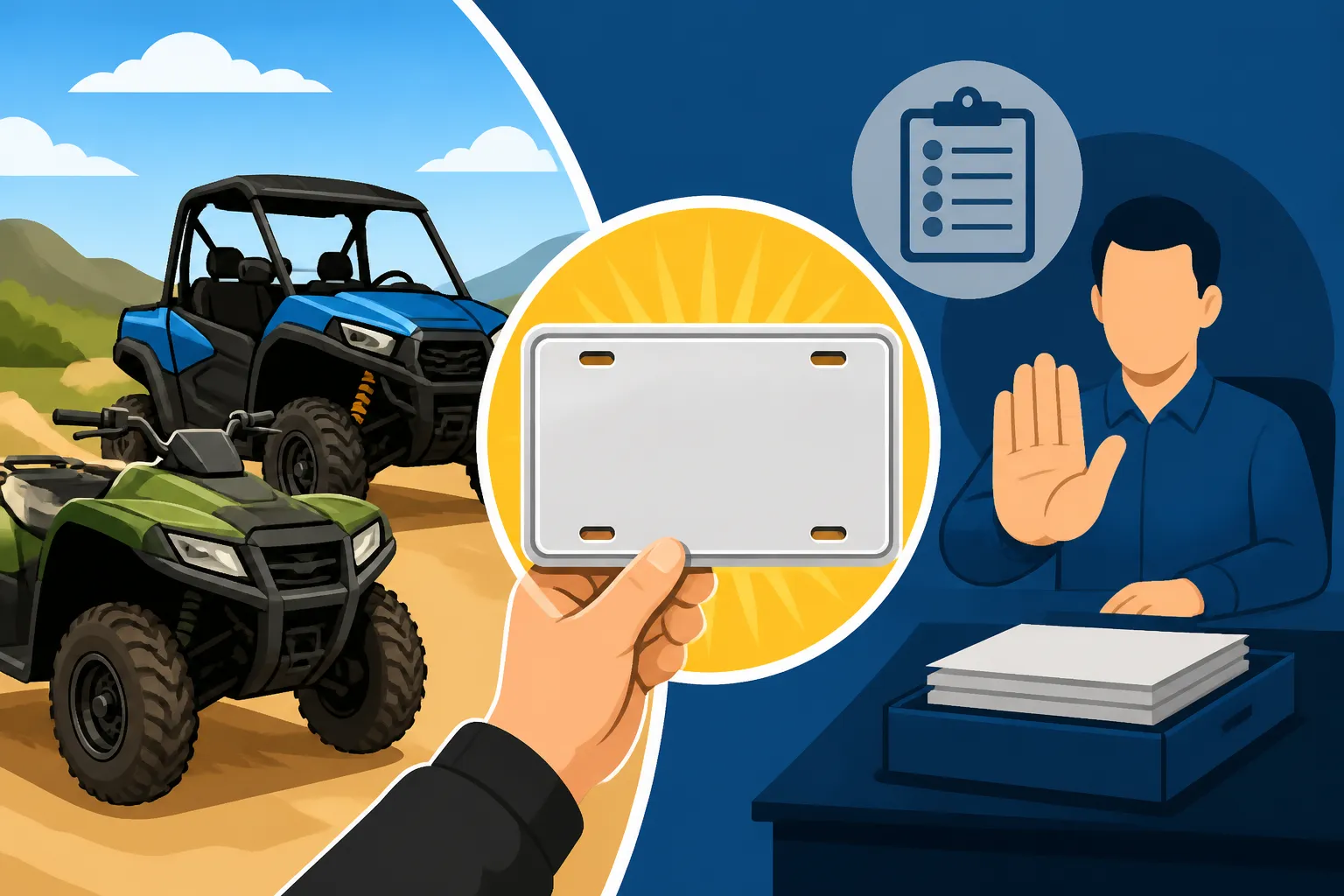
So, the OHV plate isn't a "registration" plate in the typical sense. It's more of an identifier, a specialized plate for very specific, limited circumstances. Because those circumstances don't apply to every OHV owner, the state doesn't automatically issue the plate. It's seen as an optional accessory, only needed by those who will actually utilize it for its intended, narrow purposes. It saves the state money on unnecessary plate production and avoids implying that every titled OHV is ready for the highway.
The Practicalities of Requesting Your OHV Plate
Once you understand why the plate isn't automatic, the next logical step is to figure out how to get one if you decide you need it. The process is straightforward, but it does require you to take that extra step.
Where and How to Make the Request
The good news is that requesting your OHV plate isn't some arduous, separate process. It's typically done right alongside your title application. When you go to [Titling at a Texas County Tax Office], which is where most people handle their OHV titling, you'll simply inform the clerk that you also wish to obtain an OHV plate for your machine. This happens when you're [Filing at the Tax Assessor-Collector].
You'll be filling out [The Texas Title Application Every OHV Buyer Files], also known as Form 130-U. On this form, or sometimes through a separate small form provided by the county office, you'll make the request for the OHV plate. It's often as simple as checking a box or verbally stating your intent. Just make sure you bring all the other necessary [Documents to Bring for a First Title], such as your proof of ownership (bill of sale or manufacturer's statement of origin), proof of identity, and proof of Texas residency. Having all your paperwork in order for the title application will make the plate request seamless.
The Minimal Cost and Its Purpose
One of the reasons the plate isn't a huge burden to request is its very modest cost. You won't be paying the hundreds of dollars associated with annual vehicle registration. In fact, the fee for the Texas OHV plate is often capped by statute. Many counties will charge you a small fee, which generally doesn't exceed [The $10 Cap on a Texas Plate]. This nominal fee covers the administrative costs for the county to process your request and for the physical production of the plate itself.
When you compare this to the fees for standard vehicle registration, it's clear the OHV plate isn't intended to be a revenue generator for road maintenance or other typical vehicle-related programs. It's simply a small charge for a specific identifier. This fee is collected by [What the Counter Charges for the Plate] at the county level and is separate from any title fees or sales tax you might pay.
Here's a quick comparison of the shape of these costs:
| Item | Typical Passenger Car Plate (Annual) | Texas OHV Plate (One-Time) |
|---|---|---|
| Purpose | General Road Use Registration | Specific OHV Identification |
| Issuance | Automatic with Registration | Only Upon Request |
| Cost Profile | Significantly Higher, Recurring | Very Modest, One-Time Cap |
| Road Legality | Grants General Road Access | Does NOT Grant General Road Access |
| Annual Renewal | Yes, Mandatory | No, Not Required |
This table really highlights that the OHV plate exists in its own category, distinct from typical road vehicle plates.
When an OHV Plate Becomes a Smart Move (or a Necessity)
So, if it's not for general road use, why would you even bother requesting an OHV plate? There are a couple of key scenarios where this little piece of metal can be incredibly useful, or even required.
Identifying Your Machine for Public Land Riding
While many private riding parks have their own systems for identifying machines, some public riding areas in Texas, and even certain private parks that have received state grants, might require a visible OHV plate for entry or identification. This is particularly true if the land manager wants a simple, official way to track or identify vehicles using their trails. The plate acts as a unique identifier for your specific machine within certain regulated environments. It helps park staff or law enforcement quickly verify the machine's ownership or access rights.
It's crucial to understand that this OHV plate is a separate item from the [The Texas OHV Decal Explained]. The OHV decal is a separate annual sticker required for most OHVs operating on public land or certain grant-funded private lands in Texas, and it signifies you've paid into a fund that supports OHV trails. While some parks might require both, they serve different administrative purposes. Think of the plate as a permanent identifier for the machine itself, and the decal as a user fee for the trails. For example, if you plan to ride on state land or a National Forest, like the Sam Houston National Forest, having the plate can be part of the overall compliance, though a separate [Texas National Forest Permits] might also be needed.
Crossing Roads Legally (Under Specific Exceptions)
This is perhaps the most critical reason many OHV owners choose to get the plate. While the plate doesn't make your OHV street-legal, it is often a prerequisite when utilizing the very narrow, highly specific exceptions that do allow an OHV to briefly operate on certain public roads. Texas law carves out these exceptions for specific purposes, such as agricultural use, certain low-speed roadways, or accessing golf courses.
For instance, if you operate a farm or ranch, you might be able to briefly drive your UTV on a public road to move between fields or access an adjacent property under the [Texas Agricultural Exemption for ATVs on Roads]. Similarly, if you live in a master-planned community with specific ordinances, you might use your golf cart (which often falls under the OHV plate rules) to get to the clubhouse, subject to [Texas Rules for Riding a UTV to a Golf Course]. And in some rural counties, you might find specific ordinances allowing OHV use on roads posted [Texas Rules for Riding on a 35 mph Road] or less, for short distances. In all these cases, having the OHV plate displayed is a vital part of complying with the law. It signals to any law enforcement officer that your machine has been officially documented by the state, even if its road use is severely restricted. Without that plate, even these limited exceptions might not apply to you.
Common Misconceptions and What the Plate Doesn't Do
Because the concept of an "off-highway plate" is somewhat unusual, it's easy for misunderstandings to develop. Let's clear up some of the most common ones.
It Does Not Grant Street Legality
This point bears repeating because it's the most frequent misconception: obtaining an OHV plate absolutely [Are ATVs Street Legal in Texas: The Short Answer]. Many riders hope that by getting this plate, they can now legally cruise down the highway or even just use city streets to run errands. This is simply not the case. The plate is an identifier for off-highway vehicles and for use in those extremely limited road-crossing scenarios. It is not a green light for general road use.
Texas law is very explicit that OHVs are not designed or equipped for safe operation on public roadways. This is why your title clearly states "[The Off-Highway Use Only Remark on a Texas Title]". Vehicles truly registered for road use have requirements for safety inspections, liability insurance, specific lighting, mirrors, and often different construction standards – none of which are typically required or met by an OHV with just the specialized plate. If you attempt to use your plated OHV as a regular street vehicle, you are highly likely to face fines, and potentially have your machine impounded. Remember, [Why Texas Will Not Register an ATV for the Road].
Plate Transferability and Renewal
Another common question revolves around what happens to the plate when you sell your OHV, or if you need to renew it. The good news is that the Texas OHV plate doesn't require annual renewal. Once you get it, it's pretty much good for the life of the machine in Texas. This is because [Why a Texas OHV Plate Never Expires], a significant difference from annual vehicle registrations. You won't receive yearly renewal notices in the mail for your OHV plate.
As for transferability, the plate is issued to the machine, not the owner. So, if you sell your ATV or UTV, the physical plate [A Texas Plate That Stays With the Machine]. However, this doesn't mean the new buyer can just take your old paperwork and be good to go. The new owner still needs to properly title the OHV in their name at the county tax office. During their titling process, they can then request a new OHV plate if they wish to have one for their own records or intended use. This ensures the state maintains accurate ownership records tied to the specific plate number and the vehicle's VIN. You can think of it like a property identifier that physically remains with the property, but the legal details are updated with each change of ownership.
Disclaimer
This article is for general informational purposes only and does not constitute professional advice. Laws, prices and regulations vary by location and change over time. Consult a qualified professional for guidance on your specific situation.