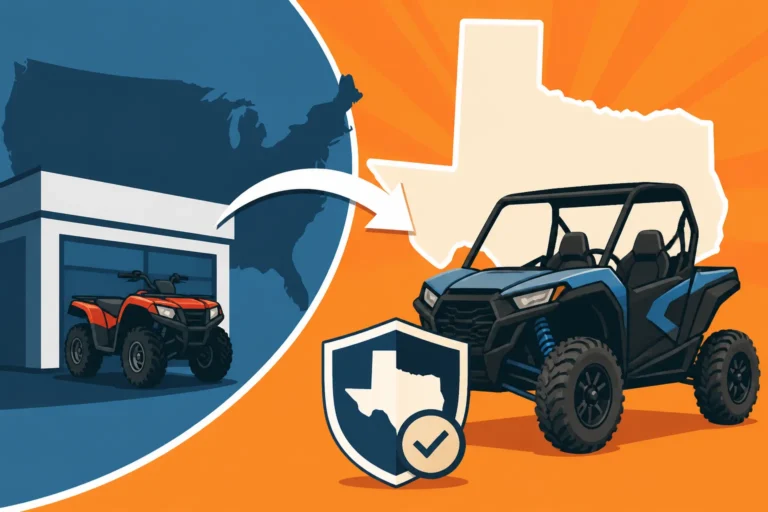
Why the 2025 Law Left OHVs Alone
It’s easy to feel overwhelmed by all the changes happening with vehicle laws in Texas, especially when you own an ATV, UTV, or any other off-highway vehicle (OHV). Many folks hear about new legislation and immediately wonder how it impacts their weekend rides or ranch work. This guide will cut through the confusion and explain exactly why the much-discussed 2025 law, focused on miniature vehicles, actually left the rules for our beloved OHVs completely untouched.
Understanding the 2025 Texas Miniature Vehicle Law
When you hear talk about new vehicle laws coming into effect in Texas in 2025, it's natural to immediately think about your ATV or UTV. After all, they’re smaller vehicles, right? But the truth is, the specific legislation many people are referring to was crafted to address a very particular segment of the vehicle population, and it drew a clear line around what it covered and what it didn't. This distinction is absolutely crucial for OHV owners to grasp, so you don't find yourself scrambling to comply with rules that simply don't apply to your machine.
What the Law Actually Addresses and What It Doesn't
The 2025 law that's been making headlines primarily focuses on what Texas defines as "miniature vehicles," which include things like golf carts, neighborhood electric vehicles (NEVs), and other similar low-speed conveyances. These are the kinds of vehicles that often blur the lines between recreational use and limited street use, and the state saw a need to clarify their titling and registration requirements, especially as more communities considered allowing them on local streets. For a deeper dive into these specific categories, you might find [Texas's Miniature Vehicle Class Explained] very helpful. The legislative intent was to standardize how these particular types of machines are handled, ensuring clarity for both owners and local municipalities that might permit their use on certain roadways.
What this law doesn't address, however, are traditional off-highway vehicles like ATVs, UTVs, dirt bikes, and sand rails. These machines already fall under a distinct legal framework within the Texas Transportation Code, which has been in place for years. They have their own titling process, specific definitions, and very strict limitations on road use. The lawmakers drafting the miniature vehicle changes understood these distinctions and opted not to lump OHVs into the same basket. It’s a bit like comparing apples and oranges, even though they’re both fruit; their legal treatment reflects their different intended uses and capabilities.
Why OHVs Were Excluded from This Specific Legislation
The primary reason off-highway vehicles were not swept up in the 2025 miniature vehicle law is because they already have their own comprehensive set of rules. Texas law already clearly defines what constitutes an OHV and mandates that they be titled, much like a car or truck, but it explicitly does not allow them to be registered for general road use. This fundamental difference sets them apart from the golf carts and NEVs that the new law sought to regulate. The existing framework for OHVs acknowledges their design for unpaved terrain and recreational or agricultural purposes.
Think of it this way: OHVs in Texas are designed for the dirt, the sand, the mud, and the ranch. They're built for trails and fields, not for navigating city streets or highways. This specific design and intended use are reflected in the long-standing laws that govern them. Any changes to OHV laws typically come through separate legislative efforts, often driven by different concerns such as safety on trails, agricultural exemptions, or enforcement issues on private land. The 2025 law was responding to the growing popularity and varied uses of street-adjacent small vehicles, a category that OHVs, by their very nature, do not fit into. So, if you're an ATV or UTV owner, you can breathe a sigh of relief – your titling and usage rules didn't suddenly get a facelift with this particular piece of legislation.
Texas's Existing Framework for Off-Highway Vehicles
Okay, so the 2025 law didn't touch OHVs. That's great news! But it doesn't mean OHVs are unregulated. Far from it. Texas has a very specific, long-standing framework in place for off-highway vehicles, and understanding it is key to being a responsible and legal owner. Many people, especially those new to the OHV scene or even seasoned riders who just haven't dug into the specifics, often get tripped up on the difference between titling and registering. It's a subtle but profoundly important distinction that shapes everything from how you buy and sell your machine to where you can legally ride it.
The Mandate to Title, Not Register, Your OHV
This is perhaps the biggest point of confusion for new and even some experienced OHV owners in Texas. The state absolutely requires you to title your ATV, UTV, or other qualifying off-highway vehicle. This title serves as proof of ownership, much like it does for your car or truck. It's the official document that links you to your machine and is essential for selling it, proving it's yours, or dealing with insurance. You'll generally do this at your local county tax office. For a complete walkthrough of this process, check out [Titling an ATV in Texas]. The title confirms who the legal owner is, helps prevent theft, and is critical for transferring ownership.
However, and this is where many people get confused, Texas explicitly states that OHVs cannot be registered for general highway use. You simply cannot get a license plate and registration stickers that permit you to drive your ATV or UTV down any public road, street, or highway. The reasons for this are rooted in safety and vehicle design: OHVs lack many of the safety features, like turn signals, rearview mirrors, and protective cabs, that are standard on street-legal vehicles. This means that while you must have a title, you absolutely will not be able to register it like a passenger car. If you're wondering more about this, [Why Texas Titles But Never Registers an OHV] goes into greater detail.
The "Off-Highway Use Only" Remark and Its Meaning
When you receive your Texas title for an ATV or UTV, you might notice a very clear, and sometimes intimidating, stamp or remark that says "Off-Highway Use Only." This isn't just a suggestion; it's a legal declaration of your machine's status. This remark is printed directly on the title document to serve as an unmistakable indicator of the vehicle's classification and its limitations regarding public road use. It's the state's way of ensuring there's no ambiguity about the machine's intended purpose. [The Off-Highway Use Only Remark on a Texas Title] explains in depth what this stamp signifies.
What does this stamp actually mean for you as an owner? It means your OHV is legally designated for operation on private property, designated off-highway trails, and certain limited public lands where OHV use is specifically permitted. It absolutely prohibits you from using your ATV or UTV on public roads, streets, or highways, with only a few very narrow exceptions, such as crossing a road at a 90-degree angle or specific agricultural uses. Attempting to operate a machine with this designation on public roads can lead to fines, citations, and even confiscation of your vehicle. This mark is a constant reminder that your off-highway vehicle is exactly that—for off-highway use.
The Purpose of the Texas OHV License Plate
Despite the "Off-Highway Use Only" remark, Texas does offer an optional OHV license plate. This often adds another layer of confusion, as people assume a license plate means road legality. Let's be very clear: the Texas OHV plate is not a registration for street use. It does not magically transform your ATV or UTV into a street-legal vehicle. It's a non-expiring, one-time purchase that costs a nominal fee, capped by statute at $10, plus a small processing fee. [The Texas Off-Highway Vehicle License Plate] breaks down everything you need to know about this plate.
So, what is its purpose then? The OHV plate serves as a means of identification for your machine. It's specifically required by some designated OHV riding parks and public lands as a visible identifier that the vehicle has a valid Texas title. It also helps law enforcement identify vehicles should they be stolen or involved in an incident. It's essentially a state-issued ID for your off-highway vehicle, affirming its titled status without granting any road-use privileges. You request this plate when you title your machine at the county tax office, and once issued, it stays with the vehicle for its lifetime, never needing renewal.
Distinguishing OHVs from Other Texas Vehicle Categories
The complexity of Texas vehicle laws often stems from the different classifications the state uses. An OHV isn't just "any vehicle that's not a car." The law draws very specific lines, and understanding where your ATV or UTV falls in that grand scheme is critical. The reason the 2025 law left OHVs alone is precisely because their classification is so distinct from other smaller vehicles that the new legislation did target. Let's break down these categories to clarify the landscape.
What Texas Counts as an Off-Highway Vehicle
Texas law has a very particular definition for an Off-Highway Vehicle. Generally, it refers to a motor vehicle, other than a tractor, a farm implement, or a vehicle authorized to operate on a public highway, that is designed by the manufacturer for off-highway use. This includes your standard all-terrain vehicles (ATVs), utility vehicles (UTVs or side-by-sides), and even specialized machines like sand rails. These vehicles are characterized by their robust construction, knobby tires, powerful engines, and often lack essential street-legal equipment. You can find the exact legal definitions in [What Texas Counts as an Off-Highway Vehicle].
For example, a typical quad with handlebars, an open riding position, and a top speed designed for trails fits squarely into the ATV category. A side-by-side with bucket seats, a steering wheel, and a roll cage, often used for ranching or hunting, is a UTV. Even custom-built sand rails, designed specifically for dunes and soft terrain, are covered. What unites them under the OHV banner is their primary design and intent: to be used off public roads. This shared characteristic is why they are uniformly subjected to titling without registration for road use. For more on UTVs and ROVs, see [ROVs and UTVs Under the Texas Definition].
Golf Carts, NEVs, and Why Their Rules Differ
Now, let's talk about the vehicles that the 2025 law did impact: golf carts and Neighborhood Electric Vehicles (NEVs). While they are also smaller, often low-speed vehicles, their legal classification and intended use are quite different from OHVs. Golf carts, as their name suggests, were traditionally for golf courses, though they've found broader use in private communities and increasingly, on certain public roads where local ordinances allow. They are often less robust than OHVs and have much lower top speeds.
NEVs are essentially a step up from a golf cart, designed with more street-legal features like headlights, taillights, turn signals, and seatbelts. They are built to comply with federal standards for low-speed vehicles, allowing them to be driven on roads with speed limits typically 35 mph or less. Because these vehicles can be used on certain public roads (under specific conditions), they require a different legal framework for titling and registration to ensure they meet minimum safety and identification standards for that use. The 2025 law sought to clarify these very issues. For details on how these are handled, check out [Texas Golf Cart Titling Rules] and [Texas NEV Registration Rules]. This distinction underscores why OHVs, which are explicitly not designed or intended for public road travel, were not included in these updates.
The Line Between Off-Road and Street-Legal
It's a common dream for many ATV and UTV owners: to make their machine "street legal." You see kits online with turn signals, mirrors, and even windshields. However, in Texas, the line between off-road and street-legal for an OHV is remarkably firm. Simply adding accessories to your ATV or UTV will not, under current Texas law, make it street legal. The "Off-Highway Use Only" designation on the title is not something you can simply accessorize away. The state's definition and regulatory framework for OHVs are designed to keep these machines off public roads due to inherent safety considerations related to their design.
Texas law explicitly states that off-highway vehicles are generally prohibited from operating on public highways. This isn't just about what equipment they have, but their fundamental design classification. There are very limited, specific exceptions, such as for agricultural purposes, utility work, or crossing a road. But attempting to permanently convert an OHV for street use by adding aftermarket parts is usually a costly and fruitless endeavor in Texas. The short answer to the question of making your ATV or UTV street legal is generally "no." For a comprehensive answer, refer to [Street Legal ATVs in Texas: The Short Answer].
Common Misconceptions About OHV Laws and Updates
The world of vehicle regulations can feel like a labyrinth, and when new laws are passed, it's easy for misinformation and misunderstandings to spread. For Texas OHV owners, the 2025 miniature vehicle law created a fresh wave of confusion. It's important to dispel these myths and ensure you're operating with accurate information, especially when it comes to something as important as legal compliance and safety. Let's tackle some of the most persistent misconceptions head-on.
"I Heard All Small Vehicles Are Getting New Rules"
This is a really common and understandable assumption. When news breaks about legislation affecting "small vehicles" or "non-traditional vehicles," it's easy to paint all such machines with the same brush. After all, an ATV is a small vehicle, right? However, as we've discussed, the 2025 law specifically targeted miniature vehicles like golf carts and NEVs, which have distinct characteristics and potential road-use applications that differ significantly from off-highway vehicles. The legislation was a response to the specific challenges and ambiguities surrounding these street-adjacent vehicles.
The legislature didn't intend to overhaul the entire small vehicle landscape. Instead, they focused on closing a particular gap in the law and providing clearer guidance for vehicles that might operate both on private property and under limited conditions on public streets. Your ATV or UTV, designed for rugged off-road terrain, occupies a different legal category and wasn't the subject of this specific legislative effort. So, while it's smart to stay informed, don't assume every new law for a "small vehicle" applies to your quad or side-by-side.
The Difference Between Titling and Registering for Road Use
This misunderstanding is perhaps the most enduring source of confusion for OHV owners. Many people hear they need a "title" and immediately equate it with "registration for road use," because that's how it works for cars and trucks. But for OHVs in Texas, these are two very distinct processes with entirely different outcomes. Titling establishes ownership, plain and simple. It's a bureaucratic process that links a serial number to a person or entity, creating a legal record of who owns the machine. It's required for virtually every motorized vehicle in Texas.
Registering for road use, on the other hand, is what grants a vehicle the privilege of operating on public roads and highways. This involves getting a traditional license plate and stickers, proving insurance, and ensuring the vehicle meets specific safety standards for street operation. Texas explicitly denies this privilege to OHVs. The state has made a clear policy decision that off-highway vehicles are not suitable for general road use. Therefore, even though you must title your OHV, you cannot register it for the road. For more on this, you'll want to read [Why Texas Will Not Register an ATV for the Road]. Understanding this fundamental difference is key to avoiding legal trouble.
Why Legislative Changes for OHVs Are Separate Considerations
The reason OHV laws are typically handled separately from other vehicle categories boils down to several factors: their unique design, intended use, and existing regulatory framework. OHVs have specific safety concerns related to off-road operation, environmental impacts on trails, and different needs for agricultural or commercial exemptions. These issues are often addressed through dedicated legislation or amendments to specific chapters of the Texas Transportation Code that deal exclusively with off-highway vehicles.
Lawmakers usually approach vehicle laws with a targeted focus. Rather than creating sweeping legislation that tries to cover every type of vehicle, they tend to address categories as their specific needs or challenges arise. When it comes to OHVs, changes might involve updates to the OHV decal program, rules for youth riders, or regulations for riding on public lands. These are distinct discussions from those concerning miniature vehicles that might occasionally venture onto a paved street. So, when new laws pop up, it’s best to verify which specific vehicle types they’re designed to regulate rather than making assumptions.
Navigating OHV Ownership Under Current Texas Law
So, the 2025 law didn't change anything for your ATV or UTV. Fantastic! But that doesn't mean you're off the hook when it comes to being a responsible and legal OHV owner in Texas. There are still crucial steps you need to take, and rules you need to follow, to ensure your machine is properly documented and that you're riding in accordance with state and local regulations. Getting these basics right will save you headaches down the road and ensure you can enjoy your off-road adventures without worry.
Essential Paperwork: Titling, Sales Tax, and Transfers
The most critical piece of the puzzle for any OHV owner in Texas is proper titling. When you purchase an ATV or UTV, whether new from a dealer or used from a private seller, you are required to title it in your name. This process involves filling out the Texas Application for Texas Title and/or Registration (Form 130-U) and submitting it, along with proof of ownership (like a manufacturer's certificate of origin or a properly assigned previous title) and payment for applicable fees and sales tax, to your county tax assessor-collector's office. [The Texas Title Application Every OHV Buyer Files] is a great resource here. You can also learn more about [Filling Out Texas Form 130-U for an OHV].
Don't forget about sales tax! In Texas, OHVs are generally subject to state and local sales tax, whether you buy from a dealer or a private party. If you buy from a private party and the seller doesn't collect the tax, you'll pay "use tax" when you title the machine. If you're looking for help with the documentation for a private sale, especially a solid bill of sale, resources like LawDepot can provide customizable templates to ensure all the necessary legal details are covered. This helps protect both the buyer and the seller during the transfer process. A well-drafted bill of sale, perhaps generated through LawDepot, can make the titling process much smoother at the county office, avoiding potential snags or delays.
Where You Can Legally Ride Your OHV in Texas
Since your OHV is for "Off-Highway Use Only," knowing where you can legally ride it is paramount. Generally, OHVs in Texas are permitted on:
- Private Property: With the landowner's permission, of course. This is the most common place for Texans to ride.
- Designated Public Riding Areas: Texas has several fantastic OHV parks and trails, often managed by state parks, federal agencies (like the Sam Houston National Forest), or private entities. These areas have specific rules and often require a Texas OHV decal and sometimes a safety certificate. [Where to Ride an ATV in Texas] offers a comprehensive overview of options.
- Limited Road Use Exceptions: As mentioned, there are very specific, narrow exceptions for crossing a public road (at a 90-degree angle after a full stop), agricultural use, or utility work. These exceptions do not constitute general street legality.
It's absolutely crucial to research the specific rules of any public riding area before you go, as regulations can vary. Some parks require helmets at all times, others have width restrictions for trails, and nearly all require spark arresters on exhaust systems. Always prioritize safety and legal compliance to ensure a fun and uninterrupted riding experience.
The Importance of Staying Informed and Where to Look
The regulatory landscape, while generally stable for OHVs, can shift, and new rules, though not necessarily sweeping, may emerge. Staying informed is your best defense against inadvertently breaking a law or missing out on opportunities. Always make it a habit to check official sources for the most up-to-date information. The Texas Department of Motor Vehicles (TxDMV), the Texas Parks and Wildlife Department (TPWD), and your local county tax assessor-collector's office are your go-to official resources. These agencies publish current laws, fees, and requirements directly on their websites.
Beyond official government channels, reputable organizations focused on off-roading in Texas can be excellent community resources. They often share updates and clarify common questions. For creating or acquiring legal documents related to your OHV, such as bills of sale or transfer agreements, using trusted platforms like LawDepot can save you time and provide peace of mind that your paperwork is legally sound. They offer user-friendly templates for various legal needs, including when buying or selling an OHV, ensuring you have the right documentation. Being proactive in seeking out information and using reliable tools will keep you well-equipped for years of enjoyable and legal OHV ownership in the Lone Star State.
Disclaimer
This article is for general informational purposes only and does not constitute professional advice. Laws, prices and regulations vary by location and change over time. Consult a qualified professional for guidance on your specific situation.