Texas OHV Parks That Rent Machines
A weekend ride can fall apart when you arrive with a group, discover your machine won’t start, and learn that nearby rentals need to be booked ahead. This guide explains where to start looking for ATV and UTV rentals at Texas OHV parks, what to confirm before you travel, and how to prepare if you’re renting rather than bringing your own machine.
Texas OHV parks to check for rentals
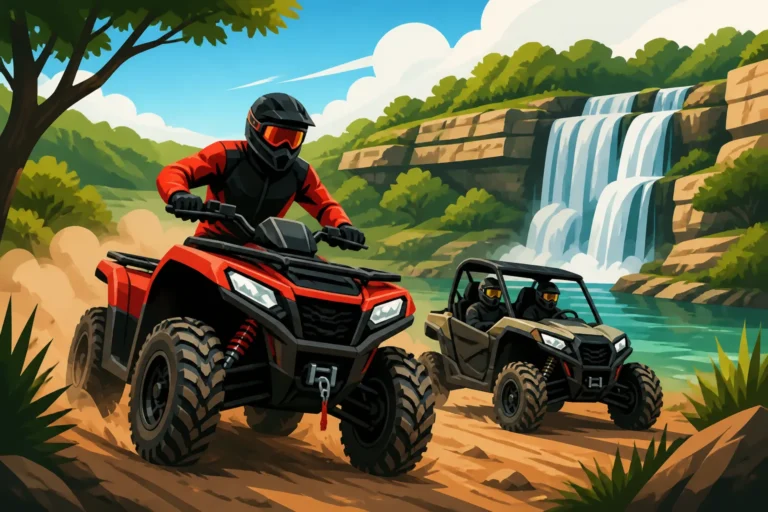
Hidden Falls Adventure Park near Marble Falls
Hidden Falls Adventure Park is a sensible first place to check if you want to pair a ride with a rental. Before planning around a machine being available, ask the park whether rentals are offered on the dates you want, what types of machines are available, and whether rentals are handled by the park or a separate operator. A park’s general riding access does not guarantee that a rental machine will be available when you arrive.
Ask about the whole experience, not just the vehicle. Find out whether the rental includes required safety equipment, whether you need to complete an orientation, and what portion of the park is appropriate for a first-time rider. Hidden Falls has varied terrain, so a machine that feels manageable on an open trail may be a different story on steep or rocky ground. If someone in your group is new to off-roading, ask which routes are considered suitable for beginners and whether those routes are open.
It also helps to ask what is included in the rental agreement. Clarify whether fuel, a helmet, a recovery strap, or a passenger seat is provided, and what the operator expects if the machine gets stuck or damaged. If you’re comparing lodging and riding plans, [Texas OHV Parks With Camping] and [Texas OHV Parks With Cabins] can help you think through where to stay, but check the park’s current arrangements directly before booking.
Escondido Draw near Ozona
Escondido Draw Recreational Area near Ozona is another place to investigate when you’re looking for a ride-and-rental option. Because a recreation area and a rental provider may not be the same business, confirm who supplies the machine, where you pick it up, and whether the rental includes access to the trails you plan to ride. Don’t assume a rental advertised in the surrounding area automatically comes with permission to ride inside a particular park.
The questions matter even more if you’re traveling a long distance to West Texas. Ask whether the rental must be reserved in advance, what happens if weather affects trail conditions, and whether the machine is suitable for the terrain and experience level of your group. Get the pickup location and return expectations in writing. A vague “near the park” can mean an inconvenient detour when you’re already on the road.
Use a mapping app such as onX Offroad to review the area and help plan your trip, but treat the park’s rules and staff guidance as the authority on where you can ride. A map can help you understand distances and terrain; it does not confirm that a rental operator is open, that a route is currently accessible, or that a particular machine is permitted on every trail.
A rental is not guaranteed at every riding park
Many Texas OHV parks are designed primarily for visitors bringing their own ATVs, UTVs, or other off-highway vehicles. A park may have extensive trails and camping without operating a rental fleet. That distinction is easy to miss when you’re searching for “ATV park” or “UTV trails,” so verify rentals directly rather than relying on a general park listing.
For example, Barnwell Mountain Recreation Area near Gilmer is well known as a riding destination, but visitors should confirm current rental availability instead of assuming that park access includes a machine. The same rule applies to other popular areas: check whether rentals are provided on-site, through a partner, or not offered at all. [Texas OHV Parks That Rent Machines] is a useful related topic to explore, but still confirm details with the park or rental operator before you book.
| What to confirm | Why it matters |
|---|---|
| Whether rentals are available on your dates | A rental fleet may be limited or already reserved |
| Who supplies the machine | The park and rental operator may be separate businesses |
| Where pickup and drop-off happen | The rental location may not be at the trail entrance |
| Which trails the machine can use | Width, vehicle type, or park rules may limit access |
| What safety gear is included | You may need to bring or arrange helmets and other equipment |
| What the rental agreement covers | Damage, recovery, fuel, and breakdown procedures can differ |
| Whether an OHV decal or other permit is needed | Park access and public-land requirements are not always identical |
When comparing options, look beyond the words “rentals available.” A machine that is available but too wide for the trails you want, or a rental counter far from the riding area, may not solve the problem you’re trying to avoid.
How to book an ATV or UTV rental in Texas
Call before you build the trip around a rental
Start with the park or rental operator’s own contact information. Ask whether the rental is confirmed for your intended date, whether the machine is an ATV or UTV, and whether it is a single-seat or multi-passenger model. If you need a particular configuration for children or a group, say so plainly. “We need a UTV for four adults” is much more useful than asking generally whether they rent machines.
Then confirm the full pickup and return process. Some rentals may require check-in before you enter the riding area; others may involve a separate business, a meeting point, or a guided ride. Ask how early to arrive, what identification is required, and whether all drivers must be present for the orientation and paperwork. If you are traveling from Austin, Dallas, Houston, or San Antonio, a small scheduling detail can affect the whole day.
Before paying a deposit or signing an agreement, ask what happens if the machine has a mechanical problem or the park closes a trail. Also ask whether you can change to a different machine if the original one is not available. These aren’t awkward questions; they help you understand what you’re agreeing to and prevent unpleasant surprises at the counter.
Match the vehicle to the riders and terrain
An ATV is generally ridden by one person at a time, while a UTV is designed with a seated passenger area. Don’t plan to carry a passenger on a quad unless the manufacturer designed it for that use. If you need room for a family, ask the rental provider about seating capacity and seat belts, and confirm that the vehicle is approved for the trails you plan to ride.
Think honestly about experience. A powerful machine can feel intimidating if you’ve never ridden off-road, especially on loose rock, mud, or uneven hills. Tell the operator whether you’re a beginner and ask what type of terrain the rental is suited to. A beginner-friendly route and a manageable vehicle can make the ride more enjoyable than choosing the biggest machine available.
For planning, onX Offroad can help you look at routes and surrounding terrain before you go. Use it as a planning aid, not a substitute for the park’s trail map, posted closures, or staff instructions. When you arrive, confirm that the route you selected is open and appropriate for the rental vehicle. Park rules can determine what is allowed even when a trail appears on a map.
Read the rental terms and check what is included
Rental agreements can differ in how they handle damage, recovery, cleaning, fuel, and late returns. Ask what you are responsible for if the vehicle needs assistance on a trail. Clarify whether towing or recovery is included, whether there is a designated area you must stay within, and whom to contact if the machine stops running. A clear answer is much better than trying to work it out after a breakdown.
Check the included gear as carefully as the vehicle. Ask whether helmets are supplied and whether you need to bring eye protection, gloves, long sleeves, or other protective clothing. Some parks have their own safety rules in addition to the rental provider’s requirements. For guidance on one statewide requirement, see [Texas OHV Safety Certificates]. Also check whether the rental operator requires a particular age or supervision arrangement for younger riders.
Finally, take a few minutes to inspect the machine with the rental staff before leaving. Point out existing scratches, damaged parts, or warning lights, and make sure they are recorded according to the operator’s procedure. Confirm that you know how to start and shut down the machine, use its controls, and contact help. A brief walk-through can prevent confusion once you’re away from the staging area.
Permits, safety, and trail access
Check the decal and park requirements
A rental does not automatically settle every permit question. Texas OHV decal rules depend on where a machine is operated, and parks may also have their own admission, waiver, or vehicle requirements. Ask the park or rental provider whether the machine already has the required decal for the planned ride, whether you need to purchase anything separately, and what proof you should carry.
This is especially important if your itinerary includes more than one riding area. A decal or permit that applies in one setting may not replace a fee or requirement at another location. Review [Where a Texas OHV Decal Is Required] and [Texas Rules for Riding Public Land] when you’re sorting out the rules for a trip. Then confirm the specific requirements with the place you’ll ride, since a private park, public trail, or nearby land unit may operate under different rules.
Do not rely on a rental employee’s casual “you’re all set” unless you understand what that covers. Ask whether the statement refers to the rental paperwork, the park entrance, or the decal and land-use requirement. If you are unsure, get the answer from the park office before you set off.
Choose routes within your limits
A rental machine can make a trail accessible, but it cannot make a difficult route safe for a novice. Start with the park’s easier trails and build confidence before attempting steep climbs, deep mud, or rocky obstacles. Keep the group together, agree on a meeting point, and avoid splitting up simply because riders have different comfort levels.
Before leaving the staging area, ask about trail markings, closures, and emergency procedures. Make sure every rider knows how to stop safely and what to do if someone becomes separated. Keep enough water with you, particularly in hot weather, and take breaks before fatigue affects your judgment. For regional options and terrain comparisons, [Texas OHV Parks by Region] can help you narrow down where to ride, while [Texas Riding Seasons and Heat] is useful for planning around conditions.
A route-planning app such as onX Offroad can help your group understand the layout before the ride and keep track of a planned route. Download or save what you need before entering areas where cell service may be unreliable. Still, follow signs, closures, and staff directions over a route displayed on your phone.
Make a rental day go smoothly
Use a simple pre-trip checklist
A little preparation prevents the familiar scramble at the counter. Before leaving home, confirm the reservation, pickup location, rider ages, machine type, and required identification. Make sure the rental provider knows how many people are in your group and whether anyone needs a particular seating arrangement. If your plans include camping, check whether your site and riding schedule fit the rental pickup and return times.
Pack clothing that can handle dust, brush, and changing weather. Bring water, eye protection, gloves, and any personal safety gear the rental provider says to bring. Keep a charged phone with your key trip details saved, but don’t assume you’ll have continuous reception on the trails. Ask whether the park recommends a radio or another way to communicate within your group.
A useful last-minute check is to call the park and rental provider separately. The park can confirm access, closures, and its rules; the rental operator can confirm the machine and contract details. If those answers differ, pause and get clarification before you travel.
Have a backup plan
Rental availability can be affected by maintenance, weather, staffing, or demand. Before committing to a long drive, ask about the cancellation or rescheduling process and identify another activity in the area in case the ride does not happen. If no suitable rentals are available, consider whether someone in the group can bring a machine or whether a different park or riding date would work better.
A backup plan also helps when the machine is available but doesn’t suit your group. For instance, a family expecting a side-by-side may discover that only a single-rider quad is offered. Rather than improvising with an unsafe passenger arrangement, be ready to change the reservation or choose another outing.
For more planning help, [Texas OHV Parks With Camping] and [Texas OHV Parks With Electric Hookups] can help you compare trip logistics. Use onX Offroad to prepare a general route plan, then confirm the details with the park before riding. The best rental day is usually the one where the vehicle, route, permits, and expectations are all settled before you arrive.
Disclaimer
This article is for general informational purposes only and does not constitute professional advice. Laws, prices and regulations vary by location and change over time. Consult a qualified professional for guidance on your specific situation.