Texas OHV Parks With a Motocross Track
Finding a Texas OHV park with a motocross track can be harder than it sounds: a park may advertise off-road trails, yet offer no dedicated track—or may restrict its track to certain vehicle types. This guide explains what to check before you haul your ATV or UTV, how to compare park options, and how to plan a safer, less frustrating ride.
What counts as a motocross track at a Texas OHV park
A motocross track is a purpose-built course, usually with turns, jumps, berms, and other features arranged into a marked loop. It is different from a trail network, mud area, rock-crawling route, or open riding field, even if a park groups all of those under “off-road riding.”
That distinction matters when you’re bringing an ATV or UTV. A track designed for dirt bikes may be too narrow for a side-by-side, may not allow four-wheel machines at all, or may have operating rules that differ from the park’s trails. Before you book or load the trailer, confirm the track’s actual vehicle access and operating status.
A motocross track is not the same as an OHV trail
Trails tend to wind through terrain and can vary widely in surface and difficulty. A motocross track is more controlled, but that doesn’t automatically make it suitable for every rider or vehicle. A narrow course with jumps may be designed for motorcycles and quads, not a wider UTV.
Ask whether the track is open to your specific machine type and whether riders can use it during your planned visit. A park’s general admission information may cover trails while leaving track access to a separate schedule, event, or operating condition. If you’re traveling with a group, check rules for each vehicle rather than assuming the entire group can ride together.
If you’re still deciding what kind of riding area you want, compare dedicated track time with trail riding at places listed in [Texas OHV Parks by Region]. For a broader look at parks with different terrain and riding styles, [Best Places to Ride an ATV in Texas] can help you build a shortlist.
Ask whether the facility is a track, practice area, or event course
The word “track” is used loosely in park descriptions. It may refer to a formal motocross course, a practice loop, a small beginner area, or a course used only during organized events. Those differences affect how useful the facility will be for a casual weekend visit.
Ask the park these questions before you go:
- Is there a dedicated motocross track on the property?
- Which vehicle types are allowed on it: dirt bikes, ATVs, UTVs, or only some of these?
- Is it open for ordinary riding, or only during scheduled practices and events?
- Does track access require a separate sign-up, fee, waiver, or safety briefing?
- Are there age, experience, protective-gear, or machine-size rules?
- Is the track currently open, or can weather and maintenance close it?
These details can prevent a disappointing arrival. A family that plans a day around a child riding a small quad, for example, needs to know whether the course has a suitable riding area—not merely whether the property has a track somewhere on site. For general access considerations, see [Texas Parks for Beginners] and [Texas Parks That Require Helmets at All Times].
Texas parks to investigate and what to verify
Northwest OHV Park outside Bridgeport is a reasonable place to investigate when you’re looking for a Texas off-road facility that may offer more than trail riding. Before making the drive, confirm directly with the park whether its motocross track is open to your machine and available on your intended date. Park features, access rules, and schedules can change, and a track’s existence does not guarantee that every visitor can ride it.
Other well-known Texas OHV destinations may be excellent for trails or specialized terrain without necessarily meeting your motocross-track requirement. Treat them as alternatives only after confirming the specific feature you want. If you’re comparing trail-focused destinations, [Northwest OHV Park in Texas's Wise County], [Barnwell Mountain Recreation Area], and [Hidden Falls Adventure Park at Marble Falls] are useful starting points for planning—but verify the track question rather than inferring an answer from the park’s overall size or off-road reputation.
Compare the riding experience, not just the park name
A good match depends on your vehicle, riding experience, and reason for going. A newer rider might prefer a clearly marked practice area and an easy way to leave the track if they feel uncomfortable. An experienced rider may care more about course design, jump configuration, track maintenance, and whether the surface suits their tires and suspension.
For UTV owners, width is especially important. A track that accommodates dirt bikes or ATVs may not safely accommodate a side-by-side. Ask for the width limit and any restrictions on wheelbase, vehicle class, passengers, or speed. If the park has both trails and a track, find out whether the rules differ between them.
| What you want to ride | What to verify with the park | Why it matters |
|---|---|---|
| ATV on a motocross track | Whether quads are allowed and whether the course is appropriate for your machine | Some tracks are built or scheduled for motorcycles only |
| UTV on a track | Maximum width, vehicle class, and track-specific restrictions | A UTV may be too wide or otherwise unsuitable for the course |
| Beginner practice | Whether there is a beginner area, easier loop, or supervised session | A full-size track may feel intimidating for a first visit |
| Casual weekend riding | Regular opening schedule and whether events affect access | A track may be closed to general riders during an event |
| Trail riding plus track time | Whether both areas are open and included in your planned visit | The track and trail system may operate under different rules |
Check location, terrain, and practical logistics
A track can sound appealing on paper but be a poor fit if the drive, surface, or facilities don’t work for your group. Check the route, parking and unloading arrangements, camping options, fuel availability nearby, and whether the park has the amenities you need. A long tow followed by a closed track is frustrating; a long tow followed by an open track that excludes your UTV is worse.
Use a mapping tool such as onX Offroad to review your route and organize potential riding locations, but treat the park’s own current instructions as the authority for access, closures, and rules. Map information can help you plan where you’re going; it does not establish that a motocross course is open or that your particular machine is permitted.
For a wider trip-planning comparison, [Texas OHV Parks With Camping] and [Texas Riding Areas Within Two Hours of a City] can help you weigh the ride against travel time and overnight plans.
How to choose a park for your ATV or UTV
Start with the machine, not the park’s marketing language. Write down the vehicle type, width, rider ages, experience levels, and whether you want track practice, trails, or both. Then contact the park and ask questions using those specifics. “Can I ride there?” is too broad; “Can my two-seat side-by-side use the motocross track during general admission?” is much more useful.
Also be honest about the group’s experience. A motocross course can include jumps and uneven surfaces that require more control than a smooth trail. If your group has mixed abilities, look for a park with separate options so less experienced riders can choose easier terrain while advanced riders have room to progress.
Match the track to the rider and vehicle
For an ATV rider, ask about track width, jump size, direction of travel, and whether the course is shared with faster vehicles. For a UTV, ask whether it can enter the course at all and whether there are separate routes or designated areas. Don’t assume that because a machine is an OHV, it can use every OHV facility.
For a beginner, a track with a clear practice schedule and a less technical area can be more enjoyable than a demanding course. Riders should be able to build confidence gradually, rather than feeling pressured to follow faster traffic or attempt jumps they aren’t ready for. Review [Texas Trail Difficulty by Park] when your group is also considering trail routes, and check [Texas Rules for a Machine Over 50 Inches] if a wider vehicle is part of the plan.
Check safety rules before loading the trailer
Ask about helmets and other required protective equipment, vehicle inspections, passenger rules, age limits, noise restrictions, and track direction. Requirements may differ between the park’s trails and its motocross course. Bring the gear the park specifies, and don’t count on being able to borrow or buy a missing item at the gate.
Inspect your machine before leaving home. Check tires, brakes, throttle return, steering, fluid levels, and any loose components. For a UTV, confirm belts and seating are in good condition and that passengers have properly designed seats. A small maintenance issue can become a serious problem once you’re riding hard or far from the parking area.
A practical plan includes water, a tool kit, a first-aid kit, and a way to contact your group if riders become separated. If you use onX Offroad to save route information, make sure you understand the park’s own trail markings and emergency procedures too. A mapping app is a planning aid, not a substitute for following posted signs or staff instructions.
Plan the visit and confirm details before departure
Once you’ve found a likely park, confirm the essential details close to your trip. Ask whether the course is open to your vehicle, whether general visitors can ride it, and whether any scheduled event affects access. Also check whether rain or maintenance can close the course and whether the park posts changes through its own channels.
Write down the answers, especially if you spoke with someone by phone. When you arrive, review signs and check in with staff before unloading. If the course appears closed, muddy, or different from what you expected, ask before entering. Conditions can change, and a track’s status may not match an older review or a third-party map listing.
Use a simple pre-trip checklist
Before leaving, confirm:
- The park has a dedicated motocross track, not only trails or an open riding area.
- Your ATV or UTV class is allowed on that track.
- The track is open to the public during your planned visit.
- You understand the fees, waiver, check-in, and protective-equipment rules.
- You know whether the track is suitable for your riders’ experience levels.
- You have checked weather, road access, and any posted closures.
- You have a backup plan if track access changes.
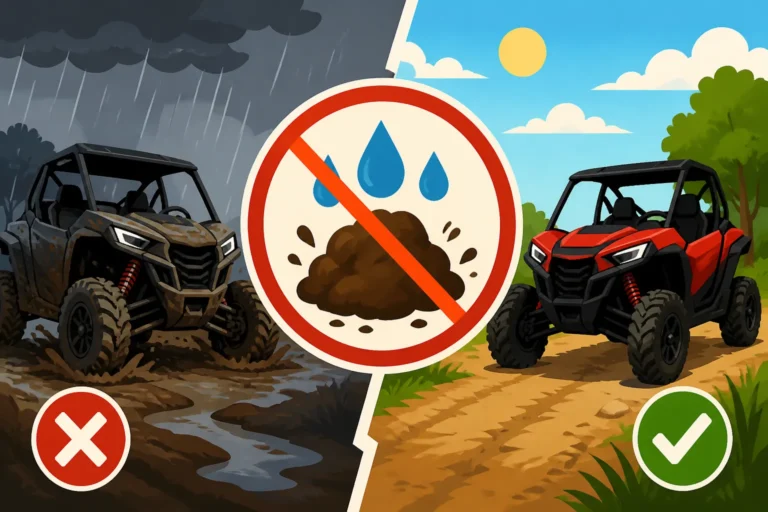
If the track is unavailable, decide in advance whether trail riding alone is still worth the trip. That sounds obvious, but it saves the group from trying to make a rushed decision in the parking lot after a long drive. The alternatives might include riding marked trails, visiting another park, or rescheduling for an open practice day. For broader planning, [Texas Riding Seasons and Heat] and [Texas Trails After Heavy Rain] are useful reads when weather and trail conditions could shape the day.
The key is to verify the exact facility and access rules rather than relying on the phrase “OHV park.” A little research before loading up helps ensure the park, track, and vehicle are genuinely a match.
Disclaimer
This article is for general informational purposes only and does not constitute professional advice. Laws, prices and regulations vary by location and change over time. Consult a qualified professional for guidance on your specific situation.