Texas Trail Difficulty by Park
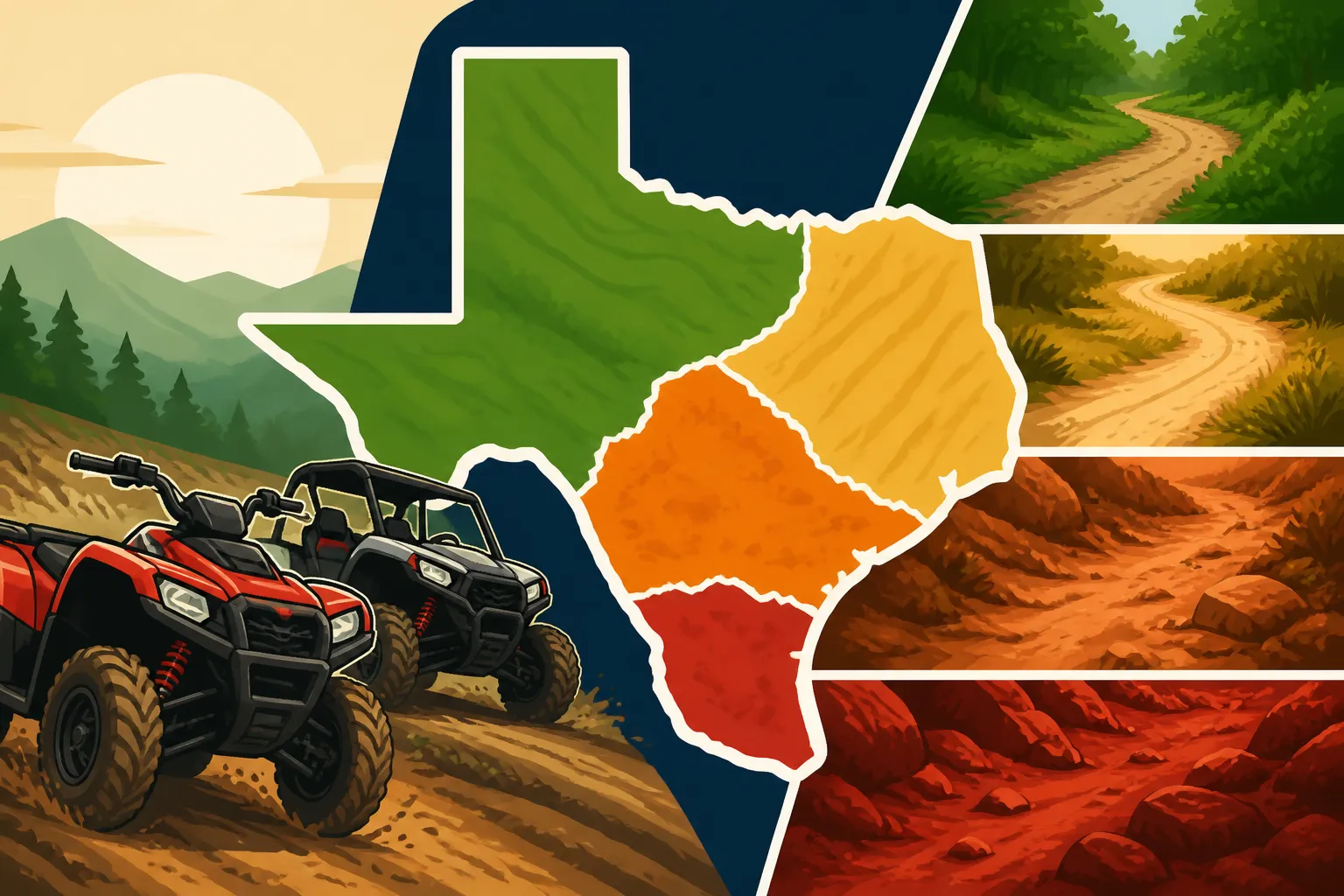
Texas trail difficulty can change dramatically from one park to the next—and even from one loop to another at the same park. A route that feels easy in a dry week may turn slick, rutted, or tiring after rain. This guide compares the general riding character of several Texas OHV areas so you can choose trails that fit your experience, machine, and comfort level.
How to Read Texas Trail Difficulty
Trail ratings are a starting point, not a promise
Parks may use their own color systems, signs, or descriptions, and the same label does not always mean the same thing everywhere. One park’s “intermediate” route might involve uneven dirt and tight turns; another’s could include rock ledges or steep descents. Treat ratings as local guidance rather than a universal scale.
Conditions also change. Rain can soften sand, create muddy ruts, and make rock slick. Dry weather can bring loose dust, washouts, and poor visibility behind another vehicle. A route you handled comfortably last month may feel quite different after a storm or a busy weekend.
Before unloading, read the park’s current map and ask staff about recent conditions, closures, and any routes they consider unsuitable for your machine. If you use a mapping tool such as onX Offroad to plan a ride, compare what it shows with the park’s own information. A mapped line does not necessarily mean a trail is open, appropriate for your vehicle, or easy to follow on the ground.
Judge the challenge by more than the trail name
Difficulty is a combination of obstacles, terrain, exposure, and how much room you have to recover from a mistake. A rocky climb may be manageable for an experienced driver in a suitable UTV, while a narrow, off-camber section may feel more intimidating even if it has fewer obvious obstacles. Visibility matters, too: blind corners and dust can make a simple route stressful when traffic is heavy.
Your machine changes the experience. A short-wheelbase ATV may thread through tight turns where a wide side-by-side needs more space. A vehicle with less ground clearance may struggle over ledges that do not trouble a machine built for rough terrain. Width rules are especially important in areas with narrow trails; check [Texas's 50-Inch National Forest Width Limit] before taking a wider machine onto a forest route.
Rider experience, fatigue, and group pace matter just as much. Someone who can ride a technical section early in the day may make poor choices after hours of heat and vibration. If a route looks more difficult than expected, turning around is a sound decision—not a failure.
A practical way to compare parks
The table below describes broad riding character, not official or permanent park ratings. Conditions, route availability, and individual trail choices can vary, so use it to narrow your options and then verify details directly with the park.
| Riding area | General terrain character | Often a better fit for | Consider carefully if |
|---|---|---|---|
| Barnwell Mountain Recreation Area | Forested trails, changing elevation, rocks, and varied surfaces | Riders who want a mix of routes and are willing to choose carefully | You are new to off-road riding or unfamiliar with rocky terrain |
| Hidden Falls Adventure Park | A wide range of terrain and route choices | Groups with mixed experience who can split up by ability | Your group expects to stay together on every trail |
| Sam Houston National Forest OHV Trail | Forest trail riding with surface and weather changes | Riders who meet the area’s vehicle requirements and want a marked trail experience | Your vehicle is too wide or conditions are wet |
| Northwest OHV Park | Managed riding areas with different types of terrain | Beginners and developing riders looking for a controlled place to practice | You assume every route is suitable for every vehicle |
| Escondido Draw | Open, rugged West Texas terrain with rocky sections | Riders comfortable with remote-feeling, uneven landscapes | You need frequent services or immediate help nearby |
| Katemcy Rocks | Highly technical rock features and obstacles | Experienced riders with capable vehicles and careful spotters | You are seeking an easy, casual trail day |
For a broader overview of the riding options around the state, see [Texas Trail Difficulty by Park] and [Texas OHV Parks by Region]. The useful question is not simply “Which park is easiest?” but “Which park offers terrain I can manage today, with the machine and support I have?”
Comparing Texas Parks by Riding Style
Barnwell Mountain for variety and changing terrain
Barnwell Mountain Recreation Area near Gilmer is known for a forested setting and a mix of riding experiences. A group can encounter changing grades, uneven surfaces, and rocky sections, so a single label for the whole park would be misleading. Choose routes based on the least experienced rider in your group, not just the most confident driver.
For a newer rider, the most comfortable day may mean staying on easier routes, taking breaks, and treating any unfamiliar obstacle as a reason to pause and assess. More experienced riders may seek out steeper or rockier challenges, but that does not make those routes automatically suitable for every ATV or UTV. Ground clearance, tire condition, vehicle width, and the driver’s ability to control speed all affect how manageable a section feels.
Barnwell’s variety can make it tempting to explore “just one more” trail. Set a turnaround time and keep track of where the group is, especially if riders have different comfort levels. Review [Barnwell Mountain Recreation Area] and [Texas Trail Difficulty by Park] for related planning topics, then confirm current route information with the park before your trip.
Hidden Falls for groups with different experience levels
Hidden Falls Adventure Park near Marble Falls offers enough variety that a mixed-ability group may be able to choose routes that better match individual skills. That can be a real advantage: beginners do not have to prove themselves on the same technical section as experienced riders, and confident drivers can still find challenges suited to them.
The tradeoff is that a group needs a plan. Agree on meeting points, decide whether everyone will ride together or split into ability groups, and make sure each subgroup knows how to get back. A beginner who feels pressured to keep up may take a line too quickly or attempt an obstacle without understanding the risk. A slower pace and an agreed-upon turnaround point usually make the day more enjoyable for everyone.
Before choosing a route, consider how your machine handles the park’s terrain and how comfortable you are with hills, loose surfaces, and uneven ground. Use the official map and posted signs as the primary guide; a third-party track or an onX Offroad route view can help with orientation, but it should not override closures or park directions. You can also compare [Hidden Falls Adventure Park at Marble Falls] with [Barnwell Mountain or Hidden Falls for a Weekend] when deciding which style of ride better suits your group.
Sam Houston National Forest for a different kind of ride
The Sam Houston National Forest OHV trail is not interchangeable with a privately operated park. Forest routes have their own access rules, vehicle limits, and conditions to consider. The trail environment can include roots, sand, ruts, and sections affected by moisture, so a route that seems straightforward on a dry day may become less predictable after rain.
The width requirement is an essential part of planning. Do not assume a trail is suitable because your UTV can physically travel along it. Check the rules and measure your machine as directed before you leave home. If your vehicle does not meet the applicable width limit, choose a riding area that permits it rather than trying to squeeze through a restricted route.
Forest access also calls for a little extra preparation. Carry what you need for the trip, tell someone where you are going, and check whether wet conditions or trail closures affect your plan. For practical details, review [Riding the Sam Houston Trail] and [When the Sam Houston Trail Shuts for Wet Soil]. When using onX Offroad or another mapping app, download or review the map before heading into an area where cell service may be limited; still follow posted signs and official forest notices.
Choosing a Difficulty Level That Fits Your Machine
Beginner-friendly does not mean risk-free
A beginner-friendly route usually gives a new rider room to learn basic control without immediately facing steep drops, large ledges, or tight technical obstacles. It does not mean the route is perfectly smooth or that nothing can go wrong. Loose gravel, roots, hidden holes, and unexpected traffic can catch out a rider who is concentrating only on the vehicle ahead.
Start with a short route and pause before obstacles. Look at the surface, identify a clear line, and decide whether you have enough room to stop if something changes. New riders often benefit from practicing smooth throttle control and braking on forgiving terrain before trying a hill or rocky section. If the machine begins to feel unstable, slow down and reassess rather than trying to power through uncertainty.
Parents should be especially cautious about matching trail difficulty to a young rider’s size and experience. A child who can operate a machine in an open area may not yet have the judgment or strength for a demanding trail. Choose an appropriate vehicle and route, supervise closely, and make the ride about building control rather than covering distance. For more on family planning, see [Texas Riding With Small Children].
Intermediate terrain calls for deliberate decisions
Intermediate riding can involve a combination of uneven ground, moderate climbs, ruts, loose surfaces, and obstacles that require attention. The challenge is often less about one dramatic feature and more about staying focused through a series of small decisions. Fatigue can build gradually, particularly when the route is bumpy or the weather is hot.
Before entering a harder section, look for a safe place to stop and discuss the line with your group. Keep enough distance between vehicles to avoid dust and to leave room for an unexpected stop. If someone gets stuck, do not crowd around the machine or attempt a recovery without considering where it could move. A basic plan for communication and recovery equipment is useful even on a route that does not look extreme.
Intermediate trails can also expose weaknesses in setup. Underinflated or damaged tires, loose cargo, and a poorly secured helmet can turn a manageable day into an uncomfortable one. Check the machine before riding, carry water, and take breaks before the group is exhausted. [Texas Riding Seasons and Heat] and [Heat Risk on a Summer Ride] offer useful reminders for planning around Texas weather.
Advanced obstacles require more than confidence
Advanced terrain can include steep grades, large rocks, narrow passages, off-camber sections, or obstacles where a poor line can damage the vehicle or injure someone. Experience matters, but so does knowing when not to attempt a feature. A capable machine does not make every obstacle safe, and a confident driver can still misjudge traction or clearance.
Spotting is a skill, not simply standing nearby and pointing. The person guiding the driver should stay out of the vehicle’s path and agree on clear signals before the attempt. If the driver cannot see the spotter or does not understand the instructions, stop and reset. Do not put a passenger or bystander in a position where a sliding or rolling vehicle could reach them.
At highly technical areas such as Katemcy Rocks, choose lines conservatively and know what lies beyond the obstacle before committing. If a feature is beyond your comfort level, watch from a safe location or take another route. The goal is to ride home with the machine and the people in your group in good shape—not to check off every obstacle.
Plan Around Conditions, Group Size, and Access
Weather can change the difficulty quickly
Texas weather has a strong influence on trail feel. Rain may make clay and rock slick, deepen ruts, or leave low areas soft. A dry period can make some surfaces loose and dusty, which reduces visibility and can make it harder to judge the shape of the trail. Conditions may differ across a large riding area, so a forecast for the nearest town is only one piece of the picture.
Check the park’s own status information before traveling, especially after heavy rain. Some places close routes to prevent damage or reduce safety risks, and riding around a closure can harm the trail and create problems for other visitors. If a route is closed, treat that as a firm boundary rather than searching for an unofficial way around it.
Bring a flexible plan. Pick a primary route and an easier alternative, and be willing to shorten the day if conditions deteriorate. For broader weather considerations, see [Texas Trails After Heavy Rain] and [Texas Riding in Summer Heat]. An app such as onX Offroad may help you understand your location and route options, but it cannot replace a park’s latest closure notice or staff guidance.
Match the route to the least experienced rider
A common group-ride frustration is discovering that “easy” meant something different to each person. One rider may think of easy as a maintained dirt path; another may be comfortable with hills and loose rock but not narrow ledges. Talk through the plan before the group starts, and ask people to say plainly what they are not comfortable attempting.
Groups can ride together at first, then divide if the park allows it and everyone has a safe way to regroup. Make sure each group has a competent lead rider, a designated sweep, and a clear meeting location. Avoid pressuring a newer rider to attempt an obstacle simply because others have already crossed it. A short detour or a return along a familiar route is often the better call.
If a group includes different machine types, check that the selected trails are appropriate for all of them. A tight route can be stressful for a wide UTV, while a steep or rocky route may challenge a smaller or less capable machine in a different way. Review [Texas Parks That Allow Full-Size Rigs] and [Texas OHV Parks for Beginners] when narrowing down areas for a mixed group.
Confirm access requirements before you set out
Trail difficulty is only one part of trip planning. Parks and public riding areas may have separate rules about permits, safety gear, vehicle width, hours, or access. A machine that is allowed at one site may not qualify for another trail system, so verify requirements for the specific place you plan to ride.
Public-land riding may involve requirements that do not apply in the same way at a privately operated park. Learn what applies to your route, carry required documents or permits, and follow the posted rules. For an overview of decal questions, read [Where a Texas OHV Decal Is Required] and [Texas Rules for Riding Public Land].
Also plan for the practical parts of the day: fuel, water, food, a charged phone, and a way to transport the machine if it needs help. In remote areas, do not assume that cell service will work or that assistance will arrive quickly. Leave a trip plan with someone who is not riding with you, and tell them when you expect to check in.
A Simple Method for Picking Your First Route
Start with the day you actually have
Choose a route based on how your group is feeling, not on the hardest trail you hope to conquer. If the drive was long, the weather is hot, or a rider is new to the machine, begin with something short and forgiving. That gives everyone time to adjust and lets you learn how the surface and vehicle behave before committing to a longer loop.
At the trailhead, read signs and look at the map together. Identify the route’s approximate direction, any junctions that could be confusing, and a safe place to turn back. If signage or conditions do not match what you expected, stop and get clarification instead of following an uncertain track deeper into the area.
Use a navigation app as a backup aid, not as permission to ride wherever a line appears. onX Offroad can be one reference for route awareness where relevant mapping is available, but posted signs, official maps, closures, and staff instructions take priority. Make sure everyone in the group understands that hierarchy before setting off.
Use a checkpoint before moving to harder trails
After the first route, take a few minutes to check in. Ask whether anyone feels uncomfortable, whether the machine is showing signs of trouble, and whether the group still has enough energy and water for another section. A small problem is easier to address while everyone is rested and still near a familiar place.
If you decide to try a more difficult route, be specific about what makes it harder. “There are some rocks” is less useful than explaining that the route may involve uneven climbs or narrow passages. Give riders permission to skip an obstacle or take an easier route without embarrassment. That makes it more likely someone will speak up before a situation becomes unsafe.
Keep an eye on time. Turning back while the group is comfortable is better than trying to finish a long loop in fading light or after everyone is tired. A good first day at a new park is one that leaves you interested in returning, not one that ends with a rushed recovery or a damaged machine.
Build experience gradually
Improving as an ATV or UTV rider is a process of learning to read terrain, manage speed, and make sensible decisions. Repeat easier routes until you can ride them smoothly and consistently. Then add one new challenge at a time, such as a steeper grade or a rougher surface, rather than combining several unknowns in one outing.
After each ride, think about what felt manageable and what felt stressful. Maybe the group chose a route that was too long, the tires struggled in a particular surface, or a rider needed more practice with controlled descents. Those observations make the next trip easier to plan and help you choose equipment and parks that suit the way you ride.
There is no benefit to comparing your pace with another group’s. Texas parks offer very different terrain, and riders arrive with different machines and experience. Choose the right route for your own group, follow local rules, and let skill develop at a comfortable pace.
Disclaimer
This article is for general informational purposes only and does not constitute professional advice. Laws, prices and regulations vary by location and change over time. Consult a qualified professional for guidance on your specific situation.