Lake Meredith and the Texas Panhandle
Lake Meredith can look like an easy Panhandle destination on a map, but reaching the right riding area, understanding its permits, and preparing for shifting sand and remote conditions takes more than a quick drive. This guide explains where off-highway riding is allowed, how to plan for Rosita Flats, what to bring, and how to avoid common access and safety mistakes.
Where to Ride Near Lake Meredith
Rosita Flats is the main OHV destination
Lake Meredith National Recreation Area is a large landscape of water, shoreline, prairie, canyons, and public recreation areas north of Amarillo. It is not an invitation to ride anywhere you can reach by machine. OHV use is restricted to designated areas and routes, so the important first question is not simply “Can I ride near the lake?” but “Is this exact spot open to my type of vehicle?”
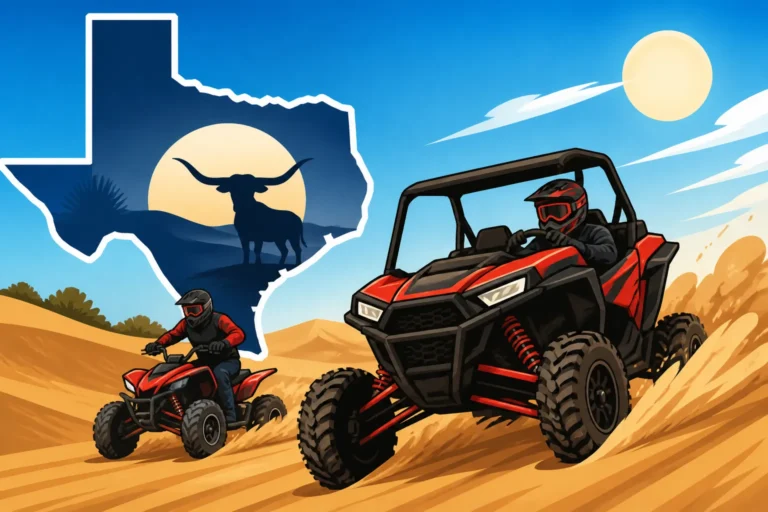
Rosita Flats is the area most riders mean when they talk about riding at Lake Meredith. It offers open, sandy terrain that feels very different from the rock gardens and wooded trails found at some Texas OHV parks. The space and changing terrain can be part of the appeal, but they can also make it easy to lose your bearings or underestimate how much effort it takes to get back to your vehicle.
For a closer look at the area, see [Rosita Flats at Lake Meredith] and [Riding the Rosita Flats OHV Area]. Treat any boundary, closure, or route information as something to confirm before unloading. Conditions and posted restrictions matter more than a route someone remembers from a previous trip.
The park is bigger than the riding area
Lake Meredith National Recreation Area is managed by the National Park Service, and its recreation opportunities extend well beyond OHV riding. A shoreline pullout, boat launch, campground, or open-looking patch of ground is not automatically a legal riding area. Riding outside designated OHV locations can damage sensitive ground and create conflicts with other park visitors.
That distinction matters when you arrive with a trailer and start looking for a convenient place to unload. A wide turnout may be intended for parking or water access, not for riding. Likewise, a visible track across open ground does not prove that the route is authorized. Use official park information and on-site signs to confirm what is permitted.
If your group wants more than dunes and open sand, compare Lake Meredith with other destinations using [Texas OHV Parks by Region]. That broader view can help you decide whether the Panhandle landscape suits your riding style, or whether a managed trail park with more marked routes would be a better fit.
Getting There and Finding the Right Access
Plan the approach before towing north
Lake Meredith sits in the Texas Panhandle, with communities such as Fritch and Borger serving as familiar reference points and Amarillo as a common starting place for longer trips. The last part of the journey may feel more remote than the highway drive. A turn that looks minor on a phone map can lead to a rougher approach, limited services, or a route that is not suitable for every tow vehicle and trailer.
Before leaving town, check the park’s official directions and access notices, then compare them with your navigation plan. Save the details you need while you have reliable service. If you are using a mapping app such as onX Offroad to explore roads and plan a route, use it as a planning aid—not as proof that a road is open, passable, or approved for OHV riding.
The difference between reaching a park entrance and reaching the correct OHV staging area is worth sorting out in advance. Confirm where you can park and unload, whether the approach is appropriate for your trailer, and whether there are temporary restrictions. A few minutes of checking at home can prevent a frustrating detour with a loaded rig.
Understand the Blue Creek approach
Blue Creek is one of the access points riders may encounter while planning a trip to the Rosita Flats area. The drive in can be part of the trip’s challenge, particularly after weather changes the road surface. Look up [Blue Creek and the Road In] and [Getting to Blue Creek Off FM 1913] as starting points for understanding the approach, then confirm directions and conditions with official park information before setting out.
Do not assume a road that was manageable for a high-clearance truck will feel easy with a long trailer behind you. Loose or rutted surfaces, washboard, standing water, and sharp turns can change the equation. If the route is questionable, stop somewhere safe and reassess rather than pushing a tow vehicle into a situation that could leave the trailer stuck or damaged.
It also helps to arrive with enough daylight to find the staging area, unload carefully, and sort out your group’s equipment. A late arrival can turn a simple parking decision into a rushed one, especially if drivers are unfamiliar with the site. If the plan depends on reaching a particular entrance, confirm that access before the drive rather than relying on a pin saved months ago.
Permits, Decals, and Park Rules
Check both Texas and site-specific requirements
A frequent source of confusion is assuming that one decal or permit automatically covers every requirement. Texas OHV decal rules and site-specific requirements at a federal recreation area are separate questions. A park permit or identifier does not necessarily replace a Texas decal when one is required, and a Texas decal does not necessarily satisfy a park’s own check-in or display rules.
Before the trip, confirm which documents and identifiers apply to your machine, where to obtain them, and where they must be displayed. Start with [The Texas OHV Decal Explained] and [Where a Texas OHV Decal Is Required], then check Lake Meredith’s official information for its local requirements. Keep proof of purchase or permit details accessible rather than buried in a trailer storage bin.
Lake Meredith has site-specific permit information that riders should not overlook. The articles [Why Lake Meredith's Free Permit Is Still Required] and [The Lake Meredith Decal That Changes Color Each Year] address details that can be easy to miss when riders rely only on general Texas guidance. Verify current instructions before leaving home, including whether a permit must be obtained in advance or displayed on the vehicle.
Read the rules for your vehicle and your group
A quad, a side-by-side, and a larger recreational vehicle may not all be treated the same way under every site rule. Check the permitted vehicle types, any width restrictions, and the routes or areas each type may use. Do not assume that because your machine fits physically, it is allowed on every route or through every access point.
Rules for operators and passengers also deserve a careful review. Helmet, safety certificate, age, seating, and supervision requirements may depend on the rider, the vehicle, and the land being used. Begin with [Texas OHV Safety Certificates] and [Texas Rules for Riders Under 14], then confirm applicable park rules. A youth rider’s eligibility should be settled before the trip, not debated beside the staging area.
Make the rules part of the group briefing. Tell everyone where riding is allowed, what identification or permits to carry, and what to do if someone gets separated. If a friend is bringing a borrowed machine, ask them to check its requirements too; the group’s paperwork does not automatically cover every vehicle.
Terrain, Weather, and Riding Conditions
Expect sand, wind, and changing ground
Rosita Flats is associated with sandy terrain, so expect a very different ride from a hard-packed forest trail. Sand can hide dips and changes in firmness. A section that looks smooth from a distance may contain soft patches, ruts, or a steep transition. Riders who are new to sand often find that choosing a controlled line and maintaining a steady pace works better than sudden throttle or braking inputs.
Wind is another feature of Panhandle riding that can affect visibility and comfort. Blowing dust can make it harder to see other vehicles, while gusts can push loose sand across open ground. Leave more space between machines than you might on a narrow, familiar trail, and slow down when visibility drops. A dust cloud is not a reliable indication that the rider ahead is far enough away to be safe.
The land can also look deceptively uniform. In open country, it is easy to travel farther than intended because there are fewer trees or other close landmarks to judge distance. Use a pre-agreed meeting point, keep track of your route, and avoid wandering into areas where riding is not authorized. If you use onX Offroad or another mapping tool, check your position regularly and compare it with park guidance.
Check the forecast and ground conditions
The Panhandle can bring hot summer days, cold weather, strong winds, and sudden storms. A comfortable morning does not guarantee a comfortable afternoon. Pack for the expected conditions and keep an eye on the forecast for the full outing, including the return drive. Heat can be especially difficult when you are riding in exposed areas with little shade.
Rain can quickly change access roads and sandy terrain. A road that was easy on a dry day may become slick or rutted after a storm, and a low spot can hold water longer than expected. Check [Texas Trails After Heavy Rain] for broader planning considerations, but use park updates to make the final call for Lake Meredith. Do not treat a vehicle’s four-wheel drive as a reason to ignore a closure or a deteriorating road.
Timing matters as much as the forecast. If a storm is approaching, do not wait until the sky is directly overhead to head back. Build a turnaround time into the plan and leave enough daylight to load, secure the machines, and travel back to your lodging or campsite. The best ride is not worth pushing into a worsening weather situation.
| Condition | What it can mean at Lake Meredith | A practical response |
|---|---|---|
| Soft or shifting sand | More effort to steer and maintain momentum | Ride smoothly, give others space, and avoid abrupt maneuvers |
| Strong wind | Dust, reduced visibility, and faster fatigue | Slow down, increase spacing, and pause if you cannot see clearly |
| Recent rain | Slick or damaged access roads and changed trail conditions | Check official notices and avoid closed or unsafe routes |
| Summer heat | Dehydration and heat stress in exposed areas | Carry water, take breaks, and plan conservatively |
| Cold or rapidly changing weather | Discomfort and reduced dexterity | Bring suitable layers and allow time to return before conditions worsen |
Preparing Your Machine and Group
Inspect the machine before loading
A remote ride is a poor place to discover a weak battery, loose tie-down point, or tire problem. Before departure, check tires, wheels, brakes, controls, lights, fluid levels, and the general condition of the machine. For a side-by-side, also inspect seat belts, doors or nets, and any equipment required for safe passenger use. A basic inspection can catch small problems before they become a long walk back to the trailer.
Sand can work its way into places that stay cleaner on a paved-road trip. Make sure the air filter is in good condition, and bring the tools and supplies you normally need for minor adjustments. If your machine has been sitting between rides, check the battery and fuel system before the trip rather than assuming it will start after a long tow.
Bring recovery and repair equipment that matches the vehicle and the group’s skill level. A tow strap, tire repair supplies, basic hand tools, and a way to communicate your location can be useful, but gear is only helpful if someone knows how to use it. Avoid improvising a recovery that could pull a machine over or injure someone. If a problem exceeds your ability, stop and seek appropriate help.
Pack for people, not just machines
Water, food, sun protection, and a first-aid kit should be treated as core riding gear. In an exposed landscape, riders can become tired or dehydrated without noticing how quickly the conditions are affecting them. Bring more water than you expect to need, and make breaks normal rather than waiting until someone feels unwell.
Each rider should have eye protection, suitable clothing, and the required protective equipment. Dust can irritate eyes and lungs, while sun exposure can wear people down even when the air feels cool. Pack a spare layer for weather changes and a way to keep personal items secure. If children are in the group, make sure their equipment fits properly and that the planned ride is appropriate for their experience.
Agree on the group’s basic procedures before starting. Decide who leads, who follows, where the group will stop, and what everyone should do if a machine has a problem. Keep inexperienced riders within a pace they can manage. A short briefing may feel unnecessary when everyone is eager to ride, but it prevents avoidable confusion once the group spreads out over open terrain.
Riding Safely and Respecting the Area
Keep the ride within designated boundaries
The open appearance of the landscape can tempt riders to choose their own route. Resist that temptation. Stay within the designated OHV area and follow signs, barriers, and closures. Tracks left by other vehicles do not establish legal access; they may be old, unauthorized, or leading somewhere that is currently closed.
This is especially important near shorelines, vegetation, and areas that look like convenient shortcuts. Repeated traffic can damage ground and create erosion, and a route that seems harmless to one rider may affect other visitors or park resources. If you are unsure whether a section is open, turn around and check rather than relying on guesswork.
Do not leave trash, broken parts, or fuel containers behind. Secure loose items before riding, and pack out everything your group brings in. Respect quiet areas and other visitors who may be there for boating, fishing, camping, or wildlife viewing. A good ride leaves the site in a condition that does not create a problem for the next person.
Use a conservative pace in open terrain
Wide-open ground can make speed feel safer than it is. Sand can conceal a rut or soft patch, and another rider can appear unexpectedly from behind a rise or dust plume. Keep a pace that leaves enough time to react, especially when visibility is limited or you do not know the terrain.
Avoid following too closely. The rider ahead may brake, bog down, or change direction without warning. Give more room when the surface is dusty, and use a clear hand signal or a planned stop if the group needs to regroup. For groups with mixed experience, the lead rider should choose a pace that the least confident participant can manage.
Use route-tracking tools as a backup, not a substitute for judgment. onX Offroad can be helpful for organizing a planned route and checking your location, but digital maps can be incomplete or out of date. They do not override a gate, sign, closure, or land-management rule. Carry a backup plan and make sure every rider knows how to get back to the staging area if the group becomes separated.
Planning a Better Panhandle Riding Trip
Match the outing to your group
Rosita Flats can suit riders who enjoy open space and sand, but it may not be the right first ride for everyone. A new rider who has only ridden firm, narrow trails may need time to learn how the machine behaves in loose terrain. Consider the group’s experience, vehicle type, and comfort with self-navigation before deciding how long to ride or how far to explore.
Families should think through each child’s needs, not just whether the child can sit on a machine. Size, control, protective equipment, attention span, and adult supervision all affect whether the outing will be enjoyable. Build in frequent stops, keep the riding area familiar, and do not let a child ride beyond their skills because other members of the group want to go farther.
If your group wants a structured trail network, compare other options in [Texas OHV Parks for Beginners] or [Texas OHV Parks Near Amarillo]. Lake Meredith offers a distinctive Panhandle setting, but “best” depends on what your group wants from the day. One rider may love open sand and long sightlines, while another may prefer marked trails, shade, or facilities closer to the riding area.
Make a practical day-of checklist
Before leaving, confirm access, permit instructions, weather, and any posted closures. Check the tow vehicle and trailer, verify that all machines are secured, and make sure everyone has the equipment and documents they need. Save official directions and key contact information in a form you can access without a mobile connection.
At the site, take a few minutes to identify the staging area, review signs, and make a group plan. Confirm that each machine is permitted in the intended area and that the group understands where riding is allowed. If anything has changed since your planning—such as a closure, damaged road, or poor visibility—adjust the plan instead of forcing the original itinerary.
After the ride, inspect machines for damage and remove accumulated sand before it causes problems. Check tires, filters, and vulnerable components, and secure the machines for the return trip. A quick post-ride check also helps you notice a developing issue before the next outing. For seasonal planning, [Texas Riding Seasons and Heat] can help you think about weather and timing across the state, while Lake Meredith’s own notices should guide local decisions.
Disclaimer
This article is for general informational purposes only and does not constitute professional advice. Laws, prices and regulations vary by location and change over time. Consult a qualified professional for guidance on your specific situation.