Does a Roll Cage Replace the Helmet Requirement?
Navigating the myriad of rules and regulations for ATVs and UTVs in Texas can feel like trying to find your way through dense brush without a map. One of the most common questions, especially for those venturing onto public lands or limited road sections, revolves around safety gear: specifically, whether adding a robust roll cage to your side-by-side means you can ditch the helmet. This guide will cut through the confusion and explain exactly what Texas law says about roll cages, helmets, and other essential safety requirements for your off-highway vehicle.
The Texas Helmet Mandate and the Roll Cage Exemption
When it comes to riding off-highway vehicles in Texas, safety is paramount, and state law reflects that. Many riders assume that if their UTV has a factory-installed or aftermarket roll cage, they are automatically exempt from wearing a helmet. While there is a specific exemption, it's crucial to understand its exact wording and limitations to ensure you're compliant and, more importantly, safe.
Texas Helmet Law for ATV and UTV Riders
Generally speaking, Texas law does require helmets for most off-highway vehicle (OHV) operators and passengers when riding on public land or in any situation where the law allows limited road use. The intent is clear: to protect riders from head injuries in the event of a crash or rollover. This applies whether you're on a traditional ATV or a modern UTV, regardless of the number of seats or manufacturer's specifications. It's a foundational rule that aims to prevent serious harm in environments where accidents, even minor ones, can happen quickly.
The state isn't just trying to make things difficult; it's genuinely concerned with rider safety. Imagine a quick turn on a loose gravel trail or an unexpected bump that sends you flying. A helmet is your first line of defense. This general requirement is broadly applied, covering most recreational riding scenarios across the state, from designated OHV parks to allowable crossings on public roads. Understanding this baseline requirement is key before exploring any exemptions. For a deeper dive into the specific rules, you can check out [Texas Helmet Law for ATV Riders] and [Texas Helmet Law for UTV Drivers].
The Roll Cage Exemption: What the Law Says
Now, let's address the roll cage. Texas law does indeed provide an exemption from the helmet requirement, but it's not simply "having a roll cage." The exemption specifically states that a helmet is not required if the OHV is equipped with a roll bar or cage and the operator and passengers are wearing seat belts. This means both conditions must be met simultaneously for the exemption to apply. It's not one or the other; it's a package deal.
This distinction is incredibly important. Many UTVs come from the factory with robust roll cages and seat belts, making this exemption applicable right off the dealership lot. However, if you have an older UTV, or if you've modified your machine, you need to ensure both the roll cage and working seat belts are in place and being used by everyone in the vehicle. The law aims to create a protective cell around the occupants, much like in a car, where the combination of structural integrity (the cage) and occupant restraint (the seat belt) works together to enhance safety. Removing one element, like not buckling up, negates the entire exemption. This also means that traditional ATVs, which typically lack roll cages and often only have minimal safety features beyond the rider's own gear, rarely qualify for this exemption.
Practical Implications for Riders
So, what does this mean for your typical Saturday ride? If you're driving a side-by-side that has a factory-installed or aftermarket roll cage, and everyone inside is securely buckled with [Texas Seat Belt Rules in a Side-by-Side] in mind, you are legally exempt from wearing a helmet. This is a common scenario for many UTV owners who appreciate the open-air feel without compromising safety in the eyes of the law. Companies like SuperATV offer a range of aftermarket roll cages and components that can enhance the safety and structural integrity of your UTV, often exceeding factory standards. However, if even one passenger isn't belted in, or if your machine is a traditional ATV without a full cage, then helmets are required.
Consider a family outing at a place like Barnwell Mountain Recreation Area. If you're in a four-seat UTV with a strong roll cage, and all four occupants—driver, front passenger, and two rear passengers—are wearing their seat belts, then helmets aren't legally mandatory for you in that situation. But if one of your kids unbuckles for a second, or you bring a friend on an ATV, then helmets become a legal necessity. Always remember that the law is the minimum standard for safety. Even with the exemption, many experienced riders choose to wear helmets for added protection, especially when tackling challenging terrain where a rollover, even within a cage, could result in unexpected impacts.
Complementary Safety Gear and Texas Road Rules
The discussion around helmets and roll cages often leads to other critical safety considerations. Texas law doesn't stop at just those two items; it also addresses eye protection, seat belts, and proper passenger seating, especially in the limited instances where OHVs might find themselves on public roads.
Eye Protection and Seat Belt Rules
Even if you're exempt from wearing a helmet due to a roll cage and seat belts, eye protection is still a very smart idea, and often a legal requirement in many riding scenarios. Debris, dust, insects, and even low-hanging branches can cause serious eye injuries in an instant. While the helmet exemption might give you a pass on headgear, it doesn't diminish the need for clear vision and protected eyes. Many UTVs have windscreens that offer some protection, but for open-air riding, goggles or safety glasses are crucial.
As for seat belts, their role in the helmet exemption cannot be overstated. Texas law is clear: if you rely on the roll cage exemption, those seat belts must be worn. This isn't just a formality; seat belts keep you inside the protective shell of the cage during a rollover or sudden stop. Without them, you could be ejected, rendering the roll cage largely ineffective and putting you at severe risk. Always ensure your seat belts are in good working condition, properly adjusted, and used by everyone. Aftermarket seat belt harnesses, often sold by companies like SuperATV, can offer enhanced restraint and comfort over standard factory belts, especially for aggressive riding.
Manufacturer-Designed Seating for Passengers
Another crucial aspect of OHV safety, particularly for UTVs, pertains to passengers. Texas law generally specifies that passengers may only be carried if the OHV is "designed by the manufacturer to carry more than one person." This means no piling extra people onto a single-seat ATV, and for UTVs, it means using only the seats explicitly provided by the manufacturer. If your UTV has two bucket seats and a rear bench for three, you can carry five people. If it only has two bucket seats, you can only carry two.
This rule is designed to ensure that passengers have proper seating, handholds, and are positioned safely within the vehicle's design. Adding a makeshift seat or trying to squeeze an extra person into a space not designed for them not only risks a fine but also dramatically increases the chance of injury in an accident. Always adhere to the manufacturer's passenger capacity guidelines to keep everyone safe and compliant with the law. You can read more about [Texas Passenger Rules on an ATV].
When ATVs/UTVs Can Be on Texas Roads
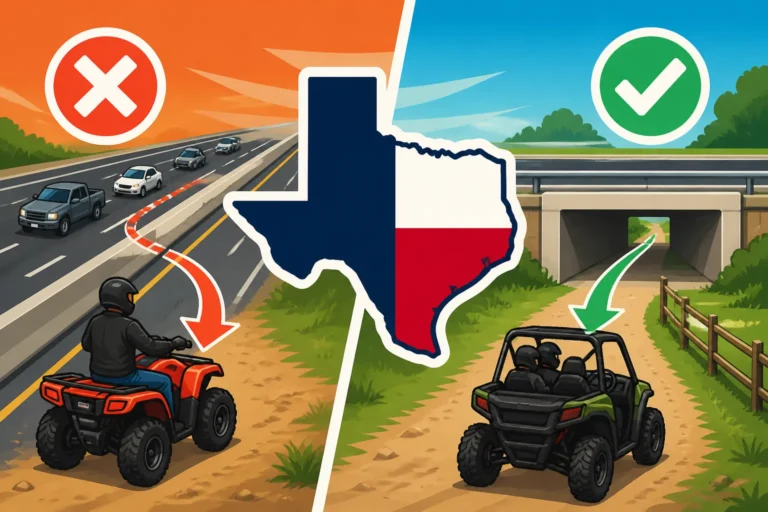
Understanding safety equipment requirements is often intertwined with knowing where you're allowed to ride your OHV. Texas has very specific and limited rules about when an ATV or UTV can legally operate on public roads. This context is vital because most safety requirements, including the helmet exemption, apply when you're interacting with these public spaces.
Agricultural and Utility Use Exemptions
For many Texans, ATVs and UTVs are indispensable tools for work. The state recognizes this with specific exemptions for agricultural and utility operations. If you're using your OHV for legitimate agricultural purposes, such as ranching, farming, or timber operations, you might be allowed on certain public roads, typically county roads or farm-to-market roads, for limited distances. This includes activities like hauling feed, checking fences, or moving equipment. Similarly, utility workers using OHVs for maintenance on power lines or pipelines also have specific allowances.
However, these are not blanket permissions to joyride. There are often restrictions on speed, distance, time of day (daylight hours only), and even specific safety equipment like a mounted orange flag. Importantly, while these exemptions allow road access, they don't necessarily waive all other safety requirements. Even if you're using your side-by-side for farm work, the general rules for [Texas Agricultural Exemption for ATVs on Roads] still apply, and you should always prioritize safety gear. For most recreational riders, this exemption won't apply. It's crucial to understand [Why Texas Will Not Register an OHV for the Road] for general use.
Master Planned Communities and Local Ordinances
Beyond agricultural use, some very specific, localized exemptions exist. Texas law allows for the possibility of OHV use on public roads within certain "master planned communities" if the community meets specific criteria and has an approved plat. These are often highly controlled residential developments where the roads are privately maintained but publicly accessible. Additionally, some cities and counties have enacted local ordinances that permit OHVs on certain low-speed public roads, typically those with a posted speed limit of 35 mph or less. These ordinances are rare and highly localized.
If you live in such an area or plan to visit one, it's absolutely essential to check the local city or county ordinances directly. Never assume you can ride on city streets just because you saw someone else do it. These exceptions are highly specific, often come with their own set of rules regarding hours of operation, required equipment (like lights, mirrors, and turn signals, even if your machine isn't fully street-legal), and driver licensing. Remember, while a roll cage might provide some protection, [Why Modifying an ATV Will Not Make It Street Legal] for general road use. You can learn more about [Texas Rules for Riding on a 35 mph Road] and [Texas Rules for Master Planned Communities] for more details on these very limited exceptions.
Putting Safety First, Regardless of Exemptions
While understanding the letter of the law is crucial for compliance, true safety goes beyond just avoiding a ticket. Riders should always strive to make choices that maximize their protection and minimize risk, regardless of whether a specific exemption applies to their situation.
Beyond the Letter of the Law: Prioritizing Your Safety
The legal exemption for helmets when using a roll cage and seat belts in a UTV is a valuable one, offering riders a choice in specific circumstances. However, it's vital to view legal requirements as a baseline, not a ceiling, for safety. An accident can still cause significant injury even within a roll cage. The forces involved in a rollover can be violent, and while a cage protects against crushing, your head can still impact the cage itself or other parts of the vehicle. Wearing a helmet, even when not legally required, adds an extra layer of impact protection and can absorb rotational forces that a bare head cannot.
Consider the terrain you ride. Are you tackling challenging rock crawls, high-speed desert trails, or tight, wooded paths where impacts are more likely? In these scenarios, the added protection of a helmet can be invaluable. The choice to wear a helmet when legally exempt comes down to personal risk assessment and prioritizing your well-being. Many riders, even those in fully caged UTVs, choose to wear helmets for peace of mind and enhanced protection. It's a personal decision, but one that should always err on the side of caution.
Making Informed Gear Choices
Selecting the right safety gear involves more than just buying what's legally mandated. It's about choosing equipment that fits well, is appropriate for your riding style, and offers maximum protection. For helmets, look for models certified by organizations like the DOT (Department of Transportation) or Snell. Ensure it fits snugly but comfortably, without obstructing your vision. For UTVs with roll cages, consider the quality of the cage itself. Aftermarket options from reputable brands, like SuperATV, often feature reinforced construction and better designs than some factory cages, providing enhanced protection in extreme conditions.
Don't forget other gear: eye protection (even with a windshield, dust and small debris can get in), gloves for grip and hand protection, and sturdy boots that protect your ankles and feet. Protective clothing, such as long sleeves and pants, can prevent scrapes and reduce sun exposure. While [Texas Exempts OHVs From Insurance] requirements for off-road use, carrying medical insurance is always a wise decision to cover unforeseen accidents. Investing in high-quality gear is an investment in your safety and enjoyment of the sport. Make informed choices, stay safe, and enjoy the incredible Texas outdoors.
Disclaimer
This article is for general informational purposes only and does not constitute professional advice. Laws, prices and regulations vary by location and change over time. Consult a qualified professional for guidance on your specific situation.