Daylight Only on the Way to a Tee Time
It’s a scenario many of us have faced: you’re heading out for an early morning tee time, or maybe just wanting to cruise to a neighbor’s house in your golf cart, and you wonder if it’s okay to hit the pavement before the sun fully crests the horizon, or after it dips below it. Navigating the rules for operating golf carts and other off-highway vehicles (OHVs) on Texas roads can feel like deciphering a secret code, especially when it comes to specific conditions like time of day. This guide is here to untangle the complexities of Texas law regarding golf carts and OHVs on public roads, focusing particularly on the "daylight only" stipulation and what it means for your ride.
The Basics of Texas Road Use for Golf Carts and OHVs
Texas has a reputation for being a state that loves its wide-open spaces and the freedom to enjoy them, but when it comes to operating off-highway vehicles (OHVs) on public roads, things get a bit more structured than you might expect. The key distinction here is between a vehicle designed for on-road use and one that isn't.
Why Most ATVs and UTVs Aren't Street Legal The General Rule
Let's start with the hard truth: for the most part, your typical ATV or UTV is not considered street legal in Texas. These machines, while incredibly versatile and fun for tearing up trails or helping with ranch work, are specifically designed for off-highway use. The state defines an off-highway vehicle, or OHV, as a motor vehicle that is not a golf cart, low-speed vehicle, or antique. This includes your standard four-wheelers, side-by-sides, and even some custom-built buggies like sand rails. [What Texas Counts as an Off-Highway Vehicle]
The reason for this lies in their design. OHVs typically lack the safety features required for highway travel, such as turn signals, rearview mirrors, proper braking systems for road speeds, and often don't meet federal motor vehicle safety standards for crashworthiness. Trying to modify an ATV with a DIY turn signal kit or a simple mirror from the auto parts store won't magically transform it into a street-legal vehicle in the eyes of the law. You can certainly buy aftermarket parts from companies like SuperATV to enhance your machine's off-road capabilities, but these additions don't change its fundamental classification for road use. The penalties for taking a non-street-legal OHV onto a public road can range from fines to more serious consequences, depending on the circumstances. It's truly a headache you want to avoid.
The Special Case of Golf Carts and Low-Speed Vehicles LSVs
Now, here's where things get a bit more nuanced. While most ATVs and UTVs are restricted from public roads, Texas law makes specific allowances for golf carts and low-speed vehicles (LSVs). These aren't the same thing, though they often get lumped together in casual conversation. An LSV is a vehicle that meets federal safety standards, can go between 20 and 25 miles per hour, and must be titled and registered, just like a regular car. Think of them as a smaller, slower version of a car, often looking like beefed-up golf carts. They typically have all the bells and whistles: seatbelts, headlights, tail lights, turn signals, windshields, and even a VIN.
Golf carts, on the other hand, have a much more limited scope of road use. They are designed for golf courses, planned communities, and short trips at very low speeds. They don't have to meet the same stringent federal safety standards as LSVs or traditional vehicles. This distinction is crucial because the rules that apply to an LSV—which can be legally driven on many public roads where the speed limit is 35 mph or less—are different from the very specific, often restrictive, rules for a golf cart. [Texas Golf Cart Titling Rules] Many communities across Texas, especially those with golf courses or large retirement populations, have grappled with how to safely integrate these slower vehicles into their local traffic patterns.
Identifying What Texas Considers a Golf Cart
So, what exactly is a golf cart according to Texas law? It's generally defined as a motor vehicle designed by the manufacturer primarily for use on a golf course. This might seem straightforward, but as more and more people customize their carts for neighborhood cruising or light utility work, the lines can blur. The critical factor is the manufacturer's primary design. If it was made to be a golf cart, it's a golf cart, even if you’ve added a lift kit, fancy wheels, or a powerful sound system from, say, SuperATV.
This definition is important because it dictates the specific set of rules your vehicle must follow. Unlike an ATV or UTV, which needs to stick strictly to private land or designated OHV parks like Hidden Falls Adventure Park, a golf cart can use certain public roads under very precise conditions. This includes specific equipment requirements and, critically for our topic today, restrictions on when you can operate it—namely, the "daylight only" rule we'll dive into next. Understanding this basic categorization is the first step toward staying compliant and avoiding an unexpected conversation with a local law enforcement officer.
Understanding the "Daylight Only" Rule for Golf Carts
When it comes to golf carts on Texas public roads, the "daylight only" rule is one of the most common points of confusion and, frankly, frustration for riders. It sounds simple enough, but there are layers to what it means and how it applies.
What "Daylight Only" Truly Means for Your Ride
The phrase "daylight only" isn't just a suggestion; it's a legal requirement for golf carts operating on authorized public roads in Texas. It means exactly what it sounds like: your golf cart can only be driven on public streets between sunrise and sunset. You cannot hop in your cart for a quick trip to the corner store before the sun is fully up, nor can you use it to get home from a late dinner party after dusk. This rule is in place for safety reasons, as golf carts typically lack the robust lighting and reflective features found on standard automobiles, making them incredibly difficult to see in low-light conditions.
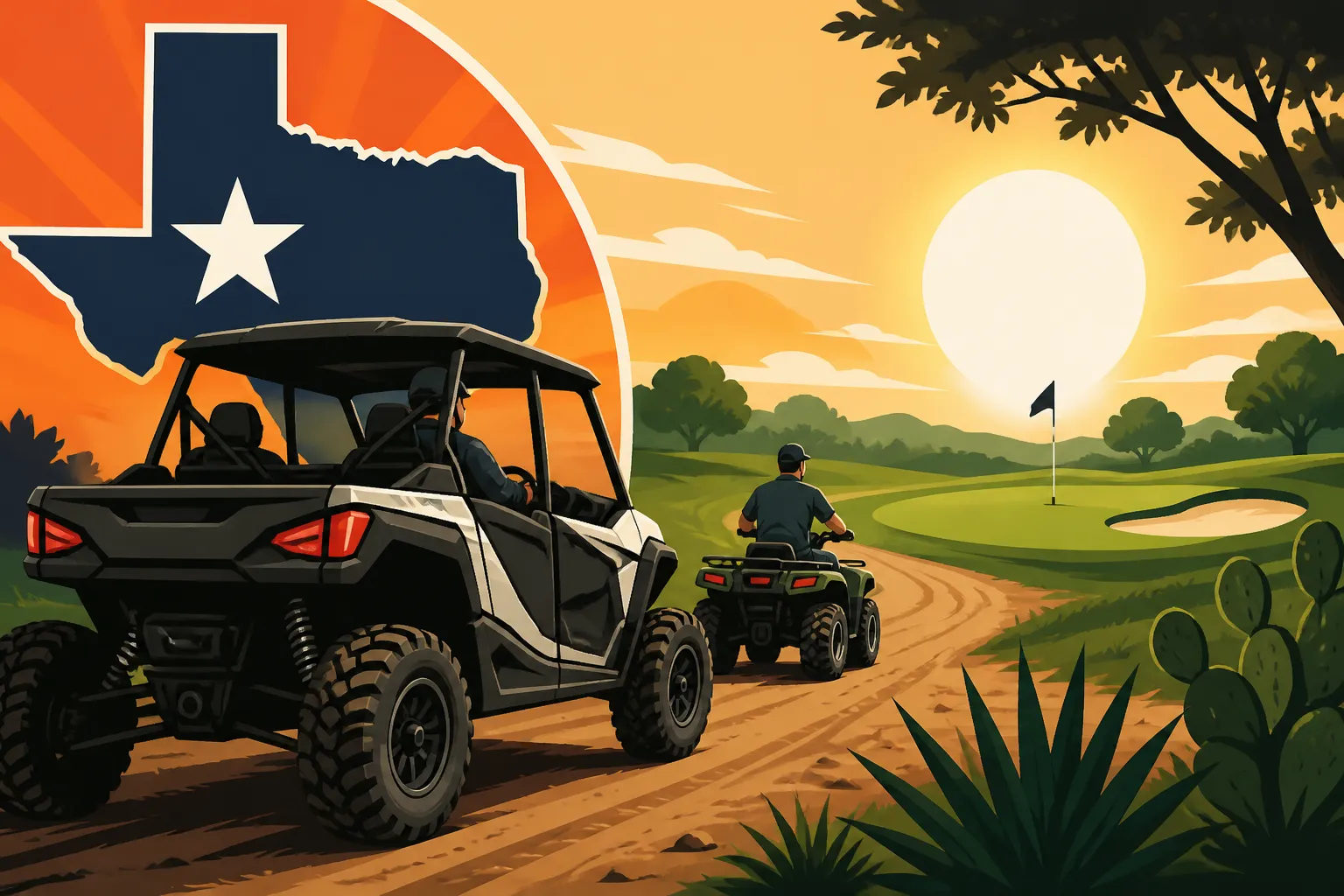
Imagine you're driving your cart to the first tee. If your tee time is at 6:30 AM in the middle of winter, chances are it's still pretty dark out. Even if you have aftermarket headlights, if it's before official sunrise, you're technically in violation. The same goes for leaving a clubhouse gathering. If it runs late and the sun has already set, you'll need to find an alternative way home for yourself and your golf cart. This can be a real inconvenience, especially for those who rely on their carts for short-distance travel within their communities, but safety always comes first in these regulations.
Equipment Requirements for Golf Carts on Public Roads
Even during daylight hours, a golf cart isn't just a free-for-all on the roads. To be legally operated on public streets where permitted, a golf cart must meet certain basic equipment standards. While they don't need to be as fully equipped as an LSV, they still need to be visible and functional for basic road interaction. This typically includes:
- Headlamps: While the "daylight only" rule seems to negate the need for them, some local ordinances might still require them, and they are certainly a good safety feature to have.
- Taillamps: Essential for visibility from the rear, even in bright conditions.
- Reflectors: Often on the sides and rear, to make the cart more noticeable.
- Brakes: A working braking system is non-negotiable for any vehicle on a public road.
- Mirrors: At least one rearview mirror, if not side mirrors, to help the driver see surrounding traffic.
- Warning Device: A horn is a good idea to alert pedestrians or other drivers.
It's tempting to think that since it's "daylight only," you don't need robust lighting. But it's about being seen, not just seeing. If you've invested in upgrading your golf cart with high-quality parts, perhaps a heavy-duty suspension kit or custom seats from a brand like SuperATV, remember that safety equipment for road use takes precedence over purely aesthetic or performance enhancements when it comes to compliance. Always check with your local municipality for any specific additional requirements they might have, as these can vary slightly.
The Distance Limit: A Crucial Detail
Beyond the "daylight only" and equipment rules, there's another often-overlooked restriction for golf carts: the distance limit. In many authorized areas, a golf cart may not be operated more than two miles from the location where it is parked or garaged. This rule really drives home the point that golf carts are intended for very localized travel, not for lengthy excursions or connecting disparate parts of a large city. [2 Miles From Where the Machine Is Parked]
This distance restriction is particularly relevant for those living in communities built around golf courses, or large rural properties. You can easily drive your golf cart from your home to the clubhouse, or to a neighbor's house a few blocks away, but trying to take it on a longer journey to a grocery store across town, even if the speed limit allows, would likely put you over this two-mile limit. It's designed to keep these slower vehicles confined to areas where they pose the least risk and where traffic patterns are predictable and low-speed. For anything beyond this short radius, a proper vehicle, or at least an LSV, would be the appropriate choice.
Navigating Master Planned Communities and Golf Courses
Texas law provides specific exceptions that allow golf carts on public roads in certain contexts, primarily revolving around golf courses and master planned communities. These exceptions are critical for understanding where and when you can legally operate your cart.
Riding to the Clubhouse: Specific Rules Around Golf Courses
For many golf cart owners, the primary use case for taking their cart on a public road is getting to and from the golf course itself. Texas law accommodates this by allowing golf carts on public roads if they are being operated by a person who holds a valid driver’s license and is traveling a short distance to or from a golf course. However, this is not an open invitation to cruise anywhere. This permission is generally contingent on the local governing body—like a city council or county commissioners court—having adopted an ordinance allowing such operation. [Texas Rules for Riding a UTV to a Golf Course]
This means that just because you live near a golf course doesn't automatically grant you the right to drive your golf cart on all adjacent public streets. You must confirm that your specific city or county has passed the necessary ordinance. When such an ordinance is in place, it often specifies the exact streets or types of streets (e.g., those with a speed limit of 35 mph or less) where golf cart use is permitted. Furthermore, these allowances almost always come with the "daylight only" restriction, reinforcing the need for visibility during your short journey to hit the greens.
Master Planned Communities and Their Unique Road Permissions
Master planned communities are often designed with a lifestyle in mind that includes easy access via golf cart to amenities like clubhouses, pools, and indeed, golf courses. Texas law recognizes this by allowing golf carts to be operated on public roads within master planned communities, again, provided certain conditions are met and a local ordinance permits it. These communities typically have lower speed limits, less traffic, and are often physically laid out to make golf cart travel convenient and safe. [Master Planned Communities and Uniform Covenants]
For a community to qualify, it usually needs to have an approved plat with uniform covenants (rules) that specifically allow golf carts on the public streets within its boundaries. These covenants often stipulate the hours of operation, which typically includes the "daylight only" rule, and may also outline specific equipment requirements. The idea here is that residents can enjoy the benefits of their community by easily getting around in their carts, but without creating unsafe conditions for themselves or others. It’s a delicate balance that relies heavily on local planning and enforcement. You might find residents in these communities really lean into customizing their carts, perhaps even adding some beefy off-road tires from SuperATV, but that doesn't change the underlying road-use rules.
Local Ordinances: When Cities Have a Say
It's absolutely crucial to remember that while state law sets the framework for golf cart use on public roads, the final word often comes down to local municipalities. Cities and counties in Texas have the authority to adopt ordinances that either permit or prohibit golf cart operation on their public streets, within the bounds of state law. This means that what's perfectly legal for a golf cart in one town might be strictly forbidden in a neighboring one. [What Texas Cities Can and Cannot Allow]
Before you ever take your golf cart onto a public road, whether it's to the golf course or just around your neighborhood, you must check the specific ordinances of your city and county. A quick call to the city clerk's office or a visit to the municipal website can save you a lot of trouble, including fines or even having your cart impounded. These local rules will confirm not only if golf carts are allowed but also where, when (hello, daylight only!), and under what conditions. Ignoring this step is one of the quickest ways to run into unforeseen legal issues.
Here's a quick overview of some key distinctions:
| Feature | Standard ATV/UTV (Off-Highway Vehicle) | Golf Cart | Low-Speed Vehicle (LSV) |
|---|---|---|---|
| Primary Design | Off-road recreation/work | Golf courses | Short-distance street travel |
| Street Legal | Generally NO | YES, with many restrictions | YES, on roads ≤ 35 mph |
| Daylight Only | N/A (Not allowed on roads) | YES, often required | NO (can be driven at night with proper lights) |
| Speed Limit | N/A | Very low speed (typically < 20 mph) | 20-25 mph (min/max) |
| Titling/Reg. | Titling required, NO registration | No title/registration (often) | YES, titled and registered |
| Equipment Req. | Minimal for off-road | Basic lights, reflectors, brakes, mirror | Full DOT safety equipment (lights, seatbelts, etc.) |
| Distance Limit | N/A | Often 2 miles from parking location | None, within speed limit roads |
| Driver's Lic. | N/A (Only on public land where allowed) | YES, required | YES, required |
What Happens If You Break the Rules (or Try to Skirt Them)
It's tempting to think that "no one will notice" if you take your golf cart out a little early or a little late, or if you modify your UTV just enough to feel like it's road-worthy. However, ignoring the established rules for OHV and golf cart use on public roads in Texas can lead to consequences that are anything but minor.
Penalties for Illegal Road Use
Operating a golf cart or an OHV illegally on a public road in Texas can result in a Class C misdemeanor, which comes with a pretty hefty fine. We're not talking about a slap on the wrist here. Depending on the county and the specific circumstances, these fines can range significantly, and they are typically accompanied by court costs. Imagine trying to save a few minutes getting to your tee time, only to end up with a several hundred-dollar ticket. It quickly erases any perceived convenience.
Beyond the financial penalty, there are other potential headaches. If you're involved in an accident while illegally operating your vehicle on a public road, your insurance company might deny coverage. This means you could be personally liable for damages, injuries, and legal fees, which can run into the tens or even hundreds of thousands of dollars. It's a terrifying thought. Furthermore, law enforcement has the authority to impound your vehicle, adding towing and storage fees to your growing list of expenses and inconveniences. It's simply not worth the risk. [Texas Fines for Illegal ATV Road Use]
The Importance of Knowing Your Local Laws
This point can't be stressed enough: you are responsible for knowing and following the laws in your specific area. Texas state law provides the overarching framework, but as we've discussed, local ordinances often dictate the precise conditions for golf cart use on public roads. Relying on what your neighbor does, or what you think the rules are, is a recipe for trouble.
Before you make any assumptions, take the time to look up your city and county ordinances. Many municipalities have their codes available online, or you can contact the city clerk's office directly. Understanding nuances like [Texas Rules for Riding on a 35 mph Road] or [Texas Rules for Riding in a Master Planned Community] is crucial. These local regulations will tell you definitively whether golf carts are allowed, on which specific streets, during what hours (reconfirming that "daylight only" rule!), and what equipment is required. Being informed is your best defense against accidental violations and the headaches that follow.
Modifications That Won't Make Your OHV Street Legal
Some riders, eager to use their ATVs or UTVs for more than just off-road fun, will try to "street legal" their machines through various modifications. They might add turn signals, a horn, a rearview mirror, or even DOT-approved tires, often sourcing these upgrades from reputable aftermarket companies like SuperATV. While these modifications can certainly enhance safety and functionality off-road, they typically do not, in themselves, make a standard ATV or UTV street legal in Texas. [Why an Altered Quad Still Cannot Be Plated]
The core issue is that ATVs and UTVs are not manufactured to meet federal motor vehicle safety standards for on-road use. Adding a few accessories doesn't change the underlying chassis, engine emissions, crashworthiness, or other fundamental design elements that classify a vehicle as street legal. Trying to pass off a modified UTV as a low-speed vehicle (LSV) will likely fail, as LSVs have a much more stringent set of manufacturing requirements. Texas explicitly states that simply adding lights and mirrors to an OHV does not make it street legal. [Why Adding Lights and Mirrors Changes Nothing]
If you truly need a low-speed vehicle for road use, your best bet is to purchase a vehicle that was manufactured and certified as an LSV from the start. Otherwise, stick to designated off-road areas for your ATV or UTV, and respect the very specific, limited allowances for golf carts on public roads. It will save you a lot of grief in the long run.
Disclaimer
This article is for general informational purposes only and does not constitute professional advice. Laws, prices and regulations vary by location and change over time. Consult a qualified professional for guidance on your specific situation.