Divided Highways and Where You May Cross
There's a unique kind of knot in your stomach when you're out on your ATV or UTV, enjoying the vastness of Texas, and suddenly realize you need to get to the other side of a major divided highway. It’s not like driving a car where you can just hop in a turn lane. The rules for off-highway vehicles (OHVs) are different, often confusing, and sometimes feel downright contradictory. This guide is here to untangle that knot, meticulously breaking down the specific regulations, challenges, and best practices for safely and legally crossing divided highways with your off-highway vehicle (OHV) in Texas. We’ll cover everything from what a divided highway actually means for an OHV to the crucial safety steps you need to take.
Understanding Divided Highways in Texas: More Than Just a Median
Before we even talk about crossing, let's get on the same page about what a "divided highway" actually means in the eyes of Texas law and why that distinction is so vital for OHV owners. It's more than just a strip of grass or concrete down the middle; it impacts how, or even if, you can legally interact with it.
What Defines a Divided Highway?
When we talk about a divided highway in Texas, we're generally referring to a roadway where opposing streams of traffic are physically separated. This separation can take many forms: a wide, unpaved grassy median, a concrete barrier, a raised curb, or even a ditch. The key is that there’s a distinct, physical divider making it impossible (or at least highly impractical) to drive directly from one side of the road to the other without using a designated opening or intersection. Think of your major interstates, like I-35, and their frontage roads – even the frontage roads themselves can sometimes be divided. Or imagine a rural state highway where the two directions of travel are separated by a couple of hundred feet of undeveloped land.
The legal definition often focuses on these physical barriers, recognizing that they create two distinct roadways rather than one contiguous one. This isn't just a fun fact; it's the bedrock of how OHVs are permitted (or not permitted) to operate on or across them. Because the road is physically separated, any crossing becomes a two-part event, not a single dash. You're effectively dealing with two independent roads, and the space in between, the median, has its own set of unwritten rules and significant hazards.
Why the Distinction Matters for OHVs
For an OHV owner, understanding that a divided highway represents two separate roadways is critical because it directly impacts your legal obligations and safety strategy. Unlike a car, which might simply use a median to make a U-turn or merge, your OHV isn't designed or licensed for sustained travel on these high-speed thoroughfares. The physical barrier of a divided highway fundamentally changes the nature of a crossing. You can't just drive across the entire width in one swift motion; you must address each side of the divided highway as a separate challenge.
This distinction also matters because of enforcement. Law enforcement officers are well aware that OHVs are generally not street-legal. Seeing an OHV traversing a median or lingering near a divided highway immediately flags it for attention. The high speeds of traffic on these roads mean a misstep can have catastrophic consequences, both for you and for other drivers. The increased complexity and inherent dangers associated with divided highways mean that any interaction with them, no matter how brief, demands a heightened level of caution and meticulous adherence to the law. You can't just wing it, hoping no one notices or that you can get away with a quick dash. The stakes are simply too high.
The General Landscape of Texas OHV Road Use
Before diving specifically into divided highways, it's really important to ground ourselves in the basic Texas rules for OHVs on any public road. This context is everything, because divided highways are just a more complex extension of these general principles. Many riders mistakenly believe that if they're "just crossing," the rules don't apply, but that couldn't be further from the truth.
The Baseline: OHVs Are Not Street Legal
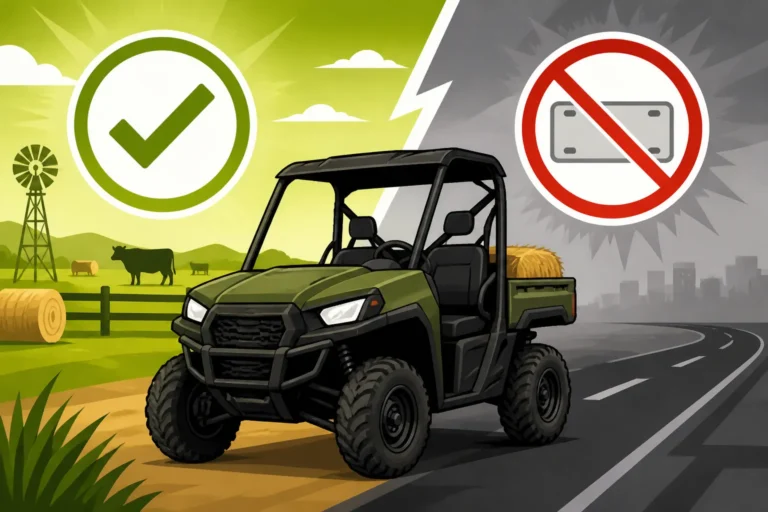
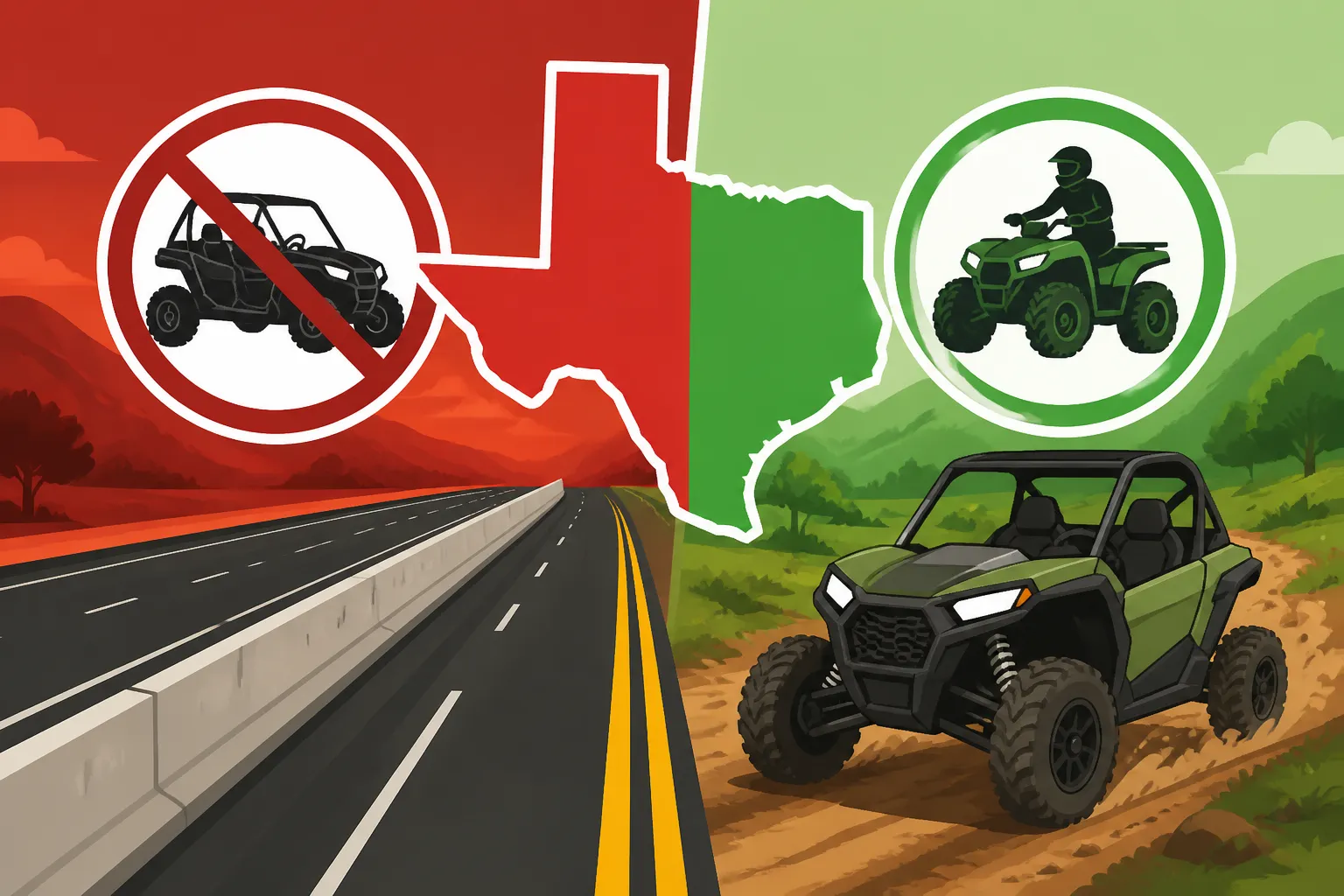
Let's cut right to the chase: In Texas, your ATV or UTV is designed for off-highway use, and generally speaking, it's not street legal. This isn't just a suggestion; it's a fundamental principle of Texas law. You cannot register your OHV with the Texas Department of Motor Vehicles for on-road use like you would a car or truck. The state clearly defines what an OHV is, and that definition doesn't include the necessary components or legal classifications for regular street travel.
This distinction is often a source of frustration for riders, especially those who own large ranches or need to move equipment between properties. You might think, "But it has headlights, taillights, and turn signals! Why can't I just take it on the road?" The simple answer is that the legal framework for OHVs is distinct from that of conventional motor vehicles. The law recognizes their specific purpose and limits their use to protect both riders and the public. We've talked more about this in articles like [Why Texas Will Not Register an ATV for the Road] and [Are ATVs Street Legal in Texas?]. So, when you approach any public road, especially a divided highway, start with the understanding that your machine is not a car, and you’re operating under very specific, narrow exceptions, not general permission.
Exceptions for Limited Road Use
While the general rule is "no street use," Texas law does provide a handful of very specific, narrowly defined exceptions that permit OHVs to briefly operate on or cross certain public roads. These exceptions are critical, but they are not a license to joyride or travel extensively on roadways. They are intended to accommodate practical needs, primarily for agricultural, utility, or property access purposes.
For instance, if you're a farmer or rancher, Texas allows you to use your OHV on public roads for agricultural operations. This means moving equipment, checking fences, or tending to livestock, usually on roads with a speed limit of 35 mph or less. Similarly, utility workers might have limited permissions. There are also specific rules allowing golf carts and other low-speed vehicles in certain master-planned communities or small towns. We've explored these in more detail in posts like [Texas Agricultural Exemption for ATVs on Roads] and [Texas's Golf Course Exception]. However, even within these exceptions, strict conditions apply, such as operating during daylight hours, adhering to speed limits, and often displaying a visible orange flag. These are privileges, not rights, and they come with significant responsibilities. Any deviation from these precise rules can quickly turn a legal crossing into a costly violation.
The Fundamentals of Crossing Any Texas Road with an OHV
Okay, so we know OHVs aren't generally street-legal, but that doesn't mean you're completely stuck if you need to get across a road. Texas law acknowledges the practical realities for many property owners and allows for road crossings under very specific conditions. These fundamental rules apply to any public road, but they are exponentially more important when considering a divided highway.
Stopping and Yielding: Universal Crossing Rules
When you approach any public roadway with your OHV, whether it’s a quiet county road or the first half of a busy divided highway, the law is crystal clear: you must come to a complete stop before entering the travel lanes. This isn't optional; it's a non-negotiable safety and legal requirement. Just like a car at a stop sign, you need to bring your machine to a full halt. But it doesn't stop there. Once you're stopped, you must yield the right-of-way to all approaching traffic. This means waiting until the road is clear enough for you to make your crossing safely and without impeding the flow of traffic.
This rule is designed to prevent accidents, especially since OHVs are less visible and often slower to accelerate than typical road vehicles. You need to be extra vigilant, looking both ways multiple times, checking for blind spots, and making sure other drivers see you. Never assume that because you can see a gap, you have enough time to cross. Consider the speed of oncoming vehicles and how quickly that gap can close. It's about being unequivocally safe, not just barely making it. We’ve covered some of these basics when discussing [Crossing a Texas Road at an Intersection]. Taking that extra moment to ensure the coast is truly clear can make all the difference.
The 90-Degree Rule and Direct Crossing
Another foundational rule for OHV road crossings in Texas is the "90-degree rule." This means that when you cross a public road, you must do so as directly as possible, at an angle of approximately 90 degrees to the flow of traffic. You are absolutely not permitted to drive down the shoulder, parallel to the road, or make long, sweeping turns onto or off the pavement. The intent is to minimize the amount of time your OHV is actually on the paved surface, reducing your exposure to faster-moving traffic.
Imagine a straight line drawn from where you stopped on one side of the road to your intended point on the other side. That's the path you should take. This isn't the time for fancy maneuvering or trying to get a better angle. A direct, perpendicular crossing ensures you enter and exit the roadway as quickly and predictably as possible. Any deviation, such as riding along the edge of the road to find a "better" crossing spot, is likely a violation and significantly increases your risk. This principle is foundational to safe crossings, as elaborated in [Ninety Degrees and a Full Stop in Texas]. The faster you can get off the road, the better.
Essential Safety Equipment for Road Interaction
Even for the briefest interaction with a public road, whether it's a quick county road crossing or navigating a divided highway, your OHV needs to be equipped for maximum visibility. These aren't just suggestions; they are crucial safety measures that can prevent accidents. First and foremost, working headlights and taillights are non-negotiable. Even in broad daylight, having your lights on makes your machine much more noticeable to approaching drivers, especially with glare or varying light conditions.
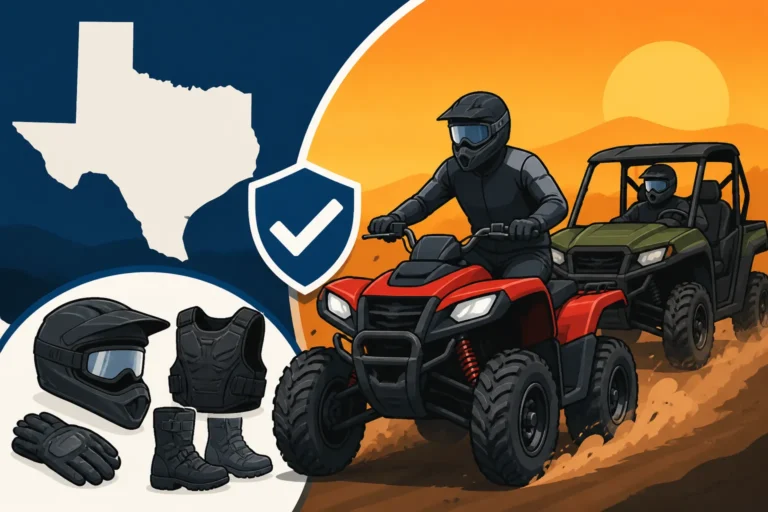
Beyond basic lighting, consider adding a tall, brightly colored whip flag, especially if you're in an area with rolling hills or blind spots. Texas specifically requires a 6-foot orange flag in certain contexts, as discussed in [The 6-Foot Orange Flag Texas Requires]. This flag dramatically increases your vertical profile, making you visible over obstructions or other vehicles. For personal safety, helmets and eye protection are paramount, not just legally required in many situations ([Texas Helmet Law for ATV Riders]), but life-savers. Lastly, think about the accessories that enhance visibility and control. Aftermarket solutions, like those from SuperATV, offer a range of robust LED light bars, brighter taillights, and sturdy mirrors that can make a monumental difference during those fleeting moments on the pavement. Investing in these, even for occasional crossings, is a small price to pay for increased safety.
Navigating the Challenges of Divided Highway Crossings
Now that we’ve covered the fundamentals, let’s tackle the big one: crossing a divided highway. This isn’t just double the trouble; it’s a fundamentally different beast that requires a heightened level of planning, caution, and adherence to the law. What works for a two-lane county road simply won't cut it here.
The Double Crossing Dilemma
The most critical thing to understand about crossing a divided highway in Texas is that it's not one continuous movement; it's effectively two separate crossings. You are dealing with two distinct roadways, one for each direction of travel, separated by a median. This means your crossing will involve a two-step process:
- Crossing the First Roadway: You’ll approach the first set of lanes, come to a complete stop, yield to all traffic, and then cross at a 90-degree angle to reach the median.
- Waiting in the Median (if safe and legal): Once in the median, you must stop again. This is your temporary "holding area" before you attempt the second crossing. You then need to reassess traffic from the opposite direction.
- Crossing the Second Roadway: Just like the first, you’ll yield to all traffic on the second set of lanes and cross at a 90-degree angle to safely reach the other side of the highway.
This "double crossing dilemma" means you're exposed to traffic for a longer period, and you have to make two independent judgments about traffic flow and safety. It doubles the potential points of conflict and requires intense focus and patience. Never attempt to "thread the needle" through both directions of traffic or try to keep rolling across the median. Each half of the divided highway is its own distinct challenge. This intricate process requires more than just good timing; it demands a clear understanding of your vehicle's capabilities and traffic patterns.
Legal Restrictions on Median Use
While the median serves as a necessary stopping point for OHVs traversing a divided highway, it’s crucial to understand that it is generally not a designated OHV waiting area. The median, whether it's a wide grassy strip or a concrete barrier, is typically still considered part of the public right-of-way and can have its own restrictions. You cannot linger there indefinitely, drive up and down it, or treat it as an extension of the shoulder. Your presence in the median should be as brief as absolutely necessary to safely assess and execute the second half of your crossing.
In many cases, unpaved medians might appear to be open space, but driving an OHV on them could be considered operating off-road in a prohibited area, potentially leading to trespassing charges or other violations. For medians with concrete barriers, there might be little to no safe space to wait. Your focus must be on using the median strictly as an intermediary waiting zone between two direct, 90-degree crossings. If there isn't ample, safe, and legal space within the median to wait without impeding traffic, creating a hazard, or violating additional laws, you should seriously reconsider the crossing altogether. Never assume the median is a safe haven or a place to take a break.
High-Speed Traffic and Limited Visibility Concerns
The inherent danger of crossing a divided highway is compounded by the high-speed traffic typically found on such roadways. Unlike a low-speed county road, vehicles on a highway are traveling much faster, reducing the time you have to react and the distance drivers have to see and respond to your OHV. Judging the speed of an approaching vehicle is significantly harder when it’s moving at 70+ mph, and a gap that looks sufficient can close in mere seconds.
Furthermore, visibility can be a major issue. Your OHV is smaller and lower to the ground than a typical car or truck, making it harder to spot, especially in varied lighting conditions, around curves, or in heavy traffic. Add to that the potential for large trucks or SUVs to block the view of smaller vehicles behind them. This is where investing in maximum visibility really pays off. Think about high-mounted LED whips, additional bright lights (perhaps from SuperATV, known for their powerful lighting solutions), and wearing reflective gear. These measures aren't overkill; they're essential for mitigating the risks associated with high-speed, limited-visibility crossings. Always assume drivers don't see you, and be prepared to wait much longer than you might think necessary for an absolutely clear path.
Penalties, Precautions, and Planning for Divided Highways
Ignoring the rules or taking unnecessary risks when crossing a divided highway with your OHV in Texas isn't just dangerous; it can lead to significant legal and financial consequences. A little planning and a lot of caution can save you a world of trouble.
The Cost of Non-Compliance
Operating an OHV on a public road, especially a divided highway, outside of the very narrow legal exceptions, can quickly turn a simple trip into a nightmare. Violations are typically classified as Class C misdemeanors, which, while not leading to jail time, can result in hefty fines. These fines, as outlined in statutes and sometimes discussed in articles like [Texas Fines for Illegal ATV Road Use], can range from minor to significant, easily running into the hundreds of dollars. But the financial pain doesn't stop there.
In addition to fines, law enforcement has the authority to tow and impound your off-highway vehicle. The costs associated with towing, impound fees (which accrue daily), and any administrative release fees can quickly skyrocket, making a single "quick hop" across a road an incredibly expensive mistake. Imagine retrieving your machine from an impound lot hundreds of miles away, adding travel and lost time to the already escalating costs. It's a frustrating situation that many riders face, often because they didn't fully understand the strict nature of Texas OHV road laws. The message is clear: the potential costs far outweigh the convenience of an illegal crossing.
Strategic Planning for Crossings
Given the inherent risks and legal complexities, the best approach to divided highway crossings is strategic planning. The first question to ask yourself is: "Can I avoid this crossing entirely?" Are there alternative routes on private land, underpasses, overpasses, or designated farm roads that can circumvent the need to interact with a high-speed divided highway? If you own property on both sides, explore options for bridges or culverts that keep you off public pavement. If avoidance isn't possible, then serious consideration must be given to when and how you cross.
Avoid peak traffic hours at all costs. Early mornings or late evenings, when traffic volume is significantly lower, present a much safer window for a crossing. Consider using a spotter – a friend or family member in a car or truck who can help you judge traffic, signal to drivers, and provide an extra set of eyes. They can also serve as a safety escort, making your OHV more visible. If the crossing is part of regular work, factor in the time needed for safe, legal crossings into your daily schedule. Sometimes, the safest and most legal option is simply to load your ATV or UTV onto a trailer and transport it to the other side. It might take a bit more time, but it eliminates all the risks and potential penalties associated with crossing.
Enhancing Safety and Visibility
When you absolutely must cross a divided highway, every measure you can take to enhance safety and visibility is crucial. Beyond the required headlights and taillights, consider these practical steps:
- Bright Colors and Reflective Gear: Wear brightly colored clothing, preferably with reflective strips, to make yourself more noticeable. Consider adding reflective tape to your OHV itself, especially on the front, rear, and sides.
- Whip Flags: A tall, brightly colored whip flag (as mentioned earlier, often 6 feet or more) can make your OHV visible over obstacles, guardrails, and other vehicles. This is especially important on divided highways where trucks and larger vehicles can easily obscure a smaller OHV.
- Auxiliary Lighting: Think about additional lighting. LED light bars, strobe lights (where legal and appropriate), or even extra marker lights can significantly increase your presence on the road. Brands like SuperATV offer a robust selection of auxiliary lighting solutions that are built tough for off-road conditions but provide crucial visibility for those brief on-road moments. Their side mirrors can also offer a much-needed wider field of view, helping you spot oncoming traffic more effectively.
- Slow Down and Be Predictable: Approach the crossing at a reduced, controlled speed. Make your intentions clear. If possible, make eye contact with drivers. Do not weave or make sudden movements. Your goal is to be as predictable as possible.
- Wait for the Widest Gap: Patience is your best friend. Don't feel pressured to cross in a tight gap. Wait for a truly significant break in traffic that allows you ample time to cross both sections of the highway safely, with room to spare.
By combining thorough planning, strict adherence to Texas's OHV road use laws, and a commitment to maximizing your visibility, you can navigate the challenge of divided highway crossings as safely and legally as possible.
| Feature | Single Lane/Two-Lane Road Crossing | Divided Highway Crossing |
|---|---|---|
| Stop Requirement | Full stop before entering roadway | Full stop before entering each roadway (both directions) |
| Crossing Angle | 90 degrees to traffic flow | 90 degrees to traffic flow for each section |
| Median Use | Not applicable | Temporary wait, if safe and legal, between traffic flows |
| Traffic Speed | Potentially slower, but varies | Generally higher speeds, increased risk |
| Visibility Needs | Headlights/taillights, bright clothing recommended | Critical: High-visibility flags, bright lights, reflective gear. Products like SuperATV's LED whips or mirrors can enhance this. |
| Complexity | Single maneuver across traffic | Two distinct maneuvers, potentially with a wait in between |
| Legal Basis | Texas Transportation Code, specific OHV exceptions | Same code, but application to medians adds complexity |
| Spotter Benefit | Helpful, especially on busy roads | Highly recommended due to dual traffic flows and speed |
Disclaimer
This article is for general informational purposes only and does not constitute professional advice. Laws, prices and regulations vary by location and change over time. Consult a qualified professional for guidance on your specific situation.