Documents to Bring for a First Title
Navigating the paperwork for a first-time Texas off-highway vehicle (OHV) title can feel like trying to climb a steep, dusty hill without enough traction. You've got your machine, you're ready to hit the trails or get to work on the ranch, but before you can truly call it yours in the eyes of the state, you need to prove ownership and pay your dues. This guide is here to flatten that hill for you, breaking down exactly which documents you'll need to bring to your local county tax office to successfully get that first Texas title.
Why Texas Titling Feels Like a Mountain of Paperwork
It's a common frustration: you just bought your ATV or UTV, and suddenly you're faced with a stack of forms, receipts, and proofs. Texas takes its vehicle titling seriously, and that includes off-highway vehicles like quads, side-by-sides, and even sand rails. For a "first title," the state isn't just transferring ownership from one person to another; it's officially recording your machine's existence and linking it to you. This is why the process can seem a bit more involved than just signing the back of a previous title.
Understanding the "First Title" Hurdle
When we talk about a "first title," we're generally referring to situations where a vehicle has never been titled in Texas before, or perhaps never titled anywhere at all. This might be a brand-new ATV straight from the dealership, a used UTV you brought in from a neighboring state like Oklahoma or Louisiana, or even a homebuilt buggy that you've poured your heart and soul into. In each of these scenarios, the Texas Department of Motor Vehicles (TxDMV), working through your local county tax office, needs to establish a clear chain of ownership and verify that all applicable taxes have been paid. This foundational step is critical for preventing theft, ensuring proper tax collection, and maintaining accurate records of OHV ownership within the state. It's not personal; it's just the official procedure.
The Local County Tax Office as Your Go-To
When you're ready to apply for that first title, your journey will most likely lead you to your local county tax assessor-collector's office. This is the frontline for most vehicle-related transactions in Texas, including titling your OHV. While the overarching rules are state-mandated, the experience can vary slightly from county to county. Some offices are bustling hubs with appointment systems, while others might be more laid-back. Regardless, being prepared with all your ducks in a row – or in this case, all your documents in a neat folder – will make the process infinitely smoother. Think of it like booking time at a county counter; you want to make sure you have everything they need on hand so you don't have to make multiple trips. The county office will be the one processing your application, collecting your fees, and ultimately sending your information to the state to issue your official title. [Titling at a Texas County Tax Office]
The Absolute Must-Have Document: Your Title Application
At the heart of every title application, especially for a first title, is a crucial form that acts as the blueprint for your ownership. This document gathers all the essential information about you, the seller, and your OHV, ensuring that the state has a complete picture. Without it, your application won't even get off the ground.
Texas Form 130-U: Your Central Piece of Paper
The form you'll become intimately familiar with is the Texas Department of Motor Vehicles Form 130-U, officially titled "Application for Texas Title and/or Registration." Despite the "and/or Registration" part, remember that ATVs and UTVs in Texas are titled but never registered in the traditional sense for road use. [Why Texas Titles But Never Registers an OHV] This form is the cornerstone of your entire titling process. It collects vital details such as your full legal name and address as the buyer, the seller's information, a detailed description of the off-highway vehicle (including make, model, year, and its all-important Vehicle Identification Number or VIN), the date of sale, and the purchase price. Accuracy here is paramount; even small discrepancies or omissions can lead to delays or rejection of your application. Ensure all names, dates, and figures match any supporting documents you provide.
Where to Get and How to Fill It Out
You can typically download Form 130-U directly from the TxDMV website, or you can pick up a physical copy at any county tax assessor-collector's office. Before you even walk into the office, it's a really good idea to fill out as much of the form as possible. Take your time, use clear, legible handwriting (or type it if you download it), and double-check every single entry. Pay particular attention to the sections concerning the vehicle's identification, such as the VIN, and the purchase price. This price will directly impact the sales or use tax calculation, so ensure it reflects the actual transaction. If you're unsure about a specific section, it's always better to leave it blank and ask for clarification at the county office rather than guess incorrectly. Getting this form right the first time will save you immense hassle. [Filling Out Texas Form 130-U for an OHV]
Proving Ownership: The Foundation of Your Title
Beyond simply stating you own the machine, Texas requires definitive proof of how that ownership was established. This varies significantly depending on whether you bought a brand-new machine, a used one with a title, or a machine that has never been titled before. This is often where people encounter the most confusion and frustration.
New Purchases: The Manufacturer's Certificate of Origin (MCO)
If you've bought a brand-new ATV or UTV from a dealership, your primary proof of ownership will be the Manufacturer's Certificate of Origin, often abbreviated as MCO or sometimes MSO (Manufacturer's Statement of Origin). This document is essentially the "birth certificate" for your OHV. It confirms that the vehicle was manufactured and lists its specifications, including the VIN. Crucially, the dealer must correctly assign the MCO over to you, the buyer. This assignment typically involves the dealer's signature, your name, the date of sale, and often the sale price, all filled out on the back or an attached section of the MCO.
Without a properly assigned MCO, you won't be able to title a new machine. It's a non-negotiable requirement. Make sure to inspect it carefully before leaving the dealership. Check that your name is spelled correctly, the VIN matches your machine, and all dates and signatures are present and legible. A common issue people face is a missing signature or an incorrectly filled-out section, which can send you right back to the dealer to get it corrected. Always keep this document safe, as it's nearly impossible to get a duplicate from the manufacturer once it's been issued and assigned.
Used Purchases: The Assigned Texas Title or Out-of-State Title
For a used OHV, the situation depends on where the machine was previously titled. If you purchased a used ATV or UTV that already had a Texas title, the seller needs to properly assign that title over to you. This usually involves them signing and dating the back of the physical title certificate, entering the sale price, and sometimes providing their current address. It's crucial that the seller's signature matches the name printed on the front of the title. Any alterations or missing information on the title's assignment section can flag your application for rejection.
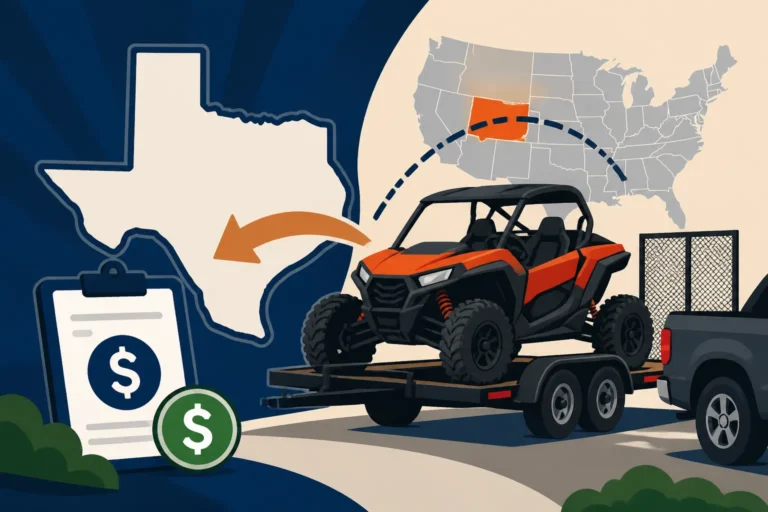
If you bought a used OHV from out of state, say you picked up a sweet deal in New Mexico or Arkansas, you'll need the original out-of-state title. This title must also be properly assigned to you by the seller according to the rules of that state. Texas will accept a properly assigned out-of-state title as proof of ownership. However, be prepared for potentially additional scrutiny, such as a VIN inspection, to ensure the vehicle is legitimate and matches the paperwork. In both scenarios, it's highly advisable to perform a [Checking a VIN Before a Texas Purchase] to ensure the machine isn't stolen or doesn't have any undisclosed liens. Having a clear title, free of any encumbrances, is essential for a smooth transfer.
What If There's No Title?
This is where things can get a bit tricky and often cause the most headaches for OHV owners. Sometimes, a machine might be so old it predates titling requirements, or perhaps the previous owner simply lost the title and never bothered to replace it. [Buying a Quad Whose Seller Lost the Title] If you're trying to get a first title for an OHV that has never had one, or for which the title is simply unavailable, you'll need to provide alternative proofs of ownership.
A strong, detailed bill of sale is absolutely critical here. This document, signed by both buyer and seller, should clearly identify the OHV (make, model, year, VIN), the purchase price, the date of sale, and contact information for both parties. While a handwritten receipt might work in some cases, a more formal, comprehensive bill of sale is always better. You can find excellent templates for these documents from services like LawDepot, which help ensure all necessary information is included. [A Texas Bill of Sale for an ATV] In situations where a title is completely absent, especially for newer machines, the county office might require you to obtain a surety bond. This bond essentially protects the state and future owners from claims against the vehicle's ownership. The requirements for a surety bond can be complex and typically involve getting the vehicle appraised and securing a bond for a certain percentage of its value. This is a last resort, but it's important to be aware that it might be a necessary step if no other proof of ownership can be established. [Texas ATV Title With No Previous Title]
Proving You Paid Your Dues: Taxes and Fees
Beyond proving who owns the OHV, Texas needs to confirm that you've fulfilled your financial obligations to the state. This means addressing sales or use tax and the various fees associated with the titling process. Misunderstanding these requirements can lead to unexpected costs or delays.
Sales and Use Tax Documentation
In Texas, off-highway vehicles are subject to sales tax, just like any other merchandise. The state sales tax rate is 6.25 percent, and there might be additional local sales taxes depending on where you made the purchase, though the total state and local sales tax rate is capped. [Texas Sales Tax on an ATV Purchase] If you purchased your OHV from a licensed Texas dealer, they are responsible for collecting the sales tax at the time of sale and remitting it to the state. In this case, your dealer invoice or bill of sale should clearly show the sales tax collected. This document serves as your proof of payment.
However, if you bought your ATV or UTV from a private seller, either in Texas or out of state, you are generally responsible for remitting the sales tax yourself. This is typically done at the county tax office when you apply for the title. For private sales, Texas law has a "presumptive value" rule. If you declare a purchase price that is significantly lower than the vehicle's market value, the county office might calculate the tax based on a state-determined presumptive value instead, unless you can provide evidence to support your stated purchase price. [Texas ATV Sales Tax on a Private Sale] If you purchased the machine out-of-state and brought it to Texas, you'll be paying a "use tax" at the Texas county office, which is equivalent to the sales tax. You'll likely need to fill out a separate form (usually Comptroller of Public Accounts Form 01-140, Texas Motor Vehicle Use Tax Resale Certificate) or have the tax assessed directly at the county counter. This requirement became more prominent after the [The March 2020 Use Tax Rule] clarified how these transactions are handled. [Proof of Use Tax Before a Texas Title]
Fees for Titling and Optional Plate
In addition to sales or use tax, you'll need to pay several fees to get your first title. These typically include the title application fee itself, which is a state-mandated amount, and usually a processing and handling fee charged by the county. While these fees are generally modest, they are non-negotiable and must be paid at the time of application. [Texas ATV Title Fee Breakdown]
Furthermore, Texas offers an optional off-highway vehicle license plate. This plate, which costs a nominal fee (often capped at around $10), is not for street-legal use but instead helps identify your machine for off-road purposes, particularly on public lands that may require it. [The $10 Cap on a Texas Plate] While it's optional, many OHV owners choose to get it during the titling process to avoid a separate trip later. You'll pay this fee at the county tax office along with your titling fees. [What the Counter Charges for the Plate] Be prepared to pay all taxes and fees by accepted methods, which usually include cash, check, or sometimes credit/debit card, though card fees may apply.
Identity and Verification: Who You Are and What You're Titling
The final pieces of the puzzle involve confirming your identity as the applicant and verifying the unique identity of your off-highway vehicle. These steps are crucial for ensuring legitimate ownership and maintaining accurate state records.
Your Personal Identification
When you walk into the county tax assessor-collector's office, you'll need to prove who you are. This means bringing a valid, government-issued photo identification. A Texas driver's license or state ID card is typically preferred. If you're new to Texas or don't have a Texas ID, an out-of-state driver's license or passport might be accepted. The primary purpose of this ID is to verify your identity and ensure that the name on your application matches the person applying for the title. This is a standard procedure designed to prevent fraud and ensure that titles are issued to the rightful owners. Make sure your ID is current and not expired.
Vehicle Identification Number (VIN) Verification
The Vehicle Identification Number (VIN) is the unique fingerprint of your ATV or UTV. It's a 17-character code that identifies the manufacturer, model, year, and specific unit. On most OHVs, you'll find the VIN stamped on the frame rail, usually near the front suspension, under the seat, or on the lower left side. [Tracing a VIN on a Frame Rail] For a first title application, especially if the machine is from out of state or has an unclear history, the county tax office might require a physical VIN inspection. This is to ensure that the VIN on your paperwork (MCO, title, bill of sale, Form 130-U) exactly matches the VIN physically present on the vehicle. [Texas ATV VIN Inspection Requirements]
Discrepancies between the VIN on the documents and the physical VIN can halt your titling process until they are resolved. If the VIN plates appear tampered with or are missing, it can trigger a more in-depth investigation. Having a clear, readable VIN is crucial for accurate record-keeping and for ensuring the legality of your machine. Be prepared to point out the VIN on your OHV if requested during your visit to the county office, though often, simply bringing the accurate documentation is enough for them to proceed.
Essential Documents Checklist for a First Texas OHV Title
To help you get organized, here's a quick summary of the documents you'll need, categorized by common scenarios. Remember, this is a general guide, and specific situations may require additional forms or proofs.
| Document Type | New Purchase (Dealer) | Used Purchase (Texas Title) | Used Purchase (Out-of-State Title) | No Previous Title (Homebuilt/Old) |
|---|---|---|---|---|
| Application Form | Form 130-U (completed) | Form 130-U (completed) | Form 130-U (completed) | Form 130-U (completed) |
| Proof of Ownership | Original MCO (assigned) | Original TX Title (assigned) | Original Out-of-State Title (assigned) | Detailed Bill of Sale (LawDepot recommended) |
| Tax Documentation | Dealer Invoice (showing tax) | Seller's Assignment on Title (price) | Proof of Use Tax Payment/Form 01-140 | Proof of Use Tax Payment/Form 01-140 |
| Personal ID | Valid Photo ID | Valid Photo ID | Valid Photo ID | Valid Photo ID |
| VIN Verification | On Form 130-U | On Form 130-U | On Form 130-U (potential physical inspection) | On Form 130-U (potential physical inspection/surety bond) |
| Payment for Fees | Title fee, county fee | Title fee, county fee | Title fee, county fee | Title fee, county fee |
| Optional Plate Fee | $10 (approx.) OHV plate | $10 (approx.) OHV plate | $10 (approx.) OHV plate | $10 (approx.) OHV plate |
Getting a first title for your ATV or UTV in Texas doesn't have to be a bewildering experience. By understanding the specific documents required for your situation—whether it's an MCO for a new machine, an assigned title for a used one, or a solid bill of sale (perhaps from LawDepot) for a never-titled vehicle—you can approach the county tax office with confidence. Double-check everything, make copies for your records, and don't hesitate to ask questions if you're unsure. With a little preparation, you'll have that title in hand, ready to hit the trails or tackle that ranch work.
Disclaimer
This article is for general informational purposes only and does not constitute professional advice. Laws, prices and regulations vary by location and change over time. Consult a qualified professional for guidance on your specific situation.