Why the Statute Caps the Plate at $10
It’s a common frustration for anyone buying an off-highway vehicle (OHV) in Texas: you brace yourself for a mountain of fees and taxes, only to find one particular charge is surprisingly, almost unbelievably, low. We’re talking about the Texas OHV license plate, which is capped by statute at a mere $10. This guide will dive deep into why this specific fee remains so uniquely affordable, how it differs from other vehicle charges, and what that means for you as a rider or owner in the Lone Star State.
Understanding the Texas Off-Highway Vehicle Plate
Before we talk about why the fee is so low, it’s important to understand what this plate actually is, and perhaps more importantly, what it isn't. When you title an ATV, UTV, or other off-highway vehicle in Texas, you'll be offered an optional license plate for it. This isn't a "registration" in the traditional sense, like you'd get for a car or truck, but rather a distinct identifier designed for specific, limited circumstances.
The Plate's Purpose and What It Isn't For
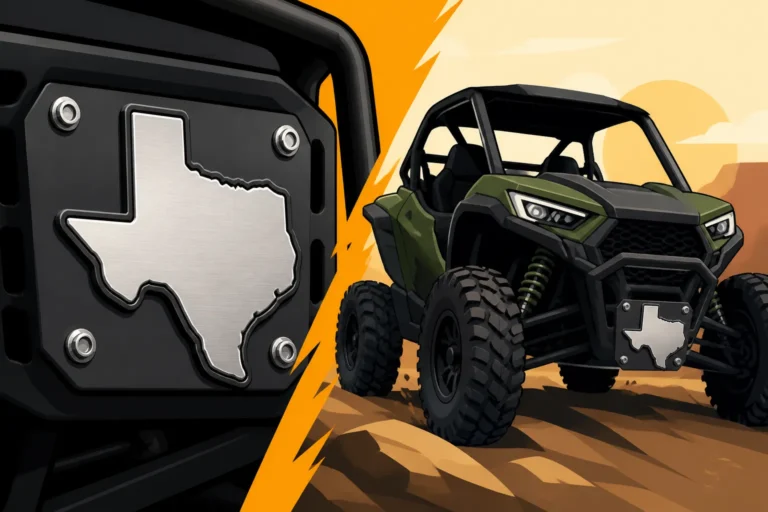
The Texas OHV plate serves a very specific, limited purpose: it's intended to identify your off-highway vehicle when it's being operated on public land, designated OHV trails, or in other areas where proof of ownership and compliance might be requested. It's a key part of how Texas differentiates these machines from street-legal vehicles. For instance, you’ll notice the [The Off-Highway Use Only Remark on a Texas Title], a clear indication that this machine is not for public roads. This plate is explicitly not for making your ATV or UTV street legal. Texas has very strict rules about off-highway vehicles on public roads, and this plate does not change that. In fact, [Why Texas Will Not Register an ATV for the Road] is a frequently asked question, and the answer almost always points back to this fundamental distinction.
The crucial point here is that Texas titles OHVs but does not register them for general road use. This is a fundamental difference compared to how passenger cars are handled. You might wonder, [Why Texas Titles But Never Registers an OHV]? It boils down to the legislative intent: OHVs are primarily recreational or utility machines for off-road environments, and the state's framework reflects that. The plate is merely a minimal identification tool.
Who Needs This Plate and Who Doesn't
You might be surprised to learn that not every OHV owner in Texas needs to get this plate. It’s issued [Why the OHV Plate Is Issued Only on Request] and is often required primarily when operating on public lands or in organized riding areas that mandate it for identification purposes. If your machine never leaves your private property, a working ranch, or a deer lease, you might never opt for the plate.
However, if you plan to venture out to public OHV parks, state recreation areas, or other spots where proof of ownership or proper titling is expected, having this plate is a good idea. It acts as a clear, official identifier for your machine. It’s also important to note that the plate itself is tied to the machine, not the owner. If you sell your OHV, the plate [A Texas Plate That Stays With the Machine]. However, a new buyer cannot simply reuse the old plate; they will need to apply for a new one in their name. [Why a Buyer Cannot Reuse the Seller's Plate] clarifies this further.
The Legislative Intent Behind the $10 Cap
Now, let's get to the heart of the matter: why is this plate fee capped at such a remarkably low $10? This isn't an arbitrary number; it's a deliberate legislative decision that reflects a specific policy philosophy in Texas regarding off-highway recreation.
Keeping OHV Access Affordable
One primary reason for the low $10 cap is to keep participation in off-highway vehicle recreation as accessible and affordable as possible for Texans. Lawmakers understood that adding significant registration fees, similar to those for street-legal vehicles, could create a barrier for many enthusiasts. By setting a nominal fee for the plate, the state signaled that it supports and encourages responsible off-highway riding without burdening owners with excessive costs simply for identification. This is particularly relevant for families or individuals who might be new to the sport and are already investing in the machine itself, safety gear, and potentially park entry fees. The goal was to avoid making the administrative cost of identifying an OHV prohibitive.
Differentiating From Road-Going Vehicle Fees
Another key factor in the $10 cap is the state's clear differentiation between off-highway vehicles and on-road vehicles. Regular vehicle registration fees are typically much higher because they contribute to funding road maintenance, traffic enforcement, and other infrastructure costs associated with public road use. Since OHVs are generally prohibited from public roads, it wouldn't make sense to impose the same level of fees that are designed to support road infrastructure.
The minimal $10 plate fee underscores this distinction. It's not a road tax; it's an administrative fee for an identifying marker. This helps avoid confusion and ensures that OHV owners are not inadvertently contributing to systems they do not, by law, heavily utilize. While the actual [Texas ATV Title Cost] might involve other county-specific fees, the plate itself is kept separate and minimal.
Funding Mechanisms Beyond the Plate
You might be thinking, if the plate fee is only $10, how does the state cover any administrative costs or fund OHV-related initiatives? The truth is, the plate fee itself isn't a major revenue generator. Instead, other mechanisms are in place. For example, a portion of the state sales tax collected on the purchase of OHVs, as well as specific OHV decal fees required for riding on state-managed lands, contributes to funding the Texas Parks and Wildlife Department's OHV grant program. This program, in turn, helps maintain and expand off-highway trails and riding areas across the state.
So, while the plate itself is low-cost, there are other ways [Where Texas OHV Title Money Goes] that ensure the infrastructure supporting OHV riding receives funding. This multi-pronged approach allows the state to support the OHV community without making the basic identification plate a financial hurdle. The overall [Texas ATV Title Fee Breakdown] will show that other elements like sales tax and title application fees make up the bulk of the initial costs.
Practical Implications for OHV Owners
Understanding the "why" behind the $10 cap is one thing, but what does it actually mean for you, the OHV owner in Texas? It has several practical implications regarding what you pay, how transfers work, and the overall cost of ownership.
What You Actually Pay for the Plate
When you go to your local county tax office, you'll be thrilled to know that the plate itself costs just that statutory $10. However, like many government services, there's often a small administrative fee added on top by the county for processing the transaction. This might be a dollar or two, but it's important to remember that this extra charge is for the county's services, not an increase in the state's plate fee. So, while the statutory cap is $10, [What the Counter Charges for the Plate] might be a few cents or dollars more to cover local processing. Still, compared to fees for other vehicles, it's incredibly modest, making the [Texas OHV License Plate Cost] very appealing.
Transferring the Plate
A common misconception is that because the plate is so inexpensive, it's easily transferable or reusable. Unfortunately, that's not the case. The Texas OHV plate is issued for the specific machine, but a buyer cannot simply take the seller's plate and use it. When an OHV is sold, the seller typically removes their plate (if they had one). The new owner, upon titling the machine in their name, will need to apply for a new OHV plate if they desire one. This ensures that the recordkeeping is accurate and tied to the current owner.
It's a small detail, but it's important to be aware of when negotiating a sale or purchase. When you're dealing with a private sale, ensuring you have all the correct documentation, like a proper bill of sale, is paramount. Resources like LawDepot can be invaluable for drafting clear, legally sound documents to protect both buyer and seller, covering everything from the agreed-upon price to the state of the machine. This attention to detail in your paperwork is far more critical than the cost of the plate itself.
Overall Costs of OHV Ownership
When you look at the total [What an ATV Costs to Own in Texas], the $10 OHV plate fee almost becomes a footnote. Your significant expenses will include the purchase price of the machine, the [Texas ATV Sales Tax Rate] (which is a percentage of the purchase price), the title application fee, and potentially an OHV decal for riding on certain public lands. Maintenance, fuel, safety gear, and even park entrance fees will quickly dwarf the plate cost.
Here’s a comparison to put it in perspective:
| Item | Typical Cost Shape (Example for clarity) | Notes |
|---|---|---|
| OHV License Plate | $10 (plus small county fee) | Statutory cap, very low. |
| State Sales Tax | 6.25% of purchase price (or more) | Significant cost, varies by machine value. |
| Title Application Fee | ~$30-$40 | Varies slightly by county, but fixed. |
| OHV Decal | ~$16 (annual) | Required for public lands, separate from plate. |
| Park Entry Fees | $10-$30+ per day/machine | Varies greatly by park and duration. |
| Insurance (Optional) | Varies widely ($100s per year) | Not legally required for off-road use, but highly recommended. |
This table clearly illustrates that while the OHV plate is incredibly affordable, it's just one piece of a much larger financial puzzle when it comes to owning and operating an off-highway vehicle in Texas.
Navigating the Titling Process and the Plate
While the $10 plate fee is straightforward, it's part of a broader titling process. Understanding this process ensures you get your machine properly documented and ready for the trails.
When and Where to Get Your Plate
You'll get your OHV plate when you apply for your title. This happens at your local county tax assessor-collector’s office. It’s the same place you would title a car, truck, or motorcycle. You can usually apply for the plate at the same time you file all your other paperwork. It's often helpful to [Booking Time at a County Counter] beforehand to ensure you have a smooth experience and avoid long wait times. Remember, you're not going to a special "OHV department" but rather the general vehicle services counter. When considering how to prepare for your visit, gathering all necessary documents is key. Utilizing resources like LawDepot can help you generate comprehensive forms, such as a bill of sale, that clarify the terms of your purchase or sale and prevent future disputes.
Paperwork Involved
To title your OHV and obtain the optional plate, you'll need several key documents. The most important is [The Texas Title Application Every OHV Buyer Files], also known as Form 130-U. This form requires detailed information about the machine, the buyer, and the seller. You’ll also need proof of ownership, which could be the original manufacturer's statement of origin (MSO) for a new machine, or the previously issued title if you’re buying a used OHV. Don't forget proof of identity and any necessary payment for taxes and fees.
If you’re buying from a private seller, a well-documented bill of sale is crucial, even though the $10 plate fee itself is minimal. This document, which you can easily generate using services like LawDepot, provides a clear record of the transaction, the agreed-upon price, and ensures both parties understand their responsibilities. For instance, if you bought a machine out-of-state, you’ll also need to prove you paid any [Texas Use Tax on an Out-of-State OHV] before you can get your Texas title and plate. The whole process, from filling out [Filling Out Texas Form 130-U for an OHV] to showing proof of tax payment, is designed to ensure proper ownership and tax collection.
Disclaimer
This article is for general informational purposes only and does not constitute professional advice. Laws, prices and regulations vary by location and change over time. Consult a qualified professional for guidance on your specific situation.