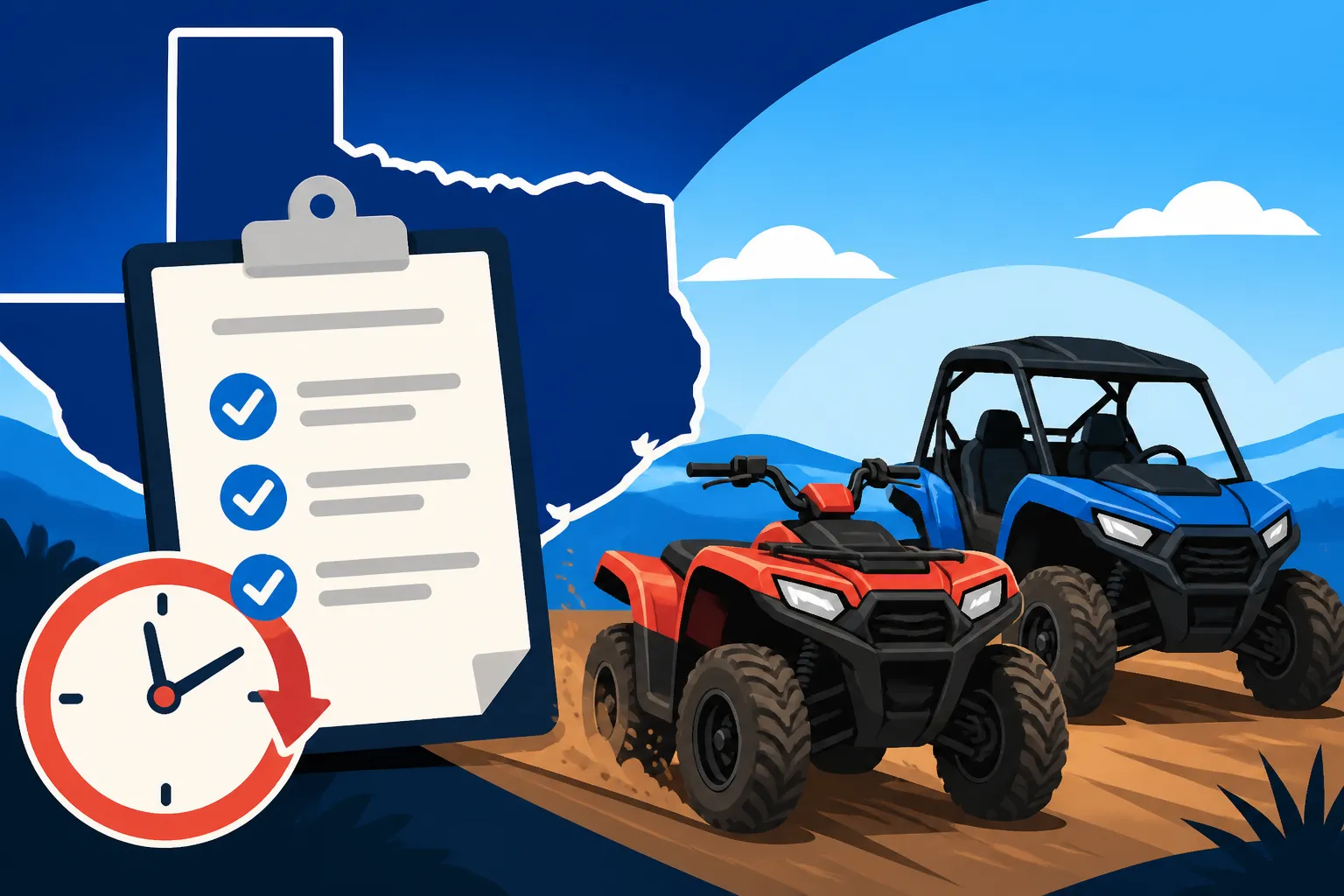
Texas ATV Title Application Deadline
So you've just brought home a shiny new (or new-to-you) ATV or UTV in Texas, and now that initial thrill is giving way to a bit of paperwork anxiety. One of the biggest questions I hear is about deadlines: "How long do I actually have to title this thing?" It's a completely valid concern, because nobody wants to accidentally run afoul of the law or incur unnecessary fees. We're going to break down the ins and outs of the Texas ATV title application deadline, making sure you know exactly what to expect and how to stay compliant.
The 30-Day Window: What the Law Says About Your Texas ATV Title
Let's cut right to the chase: In Texas, you generally have a 30-day window to apply for an off-highway vehicle (OHV) title from the date you purchase the machine or bring it into the state. This isn't just a suggestion; it's a rule outlined in state law, specifically designed to ensure timely reporting of ownership changes and the collection of sales or use tax. For many folks, this deadline can sneak up, especially if they're caught up in the excitement of a new machine or simply unaware of the specific requirement for OHVs.
This 30-day rule applies whether you're buying a brand-new ATV from a dealership down the road or picking up a used side-by-side from a private seller on the other side of the county. The Texas Department of Motor Vehicles (TxDMV) and the local county tax assessor-collector's offices work together to enforce this, and sticking to the timeline is crucial for a smooth experience. It's really about establishing a clear chain of ownership and making sure the state gets its due in sales or use tax when the transaction occurs.
The state's interest here isn't to be overly restrictive but to maintain accurate records and fund various services through these taxes. So, think of that 30-day window not as a bureaucratic hurdle, but as a necessary step in making your new ATV or UTV officially yours in the eyes of Texas.
When the Clock Starts Ticking: Purchase vs. Bringing a Machine In
Understanding exactly when that 30-day countdown begins is half the battle. It's not always as straightforward as the day you shake hands and exchange cash, especially depending on where and how you acquired your off-highway vehicle. The starting gun for your title application deadline can vary slightly.
If you purchase your ATV or UTV from a licensed dealer within Texas, the clock typically starts on the date of sale listed on your bill of sale or purchase agreement. The dealer usually handles a lot of the initial paperwork, including collecting sales tax, but the ultimate responsibility for ensuring the title application is completed on time often falls to you, the buyer. For private sales within Texas, the date you and the seller sign the [Texas Bill of Sale for an ATV] is usually the critical starting point. This document becomes your proof of ownership and the timestamp for the 30-day window.
Things get a little different if you're bringing an ATV or UTV into Texas from another state. In this scenario, the 30-day clock begins on the date the vehicle "enters this state," which can be a bit more subjective but generally refers to the date you establish residency or bring the machine to your Texas property with the intent to keep it here. This situation often involves paying [Texas Use Tax on an Out-of-State OHV] directly to the county tax office. It’s important to remember that even if you owned the machine for years in another state, once it crosses into Texas and is intended for use here, the titling process needs to begin promptly.
Why 30 Days? The State's Rationale
You might wonder why Texas has this specific 30-day timeframe. It's not an arbitrary number; it serves several important purposes for the state, primarily centered around revenue collection and consumer protection. One of the biggest reasons is the efficient collection of sales and use tax. When an OHV changes hands, whether new or used, it's generally subject to Texas sales tax if bought in-state, or use tax if brought in from out-of-state. The 30-day window ensures that these taxes are paid in a timely manner, providing funds for state and local services. Waiting indefinitely would make tax collection incredibly difficult to track and enforce.
Beyond taxation, the deadline helps establish a clear and verifiable chain of ownership. This is crucial for legal reasons, like preventing theft and quickly identifying the rightful owner of a machine. If an ATV is stolen, having an up-to-date title in the correct owner's name greatly assists law enforcement in recovery efforts. For buyers, knowing that previous owners had to title their machines promptly adds a layer of security, as it formalizes the transaction history. This helps mitigate disputes over ownership down the line.
Finally, the 30-day period promotes a sense of responsibility among OHV owners. By setting a clear expectation, it encourages new owners to complete the necessary administrative steps quickly, rather than letting paperwork languish. This streamlined process benefits everyone by keeping official records current and making future transactions (like selling your machine) much simpler and more transparent. It all ties back to the state's need for order and accountability in vehicle ownership.
What Happens If You Miss the Deadline? Real-World Headaches
Life happens, and sometimes that 30-day deadline can just slip by. Maybe you were busy with work, family, or just plain forgot. But ignoring that deadline isn't without consequences, and it's something you definitely want to avoid. While you won't immediately face a dramatic arrest for an untitled ATV, the repercussions can range from annoying fees to significant hurdles down the road. It’s not just about a penalty; it can complicate everything from future sales to even proving you own the machine if there's a dispute.
One of the most common issues is simply the accumulation of extra costs. What might have been a straightforward title application can become more expensive due to late fees and penalties. But beyond the financial sting, an untaxed or untitled OHV can become a lingering problem. Imagine trying to get an insurance policy, or worse, making a claim, when the state doesn't officially recognize you as the owner. These are the kinds of real-world headaches that make sticking to that 30-day window incredibly important.
It's tempting to think "I'll get to it later," especially if you're only riding on private land and feel like you're not "in public." But Texas law doesn't differentiate between private and public use when it comes to the initial titling requirement. That title is about ownership and tax, not just where you ride. So, while the initial oversight might seem minor, the ripple effects can be quite inconvenient.
Penalty Fees and Interest
The most immediate consequence of missing the 30-day window for your Texas ATV title application is the imposition of penalty fees and, potentially, interest. The county tax assessor-collector's office, where you submit your application, is authorized to assess these charges. They aren't trying to be difficult; they're simply following state guidelines for compliance.
These penalties typically relate to the sales or use tax that should have been remitted. If you fail to file your application and pay the associated tax within 30 days, the law allows for a penalty to be added to the original tax amount. This penalty often starts as a flat percentage of the unpaid tax, but it can also involve interest accruing on the unpaid amount for every month (or part of a month) that it remains unpaid. This means that the longer you delay, the more expensive your title application becomes.
For example, if you bought a used UTV and owed state use tax, and you let 60 or 90 days pass without applying for the title, you could be looking at the original tax amount plus a penalty and accrued interest. This isn't a one-time static fee; it can grow over time, turning what should have been a relatively small transaction into a more significant financial burden. It's a clear incentive for prompt action, and ignoring it means you're literally paying more for the same piece of paper.
Real-World Headaches: Selling Your Machine Later
Beyond the immediate financial penalties, missing the title application deadline can create significant real-world headaches, especially if you decide to sell your ATV or UTV down the line. Imagine trying to sell a machine that, in the eyes of the state, was never properly transferred into your name. It immediately raises red flags for potential buyers.
When you go to sell, a diligent buyer will typically ask to see the title. If the title is still in the name of the person you bought it from, and you haven't processed the transfer, it makes the transaction much more complicated. The buyer might worry about the legality of the sale, potential liens that weren't disclosed, or even whether they will then face penalties for a long-delayed title transfer. They could even suspect the machine is stolen or has a dubious history. A clear, properly transferred title is a sign of legitimate ownership, and without it, you erode buyer confidence. You may also find yourself trying to track down the original seller to help you sort out the paperwork, which can be an impossible task if too much time has passed.
Furthermore, if you never titled the machine, proving you paid the required sales or use tax could become an issue. A new buyer looking to title it themselves might then be hit with your overdue taxes and penalties, making them highly unlikely to proceed with the purchase. Having a solid [A Texas Bill of Sale for an ATV] and the official title in your name shows transparency and legality, making the selling process much smoother. Using a reliable template from a service like LawDepot for your bill of sale can provide an extra layer of professionalism and clarity when documenting the original purchase, which can be invaluable when proving the timeline of ownership.
Steps to Take Before the Deadline: Preparing for Your Title Application
Alright, so you know the deadline is 30 days, and you know the consequences of missing it. Now, let's talk about how to make sure you don't miss it and how to make the process as smooth as possible. Preparing for your title application involves a few key steps, primarily gathering the right documents and ensuring you've handled any associated tax payments. Thinking ahead and getting these ducks in a row can save you a ton of stress and potential delays when you finally head to the county office.
It's not just about showing up; it's about showing up prepared. The folks at the county tax office deal with countless title applications every day, and having everything they need in order will make their job easier and your wait time shorter. From verifying your identity to proving where and when you bought your OHV, each piece of the puzzle is important. Let's break down exactly what you'll need to focus on before that 30-day clock runs out.
Gathering Your Paperwork
The single most important step in preparing for your Texas ATV title application is gathering all the necessary paperwork. Showing up without a crucial document can mean a wasted trip and further delays, pushing you closer to that 30-day deadline. Think of it like putting together a puzzle; every piece needs to be there to complete the picture.
First and foremost, you'll need the original Texas title, properly signed over to you by the seller. If the machine had a title from another state, you'll bring that, along with a bill of sale. For a brand-new machine, you'll have a Manufacturer's Statement of Origin (MSO) or Manufacturer's Certificate of Origin (MCO) instead of a previous title. A [A Texas Bill of Sale for an ATV] is critical for private sales, as it serves as your proof of purchase, the purchase price, and the date of sale. Make sure it's complete, signed by both parties, and includes the vehicle identification number (VIN). Services like LawDepot offer customizable bill of sale templates that can ensure you're capturing all the necessary information accurately.
You'll also need a completed Texas Application for Texas Title and/or Registration (Form 130-U). This form is the heart of your application and requires detailed information about you, the seller, and the OHV itself. Don't worry, we have a separate guide on [Filling Out Texas Form 130-U for an OHV]. Proof of identity, such as your valid driver's license, will also be required. Finally, if you've already paid the state sales or use tax, bring proof of that payment. If not, be prepared to pay it at the county office. Having all these documents organized in a folder will make your visit much more efficient.
Paying Your Sales or Use Tax
Before you can officially title your ATV or UTV in Texas, a critical step is ensuring the sales or use tax has been paid. For many new owners, this is the part that often causes confusion or delays. It's not just about the title itself; it's about fulfilling your tax obligation to the state.
If you purchased your ATV or UTV from a licensed Texas dealer, they typically handle the collection of sales tax at the time of purchase. They will then remit these funds to the state on your behalf. In this scenario, you'll usually have documentation from the dealer confirming the sales tax was paid, which you'll need to present when you apply for your title. This makes the process fairly seamless, as the tax collection is integrated into the purchase.
However, if you bought your OHV from a private seller in Texas, or if you brought it into Texas from another state, you, the buyer, are responsible for paying the sales or use tax directly to the county tax assessor-collector's office. This payment usually happens at the same time you apply for your title. Texas law generally requires [Proof of Use Tax Before a Texas Title] is issued. This is particularly important for out-of-state purchases, where the use tax ensures that machines brought into Texas contribute to state revenue, similar to those purchased in-state. Remember the specific rules, like [The March 2020 Use Tax Rule], which clarified procedures for out-of-state purchases. Be prepared with the purchase price and any deductions for trade-ins, as these will affect the tax calculation.
Where to Go: The County Tax Office
Once you have all your documents in order and are ready to handle the tax payment, the final step is knowing exactly where to go. Unlike some other vehicle-related tasks that might be handled by the state DMV directly, titling an off-highway vehicle in Texas is a local affair. You'll need to visit your specific [Titling at a Texas County Tax Office].
The county tax assessor-collector's office is the local government agency responsible for vehicle titling and registration (for those vehicles that get registered, which OHVs typically don't for road use). This means you won't be heading to a TxDMV regional service center for this specific task. Instead, you'll locate the tax office for the county in which you reside. For example, if you live in Travis County, you'll go to the Travis County Tax Assessor-Collector's office. If you're in Harris County, you'll visit their office. It's always a good idea to check their website or call ahead to confirm their operating hours, required documents, and any specific appointment procedures they might have in place.
When you arrive, you'll submit your completed Form 130-U, the bill of sale, the previous title or MSO, and your identification. You'll also pay any sales or use tax due, as well as the applicable title fees. They'll process your application, verify your documents, and issue you a receipt. Eventually, your new Texas OHV title will be mailed to you. By knowing exactly where to go and what to expect, you can make this final step efficient and ensure your ATV or UTV is properly titled within that crucial 30-day window.
Common Exceptions and Nuances to the Titling Deadline
While the 30-day rule is a fairly consistent guideline for titling an ATV or UTV in Texas, the real world is rarely that simple. There are always unique situations that can introduce nuances or what might feel like exceptions to the standard deadline. These aren't necessarily ways to bypass the deadline altogether, but rather scenarios that require specific documentation or processes that, if not handled correctly, could still lead to delays or issues.
Understanding these variations is just as important as knowing the general rule. Whether you've received an OHV as a gift, inherited it from a family member, or bought a machine that still has a lien on it, each situation requires a slightly different approach to ensure a smooth and timely title transfer. It's about recognizing that while the ultimate goal is always to get the machine titled in your name promptly, the path to get there might have a few extra twists and turns depending on your circumstances.
Gifts, Inheritances, and Liens
Not all ATV and UTV acquisitions involve a straightforward cash transaction with a clear seller. Sometimes, you might receive a machine as a gift, inherit it, or purchase one with an existing lien. These situations introduce specific considerations for the titling deadline and the associated paperwork.
If you receive an ATV as a gift, you still need to title it in your name. While you won't pay sales tax (since there's no purchase price), you'll still need to complete Form 130-U. The original owner should complete the "Gift Statement" portion of the form, attesting that the vehicle was transferred as a gift. The 30-day clock still generally applies from the date the gift was officially transferred to you. Similarly, [Titling an Inherited Machine in Texas] requires specific documentation, such as a certified copy of the will, letters testamentary, or an affidavit of heirship, to prove your legal right to the machine. The 30-day period for titling typically starts once you legally gain control of the estate's assets.
When purchasing a machine with an existing lien, the process can be a bit more complex. The lienholder (often a bank or finance company) must release their interest in the vehicle before a new title can be issued in your name without their lien recorded. This usually requires the seller to pay off the loan, and then the lienholder will issue a release. It's crucial that this lien release paperwork accompanies your title application. If the lien isn't properly released, the county office won't be able to issue a clean title to you. Always verify the lien status before purchasing, and ensure the seller provides proof of lien release. Neglecting this crucial step can significantly delay your title application, potentially pushing you past the 30-day deadline without fault of your own, but still causing a headache.
Dealer vs. Private Sale
The source of your ATV or UTV can significantly influence how the titling process unfolds and how much of the burden falls on your shoulders. The distinction between buying from a licensed dealer and purchasing from a private seller is particularly important when considering the 30-day title application deadline in Texas.
When you buy from a licensed Texas dealer, they typically streamline much of the process for you. They will often collect the sales tax, complete the necessary sections of Form 130-U, and sometimes even submit the title application on your behalf to the county tax office. This is part of the service they provide, and it greatly simplifies things for the buyer. While you're still technically responsible for ensuring the title is eventually issued in your name, the dealer’s involvement usually means the initial steps are handled correctly and promptly, reducing the risk of you missing the 30-day deadline due to oversight or lack of information. They often have systems in place to get the paperwork moving quickly.
In contrast, [Buying From a Private Seller in Texas] places almost the entire responsibility for titling squarely on the buyer. The seller is obligated to provide you with a properly signed-over title (or MSO for never-titled machines) and a completed bill of sale. However, it is your responsibility to take those documents to the county tax office, complete the Form 130-U, pay any applicable sales tax, and submit the title application within that 30-day timeframe. There's no middleman to guide you or automatically submit the paperwork. This means you need to be proactive, gather all the necessary documents yourself, and make that trip to the county office. Many people find the clarity of using a structured bill of sale from a legal document service like LawDepot particularly helpful in private sales, as it ensures all critical details for the title transfer are accurately recorded.
| Document Type | Purpose for Titling | Where to Get It (Example) |
|---|---|---|
| Previous Title / MSO | Proves ownership from prior owner or manufacturer | Seller / Dealer |
| Texas Form 130-U | Official application for title & tax calculation | TxDMV website / County Tax Office |
| Bill of Sale | Proof of purchase price, date, and seller's info | Private Seller / Dealer (or LawDepot) |
| Photo ID | Verifies applicant's identity | State-issued Driver's License |
| Proof of Tax Payment | Confirms sales/use tax was paid (if applicable) | Dealer invoice / County Tax Office receipt |
| Lien Release | Removes previous lienholder's claim (if applicable) | Lienholder / Seller |
Disclaimer
This article is for general informational purposes only and does not constitute professional advice. Laws, prices and regulations vary by location and change over time. Consult a qualified professional for guidance on your specific situation.