Nonresidents Bringing a Machine to Texas
Bringing your beloved ATV or UTV across state lines into Texas can feel like stepping into a bureaucratic maze, especially when you're just here for a visit or a temporary stay. Many folks assume their home state's rules simply carry over, only to find themselves scratching their heads over terms like "OHV decal" or "use tax." This guide is here to untangle the confusion, helping nonresidents understand the unique Texas requirements for off-highway vehicles, from titling nuances to where you can actually ride.
Understanding Texas OHV Basics for Nonresidents
Texas has its own distinct way of handling off-highway vehicles (OHVs), which include your typical ATVs, UTVs, and even some sand rails. As a nonresident, it's really important to grasp these fundamental differences right from the start, as they directly impact how you can legally operate your machine within the Lone Star State. You might be accustomed to one set of rules back home, but Texas plays by its own book, and understanding it can save you a lot of hassle.
What Texas Considers an Off-Highway Vehicle
First things first, let's talk about what we're even discussing. In Texas, an "off-highway vehicle" is defined quite broadly, encompassing a wide range of machines designed for off-road use. This typically includes all-terrain vehicles (ATVs), utility vehicles (UTVs), dirt bikes, and even some custom-built vehicles like sand rails, as long as they meet certain criteria. The key here is that these machines are not primarily designed for public road use. They're built for the trails, the ranch, or the dunes. It's not about the brand or how fast it goes, but its fundamental design and intended purpose. Understanding [What Texas Counts as an Off-Highway Vehicle] is the first step in knowing which rules apply to your machine.
If your machine has four wheels, handlebars, and a straddle seat, it's almost certainly an ATV. If it has a steering wheel, side-by-side seating, and a roll cage, it's likely a UTV or side-by-side. Even if your home state has a different classification, for the purposes of riding or keeping it in Texas, the Texas definition is what counts. This foundational understanding prevents misunderstandings later on, especially when dealing with park staff or law enforcement who are enforcing local rules.
The Myth of Texas OHV Registration
One of the most common misconceptions nonresidents bring to Texas is the idea of "registering" an OHV for off-road use. Let me clear this up right away: Texas does not have an off-highway vehicle registration program in the way many other states do. You won't find annual stickers or plates specifically for registering your ATV or UTV to ride on trails. This often comes as a surprise, especially to those from states with robust OHV registration systems. [Why Texas Titles But Never Registers an OHV] can explain this in more detail.
Instead of traditional registration, Texas uses a title system, and for public land access, a separate decal system. This means your machine gets a title (if required), but it's not "registered" for ongoing operation in the sense of an annual fee or renewal for trail access. This lack of a formal registration might seem like one less thing to worry about, but it doesn't mean Texas has no rules for operating your machine. It just means the rules are structured differently, often focusing on proof of ownership and specific trail access permits.
Why Texas Titling Still Matters
Even without a formal registration, titling in Texas is a big deal. For nonresidents, especially those considering a longer stay or eventually selling their machine in Texas, understanding the title process is crucial. A Texas title serves as official proof of ownership, just like a title for your car or truck. It protects your investment and is essential for legal transfers of ownership. While you might keep your home state's title for temporary visits, there are situations where a Texas title becomes necessary, even for nonresidents.
For instance, if you purchase a machine while visiting Texas, or if you plan to reside in Texas for an extended period, you'll need to apply for a Texas title. This protects both the buyer and the seller. Without a proper title, proving ownership can become incredibly difficult, leading to headaches with insurance claims, resale, or even proving the machine isn't stolen. Even if your home state doesn't title OHVs, if you establish residency here, Texas will expect one for your machine, which can be a complex process we'll dive into shortly.
Titling Requirements for Nonresidents in Texas
So, you're bringing your ATV or UTV to Texas, and you're wondering about titles. This is where things can get a little nuanced for nonresidents, depending on where your machine came from and how long you plan to be in the state. Texas treats the title as the primary proof of ownership, and understanding if and when you need a Texas title for your out-of-state machine is key to smooth sailing.
Machines With an Existing Out-of-State Title
If your ATV or UTV already has a title from another state, you're generally in a pretty good position. For temporary visits to Texas, you typically don't need to get a new Texas title. Your valid out-of-state title serves as your proof of ownership, and that's usually sufficient for enjoying Texas trails and parks. This is a relief for many who just want to come down for a week or two of riding.
However, if you're planning a longer stay, or if you eventually decide to sell your machine to a Texas resident, then you'll likely need to go through the process of obtaining a Texas title. Transferring an out-of-state title to a Texas title is a fairly standard procedure, much like titling a car when you move. You'll generally visit your local Texas county tax assessor-collector's office, fill out [The Texas Title Application Every OHV Buyer Files], pay any applicable fees, and present your out-of-state title as proof of ownership. They'll issue a new Texas title, which will usually have the "Off-Highway Use Only" remark clearly stamped on it, signifying its limited road use.
Machines From States Without Titling
Now, here's where it can get tricky. Some states, believe it or not, do not issue titles for ATVs, UTVs, or other off-highway vehicles. If your machine comes from one of these states, bringing it to Texas can present a unique challenge, especially if you plan on establishing residency or selling the machine here. Without an official state-issued title, proving clear ownership can be difficult, and Texas takes ownership seriously.
In such cases, you might need to provide a robust paper trail: original bill of sale, previous owner's registration, customs forms (if imported), or even an affidavit of ownership. Sometimes, a county tax office might accept a notarized bill of sale, especially if it was acquired from a reputable source. Services like LawDepot can be helpful for creating legally sound bills of sale or affidavits if you find yourself in a situation where you need to formalize a document for ownership proof. They offer templates that can help you document your transaction thoroughly, which is vital when a state title isn't available. Be prepared for a potentially longer process, and it's always wise to call your intended county tax office ahead of time to understand their specific requirements for "first titles" for machines without prior state titles.
When a Texas Title Becomes Necessary
For nonresidents, a Texas title generally becomes necessary under a few key circumstances. The most obvious is if you become a Texas resident. Once you establish residency, Texas expects you to title your vehicles, including your OHV, here. This isn't just about paperwork; it's about officially recognizing your assets within your new home state.
Another common scenario is selling your OHV to a Texas resident. While you could sell it with an out-of-state title if the buyer is willing, it's often smoother and more straightforward to have a Texas title in hand. Buyers often prefer a Texas title because it simplifies their own process and removes any doubts about ownership history within the state. Lastly, if you purchase a brand new or used OHV within Texas, even as a nonresident, you'll go through the Texas titling process for that specific machine, even if your other OHVs remain titled in your home state. This ensures the chain of ownership starts correctly within Texas.
Texas OHV Plate and Decal Rules for Nonresidents
Beyond the title, Texas has two other forms of identification for OHVs that nonresidents often confuse: the OHV plate and the OHV decal. They serve different purposes, and understanding which one applies to you – or if you need both – is crucial for legal riding in the Lone Star State.
The Texas Off-Highway Vehicle Plate
The Texas Off-Highway Vehicle Plate is a small, typically square metal plate that can be issued for your ATV or UTV. Here's the kicker: it's not a registration plate. It's designed for limited, specific on-road use exceptions in Texas. This plate signifies that your OHV is allowed to cross certain public roads, or operate on designated public roads within specific communities or agricultural operations. It is not a "street legal" plate, and it does not make your OHV generally legal for highway use.
As a nonresident, you probably won't need this plate unless you plan on engaging in those very specific road-use exceptions (like agricultural operations or designated community streets) for an extended period. If you're just visiting to ride trails at an OHV park, this plate is almost certainly not needed for your out-of-state machine. The [Texas OHV License Plate Cost] is generally minimal, but the key is understanding its purpose. It's about enabling legal, limited road travel for specific scenarios, not just about having a permanent identifier on your machine. This plate, when issued, is tied to the machine, not to a specific person.
The Texas OHV Decal: A Separate Requirement for Public Lands
This is often the most important identifier for nonresidents looking to enjoy Texas's public riding areas: the Texas OHV Decal. Unlike the plate, this decal is specifically for off-road use on certain public lands. If you plan to ride your ATV or UTV at places like the Sam Houston National Forest or other state-funded public OHV parks, you will almost certainly need a current Texas OHV Decal displayed on your machine.
The decal is an annual sticker, typically renewed in September, and it signifies that you've contributed to the state's OHV trail system. It's a small fee that helps maintain the trails you're riding. [The $16 Texas OHV Decal] covers the cost. Even as a nonresident, if you're using these specific public lands, you'll need one. You can often purchase these decals at the entrance to the parks themselves, through the Texas Parks and Wildlife Department website, or at certain retailers. Don't confuse it with the plate; they are distinct.
Reciprocity for Out-of-State Decals
This is a frequently asked question: "Does my OHV decal from Oklahoma or Louisiana work in Texas?" Unfortunately, Texas generally does not offer reciprocity for out-of-state OHV decals. This means that even if you have a valid registration or trail permit from your home state, you will still need to purchase and display a Texas OHV Decal if you intend to ride on Texas public lands that require it.
There are some exceptions for OHV safety certificates (which we'll cover next), but for the actual machine's operating decal, Texas expects its own. The rationale is that the funds generated by the Texas decal directly support Texas's OHV program, maintenance, and grants for trails within the state. So, when planning your trip, factor in the cost and time to acquire a Texas OHV Decal if your itinerary includes public OHV areas. The question [Does a Nonresident Need a Texas OHV Decal?] is almost always answered with a resounding "yes" for public land use.
Here's a quick comparison of the key identifiers:
| Identifier | Purpose | Required for Nonresidents (Typical) | Valid Out-of-State Equivalent? |
|---|---|---|---|
| Texas Title | Proof of Ownership | If establishing residency or selling. | Yes, for temporary visits. |
| Texas OHV Plate | Limited, specific on-road use exceptions (e.g., Ag, designated roads) | Only if engaging in specific road use. | No. |
| Texas OHV Decal | Access to certain Texas public OHV lands (e.g., Sam Houston NF) | Yes, for public land riding. | No. |
| OHV Safety Cert. | Proves rider has completed safety training (age-based) | Yes, if under 18. | Yes, if approved. |
Navigating Texas Use Tax for Out-of-State Purchases
Texas has a sales and use tax system that applies to many purchases, and your ATV or UTV is no exception. For nonresidents, this often becomes a point of confusion, especially if you bought your machine recently in another state and are now bringing it into Texas. Understanding Texas's use tax ensures you don't face unexpected fees or delays.
When Texas Charges Use Tax
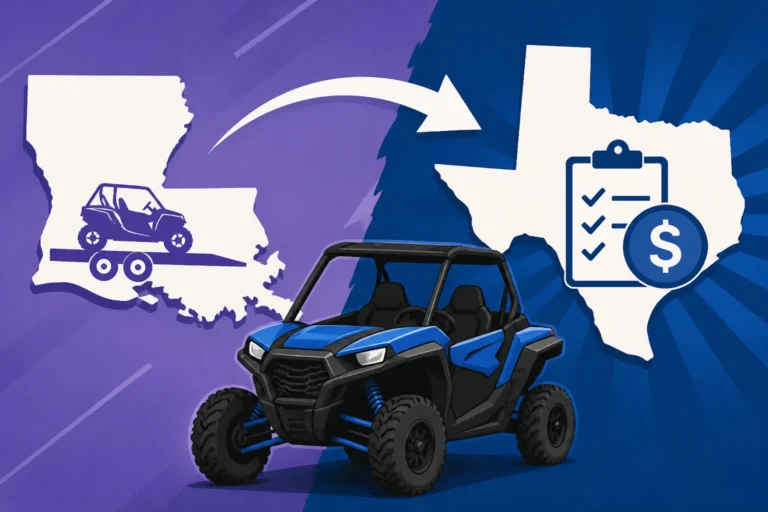
Texas will generally charge use tax on an ATV or UTV if it was purchased outside of Texas but is primarily stored or used in Texas. This is especially relevant if you bought your machine in a state with no sales tax, or a lower sales tax rate than Texas, and then immediately brought it into Texas. The state wants to collect its fair share of tax on goods that are consumed or used within its borders, regardless of where they were originally purchased.
So, if you just bought a brand new side-by-side in Oklahoma, paid their sales tax (or maybe bought it from a private party with no tax collected), and then trailer it straight to your hunting lease in Texas, be prepared. If you're seeking a Texas title for it, or if you're audited, the state Comptroller's office will likely assess use tax. [Texas Use Tax on an Out-of-State OHV] is a critical piece of information for anyone bringing a newly acquired machine across state lines. This isn't about punishing you; it's about ensuring a level playing field for Texas businesses and collecting revenue for state services.
Calculating Texas Use Tax
The good news is that calculating Texas use tax is usually straightforward. The general state sales and use tax rate in Texas is 6.25 percent. On top of that, some local jurisdictions (cities, counties, special purpose districts) can add up to another 2 percent, for a maximum combined rate of 8.25 percent. When you're dealing with use tax on an out-of-state purchase, it's typically just the state rate of 6.25 percent unless you're specifically titling it in a high-tax local jurisdiction and establishing residency there.
The tax is applied to the purchase price of the ATV or UTV. For instance, if you bought a machine for $10,000, you'd owe $625 in state use tax (10,000 x 0.0625). If you didn't pay any sales tax in the original state, you'd owe the full Texas rate. If you paid a lower sales tax in the other state, Texas will generally credit you for what you already paid, and you'd only owe the difference. For example, if you paid 4% sales tax in another state, Texas would only collect the remaining 2.25% (6.25% – 4%). This prevents you from being double-taxed. When you're ready to get a title, you'll likely need to file a Texas Comptroller of Public Accounts Form 01-900, Texas Use Tax Return, or handle it directly at the county tax office.
Proving Prior Tax Paid
To avoid paying use tax twice (once in your home state and again in Texas), it's essential to have clear documentation of any sales tax you already paid on your ATV or UTV purchase. When you go to title your machine in Texas, or if you ever have to deal with a use tax assessment, the Texas Comptroller's office will want to see proof.
This proof typically comes in the form of an original invoice or bill of sale from the dealer or seller that clearly shows the purchase price and the amount of sales tax collected and remitted to the previous state. If you used a service like LawDepot to create a detailed bill of sale for a private purchase, ensure it explicitly states the purchase price and any taxes paid if applicable. Without this documentation, Texas might assume no sales tax was paid and charge you the full Texas use tax rate. So, keep those records safe! If you bought from a private party in a state that doesn't collect sales tax on private sales, you'll still be subject to Texas use tax when you bring it here for use or title.
Operating Your OHV as a Nonresident in Texas
Now that you understand the titling and decal aspects, let's talk about actually riding your ATV or UTV in Texas. Even as a nonresident, you're expected to abide by Texas laws concerning OHV operation, which cover everything from where you can ride to what safety gear you need.
General Riding Rules for Texas Public Lands
Texas boasts some fantastic public and private riding areas, and as a nonresident, you're welcome to enjoy them, provided you follow the rules. As mentioned earlier, if you're riding on public lands like the Sam Houston National Forest or state-funded OHV parks, you'll almost certainly need a Texas OHV Decal displayed on your machine. This is non-negotiable for most of these areas.
Beyond the decal, general rules for public land riding include staying on marked trails, respecting trail closures (especially during wet conditions), and practicing ethical riding. Many parks also have specific rules regarding flags, spark arresters, and noise levels. It's always a good idea to check the specific rules of any park or riding area before you go. [Texas Rules for Riding Public Land] will give you a broader overview of the various considerations. Remember, these rules are in place not just for your safety, but for the preservation of the trails and the enjoyment of all riders.
Texas Road Use Exceptions
This is a big one for many OHV owners: "Can I ride my ATV/UTV on Texas roads?" The short answer for general public roads is almost always no. Texas law explicitly states that OHVs are generally not street legal and cannot be registered for normal road use. The "Off-Highway Use Only" remark on a Texas title is a clear indicator of this restriction. [Why Texas Will Not Register an ATV for the Road] explains this in detail.
However, there are very specific and limited exceptions where an OHV might be allowed on a public road:
- Agricultural Use: Farmers and ranchers can use OHVs on public roads for agricultural purposes, provided they display a slow-moving vehicle emblem and have a 6-foot orange flag, among other rules. [Texas Rules for Riding a Farm Road] covers these specifics.
- Crossing a Highway: You can cross a public highway or road at a right angle, after coming to a complete stop and yielding to traffic, but this is for crossing, not continuous travel.
- Designated Roads: Some specific counties (like certain Red River or Guadalupe River counties) or master-planned communities might have ordinances allowing OHV use on certain low-speed, designated roads. This is highly localized and not widespread.
- Utility or Emergency Use: Utility workers or emergency personnel might use OHVs on roads for official duties.
For nonresidents visiting for recreational riding, these exceptions are unlikely to apply to your typical trip. Do not assume your OHV is street legal just because you have an out-of-state plate or title.
Safety Gear and Age Requirements
Texas takes rider safety seriously, especially for younger riders. As a nonresident, you'll need to follow Texas's safety requirements while operating your OHV:
- Helmets: Riders under the age of 18 are generally required to wear a helmet when operating an OHV. This applies to both public and private land, unless on private property where the owner has expressly permitted not wearing one. Some OHV parks, regardless of state law, may mandate helmets for all riders.
- Eye Protection: All riders and passengers are encouraged to wear eye protection, and it's legally required if your machine doesn't have a windshield.
- Safety Certificates: For riders under 18 operating an OHV on public land, a Texas OHV Safety Certificate (or an approved equivalent from another state) is required. This means if your 14-year-old is riding at Sam Houston National Forest, they'll need that certificate. The good news is that Texas generally honors safety certificates issued by other states that meet the ATV Safety Institute's standards. [Texas OHV Safety Certificate Requirements] delves into this.
- Supervision: Children under a certain age (typically 14) often require direct adult supervision when operating an OHV. Always verify the specific age and supervision rules for the area you plan to ride.
Failing to comply with these safety regulations can lead to fines, so it's best to be prepared and safe.
Temporary Visits vs. Establishing Residency
The distinction between a temporary visit and establishing residency is crucial for nonresidents bringing an OHV to Texas. What might be acceptable for a weekend trip can become problematic if you decide to make Texas your new home.
What Defines a Temporary Stay
For OHV purposes, a "temporary stay" generally refers to a short-term visit, typically for vacation, a specific event, or a limited work assignment, where you maintain your primary residence in another state. During a truly temporary stay, Texas law generally allows you to operate your OHV using your home state's title and basic identification (like a driver's license), assuming your home state's documents are current and valid.
This means if you're coming down from Oklahoma for a week of riding at Hidden Falls Adventure Park, your Oklahoma title is fine. You would, however, still need the [The $16 Texas OHV Decal] if you're riding on designated public lands that require it. The key here is intent: if you truly intend to return to your home state and have not taken steps to formally establish yourself as a Texas resident (like getting a Texas driver's license, registering to vote, or enrolling children in Texas schools), your visit is likely temporary.
When You Become a Texas Resident
You officially become a Texas resident when you demonstrate an intent to make Texas your fixed and permanent home. This isn't just a casual declaration; it's typically evidenced by actions such as:
- Obtaining a Texas driver's license or ID card.
- Registering your vehicles (cars, trucks) in Texas.
- Registering to vote in Texas.
- Establishing a homestead and claiming a homestead exemption.
- Enrolling children in Texas public schools.
- Securing employment in Texas with no fixed return date to your previous state.
Once you take these steps, your "nonresident" status for your OHV typically changes, and you'll be expected to comply with Texas titling laws for your off-highway vehicle, just like any other Texan. This transition usually means you'll need to obtain a Texas title for your OHV, even if you brought it from a state that titles them. It's about updating your records to reflect your new home.
The Process for Becoming a Texas Titled OHV Owner
If you've established residency in Texas and need to title your out-of-state OHV, the process is quite similar to any other vehicle. You'll need to gather a few key documents and head to your local county tax assessor-collector's office:
- Your Out-of-State Title: This is crucial proof of ownership. If your state doesn't issue titles, be prepared with alternative ownership documentation, such as a notarized bill of sale or prior registration.
- Proof of Texas Residency: Your Texas driver's license or ID card will usually suffice.
- Texas Application for Title (Form 130-U): You'll fill out [Filling Out Texas Form 130-U for an OHV], providing all the necessary details about your machine and yourself.
- Proof of Identity: A valid photo ID.
- Proof of Inspection (if applicable): While generally not for off-highway vehicles, some county offices might have specific requirements for VIN verification, especially if there's no prior title.
- Payment for Fees and Taxes: Be ready to pay the titling fee, any local fees, and potentially Texas use tax if you haven't paid sales tax at the Texas rate or greater in another state on a recent purchase.
The county tax office staff will review your documents, process your application, and issue you a new Texas title. This title will prominently feature the "Off-Highway Use Only" remark, clearly indicating its status for road use. It's a straightforward process, but being prepared with all your documents, potentially including a detailed bill of sale created with tools from LawDepot, can make it much smoother.
Disclaimer
This article is for general informational purposes only and does not constitute professional advice. Laws, prices and regulations vary by location and change over time. Consult a qualified professional for guidance on your specific situation.