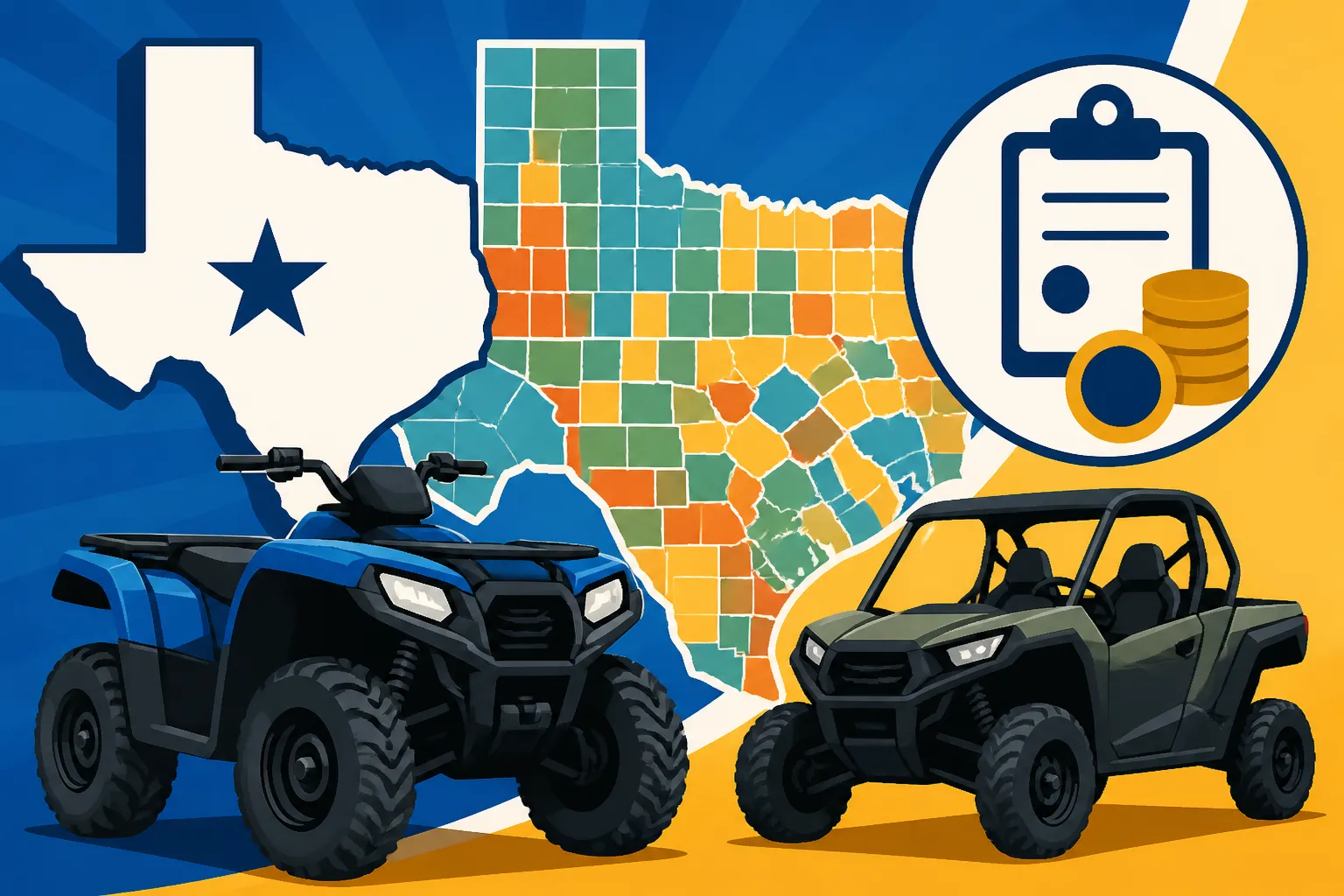
Texas ATV Title Fees Vary by County
It's incredibly frustrating when you're trying to figure out the cost of something seemingly straightforward, like titling your ATV or UTV in Texas, only to find conflicting information or realize the fees aren't the same everywhere you look. You just want a clear answer, right? Well, you're not alone in that confusion. This comprehensive guide will walk you through why Texas ATV and UTV title fees can differ from one county to the next, what specific costs you should anticipate, and how to get the most accurate information so you can budget effectively and avoid any nasty surprises.
Understanding the Core Texas ATV Titling Process
Before we dive into the nitty-gritty of fees and why they fluctuate, it’s essential to understand the basic process of titling an off-highway vehicle (OHV) in Texas. This fundamental understanding will lay the groundwork for recognizing where different charges might come into play. It's not as simple as just showing up and getting a piece of paper; there’s a structured path you’ll follow.
The Initial Application and Required Documents
Every journey to a Texas OHV title begins with a visit to your local county tax assessor-collector’s office or, in some cases, a sub-contracted service provider. The first, and arguably most critical, piece of paper you’ll deal with is [The Texas Title Application Every OHV Buyer Files]. This form, often referred to as Form 130-U, is the cornerstone of your application. You'll need to fill it out completely and accurately, detailing information about the vehicle, the buyer, and the seller. Any missing or incorrect information can lead to delays, forcing you to make multiple trips or even incur additional processing charges if the county clerk has to reject your application.
Beyond the application form itself, you'll need several other crucial documents. If you're buying a brand-new machine, you'll need the Manufacturer's Statement of Origin (MSO), which is essentially the birth certificate of your ATV or UTV. For a used machine, you'll need the previous owner's Texas title, properly assigned to you. In situations where the vehicle has never been titled or the original title is lost, the process can become a bit more complex, often requiring additional forms or affidavits. Don't forget proof of identification, proof of insurance (though OHVs aren't legally required to have liability insurance for off-road use, it's always smart to check with the county office), and, crucially, proof that you’ve paid the required sales or use tax to the Texas Comptroller of Public Accounts, or that you qualify for an exemption. It’s a lot to keep track of, and preparing everything beforehand can save you a world of headache.
Where to File Your Title Application
In Texas, unlike some other states where you might go directly to a Department of Motor Vehicles office, all OHV titling and registration processes are handled at the county level. Specifically, you’ll be heading to your county tax assessor-collector’s office. This is a crucial detail because it directly contributes to the variability in fees. While the state sets certain baseline fees, each county office operates with its own administrative structure, overheads, and sometimes even specific local ordinances that allow them to levy additional service charges.
This localized approach means that a resident of, say, Harris County might encounter slightly different administrative fees than someone in Gillespie County, even if the base state title fee remains the same. It's not about one county trying to "charge more" than another, but rather reflects the individual operating costs and service models of these independent county offices. Some larger counties might have more staff, multiple locations, or advanced online systems, which can influence their administrative fee structure. Conversely, smaller counties might have fewer resources, leading to different approaches to processing costs. This decentralized system is the primary reason you can't just get one blanket answer for "Texas ATV title fees." Knowing this helps manage expectations and guides you on why it's so important to contact your specific county office. You can find more specific information on [Titling at a Texas County Tax Office].
Why Texas ATV Title Fees Aren't Uniform Across Counties
The question of why title fees vary is perhaps the most common one, and it's a completely fair frustration. You'd think a state fee would be uniform, right? And for certain components of the fee, you'd be correct. But the total amount you hand over at the counter often includes more than just the state-mandated charges. This section will peel back the layers to reveal why your neighbor in the next county might pay a few dollars more or less for the same service.
State-Mandated Fees Versus Local Add-Ons
At its heart, the variability in Texas ATV title fees stems from the distinction between state-mandated charges and the administrative fees that individual counties are permitted to add. The core title fee itself, which is set by the state of Texas, remains consistent across all 254 counties. This is the bedrock cost for the actual piece of paper that signifies ownership. However, this is rarely the only fee you pay.
Counties, as the point of service for these transactions, often have discretion to charge additional amounts to cover their operational costs. Think about it: they process your paperwork, input your data, print the title, maintain records, and offer a physical location for you to conduct the transaction. These services aren't free, and the state allows counties to recoup some of these costs through various administrative or processing fees. So, while the "title fee" might be constant, the "total amount due at the counter" can fluctuate significantly. This is precisely [Why a Title Costs More in One Texas County] compared to another, even if the ATV is identical. These local add-ons can cover everything from the salary of the clerk assisting you to the overhead of the building itself.
Administrative Costs and "Convenience" Fees
Delving deeper into these local add-ons, we encounter what are often termed "administrative costs" or, less frequently but sometimes, "convenience fees." These aren't hidden charges; they are legitimate costs associated with running a public service office. For example, a county might charge a flat "filing fee" that covers the intake and initial review of your application. Another might have a "document processing fee" that accounts for the time and resources spent ensuring all your paperwork is correct and entered into the state system.
Consider a hypothetical scenario: You're trying to title your new side-by-side. In County A, a bustling urban center, they might have several clerks, an online appointment system, and digital processing capabilities. Their administrative fee might be slightly higher to support this infrastructure. In contrast, County B, a rural area, might have fewer staff and a more manual process. While their base operational costs could be lower, they might still charge a fee to ensure they can continue providing the service. These fees ensure the efficient operation of the local office and are a direct reflection of the resources invested in processing your title. Always remember that while you might feel the pinch, these fees are essential for the county to continue offering the services you need.
Breaking Down the Typical Costs You'll Encounter
When you walk into the county tax assessor-collector's office to title your ATV or UTV, you're not just paying one lump sum. There are usually several distinct charges that combine to form your total bill. Understanding each component is key to anticipating your costs and figuring out where the county-to-county differences emerge.
The Statutory Texas Title Fee
First and foremost, there is the actual state title fee. This is the fee for the Certificate of Title itself, the official document proving legal ownership. This particular fee is uniform across Texas and does not vary by county. It's a fixed amount set by state law. Think of it as the price for the official paper that says, "This machine is yours, and the state recognizes it." While I can't provide the exact current figure, it's generally a relatively modest sum compared to the overall purchase price of your ATV or UTV. This fee goes directly to the state and is part of the larger system of vehicle record-keeping. It's important to differentiate this specific fee from other charges you might encounter, as this is the one consistent cost in the titling process. You can refer to [Texas ATV Title Cost] for more general information on this baseline fee.
The Optional Off-Highway Vehicle Plate Fee
Another common fee you might encounter, though it's entirely optional and issued only on request, is for the Off-Highway Vehicle (OHV) license plate. This is not a standard vehicle registration plate, and it does not make your ATV or UTV street-legal. Instead, it's a small plate or decal intended for identification and often required for riding in certain public OHV parks or on designated public lands. The good news is that the fee for this plate is capped by state law. [The $10 Cap on a Texas Plate] means that regardless of where you purchase it, the statutory fee for the plate itself won't exceed this amount.
However, even with this cap, there can sometimes be minor variations in the total you pay for the plate at the counter. A county office might add a small administrative fee on top of the state-mandated plate charge to cover their processing costs. So, while the plate itself might be statutorily capped at $10, your receipt might show a slightly higher amount that includes a small processing charge from the county. This charge ensures that the county can continue to provide this service. It's vital to remember this plate is an option for off-road use, not a mandatory registration like a car, and you'll typically request it when you apply for your title. For a deeper look at this, check out [What the Counter Charges for the Plate] and [Texas OHV License Plate Cost].
Local Filing and Processing Charges
Here’s where the real county-to-county variability comes into play: local filing and processing charges. These are the fees levied by the individual county tax assessor-collector’s office to cover their specific operational overhead for handling your title application. Unlike the state title fee, these charges are not uniform. One county might have a general "service fee," another a "document handling fee," and yet another a "record keeping fee." The nomenclature might differ, but the purpose is the same: to cover the costs associated with the local office's work.
These fees reflect the unique administrative structures, staffing levels, and technological investments of each county. For instance, a very large county with multiple branch offices and an extensive digital record system might have a slightly higher administrative fee to support that infrastructure. A smaller, more rural county might have different operational costs that lead to its own set of charges. These fees are not arbitrary; they are usually set by the county's commissioners' court or through other local governance processes. They are transparently listed on your receipt, and you are absolutely within your rights to ask for a breakdown of all charges. These local fees are the primary reason for the differences in [Texas ATV Title Fee Breakdown] across the state. They are also the key factor when considering [Texas ATV Title Fees at a County Office].
How Sales Tax Plays a Role (and How It Varies)
While not technically a "title fee," sales tax is often the largest single cost you'll incur when acquiring an ATV or UTV, and it's collected at the same time you title your machine. Therefore, understanding how it's calculated and how it varies by location is critical to grasping the full financial picture of bringing your new ride home. It’s a significant piece of the puzzle that often causes sticker shock if not anticipated.
State Sales Tax and Local Additions
Texas imposes a statewide sales tax on most purchases, including off-highway vehicles. This state rate is 6.25% of the vehicle's sales price. This portion of the sales tax is consistent across all 254 counties. However, the total sales tax you pay can, and often will, be higher than 6.25% due to local sales taxes. Cities, counties, and special districts (like transit authorities) have the authority to levy their own local sales taxes on top of the state rate.
These local sales taxes can add up to an additional 2% to the state rate, bringing the maximum combined sales tax rate in Texas to 8.25%. So, if you buy your ATV in a city that has maximized its local sales tax, you'll pay 8.25% on the purchase price. If you buy it in a rural area with no additional local taxes, you'll just pay the 6.25% state rate. This is a significant factor in why the total cost of acquiring and titling your machine can vary so much from one part of Texas to another. It's not the title fee itself changing, but the tax collected concurrently. For more details on this, check out [Texas ATV Sales Tax Rate] and [Texas Sales Tax on an ATV Purchase].
Use Tax for Out-of-State Purchases
What if you bought your ATV or UTV in a neighboring state, like Oklahoma or Louisiana, and are bringing it back to Texas? This is where Texas's use tax comes into play. The use tax is essentially the sales tax on items purchased outside of Texas for use within the state. It's designed to ensure fairness and prevent people from avoiding Texas sales tax by simply buying vehicles across state lines. When you title your out-of-state purchase in Texas, you'll be required to pay the Texas use tax, calculated at the same state and local sales tax rates that would apply if you had bought the machine within Texas.
So, if you bought your quad in Oklahoma, even if you paid sales tax there, Texas will likely charge you use tax if the Oklahoma tax rate was lower than Texas's combined state and local rate. You generally get a credit for the sales tax you already paid in the other state, but you'll owe the difference if Texas's rate is higher. This means the amount of use tax you owe can also vary based on where you plan to use the vehicle in Texas (due to local tax rates) and how much tax you already paid in the originating state. The county tax assessor-collector’s office will collect this when you apply for your Texas title. This rule, significantly impacted by [The March 2020 Use Tax Rule], aims to standardize tax collection. For specific examples, refer to [Texas Use Tax on a Machine Bought in Oklahoma] or [Texas Use Tax on an Out-of-State OHV].
Navigating the County-Specific Maze: Practical Tips
Given the variations in fees and processes across Texas counties, it's clear that a one-size-fits-all approach won't work. Successfully navigating the titling process requires a bit of proactive research and preparation. Here are some practical tips to ensure you have the smoothest experience possible and aren't caught off guard by unexpected costs.
Contacting Your Local Tax Assessor-Collector's Office
This is, without a doubt, your best course of action. Before you even gather all your documents, pick up the phone or visit the website of your specific county tax assessor-collector's office. This office is the ultimate authority for titling and registration in your area. Ask them directly for a comprehensive list of all fees associated with titling an off-highway vehicle, including the state title fee, any optional plate fees, and their specific administrative or processing charges. Don't be shy about asking for a detailed breakdown of each line item.
You might even ask about typical processing times or if they have peak hours to avoid. Many offices now offer online appointment scheduling, which can save you a significant amount of waiting time. Having this information directly from the source eliminates guesswork and provides you with the most accurate, up-to-date figures for your location. This simple step can prevent considerable frustration and multiple trips to the office. This is particularly useful when considering [Which County Office Handles Your Title].
Using Online Resources and Official Websites
Most Texas counties maintain official websites for their tax assessor-collector's offices. These sites are often a treasure trove of information, providing downloadable forms (like the all-important Form 130-U), lists of required documents, office hours, and sometimes even a fee schedule. While the fee schedules may not always be exhaustive or updated daily, they can give you a very good estimate of what to expect.
Some larger counties have more sophisticated online portals that allow you to estimate fees or even start the application process digitally, though you’ll still usually need to visit in person to finalize and pay. Always cross-reference any online information with a direct call to the office, especially if the website hasn't been recently updated. The internet is a fantastic starting point for research, but when it comes to specific financial figures, a direct conversation is always best.
Document Preparation to Avoid Extra Costs
One of the biggest culprits for delays and potentially unforeseen costs isn't necessarily a high fee, but rather having to repeat steps due to incomplete or incorrect paperwork. Every time you have to go back to the office because a document is missing or incorrectly filled out, it costs you time, gas, and emotional energy. In some cases, multiple re-submissions might even incur additional small processing fees if the county has a policy for excessive corrections.
Create a checklist of every single document you need: the properly assigned title or MSO, the completed Form 130-U, proof of sales/use tax payment or exemption, your driver's license, and a clean bill of sale. For a solid bill of sale template, resources like LawDepot can be incredibly helpful to ensure you have all the necessary information covered. Make sure VINs match on all documents, and that signatures are exactly as required. A well-prepared packet of documents ensures a smooth transaction and helps avoid the additional costs of re-work or penalties for late filing. A thorough review of the [Texas ATV Title Paperwork Checklist] before you go can save you a lot of hassle and prevent situations where [What a County Clerk Rejects on a Title Application] becomes your reality.
Scenarios Where Fees Might Differ Even Further
While the core titling and sales tax rules generally apply, specific circumstances surrounding your ATV or UTV purchase can further alter the fee structure. It's not just about which county you're in; it's also about the nature of the transaction and the machine itself. Being aware of these scenarios can help you prepare for additional considerations or potential savings.
Titling a Used ATV Versus a New One
The fees associated with titling generally remain consistent whether your ATV is brand new or pre-owned. The state title fee and the county's administrative charges usually don't differentiate based on the vehicle's age. However, where you will see a significant difference is in the sales tax calculation. For a new ATV purchased from a dealer, the sales tax is straightforward: it's calculated on the dealer's invoice price.
For a used ATV bought from a private seller, things can get a little more nuanced. Texas law has provisions to prevent under-reporting the sales price to avoid taxes. The sales tax for a used vehicle is typically calculated on the greater of the actual sales price or a "presumptive value" determined by the state. This presumptive value is based on recognized trade sources or other market information. So, if you and the seller agree on a very low price, but the state's presumptive value for that make and model is much higher, you might end up paying sales tax on the higher presumptive value. This is a crucial distinction that can significantly impact your total out-of-pocket cost and something to be very aware of when [Buying a Used ATV in Texas]. Always ensure you have a clear [A Texas Bill of Sale for an ATV] outlining the agreed-upon price.
Exemptions That Reduce Your Tax Burden
Texas offers specific sales and use tax exemptions that, while not affecting the core title fee, can dramatically reduce the total amount you pay when titling your ATV or UTV. The most common of these are the agricultural and timber exemptions. If you are purchasing an OHV primarily for use in agricultural operations (like ranching, farming, or producing timber), you may be exempt from paying state and local sales tax on the purchase.
To claim these exemptions, you typically need to hold a valid Texas Agricultural and Timber Exemption Registration Number. You'll enter this number on Form 130-U, the title application, and provide any other required documentation to the county tax assessor-collector’s office. It's essential to understand that these exemptions apply to the sales tax portion, not the actual title or administrative fees. Misrepresenting your use to claim an exemption can lead to serious penalties, so ensure your usage genuinely qualifies. If you think your ATV will be primarily used for ranch or timber work, definitely look into [Ag and Timber Exemptions on Form 130-U] and [Texas Ag Exemption on an ATV Purchase].
Penalties and Late Fees
Finally, one of the easiest ways for your "title fees" to unexpectedly increase is by missing deadlines or failing to complete the process within the specified timeframe. Texas law dictates that you must apply for a title transfer within a certain number of days (usually 30 days) from the date of purchase. If you fail to do so, you can be assessed late penalties. These penalties are often applied to the sales or use tax amount, not the title fee itself, but they become part of the total bill you pay at the county office when you finally get around to titling.
These penalties can range from a fixed fee to a percentage of the sales tax due, and they can add up quickly. Life gets busy, and it's easy for paperwork to get pushed aside, but procrastinating on your ATV title application can literally cost you extra money. It's always best to prepare your documents and head to the county office as soon as possible after your purchase to avoid these preventable extra charges. Be mindful of the [Texas ATV Title Application Deadline].
Here's a simplified table comparing hypothetical title-related costs in two different Texas counties, illustrating where variations might occur:
| Fee Type | State-Mandated (Consistent) | Hypothetical County A (Urban) | Hypothetical County B (Rural) | Notes |
|---|---|---|---|---|
| Base Title Fee | $XX.XX | $XX.XX | $XX.XX | Fixed by state law, consistent statewide. |
| Optional OHV Plate Fee | Up to $10.00 | Up to $10.00 | Up to $10.00 | Capped by state law, but issued on request. |
| County Processing Fee | N/A | $YY.YY | $ZZ.ZZ | Varies by county; covers local administration. |
| County Technology Fee | N/A | $AA.AA | $BB.BB | Some counties may have specific tech or record-keeping fees. |
| Subtotal (Fees) | Varies | Varies | Varies | Total of title, plate, and administrative fees. |
| State Sales Tax (6.25%) | Varies by ATV Price | Varies by ATV Price | Varies by ATV Price | Consistent statewide rate. |
| Local Sales Tax (0-2%) | N/A | Varies by ATV Price (e.g., 2%) | Varies by ATV Price (e.g., 0%) | Highly variable, depends on local city/county/district rates. |
| Total Out-of-Pocket | Varies Greatly | Varies Greatly | Varies Greatly | Reflects all fees, taxes, and county variations. |
Note: The actual dollar amounts (XX, YY, ZZ, AA, BB) are variable and should be confirmed with your specific county tax assessor-collector's office.
Disclaimer
This article is for general informational purposes only and does not constitute professional advice. Laws, prices and regulations vary by location and change over time. Consult a qualified professional for guidance on your specific situation.