Buying an OHV Decal at the Gate
Arriving at a Texas OHV park only to discover you still need a decal can throw off the whole ride, especially if the gate is busy or the office is closed. This guide explains when you can buy a Texas OHV decal at the gate, what it does and does not cover, and how to avoid confusing it with admission, a forest fee, or a machine’s title and plate.
Buying a Texas OHV decal at the gate
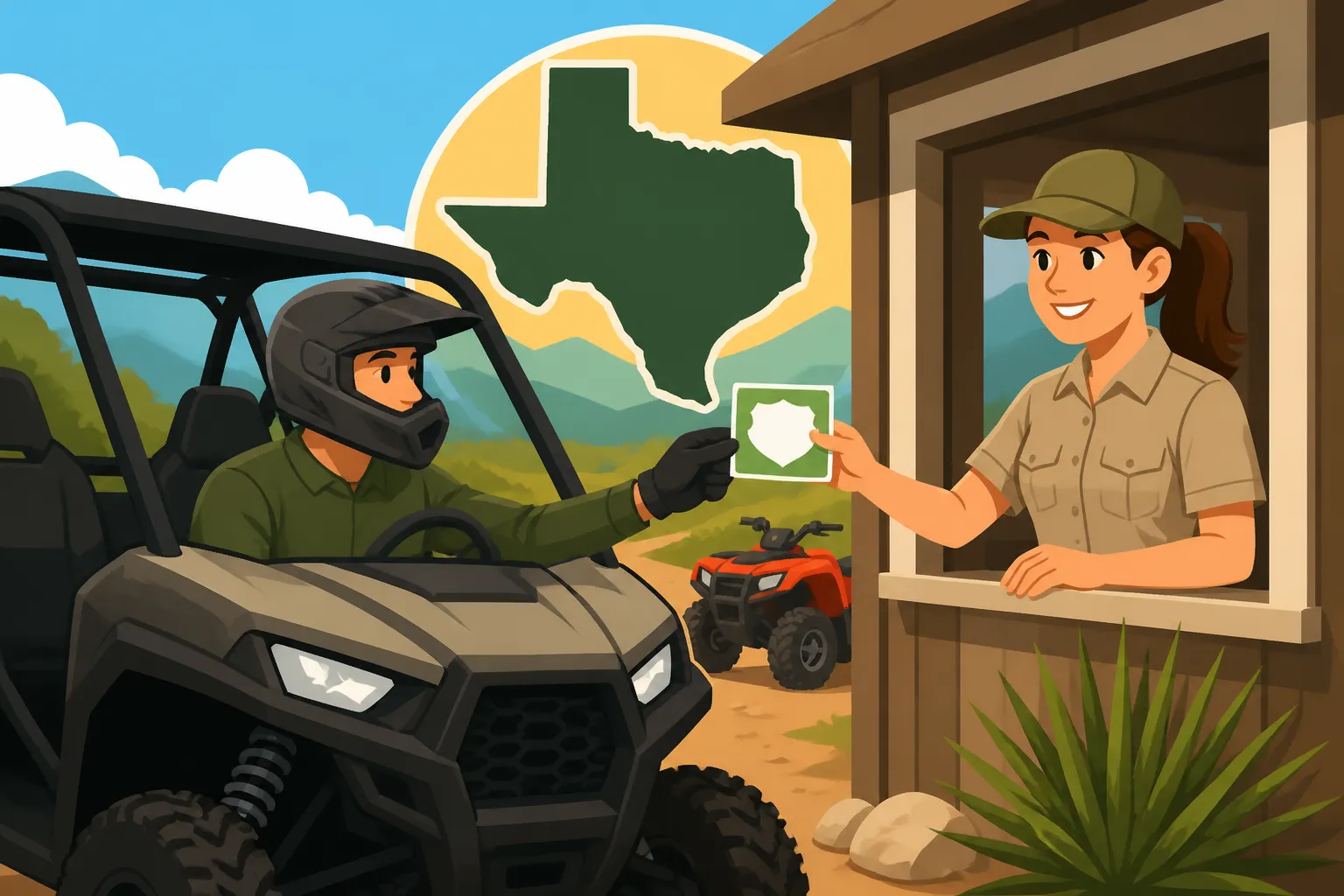
Some Texas riding areas sell the state OHV decal at the entrance or park office. It can be a practical option if you are making a last-minute trip, but gate sales are not something to assume at every location. A park may have different hours for its office and riding area, sell decals only at certain times, or require you to buy through a separate process.
The decal is for the off-highway vehicle, not a substitute for every other requirement you may encounter. Before leaving home, check the riding area’s own instructions and confirm that the decal is available at the point where you plan to enter. For a broader overview of who needs one and where it applies, see [The Texas OHV Decal Explained].
What the gate decal is for
Texas’s OHV decal is associated with riding certain public lands and trails. It is not a general admission ticket that automatically grants access to every riding area in the state. Whether you need one depends on where you are riding and the rules that apply to that land. Private property, for example, is treated differently from public riding areas, and some machines may fall under an exception.
A decal also does not make an ATV or UTV street legal. It does not replace a title, an OHV plate, a land-use permit, or a park’s entrance fee. Those requirements can overlap on a single trip, so it helps to think of the decal as one item on a list rather than an all-purpose pass. If you are unsure what applies to the land you are visiting, start with [Texas Rules for Riding Public Land] and then confirm the site’s specific instructions.
The decal year follows its own schedule, so a sticker you bought for a previous riding season may no longer be valid. If you are planning a trip near the changeover, check the dates and rules for the decal year rather than relying on when you purchased the last one. [Why the OHV Decal Year Begins Every September] explains why the timing can catch riders off guard.
What to confirm before you count on a gate purchase
Before setting out, check whether the location actually sells the Texas OHV decal at the entrance you will use. A trailhead parking area and a main park office may not offer the same services. If you are arriving early, late, or on a day when staffing may be limited, contact the park or review its official visitor information before the trip.
Also ask what the gate sells. A park may offer the state decal, its own day-use admission, a local permit, or some combination of these. The names can sound interchangeable when you are planning quickly, but they serve different purposes. A state decal does not necessarily include park entry, and a paid park ticket does not necessarily satisfy the state decal requirement.
For help comparing advance purchase options with gate sales, see [Where to Buy a Texas OHV Decal] and [Texas Decals Sold at a Park Gate]. If you are planning around cost, the useful question is not simply “How much is the sticker?” but “What charges will I still owe once I arrive?” The gate price may differ from the standard purchase price, and the park can charge for access separately. See [Why a Gate Price Is Higher] for the distinction.
What to expect when you arrive
A gate purchase is usually straightforward when the right staff member is available, but a few small details can slow the process down. Know how many machines in your group need decals, have a way to pay that the location accepts, and be ready to show the decal as directed before you unload or enter the trail system.
If the entrance is busy, it is easy to focus on getting through the line and miss an important detail, such as whether every machine has its own decal or whether the sticker needs to be placed on the vehicle before riding. Taking a moment to ask the attendant can prevent an awkward stop later at a trail checkpoint.
Have the machine count ready
The decal requirement generally applies per machine, not per rider or per group. If you are towing three ATVs and a side-by-side, do not assume one decal covers the whole trailer because one person paid for it. Check the requirement for each machine you intend to ride. [Every Machine in the Group Needs Its Own Decal] covers this common planning mistake.
It can help to make a quick list before you arrive: the machines you brought, the decals already valid for them, and the number you still need. That is especially useful when friends have borrowed machines or when one family member is driving a different vehicle to the park. A last-minute count at the window is manageable, but a clear count reduces the chance of leaving one machine without the required decal.
If the machine is borrowed, do not assume that the owner’s sticker or another rider’s decal transfers to it. Confirm the decal rules for that machine and carry any required proof as the park directs. If you are riding with children, remember that a decal does not replace any applicable training or supervision requirements. Review [Texas OHV Safety Certificate Requirements] separately.
Keep the decal separate from admission and day-use charges
This is one of the most frustrating points for new visitors: paying at the gate does not always mean you have paid for everything required to ride. A riding area may collect its own entrance or day-use charge, while the state decal is a separate purchase. Some areas also have parking, camping, vehicle, or activity-specific requirements.
National forest riding is a good example of why it pays to ask what each payment covers. A state OHV decal and a national forest day-use fee can be separate obligations. Buying one does not automatically satisfy the other. See [Does an OHV Decal Cover the Forest Day-Use Fee?] before heading to a forest trailhead, and check the specific site’s directions for how to pay any separate fee.
A practical arrival routine is to ask the attendant three questions: Is this the Texas OHV decal? Does it cover only the state decal requirement, or does it include this park’s admission? Is there another permit or fee I need before unloading? That short exchange can save you from having to backtrack to an office or payment station after you have already parked.
Know how the decal is issued and displayed
Follow the instructions provided with the decal and by the selling location. The decal is intended to identify the machine for which it was issued, so avoid treating it like a transferable pass you can move between vehicles. If you are unsure where to affix it, ask before leaving the counter rather than guessing once you are on the trail.
Keep your purchase confirmation or receipt until you have finished the trip, particularly if you bought the decal at a busy gate or through a booking process. A receipt is not a substitute for displaying the decal when required, but it can help you resolve a question about the transaction. If the decal is damaged, missing, or difficult to read, ask the park or the relevant state program what to do instead of assuming that a photo or old sticker will be accepted.
Gate purchase versus buying ahead
Buying at the gate is convenient, but buying ahead can make sense when your trip depends on arriving early or when you are traveling a long distance. Neither option is automatically best for every rider. The right choice depends on whether your destination sells decals, whether you can access the purchase method in advance, and how much uncertainty you are comfortable handling on the day of the ride.
| Situation | Buying at the gate | Buying ahead |
|---|---|---|
| You decide to ride at the last minute | Convenient if the location sells decals and staff are available | May be difficult if you have not allowed time to complete the purchase |
| You expect to arrive outside regular office hours | Risky unless the park confirms sales will be available | Can reduce the chance of an office-hours problem |
| You have several machines in your group | Easy to ask staff about the count, but a busy line can slow things down | Gives you time to confirm how many decals are needed |
| You are visiting an unfamiliar public riding area | Ask staff what else is required, but do not assume they handle every land-use rule | Lets you check decal, admission, and permit requirements before traveling |
| You are also riding in a national forest | The gate may not sell or collect every required fee | Lets you research separate day-use requirements before leaving |
When buying at the gate is a sensible choice
A gate purchase can work well if you are visiting a staffed park during its normal operating hours, the park confirms it sells the decal, and you have already checked the other entry requirements. It is especially convenient when your plans changed at the last minute or you are not sure which machines in the group will make the trip.
It can also be helpful when you want to ask a staff member about local procedures. For example, a family arriving with a youth quad and a side-by-side may have questions about the machine count, where to display each decal, or whether another park charge applies. A quick conversation at the counter can clear up practical details, though the park staff may not be able to answer every question about rules on other properties.
Gate buying is less dependable when you are arriving before the office opens, near closing time, or at a remote access point with no staffed booth. If your entire weekend hinges on getting into a particular trail system, call ahead or use an advance option where available rather than leaving the purchase until the last minute.
When to buy ahead
Buying ahead is useful when you want to have the decal requirement settled before loading the trailer. It gives you time to check whether the product is the state decal, whether a separate park booking is needed, and whether you have enough decals for the machines in your group. It can also reduce pressure when you are traveling with children or coordinating several vehicles.
Some riders use trip-planning tools such as onX Offroad to map a route and keep riding locations organized. That can help you identify the destination and plan the approach, but a map or trail app should not be treated as confirmation that a decal is required or that a particular gate sells one. Verify the land manager’s rules and the purchase process directly.
If you find the decal through an online booking or purchase process, check that you are buying the correct item for your trip. A booking site may offer its own day pass or reservation alongside a state decal, and those are not necessarily interchangeable. [Buying an OHV Decal Through an Online Booking Site] is useful if you are comparing that route with an in-person purchase.
A simple checklist for buying at the gate
A little preparation can make the gate stop quick and uneventful. Before you leave, confirm the location’s decal policy and note its office or entrance hours. Then check the number of machines you are taking and identify any other fees or permits that may apply.
Before leaving home
- Confirm that your destination requires the Texas OHV decal for the land or trail you plan to use.
- Check whether the entrance or park office sells the decal and when sales are available.
- Count every ATV, UTV, or other OHV in your group that may need its own decal.
- Ask whether admission, day use, parking, camping, or a separate land permit costs extra.
- Check the decal year and make sure any decal you already have is valid for your planned ride.
- Review safety certificate, age, supervision, and machine-specific rules that apply to your riders.
If your route includes more than one riding area, check the rules for each destination instead of assuming one park’s policy applies everywhere. onX Offroad can be handy for organizing a route and noting places you want to visit, but verify access and decal requirements with the land manager before relying on the route. A trail appearing on a map does not, by itself, confirm that it is open or that you are authorized to ride there.
At the gate
- Tell the attendant how many machines you brought and how many already have valid decals.
- Confirm that the item being sold is the Texas OHV decal, not only a park admission ticket.
- Ask whether any additional access fee or permit is required.
- Follow the instructions for placing or displaying each decal.
- Keep your receipt or confirmation until the trip is over.
- Ask what to do if a decal is missing, damaged, or issued for the wrong machine.
A useful question to ask is: “Does this purchase cover the state OHV decal only, or does it also include this park’s entry?” It is direct without assuming the answer, and it gives the attendant a chance to explain any additional steps.
If the gate cannot sell the decal
Do not assume you can ride first and sort it out later. Ask staff what options are available, whether there is another authorized place to purchase it, and whether the location has a required process for visitors without a decal. If no purchase option is available, follow the park’s instructions rather than riding in a place where the decal is required.
This is where a backup plan helps. Before traveling, save the park’s contact details and check whether an advance purchase option exists. onX Offroad can help keep your planned destinations and route in one place, while the park’s own information should guide decisions about entry, fees, and current access rules. Keeping those roles separate helps avoid treating a navigation tool as an official permit source.
Common mistakes to avoid
Most decal problems come from treating different requirements as if they were one thing. A decal is not a title or plate, an admission ticket, a forest fee, or proof that a trail is open. Checking each item on its own may feel repetitive, but it is far easier than discovering a missing requirement after the trailer is unloaded.
Assuming every park sells the decal
Gate sales vary by location, staffing, and the way the property manages access. A park’s website or visitor information may list a state decal among its requirements without promising that the sticker is sold at the gate. If you cannot find a clear answer, contact the park and ask specifically where and when visitors can buy it.
Also distinguish between a park that requires the decal and a park that sells it. Those are separate facts. A site may expect riders to arrive with the decal already in hand, even if its rules explain that the decal is required.
Treating the decal as a universal riding pass
The decal does not grant permission to ride on every public property or trail in Texas. Land managers can have additional access rules, restrictions, closures, and fees. Public access can also vary by season, weather, or land-management decision, so verify that the route is open before you tow your machine there.
For route planning, onX Offroad may help you keep track of possible riding areas and roads between them. Use it as a planning aid, then confirm land access, closures, and permit rules through the agency or park responsible for the property. A route line on a map should never be treated as a guarantee of legal access.
Forgetting separate fees or rider requirements
A decal purchase does not automatically cover trail admission, camping, national forest day use, or safety requirements. These are easy to overlook when several people are coordinating a trip and one person is handling the gate payment. Make a shared checklist, especially if the group includes borrowed machines, youth riders, or visitors unfamiliar with Texas rules.
A final check before unloading can be as simple as confirming that every machine has the required decal, every rider meets the site’s rules, and all entry or day-use payments have been made. That small pause is far less frustrating than a preventable stop after everyone is geared up.
Disclaimer
This article is for general informational purposes only and does not constitute professional advice. Laws, prices and regulations vary by location and change over time. Consult a qualified professional for guidance on your specific situation.