Texas Riding at Night
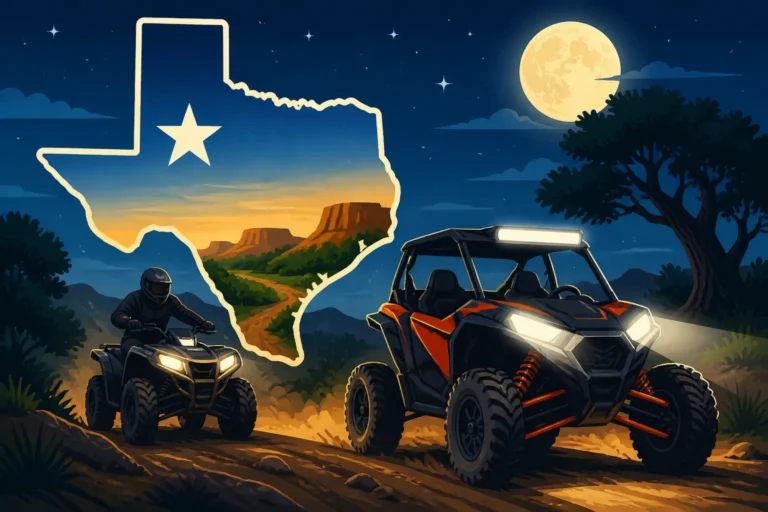
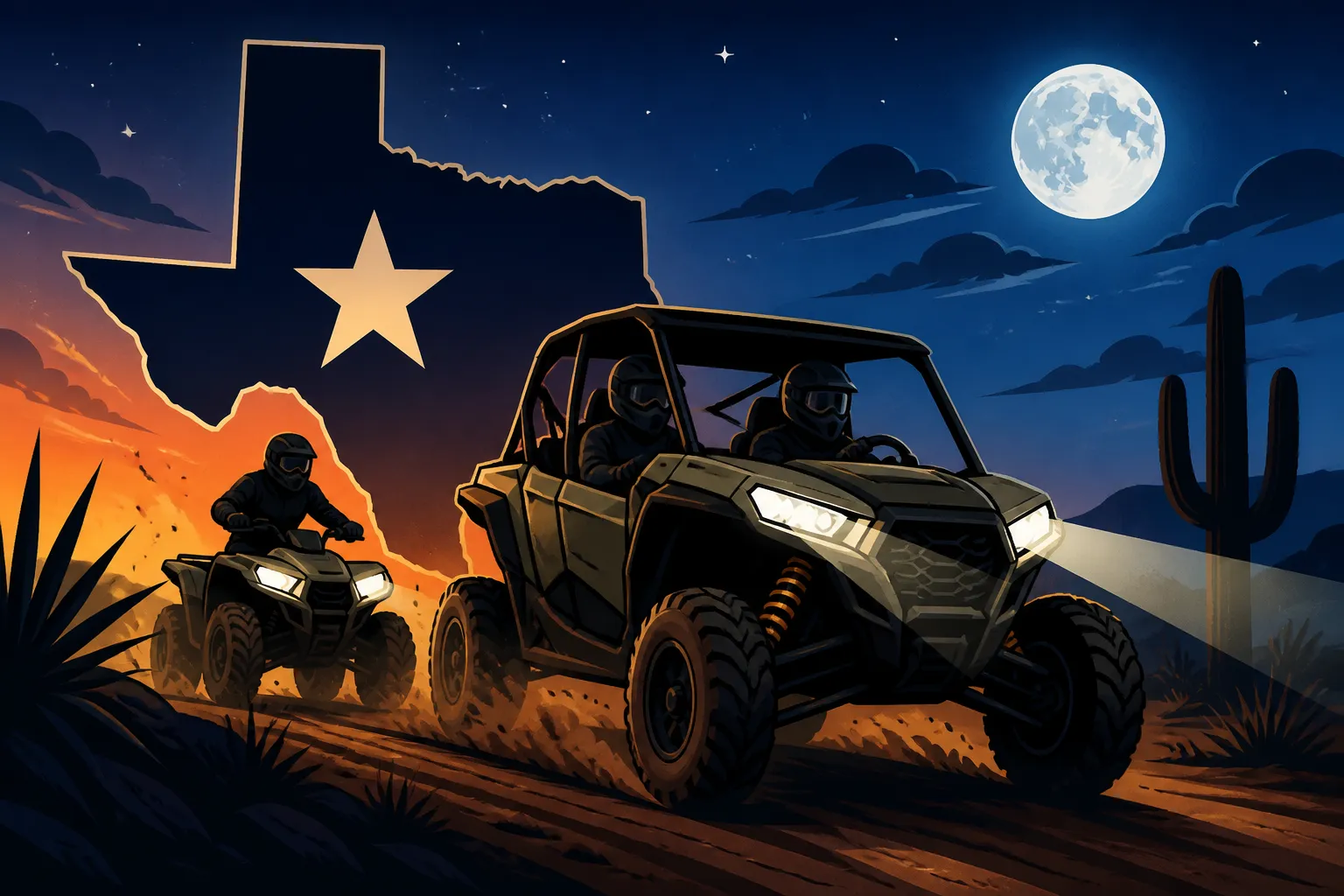
Night riding in Texas can turn a familiar trail into a very different challenge: dust hangs in the beam, rocks disappear into shadow, and a route that felt easy in daylight can become hard to read. This guide explains how to check whether night riding is allowed, prepare your ATV or UTV, and make a safer plan before you leave.
Check whether night riding is allowed
Confirm the rules for the specific riding area
There is no single statewide rule that gives every Texas trail permission to stay open after dark. Access depends on the property owner or land manager, and park hours, trail closures, event schedules, and lighting restrictions can differ. A trail that permits riding during the day may close at dusk, while another property may allow night sessions only on designated dates or routes.
Check the official rules for the exact place you plan to ride before loading up. Look for the published operating hours, after-dark restrictions, permitted trails, and any requirements for headlights, flags, or sound. If the information is unclear, contact the park or land manager directly. Don’t treat another rider’s old social media post or a general map listing as confirmation that a trail is open tonight.
That check matters at well-known destinations as much as at smaller riding areas. Before a trip to Barnwell Mountain or Hidden Falls Adventure Park, for example, confirm the location’s own current schedule and rules rather than assuming the entire property is available after sunset. For a broader overview of how schedules can differ, see [Texas Parks With Night Riding] and [Texas Riding at Night].
Separate trail access from road legality
Being allowed to ride after dark on a private trail does not mean you can ride the machine on nearby public roads. Texas generally does not make an ATV or UTV street legal simply because it has headlights, taillights, mirrors, or other equipment. Specific legal exceptions may apply in limited circumstances, but they do not create blanket permission to use roads to reach a trailhead or ride home after a session.
It’s useful to think of these as two separate questions: “Is this trail open to me after dark?” and “May I ride this machine on the road I’d need to use?” A yes to the first does not answer the second. Review [Texas Rules for Riding After Dark] and [Texas Lighting Requirements for OHVs] for the relevant equipment and road-use context, and check the rules for any specific exception before relying on it.
An OHV decal or other permit also does not automatically provide after-hours access. It may be required for certain public riding areas, but it is not a substitute for a park’s hours, a landowner’s permission, or a separate day-use requirement. If your route includes public land, check the applicable [Texas OHV Decal Explained] and [Texas National Forest Permits] guidance as well as the land manager’s access rules.
| Riding location | What to verify before dark | Common planning mistake |
|---|---|---|
| Private OHV park | Hours, designated night routes, event rules, required lights | Assuming daytime access continues after closing |
| National forest or other public land | Trail hours, closures, permits, vehicle-width rules | Treating a permit as permission to ride at night |
| Ranch or hunting lease | Owner’s permission, gates, active hunting, boundaries | Assuming a familiar access road is open after sunset |
| Beach or shoreline | Local vehicle rules, closures, tide and surface conditions | Assuming night access follows daytime access |
| Road or roadside connection | Whether the machine may legally use that road | Assuming lights make an ATV or UTV street legal |
Prepare your ATV or UTV for low-light riding
Check lighting, visibility, and controls
Before the ride, inspect the headlights and taillights, then check the battery, switches, wiring, and mounts. A light that works in the driveway can fail after vibration, mud, water, or a loose connector. Clean the lenses, confirm that the beam points where you need it, and carry a practical backup light that you can access without unpacking the entire vehicle.
A bright forward beam is only part of the picture. In dust, smoke, fog, or heavy brush, a powerful light can reflect back toward the rider and make visibility worse. Use a beam suited to your speed and surroundings, and leave enough distance to stop within the area you can actually see. Avoid aiming auxiliary lights so high or wide that they blind people coming the other way or obscure your own view of nearby obstacles.
For a UTV, check that lights remain visible around accessories, windshields, cargo, and any equipment mounted to the front or rear. For an ATV, inspect the light housing and wiring for damage after a rough ride. Neither a lighting upgrade nor a set of mirrors changes the legal status of an off-highway machine on public roads; equipment requirements and road access are separate questions.
Pack for breakdowns and changing conditions
Bring a charged phone, a basic first-aid kit, water, and a way to contact your group if you become separated. A handheld light is helpful for inspecting a tire or checking a trail marker, while a small power bank can keep navigation and communication tools usable longer. Store essentials where they won’t be buried under riding gear or exposed to mud.
Plan for a stalled machine, not just a successful loop. Decide who stays with an injured rider, who goes for help, and how your group will regroup if someone loses sight of the others. Agree on a simple stop signal before heading out, and keep riders close enough to communicate without tailgating. If you use a navigation app such as onX Offroad, download the relevant map area ahead of time and make sure everyone knows how to find the group’s planned route. Don’t rely on cell service being available on every trail.
Night conditions also make ordinary Texas weather problems harder to manage. Heat can remain intense after sunset, while a sudden storm can turn a familiar route into slick mud or a washout. Check the forecast and trail status before leaving, and reconsider the ride if conditions are deteriorating. [Texas Trails After Heavy Rain] and [Texas Riding in Summer Heat] cover two issues that deserve extra attention when visibility is limited.
Plan a route that suits the whole group
Choose familiar, manageable terrain
A route that is comfortable in daylight may be a poor choice after dark. Start with a trail your group already knows, with predictable surfaces and clear intersections. Avoid making your first night ride a long loop through unfamiliar terrain, a technical rock section, deep mud, or an area with confusing junctions.
Use a conservative pace and create room between machines. The lead rider should be able to stop before an obstacle, and the last rider should know how to contact the group if the pace becomes uncomfortable. For mixed-experience groups, choose a route that the least confident rider can handle without pressure. A shorter loop near a known staging area is often a better first outing than trying to cover as much ground as possible.
Before setting off, identify the turnaround point, expected return time, and a place to regroup if anyone gets separated. Share the plan with someone who is not riding with you. Include the riding area, vehicle descriptions, and when you expect to check in. With onX Offroad or another offline-capable mapping tool, save the route and key waypoints in advance, but carry a backup plan that does not depend on a phone battery or network connection.
Use clear group procedures
Keep the group order consistent: a lead rider who knows the route, less experienced riders near the middle, and a sweep rider at the back. The sweep should know who is in the group and confirm that everyone has cleared each turn. At intersections, stop in a safe, visible place and wait until the last rider catches up rather than leaving them to guess which way the group went.
Set expectations before riding: no passing unless the group agrees on how, no leaving the route, and no continuing if a rider signals discomfort or a mechanical problem. Nighttime can make distances and speed harder to judge, so a rider who feels fine in daylight may become overwhelmed quickly. A calm stop and a shorter route are sensible decisions, not a failure to finish the ride.
If anyone in the group is using a navigation app, have them set up the map before the ride rather than stopping repeatedly to look at a screen in the dark. onX Offroad can be one part of that preparation, but riders should still understand the route and agree on landmarks and turn-by-turn regroup points. Keep screens dimmed when practical, and never ask a driver to operate a phone while moving.
Ride with a safer nighttime routine
Do a final check before leaving the staging area
Give every rider a moment to check their helmet, eye protection, gloves, footwear, and any protective gear required by the riding area. Make sure helmets fit properly and that goggles or a face shield are clean and suitable for low light. Tinted lenses that feel comfortable during the day can make it much harder to see after sunset.
Walk around each machine together. Confirm that lights work, tires look sound, loose cargo is secured, and no gear blocks visibility or controls. Check that riders know how to shut off the machine, use the horn or agreed signal, and call for help. A quick group check can catch a dead light or missing tool before it becomes a problem several miles down a dark trail.
If the park requires particular equipment or restricts certain machines, follow those rules even if your vehicle seems well equipped. A trail permit, safety certificate, or decal may address one requirement without replacing others. For rules that apply to younger riders or required riding credentials, consult [Texas OHV Safety Certificates] before heading out.
Know when to call the ride
Turn back if visibility drops, a light fails, the trail becomes unexpectedly rough, or someone in the group is tired or uncomfortable. Don’t push on simply because the route is nearly complete. At night, fatigue can build quietly, and repeated small errors—missing a turn, braking late, or overlooking a rut—can be signs that the group needs to stop.
If a machine breaks down, move it and the riders to a safe spot if possible, use lights to make the group visible, and avoid splitting up without a clear plan. If someone is injured or in immediate danger, contact emergency services and provide the riding area, nearest access point, and any useful landmarks. Keep the rest of the group together unless the situation requires otherwise.
A good night ride is one where everyone returns safely, even if the route ends early. Confirm opening hours, stay within authorized areas, use equipment suited to the conditions, and choose a pace that leaves room to react. When the trail is unfamiliar or conditions are changing, postponing the ride is often the most practical call.
Disclaimer
This article is for general informational purposes only and does not constitute professional advice. Laws, prices and regulations vary by location and change over time. Consult a qualified professional for guidance on your specific situation.