The Texas Off-Highway Vehicle License Plate
Trying to make sense of the Texas Off-Highway Vehicle (OHV) license plate can feel like navigating a maze blindfolded. Unlike a car or truck, your ATV or UTV isn't "registered" for road use in Texas, which can leave you scratching your head wondering why there's a plate at all, what it means, and if you even need one. This guide is here to untangle that confusion, explaining exactly what the Texas OHV plate is, how it works, and when it might actually be important for your off-road machine.
Understanding the Texas OHV Plate: Not Your Typical Registration
When you think "license plate," you probably picture a vehicle that's allowed to cruise down any public road, fully registered and street-legal. That's where the Texas OHV plate throws a wrench in common understanding. It's crucial to wrap your head around the fact that this plate isn't a green light for street riding; it's a specific identifier tied to your machine's title, meant for very limited, specific scenarios. This distinction often trips up new OHV owners and even those who've been riding for years, leading to a lot of frustration and sometimes, unexpected tickets.
The "Off-Highway Use Only" Distinction
One of the first things you'll notice, either on the physical plate itself or certainly on the corresponding title document, is the prominent "Off-Highway Use Only" remark. This isn't just a suggestion; it's a legal declaration. It signifies that while your machine has been officially identified and documented by the state, it's not intended for general public road use. Imagine getting a special ID card that explicitly states it's only valid for entry into certain private clubs—that's the essence of this remark. It aims to prevent any misunderstanding that the plate somehow transforms your dirt bike or side-by-side into a street-legal vehicle.
This designation is particularly important because Texas law is quite clear about where OHVs can and cannot be operated. The plate acts as a visible reminder of these limitations. For more on this, you might want to read [The Off-Highway Use Only Remark on a Texas Title]. It sets the stage for understanding why, despite having a plate, you still can't just run to the grocery store on your quad. It’s a mechanism for the state to track ownership and ensure that if your OHV is involved in an incident or needs to be identified, there’s a clear paper trail, without implying full road privileges.
Why Texas Titles But Never Registers an OHV
This is perhaps the most bewildering aspect for many Texans. We're used to a two-step process: title and registration. For OHVs, Texas only requires a title. This means your ATV or UTV gets a formal certificate of ownership, a bit like a birth certificate for your machine, but it never receives the annual sticker or full legal standing that permits general road travel. The state defines OHVs as vehicles designed primarily for recreational off-highway use, and their operational guidelines reflect this. The state is essentially saying, "We acknowledge you own this machine, and here's the proof, but we're not clearing it for roads."
The reason behind this approach stems from the fundamental design and safety standards of OHVs. They lack many of the features required for safe public road operation, such as turn signals, rearview mirrors, specific lighting, and often, crash protection. Rather than trying to legislate a patchwork of modifications that might make them marginally road-worthy, Texas maintains a clear distinction. So, while you'll go through the [Titling an ATV in Texas] process, you'll never find a step for "registering" it in the typical sense. This simplifies the regulatory framework for machines that spend 99% of their lives off pavement, preventing them from being lumped into the same category as cars and trucks.
What the Plate Does Allow
So, if it's not registration, and it's for "off-highway use only," why even bother with a plate? The Texas OHV plate isn't about general road access; it's about identification and compliance for specific, limited circumstances. Think of it as a specialized identifier rather than a broad permission slip. Its primary function is to provide official state identification for your OHV, which becomes critical in certain scenarios where the state needs to acknowledge its existence and ownership.
For example, while you can't ride your ATV down Main Street, there are specific exceptions to the general ban on OHV road use in Texas. These might include crossing a public road, operating on a farm-to-market road for agricultural purposes, or riding in certain master-planned communities or designated areas. In these very narrow instances, having an OHV plate can serve as official identification, allowing law enforcement or other authorities to quickly verify the machine's legitimacy. It’s a simple, visible confirmation that your machine is documented with the state, even if it’s not fully registered for the road. It essentially gives your OHV a formal identity, which can be surprisingly helpful when dealing with authorities or proving ownership.
Getting Your Texas OHV Plate: The Application Process
Securing a Texas OHV plate isn't a standalone event; it's usually part and parcel of the titling process itself. You won't be visiting a separate department just for the plate. Instead, it's something you'll request when you're already doing the work to get your machine its proper Texas title. This often means gathering specific paperwork and understanding what the county office needs from you. It's a fairly straightforward process once you know the steps, but missing a single document can send you right back to the drawing board.
Filing at the County Tax Office
When it comes time to get your OHV plate, your first and usually only stop will be your local county tax assessor-collector's office. This is the same government office that handles vehicle titles, property taxes, and a host of other county-level transactions. It's important to understand that while this is a state-mandated process, the actual execution happens at the county level. This can sometimes lead to slight variations in local procedures or wait times, so it's always a good idea to check your specific county's website or call ahead. You'll be dealing with staff who process titles for all kinds of vehicles, so they're well-versed in the necessary forms and procedures, even if OHV plates are less common than car registrations.
This local office is where you'll submit all your documents, pay any applicable fees, and ultimately, receive your official Texas OHV title and plate. The efficiency of the process can often depend on how prepared you are. Having all your ducks in a row – from the completed forms to proof of payment – can make your visit smooth and quick. Remember, these offices can get busy, especially around certain tax deadlines, so choosing a less crowded time can save you a significant wait. For a deeper dive into this, check out [Titling at a Texas County Tax Office] to help you prepare.
Documents You'll Need for the Plate
Getting your OHV plate is tied directly to getting its title, so the documents you need are essentially the same ones required for titling your machine. The main star of the show is typically the Manufacturer's Statement of Origin (MSO) for a new machine, or the properly assigned title from the previous owner if you're buying used. Without these primary ownership documents, you won't be able to move forward. You'll also need proof of identity, such as a driver's license, and evidence of Texas residency.
Beyond the core ownership paperwork, expect to fill out a [Texas Title Application Every OHV Buyer Files], also known as Form 130-U. This form collects all the vital information about you, the machine, and the transaction. Don't forget proof that you've paid any applicable sales or use tax to the Texas Comptroller of Public Accounts. This step often surprises buyers, especially those purchasing from private sellers or out-of-state. For assistance with creating a bill of sale or other legal documents to ensure a smooth transaction, resources like LawDepot can be very helpful in preparing the necessary paperwork for your OHV purchase, ensuring you have all documentation in order before heading to the county office. Make sure all names, VINs, and dates match perfectly across all documents, as even minor discrepancies can cause delays.
The Texas Title Application Every OHV Buyer Files
The cornerstone of getting your OHV plate, and indeed its title, is the completion of Texas Form 130-U, also known as the Application for Texas Title and/or Registration. This document is absolutely vital, acting as the central hub for all the information about your off-highway vehicle and its transfer of ownership. It's where you'll list the buyer's and seller's information, details about the OHV itself (like its make, model, year, and VIN), and the sale price. If you're new to this, or simply want to ensure everything is correct, you can often find templates or guidance online for filling out such forms. For example, LawDepot offers resources that can help you draft a clear and comprehensive bill of sale, which in turn informs much of the data you'll put on your 130-U. This can be especially useful for private sales where formal documentation might be less structured.
Accurately filling out Form 130-U is paramount because any errors or omissions can lead to your application being rejected by the county tax office. Pay close attention to sections regarding sales tax, especially if you're claiming any exemptions (like an agricultural or timber exemption), or if you purchased the machine out-of-state and need to report use tax. The form is designed to capture all the critical details required by the state to officially recognize you as the owner and issue the plate. Taking your time, double-checking every field, and even having a second set of eyes review it before you head to the county office can save you a lot of hassle and a return trip. It's the central piece of your OHV's official identity.
Cost and Fees Associated with the Texas OHV Plate
Navigating fees for anything involving the state can feel like a game of hidden costs, but when it comes to the Texas OHV plate, it's actually quite straightforward, at least for the plate itself. What often catches people off guard are the other fees that go hand-in-hand with titling the machine, which are necessary steps before you even get to the plate. Understanding these separate costs is key to budgeting for your new (or new-to-you) off-highway vehicle.
The $10 Cap on a Texas Plate
One of the most notable aspects of the Texas OHV plate is its incredibly low statutory fee: it's capped at just $10. Yes, you read that right – ten dollars. This stands in stark contrast to the often much higher fees associated with registering a car or truck, which typically involve annual renewals and various administrative charges. The $10 fee for the OHV plate is a one-time charge, assessed when you first title your machine and request the plate. This nominal fee reflects its purpose as an identification tag rather than a full-fledged road-use registration. It’s part of the reason why the process is relatively low-cost compared to other vehicle transactions.
This cap is set by state law and ensures that getting this specific plate doesn't become a financial burden. It covers the cost of manufacturing and issuing the physical plate itself. When you're at the county tax office, you'll see this specific charge clearly itemized. It's a small price to pay for the official identification your OHV receives, offering peace of mind for those specific scenarios where having a plate is beneficial. For further reading, check out [The $10 Cap on a Texas Plate] to understand the legislative background.
What the Counter Charges for the Plate
While the plate itself has a $10 cap, what you actually pay at the county counter will usually be a bit more than just that ten dollars. This is because the plate fee is typically bundled with other necessary titling costs. When you apply for your title, you'll also pay a state title application fee, which is a separate charge. Beyond that, there's the biggest variable: sales or use tax. If you bought your OHV from a dealer, they likely collected this from you, and you'll just need proof of payment. If you bought from a private seller, you're responsible for paying the 6.25% state sales tax on the purchase price directly to the county tax office, or you'll pay use tax if you brought it in from another state.
So, while the plate is $10, your total bill at the counter might look something like: $10 (for the plate) + state title fee (a few dollars) + sales/use tax (potentially hundreds, depending on the machine's value). Some counties might also have very minor local processing fees, but these are generally small. It's essential to factor in these other charges when budgeting, as they often overshadow the modest plate fee. Always ask for a breakdown of costs when you're at the counter to understand exactly what you're paying for. You can learn more about this by reading [What the Counter Charges for the Plate].
Texas ATV Title Fees Vary by County
It might sound odd that state-mandated fees could vary by county, but when it comes to the broader titling process, which includes obtaining your OHV plate, there can indeed be slight differences. While the core state fees—like the $10 OHV plate fee and the state title application fee—are uniform, individual counties sometimes have minor local processing charges or slightly different interpretations of certain tax exemptions. This doesn't mean your $10 plate will suddenly cost $20 in one county and $15 in another, but the overall total for the title and plate can see minor fluctuations.
These variations are typically quite small and usually pertain to administrative overhead or specific local services. For instance, one county might charge a small convenience fee for certain types of payment, or have a unique local record-keeping charge that another county does not. These differences are generally negligible in the grand scheme of things, especially compared to the sales tax, but they do exist. It highlights the importance of checking with your specific county tax assessor-collector's office or website for their exact fee schedule when you're planning your visit. Understanding that [Texas ATV Title Fees Vary by County] can help you avoid any minor surprises.
Unique Aspects of the Texas OHV Plate
The Texas OHV plate isn't just different in its purpose; it also behaves differently than a standard vehicle plate in a few key ways. These unique characteristics are important for owners to understand, especially when it comes to the lifespan of the plate and what happens when an OHV changes hands. It further underscores that this isn't a typical vehicle registration, but rather a specialized form of identification.
Why a Texas OHV Plate Never Expires
This is perhaps one of the most convenient and often surprising features of the Texas OHV plate: it never expires. Unlike car or truck registration, which requires annual renewal and sticker updates, your OHV plate is a one-and-done deal. Once you've paid the $10 fee and received your plate, it's valid for the lifetime of that machine, or at least until you decide to sell it. There's no annual fee, no sticker to replace, and no need to revisit the county office year after year for this specific item. This "set it and forget it" aspect makes ownership simpler and less burdened by recurring administrative tasks.
The non-expiring nature of the plate reinforces its role as a permanent identifier rather than a temporary permission to operate. It’s designed to provide a continuous link between the OHV and its titling record, without the burden of periodic revalidation. This is particularly beneficial for owners who might only use their OHV seasonally or infrequently, as they don't have to worry about missing a renewal deadline. For more details on this, take a look at [Why a Texas OHV Plate Never Expires]. It's a small but significant detail that sets OHV plates apart from other vehicle plates in the state.
A Texas Plate That Stays With the Machine
Another distinctive feature of the Texas OHV plate is that it is issued to and intended to remain with the specific off-highway vehicle, rather than being transferred to the owner. This is different from some other types of plates in Texas or other states, where an owner might retain their plate and move it to a new vehicle. With an OHV plate, once it's issued, it's permanently assigned to that particular VIN (Vehicle Identification Number) and stays with the machine for its operational life. When you sell the OHV, the plate goes with it to the new owner.
This system ensures continuous traceability of the machine itself. Should the OHV be involved in an accident, recovered after theft, or simply identified for any reason, the plate provides an immediate link to its title history, regardless of who currently owns it. It acts as a permanent identifier for the asset, not just the current owner's right to operate it. This clarity in identification simplifies administrative processes for both the state and future owners. Understanding that this is [A Texas Plate That Stays With the Machine] is crucial when buying or selling.
Why a Buyer Cannot Reuse the Seller's Plate
Following directly from the previous point, a new buyer of a used OHV in Texas cannot simply take the machine home and continue using the plate that came with it. While the plate stays with the machine, the new owner must go through the title transfer process and, as part of that, will obtain a new OHV plate issued in their name. The old plate, even though physically attached to the machine, effectively becomes invalid for the new owner until the title transfer is completed and their own plate is issued. This might seem counterintuitive since the plate "stays with the machine," but it’s about the legal ownership record.
The reason for this lies in the titling process. Each titling transaction, whether it's an initial title or a transfer, typically results in the issuance of a new plate that reflects the current ownership. This ensures that the state's records are always up-to-date and directly link the current owner to the specific OHV and its plate number. It's a measure to prevent fraudulent transfers or gaps in ownership records. So, if you're buying a used OHV, don't assume you can skip the plate application; you'll get a new one. For further information on this, consult [Why a Buyer Cannot Reuse the Seller's Plate]. Always be prepared to apply for your own plate when purchasing a pre-owned machine.
When and Where the OHV Plate Becomes Relevant
Even though the Texas OHV plate isn't for general road use, there are specific situations where having it is not just helpful, but sometimes legally required. These instances usually involve bridging the gap between purely off-road activity and the need for official identification, particularly when there's any interaction with public land, public roads, or certain administrative processes.
Getting a Plate on Request in Texas
The Texas OHV plate is not automatically issued with every OHV title. Instead, it's something you generally receive upon request when you apply for your title at the county tax assessor-collector's office. This means if you simply apply for a title and don't specifically ask for the OHV plate, you might end up with just the title document and no physical plate for your machine. It’s important to be proactive and explicit during your titling appointment. Many people go through the titling process primarily to establish legal ownership, not realizing the plate is a separate, optional (but highly recommended) request.
This "on request" approach allows owners who truly never anticipate needing the visible identification to forgo the plate. However, given the minimal cost ($10) and the potential benefits in certain limited circumstances, most owners opt to get it. It acts as a tangible identifier, which can be useful for law enforcement, park officials, or even just for your own peace of mind, knowing your machine is fully documented. When you're [Getting a Plate on Request in Texas], make sure to clearly communicate this need to the counter clerk.
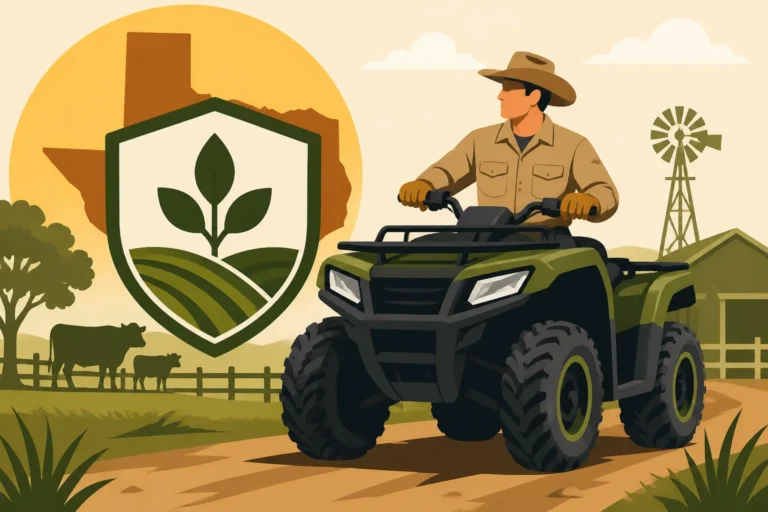
Riding an ATV for a Texas Agricultural Operation
One of the most common and accepted scenarios for an OHV to operate on certain public roads in Texas is when it's being used for a legitimate agricultural purpose. This can include tasks like moving hay between fields, checking fences, or tending to livestock on a farm or ranch. In these cases, the OHV plate can play a supportive, though not always strictly mandatory, role. The law often provides exemptions for agricultural use, allowing OHVs to cross or operate for short distances on public roads not typically open to them.
While agricultural use often waives certain requirements like the OHV decal or even helmets in some situations, having an OHV plate can provide quick visual confirmation to law enforcement that the machine is officially titled in Texas. It reinforces the machine's legitimate status and helps to distinguish it from an unregistered OHV being operated illegally on a public road. So, while your primary documentation for an ag exemption would be your agricultural registration number, the plate offers an additional layer of identification. You can learn more about this specific exception by looking into [Riding an ATV for a Texas Agricultural Operation].
Limited Road Use and the Plate's Role
As we've touched upon, the "Off-Highway Use Only" designation means no general street riding. However, Texas law does carve out very specific, narrow exceptions where an OHV might legally traverse or operate on certain public roads. These exceptions are typically limited to:
- Crossing a public road at a 90-degree angle after coming to a full stop.
- Operating on public roads with a posted speed limit of 35 mph or less in certain counties (mostly those with a population under 37,000 or designated Red River counties).
- Operation within specific master-planned communities under local ordinance.
- The agricultural use discussed above.
In these very limited scenarios, while the OHV plate itself doesn't grant permission, it acts as official state identification for the machine. It shows that the OHV is not just a random, untaxed, and untitled vehicle. For example, if you're legally crossing a road, having the plate visible can help authorities confirm that your machine is documented. It helps establish legitimacy during these brief moments of interaction with public infrastructure. Without the plate, even in an allowed scenario, an OHV might be harder for law enforcement to identify quickly, potentially leading to unnecessary stops or questions.
Specific Machine Types and the OHV Plate
The world of off-highway vehicles is diverse, encompassing everything from traditional ATVs to larger side-by-sides, specialized sand rails, and even golf carts. While the Texas OHV plate applies to many of these, it's important to understand how the state categorizes these machines, as this determines whether they fall under the OHV titling and plating requirements. Not every off-road looking vehicle gets an OHV plate, and some have their own distinct titling or registration rules.
ROVs and UTVs Under the Texas Definition
When Texas lawmakers created the rules for Off-Highway Vehicles, they made sure to include a broad range of machines. This specifically covers both Recreational Off-Highway Vehicles (ROVs), which most people commonly refer to as Utility Task Vehicles (UTVs) or side-by-sides. These machines are increasingly popular, offering greater cargo capacity, multi-passenger seating, and a more car-like driving experience compared to traditional ATVs. Despite their differences, Texas defines them under the same umbrella as ATVs for titling and plating purposes. So, if you're purchasing a new UTV or side-by-side, expect to go through the exact same process to get your [Texas ATV Title for a Side-by-Side] and, by extension, your OHV plate.
This inclusion means that ROVs/UTVs are subject to the same "Off-Highway Use Only" restrictions and the same limited road use exceptions as ATVs. The reasoning is consistent: these vehicles, while versatile, are fundamentally designed for off-road performance and lack the safety features required for general public road travel. Therefore, their official state identification mirrors that of other OHVs. Whether you're hauling gear on a ranch or hitting the trails, your side-by-side will carry that distinctive plate, signaling its documented status in Texas.
Sand Rails on a Texas Title
Sand rails, those lightweight, often custom-built vehicles designed for high performance in sandy terrain, also fall under the Texas definition of an Off-Highway Vehicle. Because they are designed exclusively for off-road use and do not meet federal motor vehicle safety standards for highway operation, they are treated much like ATVs and UTVs for titling purposes. This means that if you own or are building a sand rail in Texas, you will be required to get a title for it, and subsequently, you'll be able to request an OHV plate to go along with that title. The process for [Sand Rails on a Texas Title] will be very similar to titling any other OHV.
Often, sand rails are passion projects, built piece by piece by enthusiasts. Even if a machine is home-built, the state still requires it to be titled for identification and ownership tracking. This can sometimes involve a slightly different process for establishing the initial ownership and getting a VIN assigned if it doesn't already have one, but the end result is the same: an OHV title and the option for the plate. The "Off-Highway Use Only" remark on its title and plate will be just as prominent, reinforcing its intended environment for speed and thrills on the dunes, not on the highway.
Golf Carts and Their Own Texas Plate
Here's where things get a little different and often cause confusion: golf carts. While they are low-speed, off-road capable vehicles, they are generally not classified as OHVs for titling and plating in Texas. Instead, golf carts have their own distinct set of rules and, if eligible for limited road use, they will receive a specific "golf cart license plate." This plate is visually different from the standard OHV plate and comes with its own set of regulations regarding where and how a golf cart can be operated on public roads.
The distinction arises because golf carts, by their very design, are fundamentally different from ATVs or UTVs in terms of speed, power, and intended use. They are primarily designed for golf courses or short-distance travel within specific communities. Texas law recognizes this difference and provides a separate framework. So, if you're looking to put a plate on your golf cart for neighborhood cruising, you'll be looking into [Golf Carts and Their Own Texas Plate] and their specific registration requirements, not the OHV plate process. It's a subtle but important legal difference that can prevent you from applying for the wrong type of plate.
Common Misconceptions and Clarifications
The unique nature of the Texas OHV plate inevitably leads to a good deal of misunderstanding. Many owners, especially those new to off-roading or moving from other states with different regulations, often hold onto assumptions that simply don't apply here. Clearing up these common misconceptions is vital for responsible OHV ownership in Texas and for avoiding unnecessary legal trouble.
Why Texas Will Not Register an ATV for the Road
This is probably the biggest point of confusion and frustration for many ATV and UTV owners: the desire to make their machine "street legal." Unfortunately, despite having an OHV plate, Texas simply will not register an ATV or UTV for general road use. No amount of added lights, turn signals, mirrors, or insurance will change its fundamental classification or allow it to be registered like a car. The state's position is clear: these vehicles are designed for off-highway operation, and they do not meet the stringent safety and design standards required for conventional road vehicles.
The legal framework in Texas, as detailed in the Transportation Code, specifically designates OHVs for off-highway use. Attempting to modify an ATV to meet road standards is often a futile exercise, as the underlying legal definition and titling process prevent it from ever receiving a full "street-legal" registration. This is a common point of contention, but it's a firm stance in Texas law. For a comprehensive explanation of this, consider reading [Why Texas Will Not Register an ATV for the Road]. It saves a lot of headache and expense trying to achieve something that isn't possible under current state regulations.
Why an Altered Quad Still Cannot Be Plated
Following directly from the previous point, even if you invest heavily in modifying your ATV or UTV with all the bells and whistles—DOT-approved tires, mirrors, turn signals, a horn, and all the required lighting—it still won't qualify for a standard road vehicle registration in Texas. The OHV plate you receive is tied to its "Off-Highway Use Only" title, and no amount of after-market parts can change that core designation. The state's classification is based on the vehicle's original manufacturer's intent and design, not on modifications.
This often catches owners off guard who believe that by bringing their machine up to "street legal" specifications, they can then apply for a different type of plate. However, the legal system simply does not provide a pathway for OHVs to transition into street-legal vehicles through modification and subsequent plating. The OHV plate is specific to its off-highway nature, and adding components designed for road use does not alter the vehicle's underlying legal classification. It's important to understand [Why an Altered Quad Still Cannot Be Plated] for general road use. The only exception would be if the vehicle inherently qualifies for a separate category, like a neighborhood electric vehicle (NEV) or low-speed vehicle (LSV), which ATVs and UTVs typically do not.
Off-Highway Use Only Stamped on the Paper
The "Off-Highway Use Only" declaration isn't just a verbal warning or something implied; it's physically present on your official Texas OHV title document, often stamped or printed prominently. This tangible mark on the paper title is the state's definitive statement about the vehicle's intended purpose and legal limitations. It serves as an unmistakable and permanent record that the machine is not to be used for general public road travel. For a detailed explanation, check out [Off-Highway Use Only Stamped on the Paper].
This physical remark on the title document is crucial because it ensures clarity and prevents future disputes. If you ever sell your OHV, the buyer will clearly see this designation on the title, leaving no room for misunderstanding about its legal status. It also guides any official, from law enforcement to insurance agents, about the vehicle's classification. It’s the state's way of reinforcing the very narrow scope of operation for your OHV, ensuring that the legal intent is always visible on the most important ownership document you possess.
| Feature | Texas OHV License Plate | Standard Texas Vehicle Registration/Plate |
|---|---|---|
| Purpose | Identification; Limited Road Exceptions | General Public Road Use |
| "Street Legal" Status | No; "Off-Highway Use Only" | Yes |
| Expiration | Never expires | Annual renewal required |
| Cost (Plate Itself) | Capped at $10 (one-time) | Varies, generally higher (annual) |
| Issued With | OHV Title (upon request) | Standard Vehicle Title |
| Transfers with Machine | Yes, but new owner gets new plate | No, owner keeps plate for new vehicle |
| Required For | Titled OHVs in specific road exceptions | All vehicles on public roads |
| Road Use Allowance | Very limited, specific exceptions only | General travel on all public roads |
| Associated Documents | Texas Form 130-U, MSO/Assigned Title | Texas Form 130-U, MSO/Assigned Title |
Disclaimer
This article is for general informational purposes only and does not constitute professional advice. Laws, prices and regulations vary by location and change over time. Consult a qualified professional for guidance on your specific situation.